
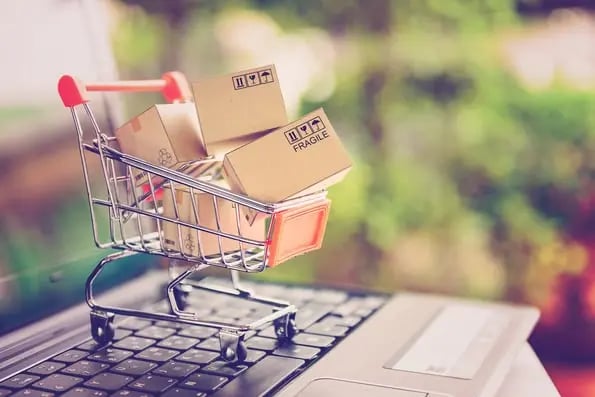
The first ecommerce sale was made in 1994 … and can you guess what it was?
It was a Sting CD.
Dan Kohn, a 21-year-old who ran a website called NetMarket, sold Sting’s Ten Summoner’s Tales CD to a friend who purchased it with his credit card for $12.48 plus shipping costs. These exchanges are what we know as ecommerce today: Sales of services and goods made through the internet.

Ecommerce has come a long way since 1994, and it’s growing as more shoppers turn to devices and computers as the primary tools for discovering and buying new products.
Let’s take a deeper look at what ecommerce is and the growth trends around it, as well as some basic getting started tips.
Guide to Ecommerce
In this section, we'll review the many benefits of ecommerce, major ecommerce trends, types of ecommerce, and sales tax.
Benefits of Ecommerce
Ecommerce is not a trend, and it isn’t going away any time soon. Why? Selling goods and services on the internet highly benefits both the seller and the buyer.
Benefits to the buyer:
- Convenience
- Quicker and easier transactions
- Informed purchasing decisions
- Easier price and product comparisons
- Improved delivery process
- Targeted communication
Benefits to the seller:
- Lower overhead costs due to the elimination of brick and mortar locations
- The ability to sell goods around-the-clock (versus traditional store hours)
- Ability to reach customers beyond geographical location
- More control over the selling process and tracking, especially if there’s one portal that handles point-of-sale (POS)
- Greater visibility to potential customers via SEO
- More control over personnel costs and inventory management
Ecommerce Trends
The biggest trend around
1. U.S. Ecommerce Growth
2. Global Ecommerce Growth
Global
3. Ecommerce Growth by Category
ComScore data indicates there are a few particular industries seeing rapid change in regard to retail
Lastly, let's review the three types of ecommerce.
Types of Ecommerce
- Business to Business (B2B)
- Business to Consumer (B2C)
- Consumer to Consumer (C2C)
There are three classifications of ecommerce. The classification depends on who is selling to who.
1. Business to Business (B2B)
Goods and services are sold from one company to another. For example, HubSpot provides products to other companies that are looking to grow better.
2. Business to Consumer (B2C)
A business sells to a customer. This is one of the most common types of ecommerce. An example would be an online clothing store or the online segment of some popular brick and mortar business, like Walmart or Target.
3. Consumer to Consumer (C2C)
As you may have guessed — consumers sell directly to consumer via online marketplaces. Craigslist, Ebay, and Amazon are all examples of C2C ecommerce.
Sales Tax for Your Online Store
Now, you might be worried about how sales tax should be incorporated into your online sales. Let’s look at a state-by-state breakdown of sales tax. There are five states that do not currently collect sales tax: Delaware, Oregon, Montana, New Hampshire, and Alaska.
Sales Tax by State
|
State |
Tax Rate |
|
Alabama |
4.00% |
|
Alaska |
0.00% |
|
Arizona |
5.60% |
|
Arkansas |
6.50% |
|
California |
7.25% |
|
Colorado |
2.90% |
|
Connecticut |
6.35% |
|
Delaware |
0.00% |
|
Florida |
6.00% |
|
Georgia |
4.00% |
|
Hawaii |
4.00% |
|
Idaho |
6.00% |
|
Illinois |
6.25% |
|
Indiana |
7.00% |
|
Iowa |
6.00% |
|
Kansas |
6.50% |
|
Kentucky |
6.00% |
|
Louisiana |
5.00% |
|
Maine |
5.50% |
|
Maryland |
6.00% |
|
Massachusetts |
6.25% |
|
Michigan |
6.00% |
|
Minnesota |
6.875% |
|
Mississippi |
7.00% |
|
Missouri |
4.225% |
|
Montana |
0.00% |
|
Nebraska |
5.50% |
|
Nevada |
6.85% |
|
New Hampshire |
0.00% |
|
New Jersey |
6.625% |
|
New Mexico |
5.125% |
|
New York |
4.00% |
|
North Carolina |
4.75% |
|
North Dakota |
5.00% |
|
Ohio |
5.75% |
|
Oklahoma |
4.50% |
|
Oregon |
0.00% |
|
Pennsylvania |
6.00% |
|
Rhode Island |
7.00% |
|
South Carolina |
6.00% |
|
South Dakota |
4.50% |
|
Tennessee |
7.00% |
|
Texas |
6.25% |
|
Utah |
5.95% |
|
Vermont |
6.00% |
|
Virginia |
5.30% |
|
Washington |
6.50% |
|
West Virginia |
6.00% |
|
Wisconsin |
5.00% |
|
Wyoming |
4.00% |
|
D.C. |
5.75% |
Source: Based on 2018 Data. Refer to State's Department of Revenue for up-to-date rates.
Now that we've reviewed some ecommerce basics, let's review the steps you should consider following if you're looking to launch an online business.
How to Start an Ecommerce Business
- Evaluate the audience and demand for a product.
- Research the competition.
- Research business models and sales strategies.
- Name and register your business.
- Establish your branding and design a logo.
- Create your product.
- Determine manufacturing costs and processes.
- Research and set up shipping and fulfillment processes.
- Buy a URL and create your website.
- Develop a marketing plan for attracting and converting customers.
- Secure social profiles and start building a following.
- Launch your online store.
While you're working through the steps above and establishing your online store, keep the following best practices for ecommerce marketing and websites in mind.
Ecommerce Marketing Best Practices
What do you need to know about marketing for an
1. Test social media ads.
With 1.18 billion daily active users, Facebook has a huge audience that can be tapped. Consider targeting your audience with social media posts and videos and experiment to see what works best and drives sales and revenue.
2. Collect email addresses and stay in touch.
Recent data shows that three-quarters of companies agree that email marketing offers "excellent" to "good" ROI. By collecting email addresses on-site and asking customers to opt-in to future communications from you, you can give visitors a reason to keep coming back to your
3. Use personalization to tailor offers/messaging.
Personalization is more important than ever for online shoppers. In fact, research shows 74% of online consumers get frustrated with websites when offers, ads, and promotions appear that have nothing to do with their interests.
Make sure you’re leveraging personalized product suggestions, personalizing your email marketing efforts, and generally striving to make each customer feel like you’re speaking only to him or her.
4. Gather feedback via surveys.
The best way to keep a finger on the pulse of what your audience wants is to ask them. Leverage online surveys to gather feedback on everything from product to your marketing efforts to customer service interactions.
5. Choose ecommerce software that helps you meet your needs and goals.
You may be wondering how to make sure you choose the right ecommerce software for your specific business. Here are some tips.
To run a successful eCommerce business, you must fulfill the most effective technical requirements for ecommerce websites that ensure the entire business functions smoothly & offers a seamless user experience. These requirements include the hosting platform, security protocols, business operations like shipping, and operational systems.
Keeping these requirements in mind will help you choose the best Ecommerce software for your business.
How to Choose the Best Ecommerce Software
When searching for the best
- Themes and customization abilities: You should be able to customize ready-made themes that allow you to personalize and add company branding.
- Domain name customization: Make sure you can get a custom domain name and URL (so you don’t have to include the platform’s name in your website URL).
- Expert, 24/7 support: Take the time to explore the platform’s service in detail. If an emergency crops up down the road, you want to be sure you’ll have fast, reliable support at a moment’s notice.
- Flexible payment options: Customers want to pay in a variety of ways today — from credit cards to digital wallets and beyond. Look for an
ecommerce software solution that is flexible enough to support many different secure payment options. - Multiple language abilities: Your customers may be coming from all over the world, so you need to be able to speak their language. It’s a good idea to work with a tool that supports many different languages.
6. Keep best practices for your website in mind.
When you’re ready to build an inbound
Select and customize a mobile-friendly theme.
BrightEdge data shows that more than half (57%) of web traffic now comes from mobile devices like smartphones and tablets — which means it’s essential to use a mobile-friendly theme when building your
On ecommerce platforms, you can browse a selection of free and premium themes (all of which are mobile-optimized) and find one that’s best suited for your needs. Plus: From there, you can customize the templated website theme. By adding your color scheme and branding elements (like your logo), you can make your
Take a look at this Shopify template example:

Optimize for the web.
Web optimization encompasses a wide range of strategies and tactics that help convert more site visitors into customers, but let’s focus on two in particular:
- Write enticing product descriptions. Use persuasive copywriting triggers to make your product descriptions sell. That means tapping into psychological tactics like fear of missing out, reciprocity, exclusivity, and more — all of which encourage site visitors to buy (and to buy NOW).
- Add beautiful product images. When it comes to marketing, visuals are extremely important — especially for online buyers who can’t see or touch products before making a purchase. Along with static product images, add context by incorporating images of models using the product and videos that give customers a 360-degree view.
Create a stellar customer experience.
Research indicates that customer experience will overtake price and product as the primary brand differentiator for sales by 2020. This means it’s important to focus on creating an impressive customer experience across all of your brand’s various touchpoints.
A few ideas to get you started:
- Add a FAQ page. Answering frequently asked questions on your
ecommerce website helps potential customers quickly and easily find the information they need to complete a purchase. - Reduce image sizes for quick load times. Survey data shows more than half of website visitors expect a page to load in less than two seconds. At more than three seconds, they leave the page (and aren’t likely to return.) Reduce the size of your on-site images so it loads quickly.
- Leverage user-generated content. Including user-generated content (think customer reviews, images from social media, and testimonials) on your
ecommerce site means adding elements of social proof — which can improve the overall buying experience for customers.
Next, let's cover the ways in which you can work to increase your ecommerce sales.
How to Increase Ecommerce Sales
Ecommerce sales in the U.S. alone gross $130 billion per quarter, which is nearly 10 percent of all retail sales (that number is increasing globally as well). That’s a lot of people looking for online products and services.
If you’re building an ecommerce business, you need to devise a strategy to increase sales and get a piece of that pie. You won’t have an ecommerce business without customers. So, consider this one of the most important sections in this article. Let’s cover a few ways that you can increase your ecommerce sales.
1. Hook prospects in the consideration stage.
If you only try to reach prospective buyers in their decision stage, you’re too late. Conversely, if you provide relevant content in the awareness stage and fail to follow-up, you risk them forgetting about you as they move along the buyer’s journey.
It’s also important to remember that people go through buying cycles and can move back and forth between stages before they commit to a product or service. Once you hook a prospect with your content keep them engaged and send them content that speaks to their present stage. Your goal should be to get on their short-list of potential purchases.
2. Use paid targeting to outrank your competitors.
There’s a reason why sites like Google Shopping are so lucrative — they work. Search engines return billions of results daily, and many of those results are for products and services just like yours. The problem is the competition. When done right, paid advertising can position your ecommerce store in front of the right audience and ahead of your competition.
3. Get (or give) some information before they leave your site.
Not everyone who visits your ecommerce store is ready to buy — engage them anyway. Think about reasons why someone would visit and bounce off a page (maybe they’re considering options or they find your product too expensive or they want to make a more informed decision).
Whatever the reason, your job is to provide them with something that will keep you top of mind as they continue their search. Ideally, you would gather some lead information but at a minimum provide them something useful that can assist them as they go about their search.
4. Invest in re-engaging shopping cart abandoners.
Shopping cart abandonment is inevitable but not irrevocable. Sometimes users just need a little nudge to get back to their cart either through remarketing or a simple email reminder. Before you reach out though, make sure to address some of the common reasons why prospects abandon their shopping carts in the first place.
5. Remember to integrate social.
Don’t underestimate the power of social media when it comes to online sales. Instagram reports that 60% of people find products on social, which makes sense with the integration of shoppable content. Meet your potential customers where they are and remove friction from the buying process by leading them seamlessly to a sale.
Examples of Inspiring Shopify Ecommerce Stores
Not sure what your ecommerce store should look like? Here are a few examples of inspiring stores to help get your creative wheels turning.
1. Tattly

Because Tattly offers a product that’s highly visual in nature, they’ve opted for a theme that’s photo-centric. This lets new visitors quickly get acquainted with the product offering and provides a few different paths for deeper product exploration, too.
2. Graydon Skincare

Graydon Skincare uses a website layout with a large rotating header image that helps communicate a feeling around the brand and product. The images feature different products sold by the brand, and the simple top navigation makes it easy for customers to quickly find what they’re looking for.
3. 18Waits
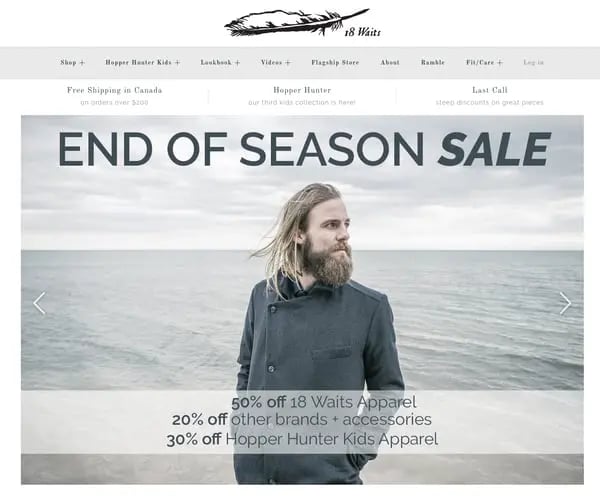
18Waits also uses large rotating photos on the home page of their ecommerce store — but they sometimes integrate them with promotional offers. This helps shoppers visualize themselves wearing the product, while also enticing them to check out a special sale going on, too. Overall, the theme they’ve used is fairly minimal, which puts all the focus on the photography.
4. Easy Tiger
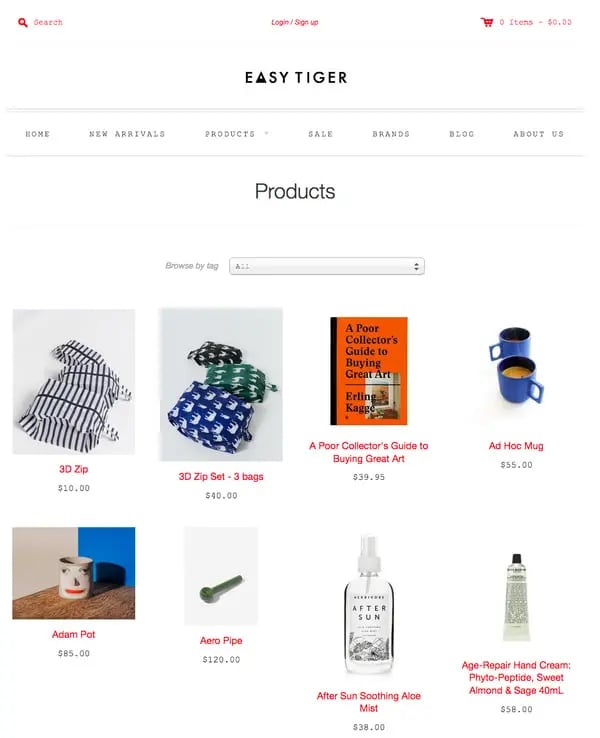
Speaking of minimal … Easy Tiger takes minimal design to the extreme. With a clean white background and no distracting design elements, all the focus is on their products. The red text also pops from the screen, making it easy to read and consume.
5. BluKicks
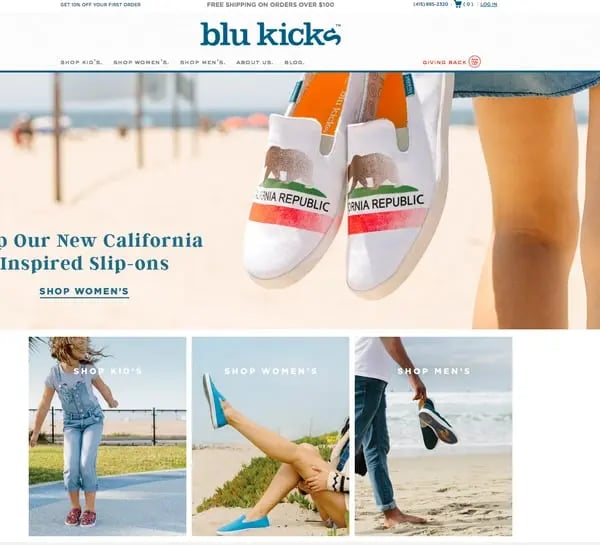
BluKicks also uses an image-centric approach on their homepage with quick navigation to product types. The lifestyle-type images they spotlight here communicate a certain feeling to shoppers — and ups the beachy charm of their product.
The Future of Ecommerce
Sales tax is a hot topic in the news right now — and the Supreme Court may be making changes to the policies for
The future of ecommerce is a bright one, and with the right strategy and tools, launching an online business can be easier than you ever imagined. Tap into the audience of engaged online shoppers and get your piece of the growing ecommerce pie.
Editor's note: This post was originally published in July 2018 and has been updated for comprehensiveness.
![50 Ecommerce Statistics To Know in 2024 [New Data]](https://blog.hubspot.com/hubfs/ecommerce-statistics.png)

![How to Map Your Ecommerce Customer Journey [Template Included]](https://blog.hubspot.com/hubfs/ecommerce-Sep-13-2023-09-08-01-7144-PM.png)



![The Beginner's Guide to Product Photography [Tutorial + Examples]](https://blog.hubspot.com/hubfs/guide%20to%20product%20photography.jpg)