
Tweeting is easy. You can type up anything in three seconds and press "tweet." But sending a clickable tweet -- that, my friend, is a science.

Thankfully, making your tweets clickable doesn't "just happen" based on the whim of the Twitter gods. It happens when you intentionally apply a certain set of principles.
In this post, we'll talk about how to put the science of Twitter to work for you so more people click on your tweets.
![Download Now: How to Use Twitter for Business [Free Kit]](https://no-cache.hubspot.com/cta/default/53/190da11f-58c6-41d5-a397-843618741e09.png)
Defining a "Click" on a Tweet
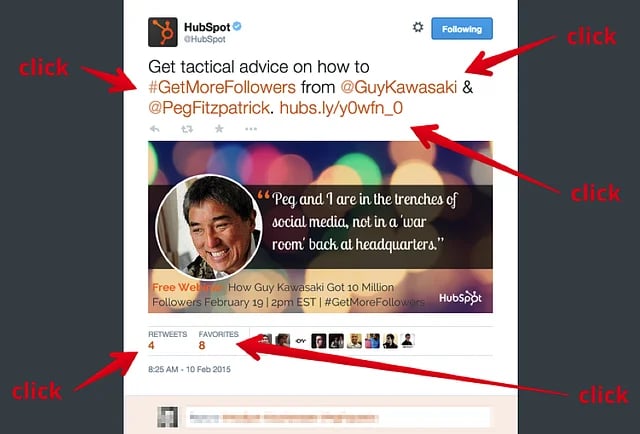
Before we dive in here, what does it mean for a person to "click on your tweet"? Think about it: There are nine different ways a user can click your tweet. They can ...
- Retweet your tweet
- Favorite your tweet
- Click your hashtags
- Click your @-mentions
- Click your link
- Click your picture
- Click the white space to expand the tweet
- Click your Twitter handle to view your profile
- Click the "Follow" button to follow you
That's a lot of metrics to follow. But in most cases, the most important outcome is a click on the link that you've posted.
After all, link clicks account for 92% of all user interaction with tweets. Link clicks are the low-hanging fruit of Twitter, and they're your strongest chance of gaining views and shares for your content.
And I'm guessing you want more traffic and attention to your blog or the articles you share, right? When people click a link in a tweet, there tends to be a chain reaction: The more people clicking on your article via Twitter, the more exposure it gets. When more people read your article, more people are likely to share your article. Your social signals will likely rise, which improves your SEO. More activity on your site will also increase user engagement metrics. With all the extra traffic, you’ll also gain more conversions, more sales, and more revenue.
Wow -- all by improving the clickthrough rate (CTR) of your tweet? That's right. My goal here is to show you how to increase the number of link clicks on your tweets.
The Challenge: It Takes Work to Get Clicks on Twitter
Data shows the average Twitter CTR is 1.64%. According to SignUpTo, the more followers you have, the fewer clicks you're getting on your tweets:
- Users with 50 - 1,000 followers had a 6.16% CTR.
- Users with 1,000 - 5,000 followers had a 1.45% CTR.
- Users with 5,000 - 10,000 followers had a 0.55% CTR.
- Users with 10,000+ followers had a 0.45% CTR.
Plus, Twitter is a crowded place. With 271 million monthly active users and 500 million tweets sent out each day, you have a lot of competition to deal with.
But Twitter is an important platform for driving traffing to your website, generating leads, and getting in touch with customers and prospects. And you can always do more to increase your engagement rate on Twitter. Challenges or none, there are ways to craft a tweet that compels more users to click through. Here are 14 ways to do it.
14 Ways to Increase Clickthrough Rate on Twitter
1) Use clear language.
Remember, your followers are likely scrolling through their feeds and scanning tweets very quickly. To catch their attention, be as clear as possible by choosing simple, easily scannable language.
HubSpot did a study where they compared CTRs from two different tweet types: those with clear, to-the-point copy and those with more ambiguous copy. They found that "clearly stated offers received 18% more clicks and 29.8% more retweets than the tweets with a more ambiguous copy."
Here's an example they used of ambiguous tweet copy:
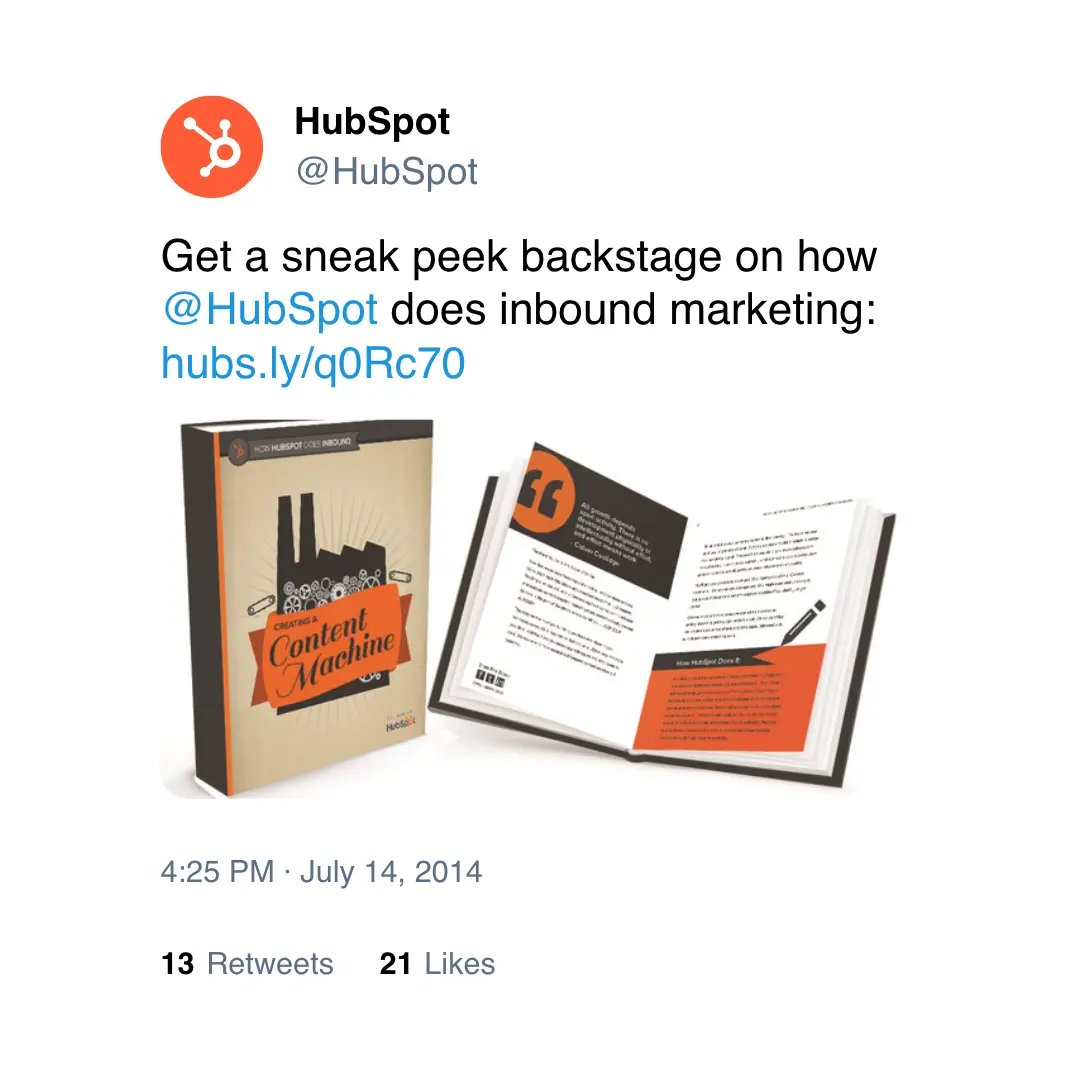
And here's an example of clear tweet copy:

The clearer you can be, the more likely you are to get clickthroughs to your URL. Sometimes, that means simply tweeting the title of the article or offer you're linking to. Which brings me to my next point ...
2) Use the article title or headline.
Good copywriters know that writing headlines is one of the most important steps to writing an article. Headlines are what make people click. So why wouldn't you use the copy from a great headline when tweeting out article?
One Twitter researcher was able to gain an 18% clickthrough rate simply by using compelling headlines. Hubspot’s research showed that their average tweet copy got an average of 98 clicks, while headline-based tweets got an average of 110 clicks.
Twitter is a sales and advertising platform, and headlines really do matter -- and they're a great place to borrow copy for your tweets. In studies that I’ve conducted, a single headline word change produced a 46% improvement in clickthroughs. Advertising wizard David Ogilvy was so enamored of the importance of headlines that he wrote this: “Unless your headline sells your product, you have wasted 90 percent of your money.”
As it turns out, the fundamental rule of clickable tweets is the same as the rule of clickable headlines. The headlines have to sizzle. Headlines with higher clickthrough rates tend to ...
- Be short. You only have 140 characters, so you can’t afford a long title. Outbrain discovered that eight-word titles had a 21% higher CTR than the average title. Social Media Scientist Dan Zarrella analyzed 200,000 tweets with links and found that the 120-130-character range was the sweet spot for high CTR.
- Ask a question. Why does this work? Questions prompt curiosity, which leads to people wanting to satisfy that curiosity (source).
- Use exclamation points. Data shows that three exclamation points will improve the CTR more than twice as much as any other form of punctuation (source).
- Use at least one superlative. Superlatives are words like “best,” “most,” “smartest.” Headlines with one superlative outperformed all other variations of superlatives (or none at all).
- Use a fun tone. Titles that are lighthearted and humorous have a higher CTR than their serious counterparts (source).
- Not be in all caps. The online equivalent of shouting is a turnoff; 64% of readers prefer sentence case.
- Include a number. Headlines that include numbers have a 15% higher CTR than those that don't. Use an odd number if you can, as headlines that contain odd numbers have a 20% higher CTR than those containing even numbers.
- Be a two-sided title with a colon or hyphen. For example, “SEO: 7 Reasons Why It Still Matters” or “8 Ways to More Money — Warren Buffett's Secrets.” Titles that have two parts like these ones have a 9% higher CTR than those with one part.
3) Use verbs.
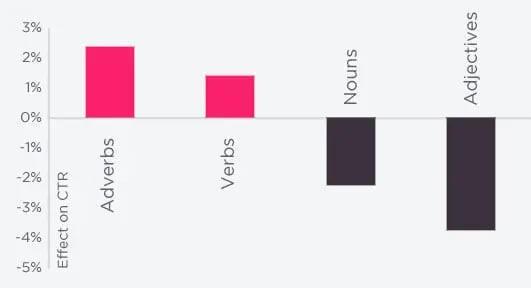
Humans find verbs much more cognitively interesting than nouns. In fact, studies show that simply seeing or listening to a verb can signal the body’s motor system. It's no surprise, then, that using more verbs in your tweets is can be a powerful way to increase clickthrough rate.
Zarrella found in his analysis that tweets that included more verbs and adverbs, rather than nouns and adjectives, received far higher CTR rates.
4) Post fewer statistics.
Statistics are awesome, but if you're looking to improve clickthrough rate for your tweets, it might be better for you to choose something else to pull from the content you're linking to. HubSpot found that their tweets with statistics had 32% fewer clicks per tweet than non-stat-based tweets. But you'll want to experiment to see what your audience responds to.
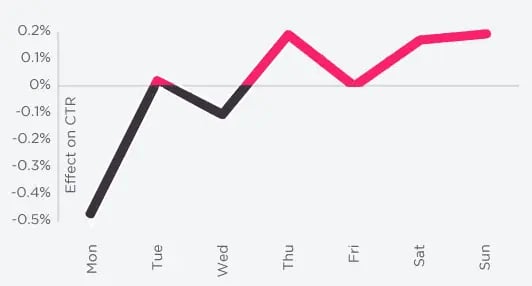
5) Tweet on the weekend.
This will depend on your audience, so you should do some experimentation. But Zarrella found from his analysis of hundreds of thousands of tweets that CTRs were highest on Thursday, Saturday, and Sunday.
6) Tweet in the afternoon.
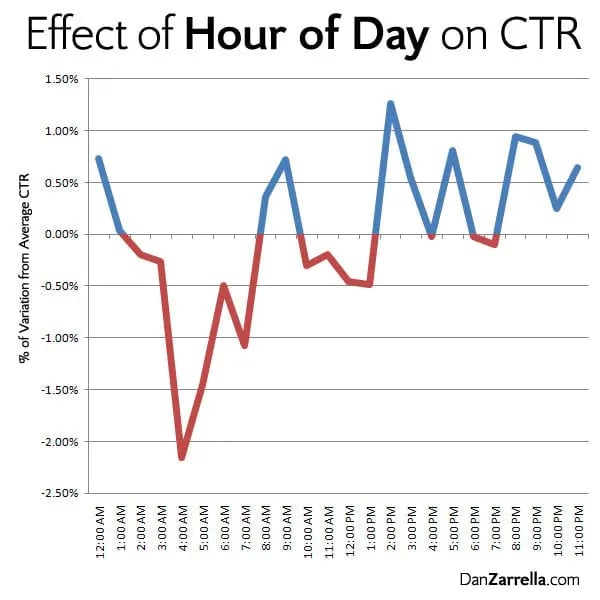
The timing of your tweets on a given day makes a difference, too. Zarrella found that tweets posted at 2:00 P.M. have the highest CTR. (Remember to experiment to see when your target audience is most interactive, though, and to post at that time.)
7) Use images.
If you use images in your tweet, you will receive higher clickthrough rates -- as much as 18%.
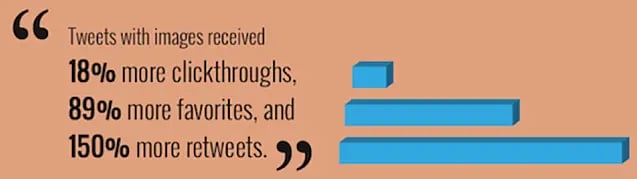
Image Credit: HubSpot
8) Space out your tweets.
If you're tweeting in spurts, your followers might think you're spamming them. Instead of tweeting all at once, space out your tweets. Tweets that are spaced appropriately get higher CTRs, according to Zarrella's research. Buffer recommends putting a space of 30 minutes before and after the tweets for which you want high engagement.
(Pro tip: Scheduling your tweets ahead of time will make your life a lot easier. Here's a social media publishing template if you don't have one already.)
9) Use hashtags.
Hashtags are a great way to improve your online presence. Above all, using hashtags will help you get more engagement and visibility. More specifically, you’ll get more clicks on your tweets.
But don't overdo it by adding too many hashtags to your post. Buddy Media found that tweets with hashtags get double the engagement metrics that no hashtags get -- but tweets with one or two hashtags have a 21% higher engagement than tweets with three or more. (For more guidance on hashtag etiquette, check out this blog post.)
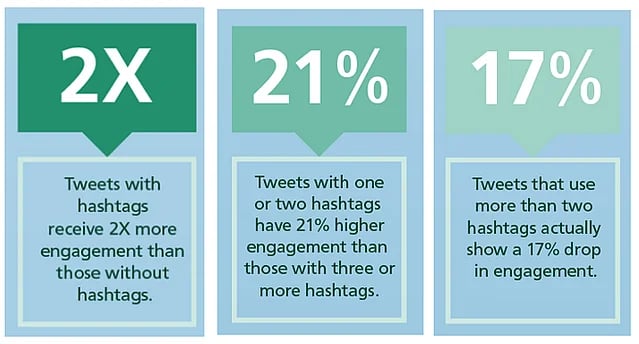
Image credit: Buffer
10) Ask for action.
The call to action (CTA) is an indispensable part of all marketing. The same holds true for clickable tweets. What kind of action do you want your followers to take? Ask them to do something on the page where you’re directing them.
Here are some examples:
- Grab your 15% coupon before time runs out!! example.com/couponecode
- Sign up now to hear about our mind-blowing new product. example.com/mindblowingnewproduct
- It’s free! Download your copy today. example/downloadnow
Each of these sample tweets has a clear text CTA followed by a link. This structure makes it very obvious that you want the user to then click on that link.
11) Don't necessarily place the link at the end of the tweet.
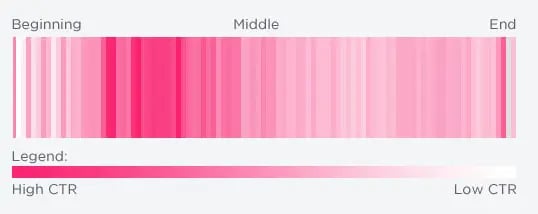
Zarrella’s analysis of 200,000 link-containing tweets concluded that putting the link approximately 25% of the way through would achieve the highest CTR.
12) Talk about Twitter.
Twitter users want to hear more about Twitter. They're already using the platform -- it naturally follows that they will be interested in tweets that have to do with that platform.
HubSpot found that their tweets that included links to blog posts and offers about Twitter and other social media topics received 22.5% more clicks on average than the average clicks for a tweet during a set period of time.
How can you talk about Twitter if your subject has nothing to do with Twitter? Try one of these:
- Hey Twitter users….
- Best thing on Twitter all day…
- You needed this in your Twitter feed…
- Twitter is raving about…
13) Talk about and link to infographics.
Infographics are a hugely popular topic on Twitter. A lot of people search for infographics on Twitter, so simply using the word "infographic" will bring more visibility to your tweets.
Not only can infographics double your blog traffic, but they can multiply your clickthroughs on Twitter. In one study, infographics received 832% more retweets than articles and 746% more clickthroughs.
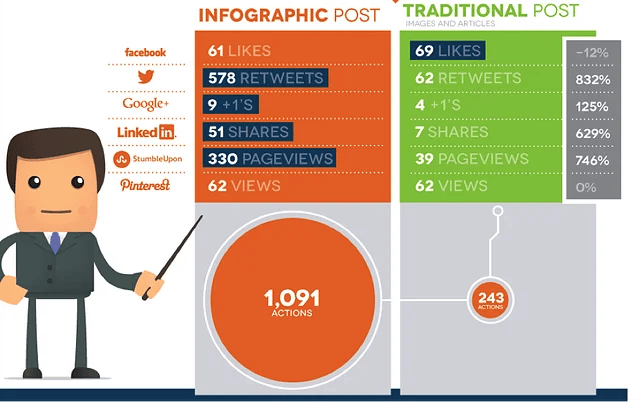
Image Credit: Adweek
14) Make sure your links work.
Nothing is worse than posting a perfectly optimized tweet with a busted link. The most common form of link errors is not having a space before the link. So check, double-check and triple-check that you've added a space between your tweet copy and the link.
By following these guidelines, you can be confident that you’re doing exactly what you should do to get the most clicks out of your tweets. Now, for your homework: Pick up a link to share, head over to Twitter, and create a clickable tweet!
What techniques do you use to create clickable tweets? Share with us in the comments below!

![How to Deal With Negative Comments on Social Media [+ Examples]](https://blog.hubspot.com/hubfs/Copy%20of%20Untitled-May-06-2022-04-54-09-47-PM.png)






![How to Use Instagram Photos to Boost Your Email Engagement [Infographic]](https://blog.hubspot.com/hubfs/00-Blog_Thinkstock_Images/Instagram_email_marketing.jpg)
