Inbound Internet Marketing Blog

SEO, Blogging, Social Media, Landing Pages, Lead Generation and Analytics

SUBSCRIBE

The HubSpot Inbound Internet Marketing blog covers all of inbound marketing - SEO, blogging, social media, lead generation, email marketing, lead nurturing & management, and analytics. Join 57,702 others and subscribe now!

Subscribe to RSS feed Add us on Facebook! Follow us on Twitter

Get Free Marketing Info!

Get the world's best marketing resources right to your inbox! Join more than 817,000 inbound marketers!

Subscribe by email

Your email:

HubSpot's Inbound Internet Marketing Blog

Current Articles | RSS Feed RSS Feed

6 Key Pieces of Lead Intelligence


.

At HubSpot, we're lucky that the marketing team has a great relationship with the sales team. Part of the reason for that is that we give them leads with all sorts of lead intelligence to help them connect with and close more deals.

6 Key Pieces of Lead Intelligence to Make Your Sales Team Jump for Joy
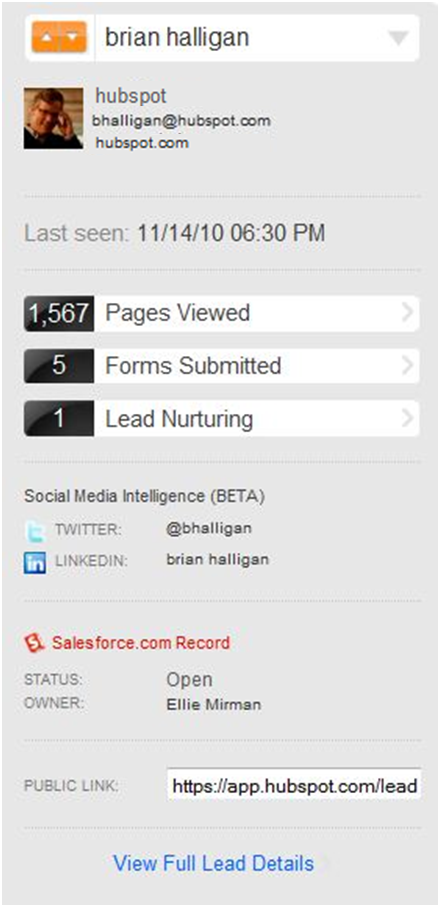
Lead Intelligence1. Pages Viewed

What warms up that phone call more than knowing what your lead browsed on your site. Maybe they were investigating a particular product line or read a blog post addressing a particular challenge. Letting your sales team review these details helps them make a much more targeted and educated phone call. Also knowing how many pages that lead viewed in total signals to the sales rep how hot this lead is.

2. All Conversion Forms Completed

Deduping your lead submissions such that your sales team is not bombarded with duplicate leads AND each lead contains all conversion activity is a huge win. This way the sales rep can see what the lead was most interested in and of course the contact information for following up with that lead.

3. Social Media Details

Email and phone are effective means for following up with leads, but in today's multi-communication-channel world, enable your team to connect with their leads in more informal and personal ways such as social media. Finding a lead's Twitter information can help your rep answer their questions through that channel. Finding a lead's LinkedIn profile can help your rep see common connections to perhaps get a personal introduction.

4. Campaign Details

It's not often that your sales team will know (or remember) all the details of the marketing team's active campaigns. At HubSpot, we tie our conversion forms to Salesforce campaigns with details on the campaign and tips to follow up.

HubSpot Salesforce Campaign

5. Email Marketing Communications

Marketing's job is not just to deliver leads but to help warm up those leads by educating and providing qualifying calls to action to them over time. These communications may overlap with a sales rep's follow up, so our sales reps want to know all the emails going to their leads, including automated lead nurturing emails and email newsletter promotions, and if those leads respond to (click through on) any of those emails.
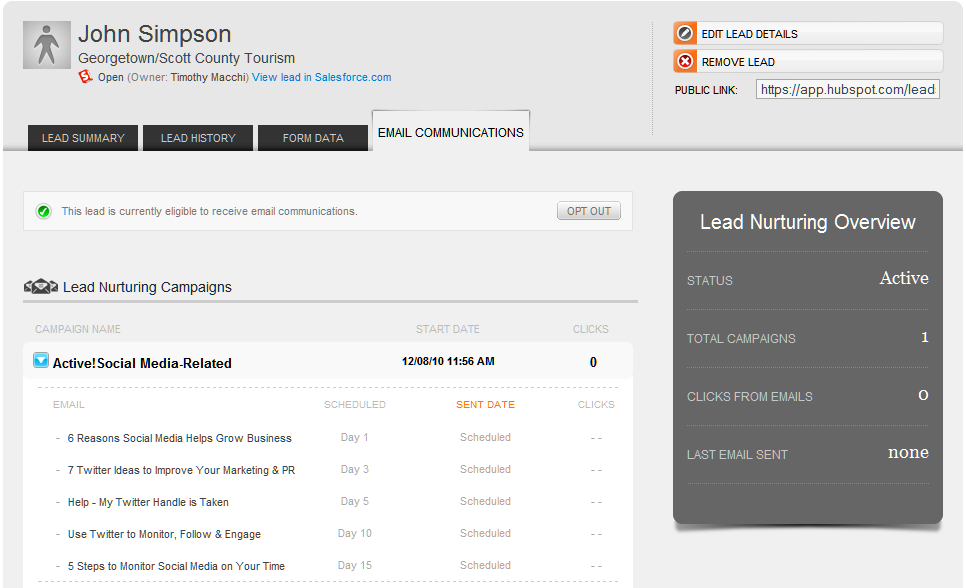
Email Communications Lead Intelligence

6. Notification When Leads Revisit Your Site

It can be hard to get in touch with someone, even when they have opted in to request more information from you company. Knowing when you are at the top of their mind - say, when they're visiting your site again and checking out more information - is critical for reaching those leads. At HubSpot, we notify our reps when their leads are back on the website.


Lead Revisit Notification Inbox

HubSpot Hugs!

Maybe when it's all said and done, your sales team will be so happy they'll be running around giving hugs to the marketing team!

What are you doing to delight your sales team?

Hug actually shown: Jonah, VP Customers, hugging a customer at HUG 2010.

Try HubSpot Free for 30 Days

See how HubSpot can help you better generate and track your traffic, leads and customers.

Get a 30-Day Free Trial of HubSpot Marketing Software.

Posted by Ellie Mirman on Thu, Dec 09, 2010 @ 09:40 AM

COMMENTS

Great info! Getting qualified leads is a problem we all face. This info pinpoints how to button up some the errors that lead to inefficiency.. Thanks!

posted on Thursday, December 09, 2010 at 9:57 AM by Athena


This is a great post but one of our greatest struggles as a Marketing team is to get our Sales team to actually look at this information we provide them. Let alone look at our leads. We've coined the term 'the lead abyss' which is a dark void our leads reside in, going unchecked by our Sales team. Our Sales reps claim they are too busy with their day-to-day stuff to follow up on new leads. Any advice on how to narrow the gap between these two sides?

posted on Thursday, December 09, 2010 at 10:07 AM by John


I concur with John's comment. There is a traditional disconnect between the marketing and sales teams in many (most?) organizations. 
 
At some stage though, the focus will turn back to acquisition and it's at that point that this kind of information is crucial. 
 
Maybe one of the answers is to establish a 'contract' between the two departments when qualifying ideal prospects. Determine a set of established 'ideal lead' characteristics and agree to act on them.

posted on Thursday, December 09, 2010 at 10:49 AM by Kevin


It is critical for Sales and Marketing to have agreements about how Sales will handle each lead. And, Marketing should have similar agreements on what qualifies a lead to be sent to Sales. Sometimes the lead is checking out many pages on your website but is still in the very early stages of information gathering. This may be too soon for a phone sales conversation. But, the lead may be receptive to another type of offer via email-based lead nurturing. The key is to find the right combination that delivers well qualified leads for sales to close.

posted on Thursday, December 09, 2010 at 10:51 AM by CK


Thanks for compiling the points. I agree that all marketing efforts should be aimed at generating leads. Still too many marketing consultants chase a client that needs an FB page built or a Twitter account created, which does not connect the client to improved leads. Thanks again!

posted on Thursday, December 09, 2010 at 12:03 PM by Alexander Zagoumenov


John, the way we deal with this (and what many have mentioned above) is to have a service level agreement (SLA) between sales and marketing that outlines yes, marketing will deliver X number of leads, but sales must follow up with each lead Y number of times. We then have metrics in place in our CRM to measure whether both teams are living up to that agreement. 
 
This has turned out to be quite effective for us in making sure we each help each team do their jobs. 
 
You might find this blog post useful - it's written by our VP Sales and outlines some of the metrics we track as part of that SLA. Both of our marketing and sales teams live and die by this SLA. 
 
http://blog.hubspot.com/blog/tabid/6307/bid/5885/Improving-Sales-and-Marketing-Alignment-The-Marketing-and-Sales-SLA.aspx

posted on Thursday, December 09, 2010 at 12:24 PM by Ellie Mirman


Strategies in business intelligence are important in all aspects in business because without it, your business will not run successful and time will come that you will fail. Remember that being consistent in all your strategies, will lead you to a bright path in the future.

posted on Thursday, December 09, 2010 at 1:09 PM by Andreas Pazer


Comments have been closed for this article.