Social media now touches nearly every stage of the sales process, from a buyer’s first exposure to your company to the point where they decide who to trust with their business.

In HubSpot’s 2025 State of Sales Report, a survey of 1,000 sales professionals updated in September 2025, social media outreach earned a 42% response rate on cold outreach, compared to 26% for email and 23% for phone. Reps also rated social media “very effective” at driving sales more often than in-person meetings or video calls.
Read on to learn more about social media prospecting, and discover which social media channels are most effective for your team's goals.
Table of Contents
- How Social Media Prospecting Works
- Best Social Media Channels for Prospecting
- Social Media Prospecting Best Practices
- How to Measure Social Media Prospecting
- Frequently Asked Questions
- B2B Social Media Prospecting Done Right
What is social media prospecting?
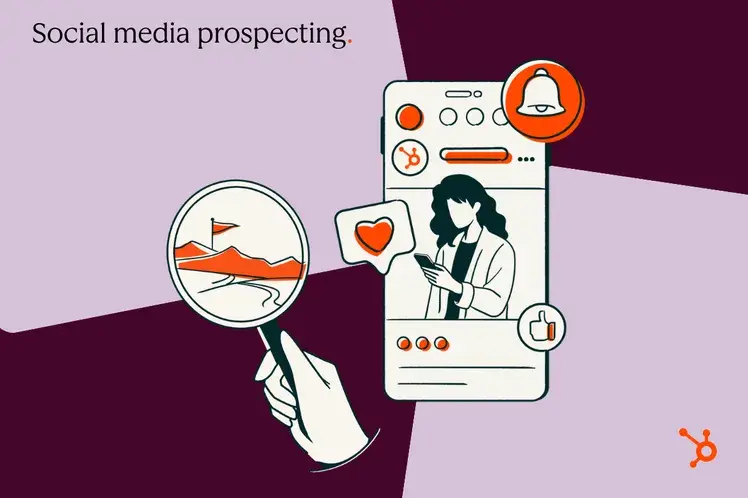
Social media prospecting is the process of using platforms like LinkedIn, Facebook, and Instagram to find, research, and engage potential buyers before you reach out directly. Instead of cold-calling a name on a list, you know who the person is, what they care about, and why your message is relevant to them before you send it.
Social media prospecting differs from both social selling and cold outreach. Social selling is the broader, ongoing practice of building your professional brand and relationships on social platforms.
Prospecting is the narrower task within it: finding specific people worth contacting and researching them before you reach out. Unlike a cold call or a generic mass email, social prospecting starts with public context about the person you’re contacting.
Free Sales Software
Built for productivity, powered by relevance.
- Sales Automation
- Call Tracking
- Lead Prospecting
- And More!
How Social Media Prospecting Works
A repeatable, five-step process covers most of what social media prospecting requires.
-
Define your ideal prospect. Before you open LinkedIn, know who you’re looking for: industry, company size, role, and the kind of problem your product solves for them. Without this, you’ll waste time scrolling profiles that don’t matter.
-
Find and research relevant people. Use search filters, hashtags, groups, and company pages to build a list, then dig into each person’s public activity. HubSpot’s guide to performing prospect research walks through how to turn a name into a useful picture of someone’s role, priorities, and recent activity before you reach out.
-
Engage using relevant, public context. Comment on a post, react to a company announcement, or reference something the prospect shared. The goal is to show you did your homework, not to flatter them.
-
Move to direct outreach when it makes sense. Once you’ve built some familiarity, or once the prospect has engaged back, send a personalized message or connection request that references the context you gathered. Don’t skip straight to a pitch.
-
Track follow-up and pipeline progression. Log what you learned and what happens next, so the relationship doesn’t stall out after one good exchange.
Best Social Media Channels for Prospecting
There’s no single “best” platform for every seller. The right channel depends on your buyer, your industry, and what you’re trying to accomplish. Here’s how the main platforms stack up.
LinkedIn tends to lead for B2B specifically. In the Content Marketing Institute and MarketingProfs’ annual B2B content marketing research (published October 2024), 85% of B2B marketers said LinkedIn delivers the best value of any social platform, compared to 28% for Facebook, 22% for YouTube, 21% for Instagram, 7% for X, and just 3% for TikTok.
Pro tip: If you’re a B2B seller, LinkedIn is worth building a real, ongoing practice around rather than treating it as one channel among many.
Facebook and Instagram still earn their place, especially for researching a company beyond its website. Business Pages, reviews, and recent posts can surface details a corporate “About” page never will, which is why using social platforms for product and company research is worth doing even when you don’t plan to prospect on that platform directly.
TikTok performs differently for B2B than it does for B2C. It’s a legitimate discovery channel for B2C and SMB brands, but the CMI data above puts it last among platforms for B2B marketers, so treat it as a brand-awareness play rather than a core prospecting channel unless your buyer is active there. For other options beyond the core networks, this older but still useful rundown on ways to leverage social media beyond social networks covers a few worth a look.
For general guidance on running social media well (not just for prospecting), HubSpot’s social media marketing guide is a solid starting point for understanding how sales and marketing activity on these platforms overlap.
Social Media Prospecting Best Practices
-
Start with a clear ICP. Every step downstream, from which platform you use to what you say in a message, gets easier once you know exactly who you’re targeting.
-
Research before you contact anyone. A message that references something specific (“Saw your post about your team’s shift to remote-first hiring”) gets a better response than a generic template. That specificity is the main advantage prospecting has over cold outreach.
-
Personalize with relevant business context, not personal details. Reference their company, their role, or something they posted about work. Skip anything that feels like you’ve been digging through their personal life; it reads as intrusive rather than thoughtful, and it can cost you the relationship before it starts.
-
Engage before you pitch, when it makes sense. A like or a thoughtful comment a few days before a message tends to land better than reaching out cold, even on social media.
-
Coordinate your channels instead of picking just one. Social media works best as part of a broader outreach plan, not a replacement for it. HubSpot’s data on social outreach outranking email for response rates doesn’t mean email and phone are obsolete; it means they perform different jobs. A multi-channel approach to prospecting that combines social research with a well-timed call (see this phone prospecting guide for timing tips) usually beats any single channel alone.
-
Respect the platform and the person. Follow each network’s terms of service, don’t scrape or automate messages at scale, and don’t treat a public profile as an invitation to message someone five times in a week. For more specific tactics you can put into practice today, these tactical social selling tips are a good next stop.
-
Record what matters, not everything. You don’t need to log every like or comment. What’s worth tracking is context that helps the next conversation: what you learned about the prospect, what you said, and what they said back.
A shared system like HubSpot’s Smart CRM gives your team one place to keep that context alongside emails, calls, and deal history, so a note from a LinkedIn exchange doesn’t get lost between reps. It won’t automatically capture everything that happens on every platform, so it’s still on you to log the meaningful moments yourself.
How to Measure Social Media Prospecting
Likes, comments, and follower counts don’t show whether prospecting is producing pipeline. Track these instead:
- Qualified prospects found: how many people who match your ICP you’ve identified and added to your pipeline
- Meaningful engagements: comments, replies, or DMs that lead to a real exchange, not just a passive like
- Accepted connections or follows: a rough signal of whether your outreach is landing with the right people
- Direct replies to outreach messages: your real response rate, the number that matters most day to day
- Meetings booked: the point where social prospecting turns into a sales conversation
- Opportunities created and won: the actual pipeline and revenue tied back to social activity
- Conversion by platform: which channel is actually producing meetings and deals, not just activity
Pro tip: For more benchmarks on how social selling connects to pipeline, see HubSpot’s roundup of social selling statistics. Likes and follower growth are supporting signals, not proof of pipeline impact.
Frequently Asked Questions
What is social media prospecting?
It’s the practice of using social platforms to identify, research, and engage potential customers before reaching out directly. It relies on public information, like posts, company pages, and shared connections, to make outreach more relevant.
Which platform is best for B2B prospecting?
LinkedIn, in most cases. It’s purpose-built for professional networking, and CMI/MarketingProfs’ 2025 research found 85% of B2B marketers rate it as the platform delivering the best value. That said, the right platform ultimately depends on where your specific buyers spend their time.
How does social prospecting differ from social selling?
Social selling is the ongoing practice of building your professional brand and relationships on social media over time. Social prospecting is the more tactical, immediate task within that practice: finding specific people worth contacting and researching them before you reach out.
How do you prospect on LinkedIn without being spammy?
Research before you message, personalize based on real, public context, and don’t send the same template to everyone. Engage with a post or two before reaching out cold, and keep your message focused on them, not your pitch.
How should sales teams measure social prospecting?
Look past likes and followers to qualified prospects found, reply rates, meetings booked, and opportunities created. Those are the numbers that connect social activity to actual revenue.
B2B Social Media Prospecting Done Right
Start with one channel where your buyers spend time, one buyer segment, and a small set of metrics, like reply rate and meetings booked, from week one. Expand once that combination is producing results.
From there, the next task is managing follow-up so replies and conversations don’t fall through the cracks. HubSpot’s Sales Hub handles that stage: managing outreach, automating follow-up, and moving prospects through your pipeline once a social media conversation turns into a sales opportunity.
Editor’s note: This post was originally published in August 2022 and has been updated for comprehensiveness.
Free Sales Software
Built for productivity, powered by relevance.
- Sales Automation
- Call Tracking
- Lead Prospecting
- And More!
Social Selling LinkedIn


