At HubSpot, we use AEO as our umbrella term for all efforts to improve visibility in answer-driven experiences, whether that’s ChatGPT, Gemini, Perplexity, or Google AI Overviews. GEO is widely used across the industry to describe optimization specifically for generative AI outputs, and you’ll encounter both terms in the wild.
This guide breaks down how AEO and GEO relate to traditional SEO, where Google AI Overviews fit into the picture, which tools support each workflow, and how to measure the impact across all three.
Table of Contents
- AEO vs. GEO: Is there a difference?
- AEO vs. GEO: Do you need both?
- Tactics That Drive Results in Answer Engines
- AEO and GEO Tools
- How to Measure AEO and GEO
- What’s next for AEO and GEO?
- Frequently Asked Questions About AEO vs. GEO
- Regardless of what you call it, optimizing for answer engines is now a core layer of search visibility.
AEO vs. GEO: Is there a difference?
AEO stands for answer engine optimization. It’s the practice of structuring content so it gets cited or surfaced in AI-generated answers, featured snippets, knowledge panels, and other answer-driven results. GEO stands for generative engine optimization. Most marketers use it to describe the same general goal: earning visibility in generative AI outputs from tools like ChatGPT, Gemini, and Perplexity.
The practical difference between the two terms is mostly terminological. Some SEOs reserve AEO for traditional search features like featured snippets and People Also Ask, then use GEO specifically for generative AI outputs. Others use AEO as a catch-all. There’s no industry standard on this, because the discipline itself is still relatively new. The terminology varies across marketers, agencies, and platforms. At HubSpot, we use AEO as the broader term that covers both. You can read more in HubSpot’s guide to answer engine optimization.
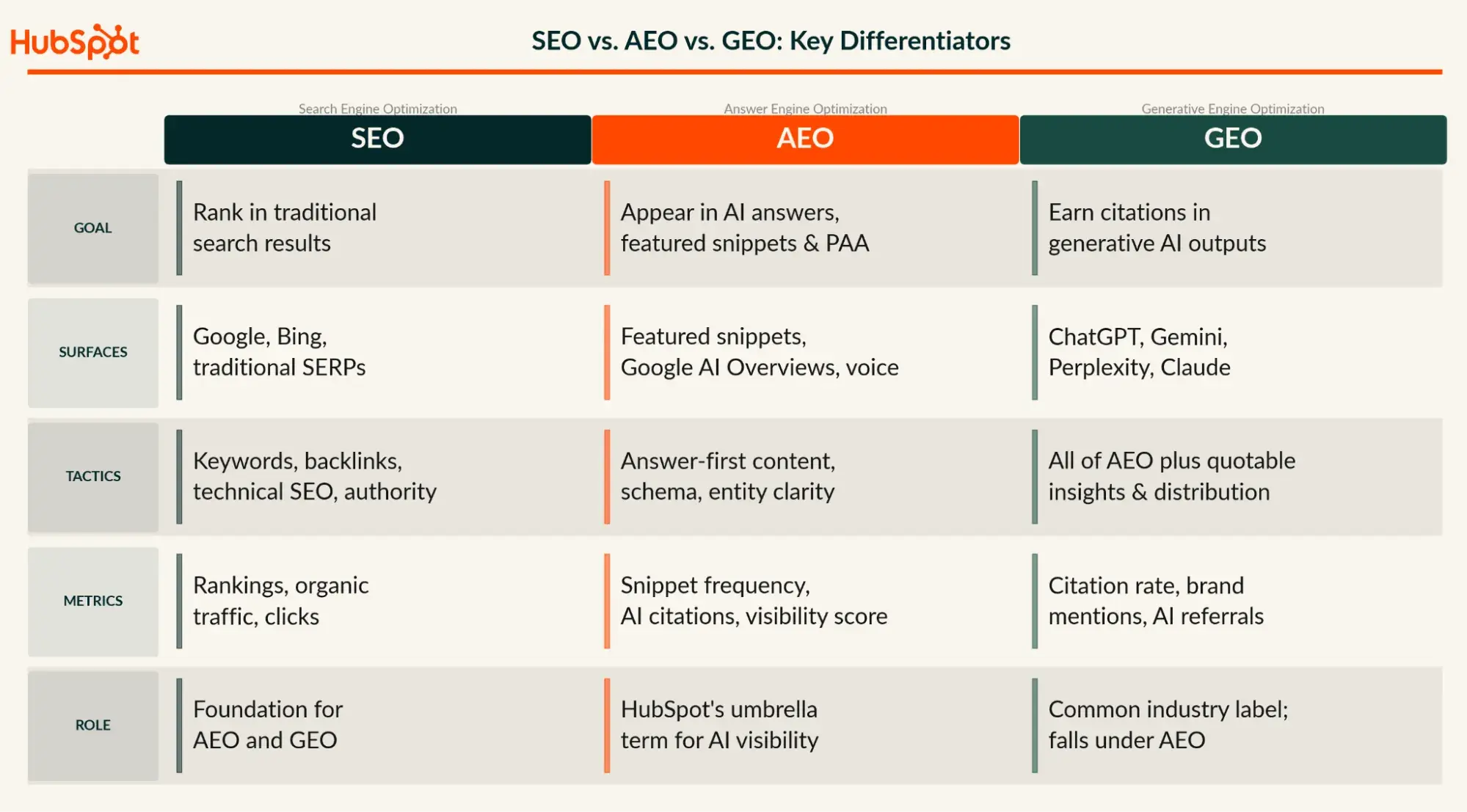
Where does SEO fit? SEO (search engine optimization) focuses on ranking in traditional search results through keyword research, backlinks, technical crawlability, and authority signals. AEO and GEO build on that foundation. Strong SEO creates the conditions that make AI visibility more likely, even though it doesn’t guarantee it.
For a full comparison of how AEO and SEO differ, see HubSpot’s AEO versus SEO guide.
Google AI Overviews sit at the intersection of both worlds. They’re generated by Google’s models but triggered by traditional search queries. Content that ranks well organically and is structured for direct answers tends to perform well in AI Overviews too, which is why SEO, AEO, and GEO strategies share a lot of common ground.
Here’s a quick-reference comparison:
AEO vs. GEO: Do you need both?
For most teams, AEO and GEO aren’t two separate content programs — they’re the same strategy described with different words. Whether you use AEO or GEO as your primary label, the work looks the same: structured content, clear entity definitions, direct answers, and consistent information across the web.
The distinction worth making isn’t AEO versus GEO. It’s answer engine optimization versus traditional SEO. Both AEO and GEO address a real gap that SEO alone doesn’t fill: appearing in AI-generated answers, not just ranked links. According to the HubSpot Consumer Trends Report, 72% of consumers surveyed said they plan to use AI-powered search more heavily when shopping. Brands that only optimize for traditional rankings are leaving visibility gaps in the places where buyers increasingly start their research.
Content that works across AEO and GEO surfaces needs to be well-structured, directly answer the questions users are asking, and define entities consistently across every page. That’s the same content standard, whatever term your team prefers.
I’ve seen this firsthand with my own marketing agency. Leads have come in from ChatGPT and other answer engines, and those results happened because my brand is visible in AI. In today’s search landscape, where buyers increasingly start their research in ChatGPT, Perplexity, or Google AI Overviews, relying on SEO alone isn’t enough.
Pro tip: For a full breakdown of the answer engine optimization discipline, read HubSpot’s Answer Engine Optimization guide.
Free AEO Guide: HubSpot's Guide to AI Engine Optimization
Navigate the AI revolution with proven strategies to optimize your content for AI visibility.
- How answer engines rank and choose content
- Practical templates and checklists
- AEO strategies that convert 27% of AI traffic to leads
- Real examples from HubSpot's AEO implementation
Download Free
All fields are required.
Form not available
Tactics That Drive Results in Answer Engines
Whether teams call it AEO or GEO, structured content is what helps brands appear in answer engines. The foundational practices improve results across both. Here are five core tactics.
Answer-First Content Structuring
Answer-first content structuring means leading with the most direct answer to a user’s question before adding supporting detail, examples, or context. Instead of burying the key point halfway down the page, writers surface the most important point immediately in a clean, skimmable format that answer engines can extract without ambiguity.
For example, if a piece of content has a heading “What is Answer Engine Optimization?” the response designed to perform well in answer engines defines AEO in the first sentence:
“Answer Engine Optimization (AEO) is the practice of structuring content so search engines can extract direct, authoritative answers for featured snippets, AI summaries, and other answer-driven results.”
That opening answer isn’t just for users anymore. It’s for the answer engines deciding whether your brand deserves to be cited.
SEO specialists have used this approach for years because it helps secure featured snippets and People Also Ask rankings. With answer engines pulling direct answers instead of links, the stakes on that first sentence are even higher. Journalists have used a similar structure for decades with the inverted pyramid: headline first, core facts second, context after. Answer-first content applies that same principle to search.
Pro tip: Evaluate how cleanly the first one to two sentences answer the core question on any given page. That’s the signal answer engines are looking for.
Entity Management and Consistency
Entity management is the practice of defining key entities (people, products, brands, or concepts) and keeping those definitions consistent wherever they appear. A brand is an entity. A product is an entity. A person is an entity. Once defined, those entities need to stay consistent across your website, blog, product pages, documentation, PR coverage, and external mentions.
When information is described consistently across sources, AI systems can reliably connect references back to your brand. Inconsistent entity signals create the opposite effect: if a product is described differently on a product page than in a press release, AI systems may merge or misinterpret the data.
With answer engines pulling from thousands of sources — competitor sites, Reddit, forums, user-generated reviews — inconsistency is a real risk. Entity clarity is becoming a form of quality control in answer engines. It doesn’t guarantee a citation, but inconsistency works against you. If you want to earn citations for specific facts about your brand or products, those facts need to be stated the same way, in the same terms, across every surface where they appear.
Here’s a real example from testing answer engines for Backlinko: a search for the lifespan of running shoes returned information stating 450–500 miles. The actual range on the manufacturer’s website is 300–500 miles. The answer engine pulled a narrower, slightly inaccurate range, which illustrates exactly why consistent entity definitions matter even when you can’t control what other sources say.
Quotable Insights and Data Passages
Quotable insights are short, authoritative statements or data points that answer engines can lift directly into summaries — stats, expert definitions, clear recommendations, or precise explanations.
Answer engines prefer clean, self-contained passages that can be cited without restructuring. Write those passages deliberately. Define the main point first in a short, complete paragraph, then follow with supporting context or examples. Don’t bury the quotable line inside a longer explanation.
Pro tip: Use quotable insights in a separate paragraph, and answer the heading directly first. Quotes or additional insights should come after the short paragraph that defines the main point.
Strong definitions, data-backed statements, and expert positions have long been part of SEO for demonstrating E-E-A-T. In answer engines, they serve the same purpose, and they’re among the passages most likely to get pulled into AI-generated summaries.
Schema and Structured Markup Implementation
Schema markup is structured data that helps answer engines understand the meaning of content, from products and FAQs to authors, how-tos, and ratings. It turns plain text into clearly defined entities and relationships that machines can parse and trust.
Schema matters for AEO because it tells answer engines exactly what content represents. Structured markup reinforces entity consistency, which generative engines use to verify information and decide which brands to cite.
As an SEO specialist, I’ve been adding schema for years. For me, it’s non-negotiable. Some of my most used schema types for B2B include:
- Person schema — identifies subject-matter experts by credentials, roles, and publications. This is particularly useful for E-E-A-T because it ties authoritative content directly to a real expert.
- Organization schema — defines a company as an entity: legal name, brand name, industry, contact details, and social profiles. It establishes a source of truth about the organization.
- FAQ schema — explicitly marks up questions and answers, giving AI models a structured understanding of what each section of content represents.
- Service schema — defines what a business provides: the service itself, who it’s for, and what problems it solves.
- Product schema — provides structured data about products including specs, features, benefits, variations, and ratings.
Reinforcement Through Repetition
Reinforcement through repetition means getting key facts, claims, and definitions repeated consistently across multiple reputable sources so answer engines treat your brand as an authoritative source. Answer engines don’t take websites at face value — they triangulate. They look for patterns and repeated assertions across the web.
If only your website says a product delivers a specific outcome, AI treats it as unverified. If that same claim appears across press coverage, partner pages, industry publications, documentation, and comparison sites, answer engines are more likely to adopt it as reliable and cite your brand as the source.
This is why PR, content partnerships, and third-party coverage aren’t just brand-building activities — they’re AEO infrastructure.
Pro tip: Don’t stress about repeating yourself. Only a small percentage of your audience sees any given piece of content you publish. What gets shown depends on the algorithm, when someone logs in, and what they’re looking for at that moment. A social media post, for example, may only reach around 8% of a large audience. Posting the same core message again, or across another platform, reinforces your entities without boring anyone.
AEO and GEO Tools
The tools that support AEO and GEO fall into a few distinct categories: dedicated AI visibility platforms that track how often and how accurately your brand appears in AI outputs; traditional SEO platforms that have added AI search features; manual testing tools (the answer engines themselves); and CRM-connected platforms that tie visibility data to pipeline and revenue.
These categories serve different needs. Free diagnostics are useful for a quick snapshot. Ongoing monitoring tools are what you need if you want to track citations, prompts, and competitor benchmarking over time. Traditional SEO platforms remain essential for the foundational keyword, backlink, and technical work that underpins AI visibility. And attribution-focused platforms help connect AI mentions to actual conversions.
The table below covers a shortlist of tools worth evaluating. Pricing, engine coverage, and feature sets change frequently, so verify current details directly with each vendor before making a decision. For a more detailed breakdown, see HubSpot’s guide to answer engine optimization tools.
Key limitation to keep in mind: Most AEO dashboards report raw mention rates. Research from Discovered Labs highlights a meaningful gap between mention rate and actual brand recall — which is why citation tracking is most useful when paired with referral traffic and conversion data, not evaluated in isolation.
For teams starting out, the HubSpot AI Search Grader is a free diagnostic that scores your answer engine visibility and the sentiment behind citations. It’s a good starting point before committing to a paid monitoring platform.
How to Measure AEO and GEO
Measuring answer engine performance requires a shift away from traditional SEO metrics like rankings and click volume alone. Marketers now need to measure visibility within answer engines, citation accuracy, referral traffic from AI sources, and the downstream impact on conversions and lead quality. These categories don’t all measure the same thing, and it’s worth being precise about what each one actually captures.
AI Visibility and Citation Coverage
AI visibility and citation coverage measures how often your brand appears in answer engine experiences like ChatGPT, Perplexity, and Gemini. Instead of tracking only clicks or rankings, this metric tells you whether answer engines are pulling your content into their responses, summaries, and recommendations, and whether those mentions are positive, neutral, or negative.
One important caveat: citation rate and brand recall aren’t the same thing. Research from Discovered Labs found that an aggregate mention rate of 10.8% corresponded to an unanchored brand recall rate of just 1.9%. That’s a significant gap, and it’s why raw citation numbers can overstate meaningful visibility. Track visibility metrics, but pair them with referral and conversion data to understand whether those citations are driving real awareness.
For a free snapshot of where your brand stands today, HubSpot’s AI Search Grader scores your answer engine visibility and citation sentiment. Teams that want ongoing monitoring can use HubSpot AEO to track how frequently the brand appears and for which prompts.
Conversions and Revenue Influenced by Answer Engines
Conversions and revenue influenced measures how often answer engine sessions contribute to the pipeline — through direct referral clicks, assisted conversions, or unclicked citations that shape buying decisions before a user ever reaches your site.
HubSpot’s State of AEO found that 44% of marketers surveyed have made a business purchase based on a brand they discovered through an answer engine. That influence is real, but it’s not always directly trackable.
The most direct way to measure conversions from AEO is to track sessions where the referrer is an AI source — chatgpt.com, perplexity.ai, gemini.google.com — and then analyze what those users do on your site. I do this in Looker Studio, with a segment for AI referral sessions layered with conversion events like form submissions and demo bookings.
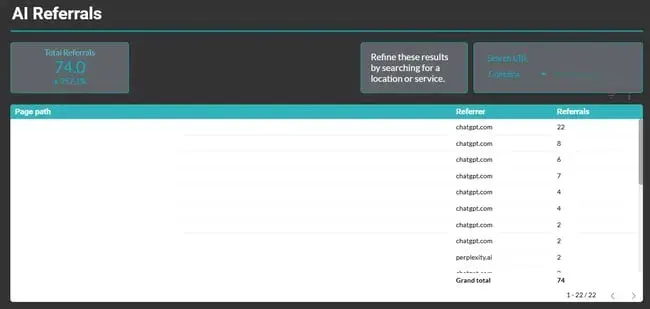
It gives a clean view of how many visits came from AI sources and how many converted.
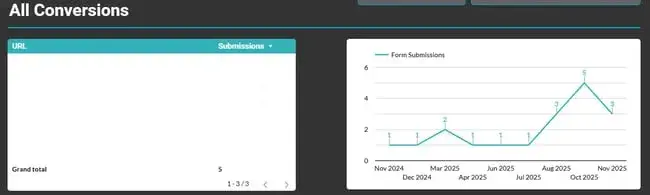
When reporting, look at:
- Assisted conversions influenced by AI exposure
- Conversions on pages that appear in answer engines
- Conversion-rate changes after AEO content updates
- Multi-touch attribution paths where answer engines were part of the journey
The nuance: many users see a brand in an AI response, don’t click, and return later through another channel. Those unclicked citations still influence decisions, which is why referral conversion data captures only part of the picture.
Pro tip: Qualify marketing leads by adding fields on contact forms. I add a “budget” field, for example. That context helps you assess lead quality by channel, including AI referrals. It’s how I was able to trace a $10k lead back to a ChatGPT referral for a client.
Free AEO Guide: HubSpot's Guide to AI Engine Optimization
Navigate the AI revolution with proven strategies to optimize your content for AI visibility.
- How answer engines rank and choose content
- Practical templates and checklists
- AEO strategies that convert 27% of AI traffic to leads
- Real examples from HubSpot's AEO implementation
Download Free
All fields are required.
Form not available
Lead Quality From AI-Influenced Discovery
Lead quality from AI-influenced discovery measures how well leads generated from answer engines match your ideal customer profile and whether they move through the funnel faster than traditional organic traffic.
Answer engine recommendations act as an intent filter. If someone finds your site through a generative engine’s answer or a vendor comparison, they’re likely already researching a specific problem you solve. That context means AI-sourced visitors often arrive with stronger problem-awareness and higher intent than general organic traffic.
What to track:
- Fit score of leads generated from pages appearing in answer engine responses
- Sales-qualified lead (SQL) rate from answer engine sessions
- Lead velocity and time-to-first-action (demo booked, asset downloaded)
- Topics and pages that consistently drive higher-quality conversions from AI sources
Pro tip: Use HubSpot lead scoring to compare AI-influenced leads with those from traditional organic search. That comparison helps sales and marketing teams quickly assess whether the AEO strategy is attracting the right buyers.
Page Performance and User Behavior
Page performance data shows which pages answer engines are recommending most frequently. The more sessions a page receives from AI referrals, the more consistently it’s being surfaced in response to relevant prompts.
Once you know which pages are getting AI traffic, analyze how those visitors behave:
- Do they stay on the page or bounce quickly?
- Do they view multiple pages?
- Are they interacting with high-intent elements like CTAs, pricing pages, or demo forms?
- Are they triggering key events like downloads or form fills?
Combining behavior data with AI visibility data gives you a clear picture of which pages are doing the heavy lifting and which ones need attention, whether that’s schema improvements, answer-first rewrites, better quotable passages, or stronger entity definitions.
What’s next for AEO and GEO?
The AEO space is evolving fast. I’ve been writing about these terms for a while, and the pace is such that I often make significant edits between first draft and publication. Those two weeks can be enough for things to shift meaningfully. For a broader look at where the discipline is heading, see HubSpot’s guide to answer engine optimization trends and the latest generative engine optimization statistics.
AI discovery will become the new top of funnel.
More buyers are starting their research in ChatGPT, Perplexity, Gemini, and other conversational tools. According to the HubSpot Consumer Trends Report, 72% of consumers surveyed said they plan to use AI-powered search more frequently when shopping. For many buyers, the first impression of a brand isn’t a homepage — it’s whatever an answer engine says in response to a prompt.
That means AEO success depends on question coverage, schema, and distribution. Being visible in the right AI responses is now a top-of-funnel function that used to belong exclusively to organic search.
SEO teams will report on AEO and GEO as standard.
AEO metrics are becoming a standard component of search reporting. The same way SEO teams track rankings, backlinks, Core Web Vitals, and keyword visibility, those reports need to include answer engine visibility, citation frequency, entity consistency, and AI-originating sessions. If your brand isn’t appearing in generative results for your core topics, that’s a performance gap.
What this looks like in practice:
- Add answer engines (ChatGPT, Perplexity, Gemini) to your acquisition reporting
- Track which pages are being recommended by AI — and whether those are your high-intent assets
- Monitor AI-originating sessions as a standalone channel
- Identify missed citation opportunities where competitors are being selected instead of you
HubSpot’s AEO best practices and GEO best practices are both worth bookmarking as the discipline continues to develop.
Once AEO metrics are embedded in your reporting cadence, patterns emerge: which pages earn citations, which topics attract high-quality traffic, and where you need to tighten entity definitions or restructure content. I built this into my clients’ Looker Studio dashboards months ago, and it’s now a standard part of every search report.
Pro tip: Treat answer engine visibility the same way you treat keyword rankings. Add AEO metrics to your monthly reporting and review them with the same rigor. That’s how you stay ahead of competitors who are still only tracking organic traffic.
If you want to understand how visible your brand is across answer engines, start with the HubSpot AI Search Grader for a free, high-level snapshot. Then use HubSpot AEO to monitor which citations the brand earns and how to improve performance over time.
Frequently Asked Questions About AEO vs. GEO
What’s the difference between AEO and GEO?
AEO stands for answer engine optimization. GEO stands for generative engine optimization. Both terms describe efforts to earn visibility in AI-generated answers, but industry usage varies. At HubSpot, AEO is the umbrella term for all answer-engine visibility initiatives. GEO is widely used by others to refer specifically to optimization for generative AI outputs like ChatGPT and Gemini. There’s no universal standard. What matters more than the label is the practice.
Where do Google AI Overviews fit?
Google AI Overviews sit at the intersection of traditional SEO and answer engine optimization. They’re triggered by conventional search queries but generated by Google’s AI models. Content that performs well in traditional organic results and is structured for direct answers tends to do well in AI Overviews too — which is why SEO and AEO strategies have significant overlap.
Do I need separate strategies for AEO and GEO?
For most teams, no. The tactics that support AEO and GEO are the same: answer-first content, entity consistency, quotable insights, schema markup, and distribution across authoritative sources. You don’t need two separate content programs. You need one strategy that produces content answer engines can extract and trust.
How do I get my brand cited in ChatGPT or Perplexity?
Use answer-first formatting, define entities consistently, include quotable data passages, and implement relevant schema. Then reinforce those facts across authoritative external surfaces like press, partner pages, and industry publications, so answer engines encounter your version of the information repeatedly and treat it as reliable.
How do I measure AEO performance without relying on traffic?
Track citation frequency, brand visibility across AI surfaces, entity consistency, and the fit score of leads from AI-influenced sessions. Tools like HubSpot AEO can monitor these metrics. For attribution, track sessions where the referrer is an AI source and analyze conversion behavior within those sessions.
How often should we refresh AEO-ready content?
Refresh your AEO-ready content on key pages at least quarterly, or whenever product updates, regulatory changes, or competitive shifts occur. Accuracy and freshness influence whether an AI engine trusts your content as a citation source.
Regardless of what you call it, optimizing for answer engines is now a core layer of search visibility.
AEO isn’t an add-on to your existing strategy. It’s becoming the foundation of brand visibility in AI-first search. Whether your team uses AEO or GEO as its preferred term, the goal is the same: structured, answer-first content with clear entity definitions, backed by strong distribution.
Build these practices into your content workflow, add AI visibility to your reporting, and use the right tools to understand where you’re winning and where competitors are getting cited instead.
Start with the HubSpot AI Search Grader to see where your brand stands today — it’s free and takes minutes to run.
Editor's note: This post was originally published in July 2026 and has been updated for comprehensiveness.
Free AEO Guide: HubSpot's Guide to AI Engine Optimization
Navigate the AI revolution with proven strategies to optimize your content for AI visibility.
- How answer engines rank and choose content
- Practical templates and checklists
- AEO strategies that convert 27% of AI traffic to leads
- Real examples from HubSpot's AEO implementation
Download Free
All fields are required.
Form not available
AEO


-What-We-Learned-from-Analyzing-10+-Brands-With-High-AI-Search-Citations-1-20260826-304258.webp)
![Using LinkedIn for AEO: How marketers can use social media to improve their AI visibility [experiment]](https://53.fs1.hubspotusercontent-na1.net/hubfs/53/AEO-for-LinkedIn-piece-1-20260826-6108454.webp)
-1.png)
![Scrunch AI alternatives compared: Features, pricing, and fit [2026]](https://53.fs1.hubspotusercontent-na1.net/hubfs/53/scrunch-alternatives-1-20260812-5006620.webp)