

Traditional search is still thriving and AEO doesn’t replace it, but the two are increasingly intertwined. According to HubSpot’s Consumer Trends Report, 72% of consumers plan to use AI for shopping more frequently. Staying current on AEO trends is no longer optional.
This post breaks down six major, emerging AEO trends, why they matter for revenue, and how to integrate AEO with traditional SEO strategies to drive full-funnel growth.
Table of Contents
-
Why Emerging Trends in Answer Engine Optimization Matter Now
- 6 Emerging Answer Engine Optimization Trends to Act on in 2026
- How to Integrate AEO Strategies With SEO for Full-Funnel Growth
- How to Measure AEO Beyond Rankings and Clicks
- Frequently Asked Questions About Answer Engine Optimization Trends
- The future of visibility belongs to answer-ready brands.
Why Emerging Trends in Answer Engine Optimization Matter Now
Answer engine optimization matters because search behavior is changing. AI Overviews reduce organic clicks to traditional listings, but increase the value of citations.
Ultimately, failure to earn visibility in AI answers is a failure to build trust with prospective audiences and make money.
AI is no longer scary or of poor quality.
HubSpot’s Consumer Trends Report reveals that the most significant emotions consumers feel while shopping using generative AI are positive — appreciation, satisfaction, optimism, and joy.
The future of search calls for brands to gain visibility in AI search results as well as in traditional search engine listings.
Important note: Traditional search remains important and marketing teams shouldn’t abandon it in favor of AEO. Here’s why it matters.
HubSpot AEO Tool
See exactly where your brand shows up in answer engines and take action to close AI visibility gaps.
- Track AI mentions.
- Analyze citations
- Monitor prompts
- Benchmark competitors
Brand perception is now shaped before the click.
AI Overviews and answer engines shape brand perception before a user visits a website. In early search phases, like discovering a solution to a problem, searchers increasingly turn to AI. Visibility during this discovery period is critical: a brand that’s absent is unknown to the searcher, and an unknown brand never gets the chance to convert.
This visibility layer is one of the major benefits of doing answer engine optimization. Be visible early on and brands make vendor shortlists.
Visibility only builds trust if the content AI surfaces is accurate. If facts about pricing, features, or differentiators are inconsistent across pages, answer engines are less likely to cite that brand.
Marketing teams need to own the brand narrative and supply the content they want cited. When they don’t, someone else fills the gap — a competitor, a review site, or an unhappy customer on Reddit. The goal is to ensure accurate, structured content is available for AI tools to summarize and deliver in response to relevant queries.
Here’s an example of how third-party sources drive the narrative for HubSpot CRM in AI Overviews:

I searched for “best free CRM for small business,” and the AI Overviews recommended HubSpot as the top option. The source cited is Zapier. Directly below AI Overviews, HubSpot appears again. First, in “Sources across the web.” Brand trust has been built significantly before the opportunity to click on HubSpot’s traditional SEO listing.
Discovery in answer engines is intent-driven and contextual.
Users ask highly specific questions of AI engines, such as “best ERP for manufacturing under 200 seats,” and answer engines return summarized insights in response. Content that directly addresses those specific needs earns stronger visibility in AI answers.
Brands that solve a specific problem for a specific customer are more likely to reach and convert that audience. This level of understanding requires deep audience research.
The best free CRM example illustrates this well. HubSpot’s visibility came from content that matched a specific, real-world buyer question rather than a broad keyword. Marketing teams that understand their buyers can build content around specific needs at the right moment in the decision journey.
Lead quality improves when AI cites your content.
Unlike traditional SEO, where marketing teams cast a wide net and qualify prospects after they visit the site, AEO brings significant personalization before a prospect ever makes contact. As Amanda Sellers, SEO & AEO Strategist at HubSpot, puts it in the AI trends report, buyers arriving from AI answer engines are “much more qualified” by the time they land on a page.
This may be because of the nuance within an AI search.
According to a 2025 report from The Growth Memo, the average query length in traditional search in the U.S. is 3.37 words. In contrast, the average prompt length in ChatGPT is 23 words, with some prompts reaching up to 2,717 words. Even when the prompt is not lengthy, the AI engine likely has gathered information about the user to further personalize the experience.
People get really specific when they use AI search. When recommendations come back, they match exactly what the user was looking for. As a result, traffic from AI engines tends to be more qualified. At HubSpot, lead conversion from AEO was 3x higher than other sources.
I recently received an email from a client asking for a Power Hour. I asked where they found me — it was ChatGPT. The prospect closed after two emails. Trust had already been established through AI, and the lead quality made it straightforward to close.
AEO directly impacts revenue attribution.
AEO can directly impact revenue. The numbers in Hubspot’s State of AEO report back this up. AI referral traffic converts at 11.4% globally in ecommerce, more than double the 5.3% conversion rate from organic search, according to Similarweb.
Although many prompts typed into AI tools are informational, many are looking for comparisons during the buyer journey phase. When someone wants to make a purchase or even push “buy” on a product.
While these searches might be few and far between, they’re not to be ignored.
Here’s a screenshot from my client’s Looker Studio dashboard where we track conversions from AI:

Note: The URLs are redacted for this article screenshot.
Conversions from ChatGPT have been increasing since around June, with a notable surge in October, the month we launched additional local pages (more on that next). On this dashboard, we can see exactly which pages ChatGPT has sent the user to and where they converted.
6 Emerging Answer Engine Optimization Trends to Act on in 2026
The most important answer engine optimization trends revolve around audience needs, entity clarity, structured answers, and the creation of content that AI can easily parse and trust.
1. Answer-first content formats become mandatory.
Answer-first formatting improves the extractability of content for conversational, definitional, and comparison queries. Answer engines prioritize content that surfaces the core answer at the very top of the page. Get to the point as quickly as possible, then elaborate.
Here’s an example where getting to the point, fast, helps AI answer a query:

AI Overviews pulls a full workflow into its answer and it’s taken directly from a knowledge base article on HubSpot.
AI systems look for extractable content. When key messages are placed directly under a heading and/or formatted cleanly (with bullets or steps, for example), it becomes significantly easier for answer engines to summarise, cite, and reuse it.
Answer-first content isn’t exactly new. SEO specialists have been writing in this format for years, probably as early as the featured snippet began dominating the top of Google. Nevertheless, it’s worth noting here as an action point because it is perhaps more important than ever to implement this format in content. Answer first content helps traditional rankings and visibility in AEO.
Actionable steps to writing answer-first content formats:
- Get to the point in your writing. Make the most important point first, then elaborate.
- Use clear headers, lists, bolding, and tight paragraphs that AI can easily parse.
- Add a “What this means” or “Why it matters” summary under key sections.
Pro tip: Read about the inverted triangle technique that journalists have used for years; implement it into your writing.
I’ve used the answer-first format for nearly a decade — it’s how I was snagging featured snippets long before AEO existed and how I keep content skimmable for human readers. It’s almost certainly how I’ve achieved AI Overviews visibility for clients. The format isn’t new to me, but I’m still finding ways to apply it more consistently. It feels more important than ever to do so.
HubSpot AEO Tool
See exactly where your brand shows up in answer engines and take action to close AI visibility gaps.
- Track AI mentions.
- Analyze citations
- Monitor prompts
- Benchmark competitors
2. Entity consistency is critical.
Entity consistency strengthens how AI systems recognize and trust a brand. Brand consistency has always mattered, but it deserves extra attention now. Key brand facts need to match across every page, directory listing, and third-party mention. That includes name, services, pricing, product categories, and differentiators.
When they don’t, authority becomes questionable and citation likelihood drops. Worse, AI may surface incorrect information as fact.
Here’s a screenshot from a Reddit page where a user is reporting an issue like this:

If the company is moving, for example, marketing becomes responsible for updating the details everywhere.
Actionable steps for maintaining entity consistency:
- Use consistent naming conventions, product descriptions, and claims across every page.
- Use schema types like Organization, Product, Service, and FAQ to reinforce factual accuracy. Schema markup improves content extraction and voice search visibility.
- Keep a centralized “Source of Truth” document so all teams publish the same facts.
- If entities or facts are changed, update them everywhere, not just on your own site.
3. Conversational, long-tail queries replace basic keyword targeting.
By now, we’re all familiar with what AI search behavior looks like. It’s nothing like a traditional keyword search. Instead of typing two or three words into a search bar, users ask full questions the way they would ask a colleague or a friend, often layering in context, constraints, and follow-up detail.
In a LinkedIn post, Aleyda Solis provides an example of how SEO and AEO search differs:

Conversational, long-tail queries replace basic keyword targeting because answer engines are built to interpret full questions, not isolated search terms. In the example above, instead of typing “Learn SEO,” a prompt for AI search reads: “Please help me create a detailed six-month SEO roadmap.”
Learning how to optimize for AI search engines means shifting content strategy away from keywords and keyword density and toward direct, conversational answers that map to audiences and problems.
Actionable steps for targeting conversational, long-tail queries:
- Build content around audiences with specific needs. Build content around audiences with specific needs. Focus less on search terms and more on the problems the business is trying to solve for its ideal customer. Pages that address specific, well-defined needs are more likely to earn citations in AI search.
- Research the language buyers actually use. Pull real questions from customer support tickets, sales call transcripts, and community forums rather than relying solely on keyword tools built for traditional search.
- Write for specificity over volume. A precise, high-intent question often earns more AEO value than a broad, high-volume keyword. A page targeting “What’s the best CRM for a 10-person sales team?” will likely outperform one targeting “CRM for small business” in AI search. Covering both is fine, but specificity drives the citations that convert.
- Cover the natural follow-up questions. Conversational queries rarely end at one question, so anticipate what a buyer would ask next and answer it on the same page.
4. AI visibility becomes as important as organic clicks.
As zero-click results surge, traditional KPIs like impressions and rankings tell only half the story. Brands are now shifting toward measurement models that focus on AI visibility metrics — how often a brand is cited, mentioned, or included in an AI-generated answer.
The shift requires a complete search mindset change. Even when traffic declines, content can still influence pipeline, authority, and demand by appearing inside AI answers. Measuring AI citations gives marketing teams a clearer view of organic influence in a zero-click world.
AI answers are often the first thing a searcher sees — either through an AI engine like ChatGPT or through AI Overviews, which sit at the top of the search engine results page (SERP).
Look at how this SERP shows the impact:

In many SERPs, sponsored products, AI Overviews, and videos fill the entire page before a single organic listing appears. AI search is now organic traffic’s first and best opportunity to earn a click.
Actionable steps:
- Track citations, mentions, and placement inside AI answers.
- Measure assisted conversions.
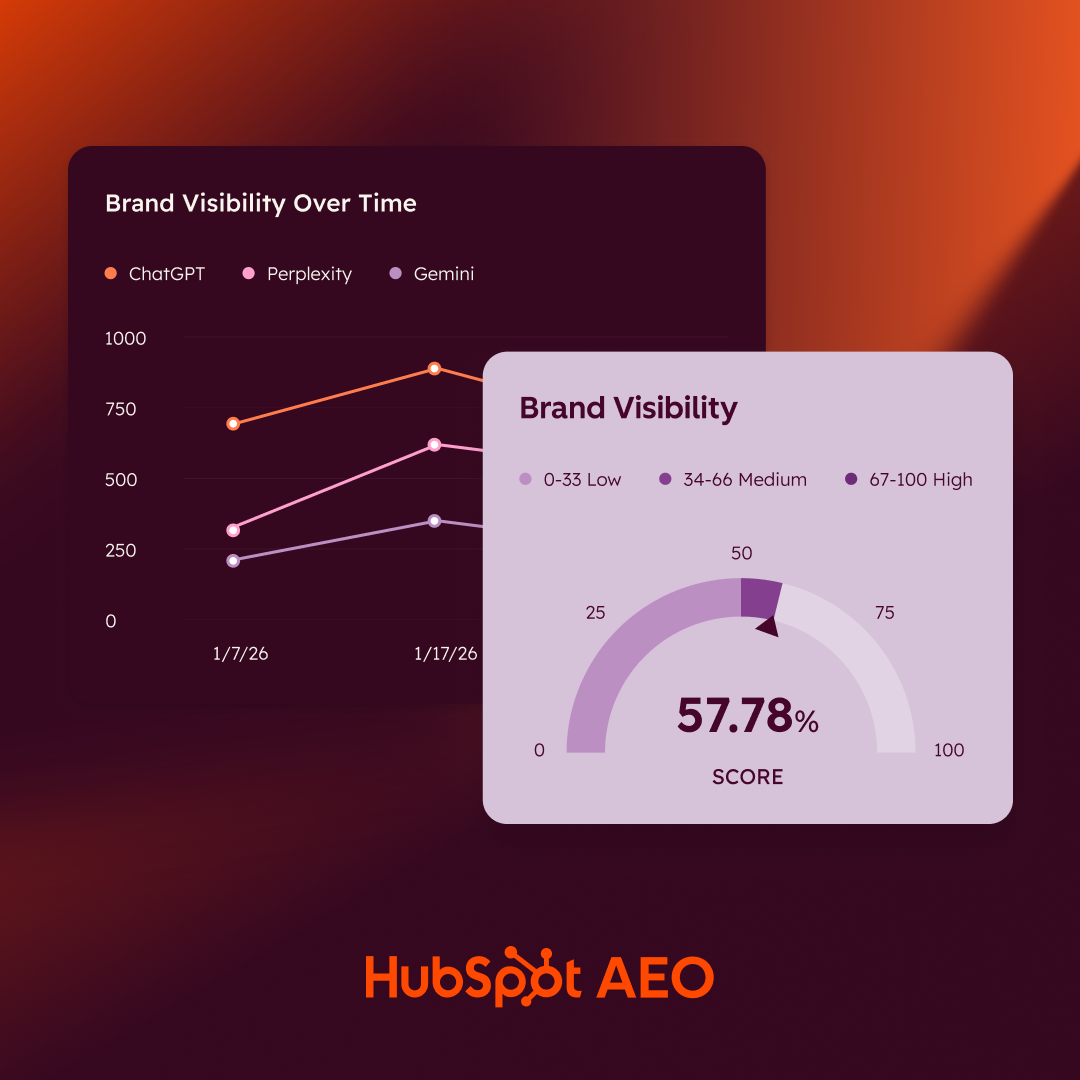
- Use tools like the HubSpot AEO tool to benchmark AEO performance. The tool helps teams track prompt coverage, citation gaps, competitor visibility, and brand presence across answer engines.
Here’s what HubSpot AEO looks like:

HubSpot AEO shows how a brand performs across ChatGPT, Perplexity, and Gemini across a range of metrics, including:
- Brand visibility score.
- Share of voice.
- Sentiment analysis.
- Citation analysis.
- Competitor comparison.
Citations provide the best page-level granularity for AEO performance and help marketing correlate changes in citations with AI referral traffic and conversion changes.
Pro tip: SEO teams now report on metrics that show the impact of AI on a business’s bottom line. For more information on SEO reporting, read: How to create an SEO report [+ benefits, best practices, and examples]. This article covers everything on SEO reporting, including what metrics to track.
5. AEO and SEO unify into a single growth strategy.
AEO and SEO indeed have some different strategies, but for now, the emerging trend is that AEO is the natural evolution of search.

Traditional SEO remains essential, and AEO builds directly on it. The difference is that AEO adds visibility across AI Overviews and conversational answer engines — surfaces that reward structured content, entity clarity, and answer-first formatting over keyword density alone.
Actionable steps for unifying AEO and SEO:
- Align SEO keyword research with answer-intent research for AEO.
- Standardize schema across all priority pages.
- Add answer-first summaries to existing SEO pages.
- Find AI visibility gaps with HubSpot AEO, available without a separate HubSpot subscription.
- Use HubSpot Marketing Hub Professional or Enterprise to apply AEO insights to content.
6. Multi-format answers (audio, video, and short-form summaries) are used by AI.
AI engines increasingly pull from multimedia content, not just text. Video transcripts, short video explainers, and even podcasts are now sources that AI systems use to build answers.
More notably, Google’s AI Overviews and YouTube AI search features can surface a video and start playback at the exact moment the answer occurs.
Here’s an example:

If someone types “how to conduct a competitive audit” into Google, the video will be cited and will start exactly at that section, skipping the intro and other irrelevant chapters.
When creating video content, structure explanations clearly and include timestamped chapters to help AI identify the “best answer moment” in your video.
Actionable steps for earning AEO citations with videos:
- Add clean transcripts to every video and podcast.
- Add chapter markers with answer-oriented titles (“What is X?”, “How does Y work?”).
- Keep core explanations within the first minute of the video.
- Upload to YouTube even if the channel is small — YouTube feeds both Google AI and Gemini.
- Turn transcripts into answer-first written content to increase citation reach.
How to Integrate AEO Strategies With SEO for Full-Funnel Growth
Integrating AEO with SEO requires aligning five key activities: audience research, answer-first content creation, technical optimization with schema implementation, unified analysis, and continuous measurement. While AEO is more of a search evolution, the two disciplines are interconnected and together drive discovery, evaluation, and conversion across both traditional blue links and AI-generated answer surfaces.
By aligning research, content creation, technical optimization, analysis, and measurement, teams can build a unified strategy that attracts high-intent prospects whether or not they click. The steps below outline how to integrate AEO with traditional SEO strategies.
Step 1: Research

AEO isn’t about keywords. Contrary to popular belief, ranking in the top traditional search spots is not a prerequisite for appearing in AI Overviews or answer engines. AI engines surface answers based on consensus, which means traditional search rankings are only part of the equation. I’ve seen websites on page two or three of Google, or even outside the first five pages, appear prominently in AI-generated answers. That’s because these resources had the clearest, most contextually relevant content for the answer engine to anchor on.
Marketing teams need deep insight into three areas:
- What problems audiences have and what solutions they need.
- How audiences search and which tools they prefer.
- Specific terminology audiences use.
Understanding these areas shapes an effective AEO content strategy.
Instead of relying solely on keyword research, develop detailed buyer personas that reveal decision-making patterns, problem statements, and informational needs. HubSpot Make My Persona helps marketing teams build personas based on real behaviors, goals, and challenges, creating the foundation for highly targeted content.
Specificity drives results. I run SEM marketing agency forank with Co-Founder Leigh Buttrey, our in-house PPC specialist. We create holistic campaigns spanning SEO, AEO, and PPC. For one client, we created a landing page targeted at a single buyer type with one specific pain point. The page aligned so closely with audience needs and search intent that it generated a £10k lead from a single visit. That level of precision doesn’t happen with generic SEO targeting — it happens when teams build content deliberately for the exact person they want to attract.
Pro tip: Traditional SEO still matters when building these landing pages. Optimizing for keywords alongside AEO improves the page’s chances of ranking on Google. Adding PPC to the mix turns a single page into a multi-purpose business asset — not just an AI visibility play.
HubSpot AEO Tool
See exactly where your brand shows up in answer engines and take action to close AI visibility gaps.
- Track AI mentions.
- Analyze citations
- Monitor prompts
- Benchmark competitors
Step 2: Content Creation
Content is the backbone of AEO. Answer engines can only cite what already exists — AI models summarize and reorganize content, they don’t invent expertise. Content that isn’t present, isn’t structured for extraction, or doesn’t directly address intent simply won’t appear in AI answers. Content creation needs to be strategic, answer-first, and supported by the right tools.
HubSpot’s ecosystem makes that easier.
HubSpot AEO provides visibility and a clear action plan. Before creating new content, marketing teams can see which prompts buyers are asking answer engines, where the brand is absent from AI-generated responses, and which content types are being cited most often. Every piece of content gets grounded in real data rather than assumed gaps.
HubSpot Marketing Hub can help teams optimize content for both SEO and AEO. It’s a complete marketing platform with built-in SEO tools, optimization checklists, and performance dashboards. When SEO specialists or writers are writing content, they can rely on Marketing Hub to provide:
- Detailed SEO recommendations.
- On-page insights.
- Technical improvements.
These alerts ensure your content is structured, findable, and answer-engine ready with SEO and AEO workflows running in one place.
Combine all the benefits of Marketing Hub with content agent, and the webpage is going to have the best chance of showing up on Google and AI engines. The tool already generates answer-first content aligned with AEO best practices.
Content Agent helps marketing teams produce summaries, definitions, FAQs, and scannable insights that AI engines can parse and cite. The result is faster content production with a cleaner, extraction-friendly structure.
When a page ranks first in traditional search and also appears in AI Overviews, it occupies multiple placements above the fold. That kind of combined visibility is one of the most effective ways to capture high-intent traffic.
I had a client secure both a rank-one placement and an AI Overview placement — and within the AI Overview, they were cited multiple times. The brand appeared five or six times at the top of Google. When AEO and SEO work together, a single page can dominate the entire first page.
Step 3: Technical Optimization and Schema Implementation
Even the most brilliant content won’t appear in AI answers if models can’t parse it.
Technical optimization ensures a site can be crawled, understood, and trusted by answer engines. Three elements matter most: structured data and schema markup, entity clarity, and clean technical signals.
Schema markup enables answer engines to verify facts, map relationships between entities, and extract accurate answers. Combined with entity consistency, it strengthens authority inside the AI knowledge graph. Entity clarity keeps messaging consistent across the web, which makes citations more likely to be accurate. Clean technical signals ensure search engine bots can crawl and index content without friction.
Step 4: AEO and SEO Analysis
AEO must be included in all SEO audits and reports. Typically, AEO measurement focuses on AI citations, mention quality, and assisted conversions.
Just as SEO teams evaluate rankings, backlinks, Core Web Vitals, and keyword performance, AEO teams need to assess how a brand appears — or doesn’t appear — within AI-generated results.
Pro tip: Add AEO to your standard SEO reporting cadence. Treat AI visibility as seriously as rankings.
I added AI tracking to my client’s Looker Studio report some time ago. The dashboard tracks overall AI performance — pages viewed, sessions, and which AI tools are sending traffic.

The report also shows conversions by type: form, phone, and email.
Step 5: Measuring Success and Content Iteration
AEO success cannot rely on clicks alone. Many of the most valuable interactions are zero-click. The metrics that matter are AI visibility, citation quality, and conversions influenced by AI exposure. HubSpot AEO tracks all three.
How to Measure AEO Beyond Rankings and Clicks
Traditional SEO metrics don’t tell the whole story in a zero-click world. AI-generated answers influence decisions long before a user ever lands on a site, so AEO success must be measured through visibility, influence, and revenue impact.
Accurate AEO measurement focuses on how often a brand appears in AI-generated answers, how those appearances influence behavior, and whether the cited content drives high-quality demand. The sections below cover the core metrics every team should track.
Citations
Citations are the sources that answer engines reference when generating responses to a prompt. When an answer engine like ChatGPT responds to a question, it draws on content from across the web to inform its answer. The pages the answer engine links to or draws from are citations.
Citations matter because the content being cited is the content that shapes what AI says about your category, your competitors, and your brand. HubSpot AEO’s citation analysis shows exactly which domains, pages, and content types are being referenced in AI answers.
What to measure:
- Which source types (owned, competitor, third-party, social, affiliate, etc.) are driving citations for specific answers.
- Pages with the highest citations count.
- Citation gaps in specific topics.
Mentions
A mention is any instance where a brand is referenced in an AI answer, whether or not the website is directly cited. Answer engines may reference a brand through third-party sites, review platforms, or news articles — meaning a brand can appear in a response even when the citation doesn’t point to its own pages. HubSpot AEO tracks mentions across ChatGPT, Perplexity, and Gemini, showing how often a brand appears and in what context.
What to measure:
- Directional mentions performance for both the brand and its competitors.
- Mention gaps in specific topics.
- Citation influence rate.
Share of Voice
Share of Voice measures how prominently a brand appears in AI answers relative to competitors. It’s calculated by dividing total brand mentions across tracked prompts by all brand mentions combined — both the brand’s and competitors’ — then expressing that as a percentage.
For example, if there are 100 total brand mentions and 25 belong to one brand, that brand’s Share of Voice is 25%. This shows not just whether a brand is appearing in answer engines, but how much of the conversation it owns relative to competitors. It also surfaces where competitors are being cited in answers where the brand is absent.
Pages Viewed (Quantity & Type)
AI tools change their answers regularly, so AI visibility tools provide a directional sense of how a brand is appearing in AI engines. However, marketing teams can also track sessions to specific pages. Tracking which pages are viewed — and how often — helps marketing teams understand where AI pulls information from. The pages that get clicked the most from an AI source are likely to be frequently cited.
What to measure:
- Increases in page views from AI sources.
- The specific types of pages being viewed (service pages, product pages, local pages, blog posts, FAQ pages).
- Pages that users jump to after interacting with AI-led results.
Pages that are frequently viewed — especially those not ranking one are often the ones surfacing heavily in AI models. Identifying these pages helps marketing strategists strengthen AEO-focused content clusters.
Pro tip: Kyle Rushton McGregor has a fantastic guide and free Looker Studio dashboard to help track AI visits.
Conversions
Although visibility is important, especially in an AI search era, conversions and revenue will always matter the most when attribution is possible.
Marketing teams must measure conversions from AI traffic and revenue generated. Conversions are measured by tracking where people came from and what happened during that session. For example, if someone came from ChatGPT and filled out a contact form, then that’s a conversion attributable, either entirely or in part, to AEO.
Pro tip: Read How to Understand Attribution Reporting
When I measure conversions, I take steps to make attribution and impact measurable. For example, I add a “budget” question to forms so I can see how much the prospect can spend. In the example of the 10k lead from ChatGPT, I knew what the budget was because the form they filled out asked for it.
One factor is harder to measure precisely: even when users don’t click through from an AI Overview or conversational answer, those citations still influence decision-making. That’s why conversion analysis remains one of the most critical AEO metrics.
Reporting should account for assisted conversions influenced by AI exposure, conversions on pages known to appear in AI answers, and conversion rate changes after AEO updates. Multi-touch attribution is also worth tracking wherever AI surfaces are part of the path to lead.
Pro tip: Track conversion paths in HubSpot to identify where AEO visibility accelerates pipeline velocity.
Pages That Generate Conversions
Tracking which pages convert — and whether those pages also appear in AI answers — gives a complete view of AEO’s role in revenue generation. Pages with high conversion rates and AI visibility are a brand’s strongest assets.
What to measure:
- Pages that consistently drive form fills, demo requests, or sign-ups.
- Correlation between AI Overview visibility and conversion surges.
- Specific high-converting pages that appear across ChatGPT, Gemini, Perplexity, and Google AI Overviews.
- Pages that generate both last-touch and assisted conversions.
The combination of AEO visibility and conversion performance tells which content is actually driving results. These pages should be prioritized for updates, schema enhancements, link building, and ongoing AEO optimization.
Lead Quality
AEO doesn’t just increase visibility; it enhances the type of visibility received. When a brand’s content appears in hyper-relevant AI answers, the leads that follow are often warmer and better aligned to its ICP.
What to measure:
- Fit score of leads generated from AEO-influenced pages.
- Sales-qualified lead (SQL) rate from AI sources.
- Lead velocity and time-to-first-action.
- Content topics that repeatedly produce high-quality conversions.
AI-driven discovery tends to attract more qualified prospects because the answer engine has already filtered for intent. High-quality leads are a signal that the answer-first content and entity clarity are working.
Pro tip: Use HubSpot lead scoring to compare AI-influenced leads with standard organic leads.
Frequently Asked Questions About Answer Engine Optimization Trends
What is answer engine optimization?
Answer engine optimization (AEO) is the practice of structuring content so AI-driven answer engines like ChatGPT, Google AI Overviews, Perplexity, and Gemini can understand, cite, and recommend it. Unlike traditional SEO, which targets a ranked list of links, AEO focuses on being included directly inside a synthesized answer. The goal is visibility that builds trust before a buyer ever visits the site.
How is AEO different from SEO?
SEO targets rankings, clicks, and impressions in traditional search results. AEO targets citation, mention, and inclusion inside AI-generated answers. Both disciplines share the same foundation of structured content, technical health, and authority signals. The difference is that AEO requires content to load key information in HTML, be structured in extractable chunks, and use semantic triples to aid bot understanding. The two work best as one unified growth strategy.
Which AI engines should we optimize for first?
The right starting point depends on where a target audience already spends time. ChatGPT and Google AI Overviews tend to have the broadest reach, while Perplexity and Gemini suit teams with more research-heavy or technical audiences. Rather than guessing, marketing teams should check which answer engines are already citing competitors and prioritize those first. Tools that track AI visibility across multiple engines make this comparison much faster than manual testing.
How quickly can we see the impact of AEO updates?
Early signals typically appear within two to six weeks. Brands with existing SEO investment often see results faster. The latest SEO and AI trends show significant crossover between what works for traditional search and what works for AEO.
The impact of AEO updates typically appears within 2-6 weeks, with brands that have invested in SEO often seeing results even faster. Many brands are already cited in AI Overviews, or within Large Language Models (LLMs) like ChatGPT or Perplexity, thanks to their previous SEO efforts. There are a lot of crossovers between what works for SEO and what works for the latest AI trends.
I worked with a client who hadn’t previously invested in SEO. Two weeks after publishing a long-form informational article, the client appeared in AI Overviews.
Do we need separate AEO content, or can we adapt existing pages?
Separate AEO content is rarely necessary. Most AEO work involves restructuring existing pages — adding answer-first summaries, standardizing facts and product descriptions, improving schema markup, and ensuring headings match how people phrase conversational questions. This approach strengthens existing content investments while improving visibility across both traditional search and AI answer engines.
What’s the best way to integrate AEO with our existing SEO roadmap?
Integrate AEO by updating existing processes rather than replacing them. Add answer-first sections to SEO pages, include schema as a standard part of content production, audit entity consistency during technical SEO checks, and evaluate both rankings and AI citations in reporting. AEO is the zero-click layer of SEO strategy, not a separate discipline.
How do we choose the most effective answer engine optimization strategies for AI visibility?
Effective AEO strategies focus on extractability, consistency, and authority. In practice, that means answer-first formatting, entity clarity across all pages, schema markup on priority content, and topics tied to revenue and ideal customer pain points. The goal is owning the topics that influence pipeline, positioning, and perception — not chasing every query.
Which tools should we start with to optimize content for answer engines?
Start with tools that support creation, optimization, and monitoring:
- HubSpot AEO provides insight into AI visibility metrics such as citations, mentions, and share of voice. HubSpot Marketing Pro or Enterprise provides SEO recommendations, on-page insights, and technical improvements to help ensure your content is structured for both search and answer engines.
- Breeze Assistant accelerates AEO drafting, QA, and monitoring.
- HubSpot Content Hub enables answer-first content creation and governance.
- HubSpot AEO Grader scores brand visibility across AI answer engines on five dimensions, including sentiment, presence quality, and share of voice, giving teams a one-time audit baseline to work from.
Together, these tools help create structured, answer-ready content and track how well you’re surfacing across both traditional SERPs and AI engines.
The future of visibility belongs to answer-ready brands.
Answer engine optimization is reshaping how customers discover, build trust and buy from brands. The brands that adapt early are building trust before a buyer ever visits their site.
HubSpot AEO tracks brand performance across ChatGPT, Perplexity, and Gemini, covering citations, share of voice, sentiment, and competitor visibility. For teams looking to understand where gaps exist and which content to prioritize, it’s a practical starting point.
Editor's note: This post was originally published in January 2026 and has been updated for comprehensiveness.
HubSpot AEO Tool
See exactly where your brand shows up in answer engines and take action to close AI visibility gaps.
- Track AI mentions.
- Analyze citations
- Monitor prompts
- Benchmark competitors
-What-We-Learned-from-Analyzing-10+-Brands-With-High-AI-Search-Citations-1-20260826-304258.webp)
![Using LinkedIn for AEO: How marketers can use social media to improve their AI visibility [experiment]](https://53.fs1.hubspotusercontent-na1.net/hubfs/53/AEO-for-LinkedIn-piece-1-20260826-6108454.webp)
-1.png)
![Scrunch AI alternatives compared: Features, pricing, and fit [2026]](https://53.fs1.hubspotusercontent-na1.net/hubfs/53/scrunch-alternatives-1-20260812-5006620.webp)

![HubSpot AEO vs. Ahrefs Brand Radar: Features compared [2026]](https://53.fs1.hubspotusercontent-na1.net/hubfs/53/hubspot-aeo-vs-ahrefs-brand-radar-1-20260805-255574.webp)