
The lead generation process works across channels: content and SEO, paid ads, email, social media, events, and referrals. What connects them is a common goal — capturing contact information from people already seeking solutions, then building the relationships that turn that interest into revenue.
This guide covers what lead generation is, how the process works, which channels and strategies drive results, how to qualify and route leads effectively, and how to measure performance in terms of pipeline and revenue — not just volume.
Table of Contents
- What is lead generation?
- How Lead Generation Works
- The Lead Generation Funnel
- How to Generate Leads
- How to Qualify and Route Leads
- Lead Generation Best Practices
- How to Measure Lead Generation
- Frequently Asked Questions About Lead Generation
- Grow better with lead generation.
What is lead generation?
Lead generation is the process of attracting prospects and capturing their contact information so your sales and marketing teams can build relationships and convert them into customers. Unlike cold outreach, effective lead generation earns attention — giving prospects a reason to raise their hand before a sales conversation begins.
What qualifies someone as a lead? A lead is anyone who shares their contact information in exchange for something of value: a content download, a free trial, a webinar registration, or a newsletter subscription. That act of exchange signals enough interest to warrant follow-up.
How is lead generation different from demand generation? Demand generation creates awareness and interest across a broad audience — many of whom aren’t yet ready to share their information. Lead generation picks up where demand generation leaves off, capturing the contact details of people who are already interested.
Both disciplines work together: demand generation fills the top of the funnel; lead generation converts that attention into identifiable prospects.
For a full breakdown of how the two disciplines relate, see the lead generation vs. demand generation article.
Inbound vs. outbound lead generation. Inbound lead generation earns attention through useful content, SEO, and experiences that bring prospects to you. Outbound lead generation proactively reaches selected prospects through email sequences, paid ads, or direct outreach.
Neither approach is inherently superior — high-performing teams typically use both, with inbound building a pipeline at scale and outbound accelerating pursuit of high-value targets.
An Introduction to Lead Generation
A starter guide to converting website visitors into leads for your business.
- Define and qualify a lead.
- Promote lead gen campaigns.
- Resources to get you started.
- Examples of great campaigns.
Download Free
All fields are required.
Form not available
Lead Types
Leads are typically categorized by lifecycle stage. Definitions vary by company, but these are the most common:
Marketing Qualified Lead (MQL): A contact who has engaged with your marketing — downloaded content, attended a webinar, or repeatedly visited key pages — but isn’t yet ready for a sales conversation.
Sales Qualified Lead (SQL): A contact who has demonstrated clear buying intent, such as requesting a demo or asking about pricing, and has been accepted by sales for follow-up.
Product Qualified Lead (PQL): A contact who has used your product — typically through a free trial or freemium plan — and taken actions that signal readiness to upgrade or buy.
Service Qualified Lead: A contact or existing customer who has indicated to a service rep that they’re interested in an upgrade or additional product.
How Lead Generation Works
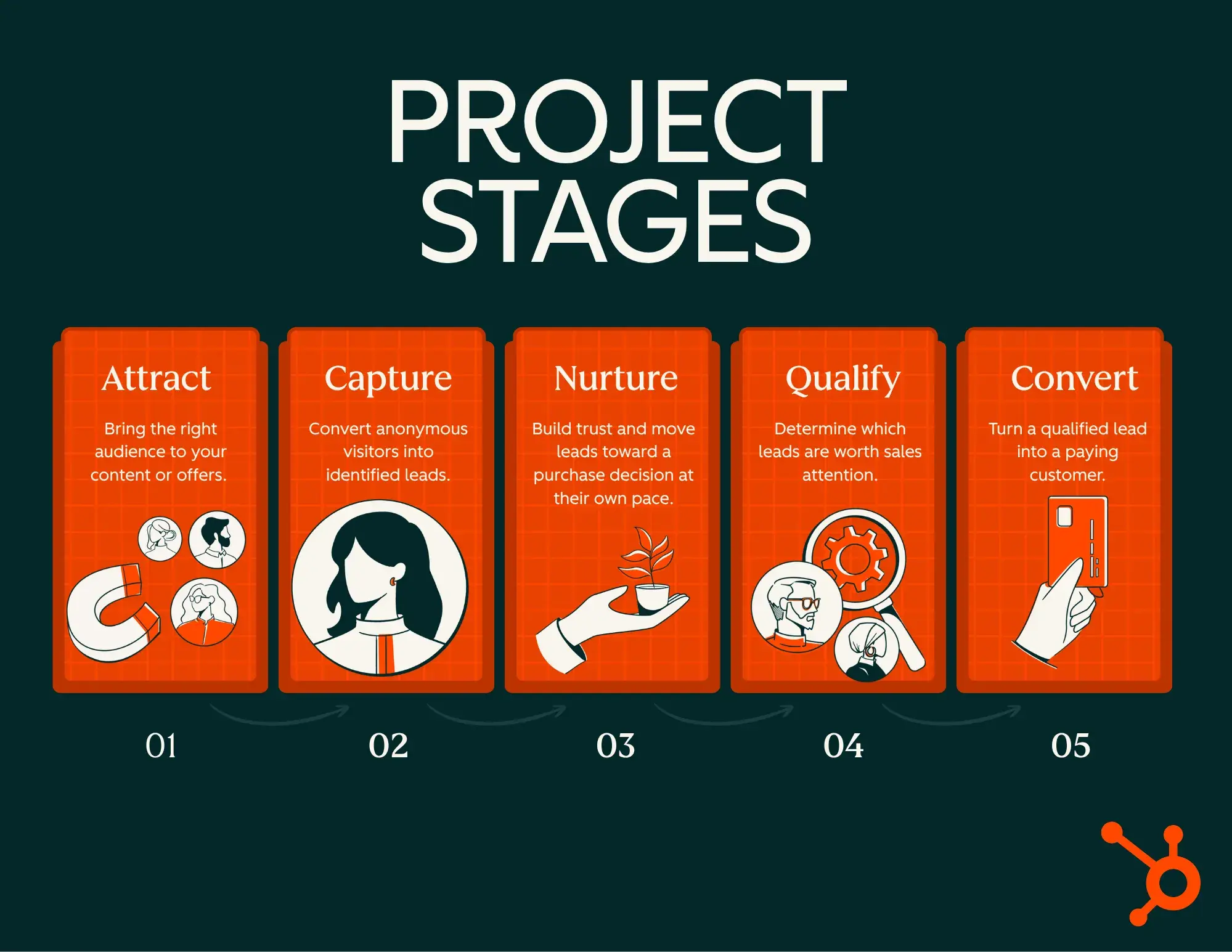
Effective lead generation isn’t a single tactic — it’s a five-stage system that moves a stranger from first contact to sales-ready prospect. Each stage has a clear objective, a primary action, and a handoff trigger that keeps leads moving forward without falling through the cracks.
1. Attract
Objective: Bring the right audience to your content or offers. Primary action: Publish SEO-optimized content, run paid campaigns, post on social media, or host events that address your audience’s real problems. CRM data captured: Traffic source, UTM parameters, first page visited.
Responsible team: Marketing. Next-step trigger: Visitor lands on a page with a conversion opportunity.
2. Capture
Objective: Convert anonymous visitors into identified leads.
Primary action: Offer something valuable — a guide, template, free trial, or demo — in exchange for contact information via a form, chatbot, or landing page.
CRM data captured: Name, email, company, role, and the offer they requested.
Responsible team: Marketing.
Next-step trigger: Form submission creates a contact record and triggers lead scoring and nurture enrollment.
3. Nurture
Objective: Build trust and move leads toward a purchase decision at their own pace.
Primary action: Deliver targeted email sequences, personalized content, and timely follow-ups based on the lead’s behavior and lifecycle stage.
CRM data captured: Email opens, clicks, page revisits, content downloads, and time spent on pricing or product pages.
Responsible team: Marketing.
Next-step trigger: Lead reaches a score threshold or exhibits high-intent behavior — such as visiting the pricing page multiple times — triggering a sales handoff.
4. Qualify
Objective: Determine which leads are worth sales attention.
Primary action: Evaluate each lead against agreed-upon criteria — fit, intent, engagement, and readiness — using lead scoring or direct sales review.
CRM data captured: Lead score, lifecycle stage, firmographic data, and sales notes.
Responsible team: Marketing qualifies to MQL; sales reviews and accepts or rejects as SQL.
Next-step trigger: SQL designation routes the lead to the appropriate sales rep with full context attached.
5. Convert
Objective: Turn a qualified lead into a paying customer.
Primary action: Sales rep conducts a discovery call, delivers a tailored proposal, addresses objections, and closes the deal.
CRM data captured: Deal stage, close date, revenue, and acquisition channel.
Responsible team: Sales.
Next-step trigger: Closed-won deal feeds attribution data back to marketing to identify which channels and content drove revenue.
A HubSpot Workflow Example
Here’s how these five stages connect in practice using HubSpot:
- A visitor downloads a lead generation guide from your blog. HubSpot captures their name, email, and company in Smart CRM and records the source as organic search.
- The contact is automatically enrolled in a nurture sequence — a series of emails tailored to someone early in the buying journey.
- As the contact opens emails, revisits your pricing page, and downloads a second resource, HubSpot’s lead scoring increments their score based on rules your team defined.
- When the contact crosses the MQL threshold, HubSpot routes them to the appropriate sales rep based on territory or company size, with a task and full activity history attached.
- The rep reaches out with context — what the lead downloaded, what pages they visited, and how long they’ve been in the funnel — and moves the deal forward.
Throughout this process, every interaction is logged in one place, giving both teams a shared view of the lead’s journey and eliminating the back-and-forth that slows handoffs down.
Ready to operationalize your lead generation process? HubSpot’s free CRM centralizes lead capture, scoring, routing, and reporting in one place — so marketing and sales work from the same data, from first touch to closed-won.
An Introduction to Lead Generation
A starter guide to converting website visitors into leads for your business.
- Define and qualify a lead.
- Promote lead gen campaigns.
- Resources to get you started.
- Examples of great campaigns.
Download Free
All fields are required.
Form not available
The Lead Generation Funnel
The lead generation funnel maps buyer readiness to the right content and conversion goal at each stage. Use it as a planning tool to ensure you have something relevant to offer prospects wherever they are in their journey.
The funnel works best when content at each stage connects naturally to the next. A TOFU blog post should lead to an MOFU offer; a MOFU webinar should have a BOFU CTA. Gaps between stages — where a lead has nowhere obvious to go — are where pipeline leaks.
For a deeper look at building and optimizing each stage, see our complete guide to lead generation funnels.
How to Generate Leads
Lead generation works across a range of channels. The right mix depends on your audience, budget, and how quickly you need a pipeline. What follows covers the most effective channels with practical guidance on each — and links to dedicated guides where the platform details run deep enough to warrant one.
1. Content and Organic Search
Content marketing and SEO work together to attract prospects who are already searching for solutions. A well-optimized blog post ranks for a relevant keyword, earns a click, and presents a lead magnet — turning an anonymous visitor into an identified contact.
The key is alignment: the offer should extend what the reader just consumed. A post on lead qualification strategies earns more conversions with a lead scoring template CTA than a generic “contact us.” The more relevant the offer, the more likely the visitor is to convert.
For inspiration on what to create, see our list of lead gen content ideas.
According to HubSpot’s 2026 State of Marketing, website, blog, and SEO content rank as the top ROI-generating channels for B2B marketers — making content and organic search the foundation of most sustainable lead-generation programs.
Pro tip: Use HubSpot’s Blog Ideas Generator to identify content ideas with proven search demand, then build lead magnets that directly complement each piece.
When you’re ready to build a full campaign around your content, this guide to running a lead generation campaign covers the end-to-end structure.
Featured resource: HubSpot Ebook Templates
2. Paid Acquisition
Paid channels — search ads, social ads, and display ads — generate leads faster than organic channels and enable precise audience targeting. The tradeoff is cost: paid leads require ongoing spend to sustain volume.
Search (PPC): Google Ads captures high-intent prospects as they search for a solution. Campaigns with a Leads objective can send clicks to a landing page form or capture information directly through a lead form extension. Use a mix of high-intent and long-tail keywords to balance volume with qualification.
Social ads: Meta’s Lead Ads and LinkedIn’s Lead Gen Forms both capture contact information without requiring prospects to leave the platform — reducing friction and improving completion rates.
LinkedIn Lead Gen Forms convert at roughly 13% compared to around 2% for standard external landing pages, making them particularly effective for B2B campaigns where professional targeting by job title, company size, or seniority is important.
Meta’s Advantage+ Leads campaigns now apply AI optimization to lead quality rather than just form volume, with early results showing meaningfully better lead-to-customer conversion rates.
For detailed campaign setup on any of these platforms, see our dedicated guides: Facebook lead generation | LinkedIn ads | Google Ads PPC.
Pro tip: Ensure your landing page and offer match exactly what the ad promises. A disconnect between ad copy and landing page is one of the most common causes of paid lead generation underperformance.
3. Email and Nurture
Email is most effective as a lead-generation channel when it targets people who already know your brand — existing subscribers, trial users, or contacts who’ve engaged with your content but haven’t converted into a sales conversation yet.
A consistent newsletter builds the kind of trust that makes readers think of your brand first when they’re ready to buy. Noel Griffith, CMO at SupplyGem, found that within months of launching a new email newsletter, it became the company’s top source of new leads — not by selling, but by consistently delivering useful information for free.
Pro tip: Every email should have a clear CTA. The best-performing CTAs are specific — “Download the lead scoring template” outperforms “Learn more” every time.
Featured resource: The Beginner’s Guide to Email Marketing
4. Social Media and Community
Social media serves two lead-generation functions: organic reach, which drives traffic to conversion points, and community building, which nurtures prospects over time.
For organic, add links to high-converting landing pages directly in posts, bios, and profile CTAs across LinkedIn, Instagram, and Facebook. Use social posts to distribute content that earns clicks to lead magnet pages. Running a contest or gated challenge is another proven way to collect contact information while building engagement.
For the community, a well-run forum or user group keeps existing leads warm and can tip undecided prospects toward conversion. Seeing peers actively using and endorsing a product often does more than any campaign.
On X (formerly Twitter): the platform’s native Lead Generation Ads format is in flux and not recommended as a primary capture channel at this time. X works better as a top-of-funnel awareness driver — particularly for real-time conversations around product launches or industry topics — feeding retargeting campaigns on higher-converting platforms.
5. Partnerships and Referrals
Referrals and co-marketing tap into trust that your brand hasn’t yet earned with a new audience — because a recommendation from a peer or partner carries more weight than an ad.
Referral programs reward existing customers for bringing in new ones. When Daniel Nyquist, CMO at Crosslist, launched a structured referral program for existing clients, referrals accounted for more than 40% of new business within six months. The key, he notes, is delivering enough value that customers are genuinely eager to recommend the brand.
Co-marketing involves partnering with companies that share your target audience but don’t compete directly. Joint ebooks, webinars, or research reports give both parties access to each other’s lists and extend reach without additional ad spend.
As Jasmine Fleming, a marketing manager at HubSpot, puts it: “Co-marketing offers have the potential to generate significantly more leads than a content piece created by one company alone.”
Influencer partnerships — particularly with micro-influencers whose audiences are highly engaged and well-matched to your ICP — can generate qualified leads at lower cost than broad-reach paid campaigns. HubSpot’s 2025 State of Marketing Report found that both B2B and B2C brands saw their highest influencer ROI from micro-influencers with 10,000–100,000 followers.
6. Website Conversion
Your website is your highest-leverage lead generation asset — traffic is already arriving. The question is whether you’re capturing it. Understanding the anatomy of a lead generation website is a useful starting point before optimizing individual pages. The question is whether you’re capturing it.
Key optimizations:
- Place CTAs at natural decision points: end of blog posts, pricing pages, and the header of high-traffic pages.
- Use exit-intent pop-ups or slide-ins to offer something valuable before a visitor leaves.
- Keep forms short — ask only for what you need at that stage. Reducing the number of fields from five to three typically increases completions without sacrificing lead quality.
- Use smart CTAs that show different offers based on where a visitor is in the buyer’s journey — new visitors see a top-of-funnel offer; returning leads see something closer to a demo or consultation.
- A/B test CTA copy, placement, and offer type regularly. Small changes in wording or position can have an outsized impact on conversion rate.
Visitor tracking tools like Hotjar help identify where users drop off, which pages generate the most scroll depth, and where CTAs are going unseen — making it easier to prioritize optimizations. For a step-by-step walkthrough of the optimization process, see our guide to optimizing your website for lead generation.
7. Events and Offline Methods
In-person and virtual events remain among the most effective ways to generate high-quality leads — particularly in B2B, where face-to-face interaction accelerates trust.
Industry conferences and trade shows allow sales teams to qualify leads through direct conversation. Hosting your own event — a roundtable, workshop, or webinar — positions your brand as the convener of a conversation your audience cares about, and gives you a natural reason to follow up.
After any event, the speed of follow-up matters. Leads captured at events quickly go cold. Have a process in place to add new contacts to your CRM and start a follow-up sequence within 24 hours.
Featured resource: An Introduction to Lead Generation — a starter guide to converting website visitors into leads for your business.
For businesses targeting a specific geography, local lead generation requires a slightly different approach — see our dedicated guide.
An Introduction to Lead Generation
A starter guide to converting website visitors into leads for your business.
- Define and qualify a lead.
- Promote lead gen campaigns.
- Resources to get you started.
- Examples of great campaigns.
Download Free
All fields are required.
Form not available
How to Qualify and Route Leads
Generating leads is only half the work. Without a shared system for evaluating which leads deserve sales attention — and getting them there quickly — pipeline fills with contacts that never convert, and sales teams lose confidence in marketing’s output.
Qualification is the process of determining whether a lead is worth pursuing, and routing is the process of getting the right leads to the right people at the right time. Both require marketing and sales to agree on the rules before a single lead enters the funnel.
The Five Qualification Dimensions
1. Fit Does this person match your ideal customer profile? Fit is assessed using demographic and firmographic data: job title, company size, industry, geography, and budget range. A lead with a poor fit wastes sales time regardless of how engaged they are. Fit signals are typically captured at the point of form submission or automatically enriched in your CRM.
2. Intent: Has this lead demonstrated an interest in buying, or just an interest in learning? Intent signals include visiting a pricing page, requesting a demo, asking about specific features, or searching for comparison content. High-intent behavior is a strong indicator that a lead is moving toward a purchase decision, even if they haven’t said so explicitly.
3. Engagement: How actively is this lead interacting with your brand? Engagement signals include email opens and clicks, content downloads, webinar attendance, repeat site visits, and time spent on key pages. Engagement alone doesn’t equal readiness, but a lead who has consumed multiple pieces of content and repeatedly returned to your site is more likely to be in active evaluation than one who downloaded a single ebook six months ago.
4. Readiness Readiness combines fit, intent, and engagement into an overall assessment of where this lead sits in the buying journey. A highly engaged lead with a strong fit, but no intent signals, may need more nurturing. A lead with clear intent but a weak fit may need to be disqualified. Readiness is the dimension that determines whether a lead moves to sales now, stays in nurture, or gets removed from the funnel.
5. Routing Destination Once qualification is assessed, where does the lead go? Routing decisions should be predefined — not made ad hoc. Common routing destinations include:
- MQL → nurture sequence: Lead shows fit and engagement but isn’t yet sales-ready.
- MQL → sales development rep (SDR): Lead shows fit, engagement, and early intent signals.
- SQL → account executive: Lead has been vetted by sales and is ready for a direct conversation.
- Disqualified: Lead doesn’t meet minimum fit criteria and should be removed from active pursuit.
Aligning Marketing and Sales Before Leads Enter the Funnel
The most common source of sales and marketing friction isn’t the leads themselves — it’s the absence of agreed-upon definitions. Before launching any lead generation campaign, both teams should align on:
- MQL criteria: What combination of fit, engagement, and intent qualifies a lead for marketing handoff?
- SQL criteria: What does sales require before accepting a lead and committing to follow-up?
- Ownership: Who is responsible for a lead at each stage, and what happens if a lead isn’t followed up on within the agreed window?
- Response expectations: How quickly should sales follow up with an MQL or SQL? Research consistently shows that companies contacting a lead within the first hour are significantly more likely to qualify it than those that wait longer.
- Disqualification rules: What criteria remove a lead from active pursuit, and who is responsible for updating the record in the CRM?
Document these definitions in a shared service-level agreement (SLA) and review them quarterly. As your ICP evolves and channel mix changes, qualification criteria should evolve with them.
Lead Scoring in Practice
Lead scoring assigns a numerical value to each lead based on its qualification signals, giving marketing a consistent, scalable way to prioritize which leads are ready for sales and which need more nurturing.
Scores are typically built from two categories:
- Demographic score: Points assigned for fit — job title, company size, industry, and other profile attributes that match your ICP.
- Behavioral score: Points assigned for engagement and intent — page visits, email clicks, content downloads, demo requests, and pricing page views.
A lead might earn 10 points for having the right job title, another 10 for their company size, 5 for downloading a guide, 10 for attending a webinar, and 20 for visiting the pricing page twice. When their total score crosses a defined threshold — say, 50 points — they’re automatically promoted to MQL and routed to sales.
Using HubSpot for scoring and routing: Lead scoring rules are configured with both positive and negative criteria. Negative scoring matters as much as positive — a lead who unsubscribes from email or hasn’t engaged in 90 days should have their score reduced to prevent stale contacts from being passed to sales.
When a contact crosses the MQL threshold, a workflow automatically updates their lifecycle stage, assigns them to the appropriate rep based on territory or company size, creates a follow-up task, and notifies the rep with the lead’s full activity history attached.
HubSpot’s Breeze AI also supports predictive lead scoring, analyzing historical conversion data to surface leads that rules-based scoring alone might miss.
A note on human review: Scoring models are only as good as the rules behind them. For high-value accounts, enterprise leads, or any contact whose signals are ambiguous, human review before handoff is worth the extra step. A score tells you how active a lead has been — it doesn’t always tell you why.
What to Capture on Lead Forms
The information you collect at the point of conversion directly feeds your qualification model. Ask for what you need to assess fit — but not so much that form abandonment increases.
A practical starting point for most B2B lead gen forms:
Progressive profiling — asking for additional information across multiple form submissions rather than all at once — lets you build a richer lead profile over time without increasing friction at the first conversion point.
HubSpot’s smart forms display different fields to returning visitors based on what’s already known about them, gradually completing the picture without repeating questions they’ve already answered.
To go deeper into form design and conversion optimization, see our guide to lead-generation forms.
Lead Generation Best Practices
Effective lead generation isn’t a collection of individual tactics — it’s an operational system. These six practices connect the pieces into a repeatable, measurable process.
1. Define the ideal lead.
Before building any capture point or launching any campaign, align marketing and sales on what a good lead actually looks like. Document your ideal customer profile (ICP): the firmographic attributes, job titles, company sizes, industries, and geographies that correlate with your best customers. Then define the behavioral signals — content consumed, pages visited, actions taken — that indicate genuine buying interest.
Everything downstream — scoring rules, nurture content, routing logic, and success metrics — depends on this definition being specific and shared. A vague ICP produces high lead volume and low conversion rates. A precise one produces the opposite.
2. Build relevant capture points.
Match your offer to where the visitor is in their journey. A first-time blog reader isn’t ready for a demo request; a prospect who’s visited your pricing page three times probably is. Build capture points for each funnel stage — educational content offers for TOFU, comparison guides and webinars for MOFU, trials and consultations for BOFU — and place CTAs where they’re contextually relevant rather than applying them universally.
Keep forms concise. Ask only for what your qualification model requires at that stage, and use progressive profiling to collect additional information over subsequent interactions. Every unnecessary field is a reason a visitor abandons the form.
3. Centralize lead data in CRM.
A lead that isn’t properly captured and attributed is a lead you can’t learn from. Every form submission, chat conversation, event registration, and inbound inquiry should flow into a single CRM — not a spreadsheet, not a disconnected email inbox, and not separate systems for marketing and sales.
Centralizing lead data in a platform like HubSpot’s Smart CRM gives every team member a shared view of each contact’s source, activity history, lifecycle stage, and ownership. It also creates the data foundation that scoring, routing, nurture, and reporting all depend on. Without it, each of the other practices in this list becomes significantly harder to execute consistently.
4. Score and route leads consistently.
Apply scoring rules uniformly across all leads so that prioritization is based on objective criteria rather than individual judgment. Consistency matters as much as accuracy — a scoring model that’s applied selectively produces the same outcome as no model at all: sales teams receive leads of unpredictable quality and marketing loses visibility into what’s actually working.
Review and recalibrate scoring rules quarterly. As your ICP evolves, your channel mix changes, or your product expands, the signals that indicate readiness will shift. A scoring model built eighteen months ago may be promoting the wrong leads today.
5. Nurture by lifecycle stage and intent.
Segment nurture sequences by lifecycle stage and the specific interest a lead has demonstrated — not just by the list they’re on. A lead who downloaded a guide on lead scoring should receive follow-up content that builds on that topic, not a generic onboarding sequence. The more closely nurture content maps to what a lead has already engaged with, the more likely they are to continue engaging.
Trigger-based emails — sent in response to a specific action rather than on a fixed schedule — consistently outperform batch sends. A follow-up email sent within an hour of a pricing page visit converts at a significantly higher rate than the same email sent two days later as part of a drip sequence.
6. Measure quality and pipeline impact.
Lead volume is a vanity metric without quality context. Track these metrics across every channel:
- Visitor-to-lead conversion rate
- MQL and SQL rates
- Lead-to-customer conversion rate
- Cost per lead and cost per acquisition
- Speed to lead
- Pipeline sourced and influenced
Review these metrics by channel, not just in aggregate. A channel that produces high lead volume but low SQL rates is either attracting the wrong audience or failing to qualify effectively. A channel with low volume but high conversion rates may deserve more investment.
Using AI in Lead Generation
AI is increasingly useful across the lead generation workflow — but it works best as an accelerant for human judgment, not a replacement for it.
Current applications worth adopting:
- Campaign and content drafting: AI tools can accelerate the creation of email sequences, ad copy, landing page variants, and content outlines. Use them to generate starting points and test more variations than your team could produce manually — but review outputs for accuracy, brand voice, and relevance before publishing.
- Lead enrichment: AI-powered enrichment tools can automatically append firmographic and technographic data to contact records, reducing the number of required form fields and improving scoring accuracy without increasing friction. HubSpot’s Breeze AI includes enrichment capabilities that pull from publicly available data to complete contact and company records.
- Scoring support: Predictive scoring models use historical conversion data to identify patterns that correlate with closed deals, surfacing leads that rules-based scoring might miss. Treat predictive scores as a signal to investigate, not a directive to act on without review.
- Personalization at scale: AI can tailor nurture content, subject lines, and CTAs to individual lead attributes and behaviors — improving engagement rates without requiring manual segmentation at the contact level.
- Reporting and anomaly detection: AI-assisted reporting can surface unexpected drops in conversion rate, unusual channel performance, or scoring patterns that warrant investigation — giving teams earlier visibility into problems that manual review might catch too late.
Important caveats: AI outputs are only as reliable as the data they’re trained on. Enrichment tools can introduce inaccuracies; predictive models can reflect historical biases in your customer data. Always maintain human review for high-value leads, edge cases, and any AI-generated content before it reaches a prospect.
Ensure that data collection, enrichment, and personalization practices comply with applicable privacy regulations and that consent is appropriately captured at the point of lead generation.
For a broader look at the category, see our roundup of the best B2B lead generation tools.
An Introduction to Lead Generation
A starter guide to converting website visitors into leads for your business.
- Define and qualify a lead.
- Promote lead gen campaigns.
- Resources to get you started.
- Examples of great campaigns.
Download Free
All fields are required.
Form not available
How to Measure Lead Generation
Lead generation measurement answers two questions: are we attracting enough of the right people, and are those people becoming customers? Volume metrics answer the first question. Quality and revenue metrics answer the second.
Teams that track only one without the other consistently make poor investment decisions — scaling channels that look productive on the surface but contribute little to closed revenue.
The Core Metrics
Visitor-to-lead conversion rate: The percentage of website visitors who complete a conversion action and become identified leads. This metric reflects the combined effectiveness of your traffic quality and your capture points. A high traffic volume paired with a low conversion rate typically signals a mismatch between what visitors expect and what you’re offering them.
Cost per lead (CPL): Total spend on a channel or campaign divided by the number of leads generated. CPL tells you what you’re paying to fill the top of the funnel, but it’s only meaningful when compared against the quality of those leads downstream. A channel with a low CPL that produces few SQLs is more expensive in practice than a channel with a higher CPL that closes consistently.
MQL rate: The percentage of total leads that meet your marketing qualification threshold. A declining MQL rate — even when lead volume is stable or growing — is an early signal that traffic quality is slipping, capture points are attracting the wrong audience, or scoring criteria need recalibration.
SQL rate: The percentage of MQLs that sales accepts as qualified and commits to pursuing. A low SQL rate relative to MQL volume often indicates a misalignment between marketing’s qualification criteria and sales’ actual requirements — a signal to revisit your shared SLA and scoring model.
Lead-to-customer conversion rate: The percentage of leads that ultimately become paying customers. This metric connects lead-generation activity to revenue and is the most important for evaluating the overall health of your funnel. Track it by cohort and by channel to understand which sources produce customers, not just contacts.
Speed to lead: The time between a lead’s conversion and a sales rep’s first contact. Research consistently shows that leads contacted within the first hour are significantly more likely to convert than those reached later — yet most teams fall well outside that window. If your average speed-to-lead is too high, the issue is usually in routing or rep capacity, not in lead quality.
Lead quality by channel—aggregate metrics obscure channel-level performance. Break down MQL rate, SQL rate, cost per acquisition, and lead-to-customer conversion rate by source — organic search, paid social, email, referral, events, and so on. This view typically reveals that a small number of channels are responsible for the majority of closed revenue, while several others contribute volume that rarely converts.
Pipeline sourced and influenced Pipeline sourced measures the revenue in your pipeline that originated from a specific lead generation channel or campaign. Pipeline influenced measures revenue that interacted with a marketing touchpoint at some point during the buying journey, even if marketing wasn’t the source. Both matter: sourced shows where leads come from, influenced shows where marketing adds value to deals that started elsewhere.
Measuring in HubSpot: Connecting Volume to Revenue
HubSpot’s reporting tools connect top-of-funnel lead-generation activity to downstream pipeline and revenue, giving marketing and sales a shared view of what’s actually working.
A practical starting point is the funnel report in HubSpot’s Marketing Analytics. It shows the number of contacts at each lifecycle stage — visitor, lead, MQL, SQL, opportunity, customer — and the conversion rate between stages.
Running this report, filtered by source, lets teams compare not just how many leads each channel produces but also how efficiently those leads move through the funnel. A channel that generates 500 leads with a 4% lead-to-customer rate is worth more than one that generates 1,200 leads at a 1% lead-to-customer rate.
Layering in the revenue attribution report connects individual contacts and deals to the marketing activities that influenced them — first touch, last touch, or multi-touch across the full journey. This view is particularly useful for justifying investment in content and organic channels, where the contribution to the pipeline is real but not always visible in last-touch attribution models.
For teams tracking speed-to-lead, HubSpot’s contact activity timeline and deal creation reports surface the average time between a form submission and a rep’s first logged activity — making response-time gaps visible and actionable rather than anecdotal.
The goal isn’t more dashboards. It’s a shared view that answers: which channels produce leads that become customers, what it costs to acquire them, and where the funnel loses people it shouldn’t.
Frequently Asked Questions About Lead Generation
What is lead generation?
Lead generation is the process of attracting prospects and capturing their contact information so your team can build relationships and convert them into customers. It replaces interruptive outbound tactics with a permission-based approach — giving prospects a reason to engage on their own terms before a sales conversation begins.
How is lead generation different from demand generation?
Demand generation creates awareness and interest across a broad audience, many of whom aren’t yet ready to share their contact information. Lead generation captures that interest — converting it into an identifiable contact your team can follow up with.
Demand generation fills the top of the funnel; lead generation converts that attention into leads. The two disciplines work together, and the strongest growth programs invest in both.
What are the main stages of lead generation?
Lead generation follows five stages: attract, capture, nurture, qualify, and convert. Attract brings the right audience to your content or offers. Capture converts anonymous visitors into identified leads through forms, trials, or other conversion points.
Nurture builds trust and moves leads toward a purchase decision through targeted content and follow-up. Qualify evaluates each lead’s fit, intent, and engagement to determine sales readiness. Convert qualified leads into sales and close deals. Each stage has a clear objective, a responsible team, and a trigger that moves leads forward.
How do you qualify a lead?
Qualification evaluates a lead across five dimensions: fit, intent, engagement, readiness, and routing destination. Fit assesses whether the lead matches your ideal customer profile based on firmographic data. Intent looks for signals that indicate buying interest — pricing page visits, demo requests, or feature-specific questions.
Engagement measures how actively the lead has interacted with your brand across channels. Readiness combines those signals into an overall assessment of where the lead sits in the buying journey. Routing destination determines where the lead goes next — nurture, SDR outreach, direct sales, or disqualification.
Marketing and sales should agree on MQL and SQL criteria, ownership, and response expectations before leads enter the funnel.
Which lead generation channels work best?
The most effective channels depend on your audience, business model, and sales cycle. According to HubSpot’s 2026 State of Marketing, website and blog content via SEO ranks as the top ROI-generating channel for B2B marketers, followed by paid social, email marketing, and content marketing.
In practice, the channels that produce the most leads rarely match those that produce the most customers. Break down performance by MQL rate, SQL rate, and lead-to-customer conversion by source to identify where your best pipeline actually comes from — not just where your volume is highest.
How do you measure lead generation?
The core metrics are visitor-to-lead conversion rate, cost per lead, MQL rate, SQL rate, lead-to-customer conversion rate, speed to lead, lead quality by channel, and pipeline sourced or influenced. Volume metrics tell you whether your capture points are working.
Quality and revenue metrics tell you whether the leads you’re generating are actually becoming customers. Measuring both — and breaking them down by channel — gives your team the information it needs to invest in what works and fix what doesn’t.
How can AI support lead generation?
AI is useful across several parts of the lead generation workflow: accelerating campaign and content drafting, appending enrichment data to contact records, supporting predictive lead scoring, personalizing nurture sequences at scale, and surfacing anomalies in conversion data earlier than manual review typically would.
The important constraints are that AI outputs depend on the quality of your underlying data, enrichment tools can introduce inaccuracies, and predictive scoring models can reflect historical biases. Use AI to accelerate and scale human judgment — not to replace it. Review AI-generated content before it reaches prospects, validate enrichment data before it feeds scoring models, and ensure all data collection practices comply with applicable privacy regulations.
Grow better with lead generation.
The most effective lead generation programs aren’t built around individual tactics — they’re built around a connected system. Attract the right audience with content and campaigns that address real problems. Capture their information with relevant, low-friction offers.
Qualify and route leads using criteria that marketing and sales. Nurture prospects with content that matches where they are in the buying journey. Measure everything in terms of pipeline and revenue, not just volume.
Each stage depends on the one before it. A high-converting capture point is only valuable if the traffic arriving at it is qualified. A well-designed nurture sequence only works if the leads entering it have been properly segmented.
A lead scoring model only improves sales efficiency if the routing rules behind it are consistently applied. Getting the system right matters more than optimizing any single piece of it.
Start by auditing where your current process breaks down. For most teams, the gaps are in qualification — leads are passed to sales before they’re ready — or in measurement — no clear line of sight from lead-generation activity to closed revenue.
Closing those gaps and maintaining a shared definition of what a good lead looks like is what separates lead generation programs that grow pipeline from those that simply generate contacts.
If you’re building or rebuilding your lead generation system, HubSpot’s free CRM gives your team a single place to capture, score, route, and report on leads — connecting marketing and sales on the same data from first touch to closed-won.
For a practical introduction to running your first lead generation campaigns, download our free guide below.
Editor’s note: This post was originally published in July 2013 and has been updated for comprehensiveness.
An Introduction to Lead Generation
A starter guide to converting website visitors into leads for your business.
- Define and qualify a lead.
- Promote lead gen campaigns.
- Resources to get you started.
- Examples of great campaigns.
Download Free
All fields are required.
Form not available
Lead Generation
![What is a lead magnet? 20 lead magnet ideas and examples [+ step-by-step]](https://53.fs1.hubspotusercontent-na1.net/hubfs/53/lead%20magnet%20represented%20by%20a%20magnet.webp)




![Gated Content: What Marketers Need to Know [+ Examples]](https://53.fs1.hubspotusercontent-na1.net/hubfs/53/UNGated%20Content.png)

![What is demand generation? Here’s how you can create buzz for your offering [FAQs]](https://53.fs1.hubspotusercontent-na1.net/hubfs/53/demand-generation-1-20251208-2900472.webp)

![Lead Generation Content: Top Types to Use [Data + Expert Tips]](https://53.fs1.hubspotusercontent-na1.net/hubfs/53/lead%20generation%20content.webp)