
Brands that want pipeline from AI search need a plan. AI visibility tools help marketing teams understand where a brand stands, what answer engines are saying about it, and what to fix.
This guide covers the best AI visibility tools on the market, how each one approaches AI search tracking, and what to consider when choosing between them.
Table of Contents
- What are AEO tools, and how do they work?
- How to Compare AI Visibility Tools for Your Needs
- The 10 Best AI Visibility Tools Right Now
- Do you need an AI visibility tool?
- AI visibility can turn mentions into higher-quality leads.
- AEO Content Patterns That Increase Citations in AI Answers
- Measure impact beyond vanity metrics in GA4 and your CRM.
- Frequently Asked Questions About AI Visibility Tools
- AI visibility only matters if it drives results.
What are AEO tools, and how do they work?
AI visibility tools, more broadly known as answer engine optimization (AEO) tools, measure how often, and how accurately, a brand shows up in AI-generated answers.
Rather than tracking rankings or clicks, like traditional SEO tools, AEO tools track whether a brand is being pulled into answers in tools like ChatGPT, Gemini, Claude, Perplexity, and more. In doing so, they surface brand health outcomes that traditional SEO tools were never built to measure.
AI visibility tools track how often a brand appears in AI answers and what is being said about it across the major answer engines. The tools then map the data into measurable categories. The categories vary by tool.
HubSpot AEO Tool
See exactly where your brand shows up in answer engines and take action to close AI visibility gaps.
- Track AI mentions.
- Analyze citations
- Monitor prompts
- Benchmark competitors
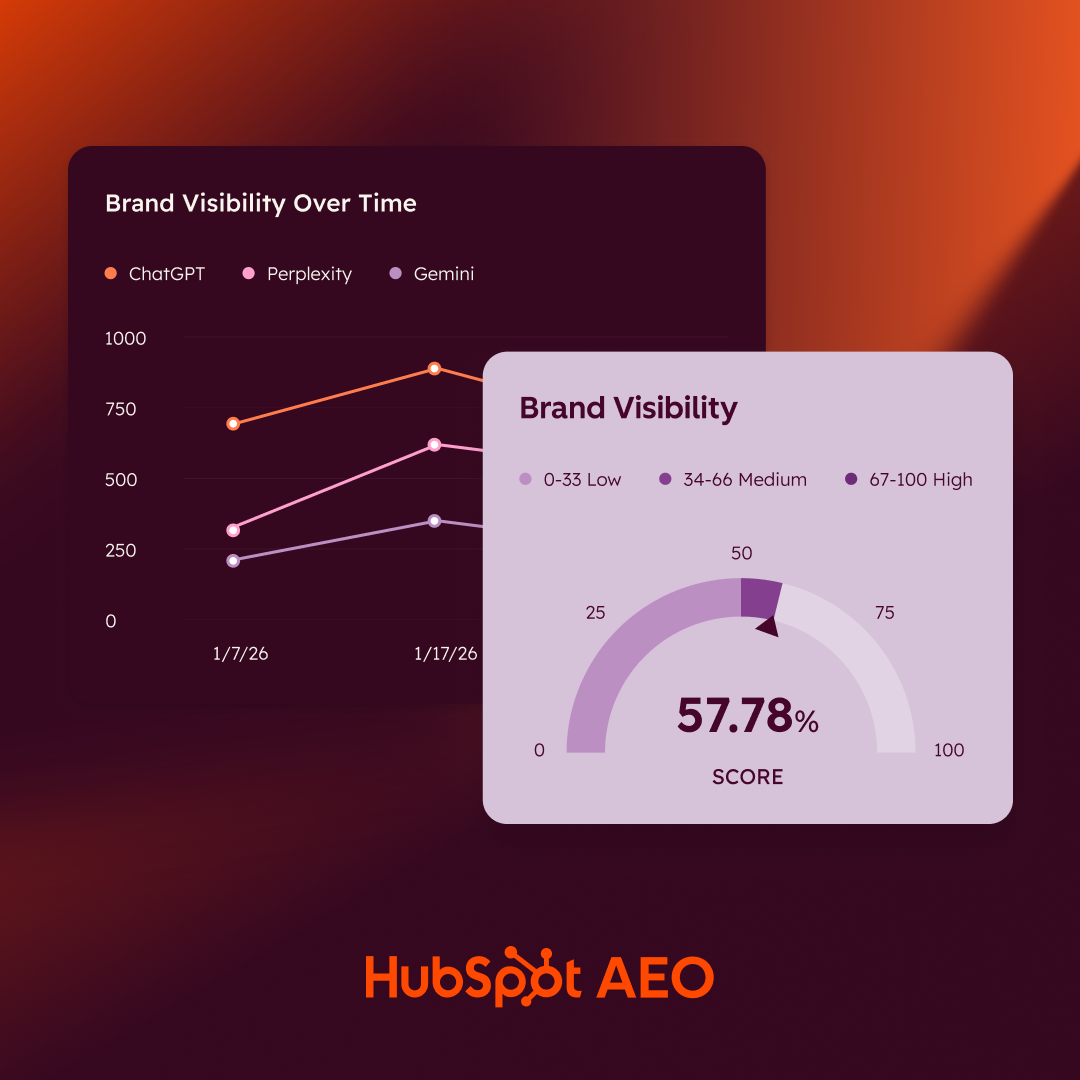
Let’s use HubSpot’s free AI Search Grader as an example of how AI tools measure brand visibility and other markers:
- AEO Score (Overall) is a score out of 100 that combines all five weighted dimensions below into a single benchmark, giving marketers a quick, shareable snapshot of overall AI visibility.
- Brand Recognition measures how widely recognized a brand is across AI training data. A high score means answer engines can discuss a brand with real depth and specificity, not just confirm it exists.
- Market Score assesses how AI models position a brand competitively against rivals in the same category, including estimated percentage of category voice plus a rank bonus, and whether the brand reads as a leader, challenger, or niche player.
- Presence Quality measures “mention depth,” how substantively the AI discusses a brand, along with the quality of the sources shaping that understanding, and the overall richness of available data.
- Brand Sentiment is the highest-weighted dimension in the score; it assesses the overall tone AI models use when describing a brand, and how that tone holds up across different topics and use cases.
- Share of voice measures how often a brand appears versus competitors in tracked prompts.
Here’s what the report categorization looks like at a glance:

In practice, AEO tools do three things:
- Scan for mentions and citations across AI responses.
- Score performance using metrics like visibility score or brand sentiment.
- Visualize change by showing how visibility shifts as content or coverage evolves.
Instead of analyzing clicks or rankings, these tools analyze representation: whether a brand is being included in the knowledge frameworks that power generative AI.
How Data Gets Collected
Visibility data only works if it’s trustworthy. Reliable platforms disclose how they collect and store information, provide clear refresh schedules, and meet compliance standards such as GDPR and SOC 2.
Each AEO tool collects data differently. The three main methods are worth understanding before comparing platforms.
- Prompt tracking feeds curated prompts into AI models and records the answers. It is fast and flexible, but accuracy depends on prompt quality.
- Screenshot sampling captures periodic screenshots of AI search results and extracts text to identify mentions. It works well for visual audits but is less precise than other methods.
- API access retrieves structured citation data directly from answer engine APIs, including timestamps and regions. It is the strongest option for enterprise reporting and integration.
These methods shape how visibility is measured.
The Models AI Visibility Tools Track
At the time of writing, five major answer engines dominate the AEO landscape.
Each answer engine handles attribution differently, and no approach is fully consistent as personalization improves and new models are released. Keeping pace with where answer engine optimization is heading next is as important as tracking today’s coverage.
In practice, AI responses and attribution can range from explicit source links to blended summaries or fully personalized responses, depending on the engine, model, and plan.
Those differences are crucial for teams comparing AEO tools. The same piece of content might appear in Perplexity but not Gemini, purely because of how the engines display responses.
How to Compare AI Visibility Tools for Your Needs
The primary search intent for AI visibility tools is commercial investigation with informational support — teams already understand the category and are narrowing down which platform fits, not asking what AEO is. AI visibility tool buyers need pricing, engine coverage, and feature comparisons.
Marketing teams evaluating AI visibility tools should choose clarity over flash. Consistent coverage, transparent methods, CRM-level integration, and defensible data practices are top considerations. It’s also worth distinguishing visibility tracking from broader AEO website optimization tools, which focus on improving the content itself rather than just measuring its performance. HubSpot’s Breeze Assistant is an example of an AEO tool that helps fix content.
The right tool will track key performance metrics and help connect them to real business outcomes.
What Actually Matters in an AI Visibility Tool
Certain patterns distinguish marketing toys from operational tools. Good AI visibility tools do five things well:
- Consistent model coverage. AI visibility tools should track the major players — ChatGPT, Gemini, and Perplexity at a minimum — with coverage of Claude and Copilot as a strong bonus, since not every platform includes them outside of higher-tier plans.
- Regular data refreshes. AI visibility tools should refresh visibility data weekly to catch meaningful trends without overreacting to noise.
- Clear methodology. Marketers should understand how the tool collects data.
- Seamless integrations. Larger teams should prioritize tools that integrate directly with analytics software and a CRM; smaller teams may find a strong standalone dashboard is enough to start.
- Strong data governance. Teams handling sensitive brand or competitive data should look for tools that support region-based storage, audit logs, and role-based access to protect data integrity.
Other features like visualizations, animations, or AI-powered insights are nice to have but not required. AI visibility tools often offer feature sets based on organizational size and maturity.
- A small business owner or solo marketer will want fast, affordable visibility. The priority is understanding where the brand stands in AI answers and what to do about it, without a long setup or a large budget.
- A marketer at a larger organization who needs a dedicated AEO tool will prioritize multi-engine coverage, competitor benchmarking, and actionable recommendations. The focus is on insights they can act on directly without adopting a new platform.
- Teams already running an enterprise marketing platform will look for native integration. That means prompt suggestions informed by existing business data and a workflow that connects insight to execution without switching tools.
HubSpot AEO Tool
See exactly where your brand shows up in answer engines and take action to close AI visibility gaps.
- Track AI mentions.
- Analyze citations
- Monitor prompts
- Benchmark competitors
A Vendor Evaluation Checklist That Kept Me Honest
When I got serious about comparing vendors, I stopped looking at feature lists and started scoring them against a short set of practical criteria instead.
Here’s the table that separates useful components of tools, shares why it matters, and what to check.
The 10 Best AI Visibility Tools Right Now
AEO tools measure how often a brand appears in AI answers and whether those mentions contribute to qualified traffic or pipeline outcomes. The comparisons below cover how each tool measures visibility, handles attribution, and supports lead quality.
1. HubSpot AEO

Most teams have no idea whether their brand shows up when buyers ask ChatGPT or Gemini for recommendations. HubSpot AEO provides that picture. Setup takes minutes — add the brand, add competitors, and add the prompts to track.
From there, the tool delivers a continuous visibility score across major answer engines, a sentiment read on how answer engines represent the brand, share of voice against competitors, and a prioritized list of what to create or change to improve visibility. No AEO expertise required.
HubSpot AEO also connects AI visibility data to CRM outcomes so marketing and sales can see exactly how AEO is influencing pipeline and helping close deals.
Best use case: Getting a clear picture of where your brand stands in AI and getting plain text recommendations for improvement.
Where it falls short: When you’re ready to move from knowing the gaps to closing them inside a single workflow, that’s where HubSpot AEO takes over. AEO in Marketing Hub Pro and Enterprise uses customer data to inform which prompts to track, and when it identifies a gap, marketing can act on it directly in HubSpot without switching tools.
How to use it to improve lead quality: Track the prompts buyers are most likely asking answer engines during their evaluation. Use the source and citation data to build or optimize content that closes your visibility gaps.
Best for: Marketers who want a simple, affordable way to track and improve how their brand shows up in AI answers.
What I like: HubSpot AEO is the tool I reach for when working with a client on implementation. The recommendations are in plain language — I can hand them straight to a content writer or a founder and they understand what to do and why, without needing an AEO explanation first

2. Peec.ai
Peec.ai provides AEO data that shows how brands appear across major search engines. It tracks brand mentions, ranking position, sentiment, and citation sources using UI-scraped outputs that match real user responses.

Best use case: High-level monitoring of brand mentions and competitor visibility.
Where it falls short: No native CRM or GA4 integrations; attribution workflows remain manual.
How to use it to improve lead quality: Use prompt and source insights to identify high-intent queries where brand visibility is low. Prioritize PR, reviews, or content updates around the sources answer engines rely on, then track shifts in position and sentiment alongside pipeline performance.
Best for: Marketing teams, SEO/AEO specialists, and agencies managing multiple brands.
What I like: The data within Peec shows what people are searching. When working with a skeptical client, Peec presents plainly what people ask and how the website appears.
3. Semrush
One of the longest-tenured tools on the market, Semrush combines AI visibility tracking with its broader SEO and competitive intelligence toolkit. Its AI search tools track prompts across the most important LLMs, including ChatGPT, Google AI Overviews, Google AI Mode, Gemini, and Perplexity, to help teams understand where their brand appears in AI-generated responses and how to improve visibility. Its AI Visibility Score provides a 0–100 score to measure brand visibility, while competitor share-of-voice data helps benchmark performance against other brands in your market.
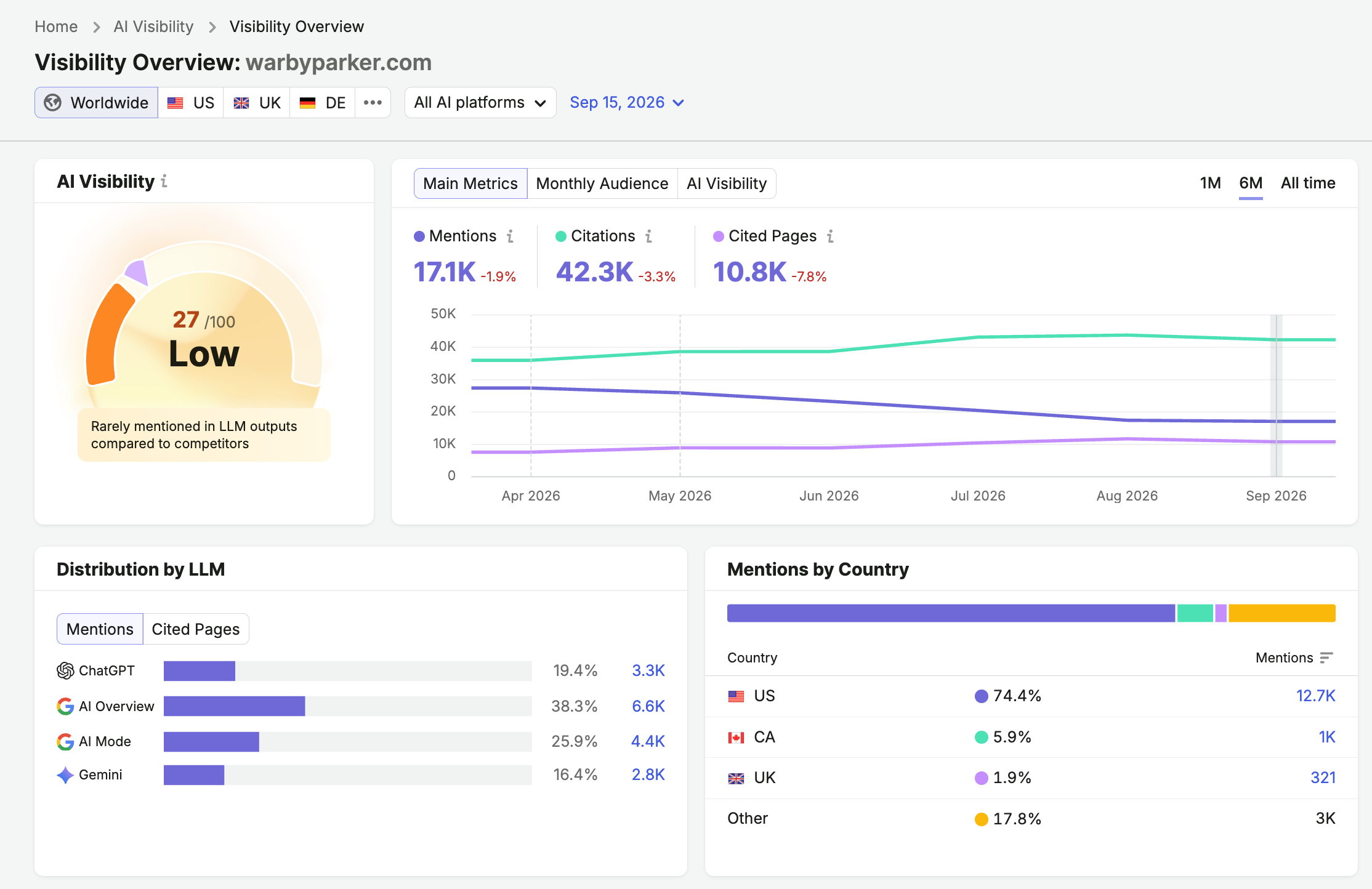
Best use case: Monitoring and benchmarking brand visibility across major AI search platforms alongside your existing SEO strategy.
Where it falls short: Semrush's deep analytics reports can be more than teams need if they’re only looking for a lightweight, standalone AI visibility tracker.
How to use it to improve lead quality: Track the prompts depending on your customer persona and buyer journey to compare your AI visibility and share of voice against competitors and establish clear baselines. Look for high-intent prompts where competitors appear more frequently, then use citation and competitor insights to identify content gaps and prioritize updates that can strengthen your visibility for those queries.
Best for: SEO teams, content marketers, agencies, and larger marketing teams that want AI visibility tracking alongside broader SEO and competitive intelligence.
What I like: Semrush makes it easy to connect AI visibility to the broader search landscape and search strategy. I particularly like being able to track prompts across multiple AI platforms, quantify performance with the AI Visibility Score, and see how a brand’s share of voice compares with competitors.
4. Aivisibility.io
Aivisibility.io provides lightweight visibility tracking for select answer engines, with features like competitive comparisons and simple benchmarking views. Its public leaderboards and cross-model comparisons show where brand presence is strengthening or declining.

Best use case: Competitive benchmarking and simple visibility monitoring across AI models.
Where it falls short: Limited CRM and GA4 integrations; attribution capabilities are minimal.
How to use it to improve lead quality: Monitor leaderboard shifts alongside inbound demand to identify when improvements in AI visibility correlate with higher-quality traffic.
Best for: SMB and mid-market teams that need fast, real-time visibility snapshots.
What I like: The public leaderboards are a great, low-effort way to start a conversation about competitors with a client. I can pull it up live on a call without any setup. It shows who is recommended in each category, for example, communications software ranks Slack number one most recommended tool. While not all my clients are competing with industry leaders, it does show what aspirational competitors are doing, and I find this can encourage decisions in the right direction.
5. GenAI Lens
Meltwater’s GenAI Lens helps marketing understand how large language models portray your brand across AI-generated responses. It surfaces patterns in how your brand appears in AI outputs, including sentiment, recurring themes, and positioning against competitors. What sets it apart is its link to Meltwater’s broader media intelligence. By connecting these insights to global media, social, and online data to show not just what AI is saying, but why certain narratives are picked up and where they originate.

Best use case: Understanding how generative AI models interpret your brand narrative and connecting AI outputs to underlying media and social signals.
Where it falls short: Not designed for teams looking to execute content updates or manage prompt optimization workflows directly within the platform.
How to use it to improve lead quality: Identify the narratives and sources that generative AI models rely on when describing your brand. Use those insights to refine PR, earned media, and content strategies so that high-authority, high-intent messaging is more likely to appear in AI-generated answers.
Best for: PR, communications, and marketing teams that want to connect AI visibility with media intelligence and understand the drivers behind how their brand is represented in generative AI.
What I like: GenAI Lens is perhaps the strongest tool on this list for PR-heavy clients. The media intelligence and social listening features are excellent. It takes visibility beyond the LLMs, and includes social media so marketing can manage brand visibility across the digital ecosystem. If there are negative statements out there, or a spike in conversation, marketing and/or PR will find out so they can react fast.
6. AI Search Grader
HubSpot’s free AI Search Grader takes a different approach from most tools on this list. Rather than continuous tracking, it provides a one-time, no-signup snapshot of how AI models currently perceive a brand. After entering a brand name and some context, the tool queries ChatGPT, Perplexity, and Gemini directly — asking each model to describe the brand based on what it already knows.

The Grader scores a brand out of 100 across five weighted dimensions:
- Brand sentiment: the heaviest-weighted metric, assessing overall tone.
- Presence quality: how substantively AI discusses the brand, and the quality of the sources shaping that understanding.
- Brand recognition: how widely and specifically AI models can describe the brand.
- Share of voice: standing relative to named competitors.
- Market score: how AI positions the brand competitively — leader, challenger, or niche player.
Results are cross-validated across all three engines rather than pulled from a single model, which reduces the day-to-day variance that can skew a single-run check.
The AI Search Grader is diagnostic, not a tracking tool. It answers how AI represents a brand right now, not how that is changing over time. That distinction matters when deciding what role it plays in a broader stack.
The Grader is designed to complement ongoing AI visibility monitoring, not replace it. HubSpot positions it as the starting point before moving to HubSpot AEO, which adds daily tracking, competitor benchmarking, and a direct path from insight to content action. The Grader provides the baseline and HubSpot AEO provides the ongoing signal.
Best use case: A fast, zero-cost baseline check of how AI models currently perceive a brand — ideal before committing budget to a full monitoring tool.
Where it falls short: It’s a single point-in-time snapshot, not continuous tracking; it won’t tell you whether your visibility is trending up or down, and it doesn’t cover Copilot.
How to use it to improve lead quality: Run the Grader on your own brand and your top two or three competitors to identify where sentiment or presence gaps exist. Use the source-quality feedback to prioritize which content or PR gaps to close first, rather than guessing at what’s driving weak AI representation.
Best for: Solo marketers, small businesses, and anyone who wants a credible baseline before investing further.
What I like about AI Search Grader: I use it often as a quick temperature check on a new site. It’s the first thing I run when I pick up a new client, and it’s useful for showing someone, in about thirty seconds, where they stand without asking them to sign up for anything. For a lot of the smaller clients I work with, it’s enough.
7. Otterly.ai
Otterly.ai tracks brand mentions and citations across a range of answer engine responses, including ChatGPT and Google AI overviews. It combines brand monitoring, link-citation tracking, prompt monitoring, and AEO auditing to show which content surfaces in AI answers and how visibility changes over time.

Best use case: AI search monitoring, citation tracking across multiple engines, AEO audits, and identifying visibility gaps in prompts, brands, and URLs.
Where it falls short: No native CRM or GA4 integrations; attribution requires manual assembly.
How to use it to improve lead quality: Analyze domain citations and prompt-level visibility gaps. Use Otterly’s AEO Audit and keyword-to-prompt insights to adjust on-page content, PR outreach, and UGC signals to increase visibility in high-intent AI answers.
Best for: SMBs, content teams, and solo marketers that need structured, automated visibility reports.
What I like: Similar to HubSpot’s AEO, Otterly’s AEO Audit feature makes light work of auditing websites and providing insights to clients. The audit runs crawlability checks, content audits, and lists recommendations that are client-friendly, meaning you can share the output and anyone, no matter AEO expertise, will understand how to make site improvements.
HubSpot AEO Tool
See exactly where your brand shows up in answer engines and take action to close AI visibility gaps.
- Track AI mentions.
- Analyze citations
- Monitor prompts
- Benchmark competitors
8. Gauge
Gauge provides marketers with full-funnel visibility into how their brand appears, along with a built-in marketing agent that turns that visibility data into published content. Marketing can track the questions your buyers are actually asking AI systems and see how your brand performs on each one across all 8 models, updated daily.
From there, the tool provides a continuous visibility score across every major AI engine, a sentiment read on how models are representing your brand, share of voice against competitors, and a ranked list of exactly what to create or change to close your visibility gaps. Ask Gauge, the built-in AI co-pilot, connects your GSC, GA4, and Semrush data to move from analysis to brief to draft inside one thread.
Best use case: SEO professionals evolving into GEO, agencies managing multiple brands and clients.
Where it falls short: If marketing need coverage across Perplexity, Gemini, Google AI Overviews, and Copilot, that requires Growth ($599/mo). Claude and Grok tracking are Enterprise only.
How to use it to improve lead quality: Track the prompts buyers ask during research and evaluation. Use citation data to identify which domains AI trusts in your category, then build or optimize content to earn those citations back.
Best for: Marketers and founders who want a single platform to track AI visibility, understand why competitors are being cited, and act on gaps without leaving the tool.
What I like: Ask Gauge is the standout feature for me. Write in natural language to the agent and it will provide a brand’s search data, instant answers, and the why behind the data. Rather than having you sift through dashboards and analyze everything, Gauge provides the insights directly to you.
9. Parse.gl
Parse.gl tracks brand visibility across ChatGPT, Gemini, Copilot, and other AI models. It surfaces detailed metrics including reach, peer visibility, authority, and model-level performance. Its public Demo Playground lets teams test brand or prompt visibility without creating an account.

Best use case: High-volume visibility tracking, peer comparisons, and flexible prompt-level analysis.
Where it falls short: No native CRM or GA4 integrations; attribution must be stitched manually.
How to use it to improve lead quality: Review model- and prompt-level patterns to identify inconsistent visibility. Map those shifts against CRM or GA4 data to see which AI surfaces drive higher-quality demand.
Best for: Data-forward teams and analysts who prefer exploratory analysis over guided dashboards.
What I like: Parse’s Brand Index is great for pitching. I like to find my client in their index, then show a prospective client how they’re performing with real data. All of this can be done for free before they’ve signed anything or given me access to their brand. Once you’ve got buy-in from the client, you can always commit to subscribed plans for ongoing use.
10. Sellm
Sellm tracks brand mentions, share of voice, sentiment, and citation sources across ChatGPT, Perplexity, Gemini, Grok, and Copilot. Rather than scoring on a single response per prompt, Sellm runs each prompt multiple times and aggregates the results. This produces visibility scores that reflect a statistically significant sample rather than a single noisy snapshot — a direct response to the day-to-day fluctuation that makes single-run checks unreliable.
The platform also exposes every dashboard metric through a pay-as-you-go API billed at less than a cent per prompt. That makes it a strong fit for engineering and analytics teams that want to pull AI visibility data directly into a warehouse or custom reporting layer.

Best use case: Multi-model visibility tracking where accuracy matters, competitive benchmarking, and programmatic data collection through a pay-as-you-go API.
Where it falls short: No user-persona analysis, so teams that want to segment visibility by buyer profile will need to model that layer themselves.
How to use it to improve lead quality: Use aggregated visibility scores to find high-intent prompts where your brand is underrepresented, then prioritize the citation sources AI models rely on for those answers. Pull the data through the API into your CRM or GA4 to track whether visibility gains correlate with qualified traffic and pipeline.
Best for: Data-forward marketing teams who want statistically reliable AI visibility data plus full API access without a platform subscription.
What I like: The pay-as-you-go API is perfect for the more technical clients I work with who want to pull AI visibility data straight into their own reporting rather than logging into yet another dashboard.
Do you need an AI visibility tool?
Most businesses will benefit from some level of visibility tracking. Even if AI visibility tracking feels more than what’s needed, set it up anyway. It doesn’t hurt for marketing to create a benchmark of AI success. According to HubSpot’s State of AEO report, 58% of marketers already say their businesses are actively optimizing content for answer engines.
Search is changing, and AI search is only going to get bigger. The real question is: how much infrastructure does the business need right now?
For solo marketers and small businesses, a free tool like the AI Search Grader is often sufficient. It provides a credible baseline without a monthly commitment, and re-running a free check monthly or comparing results against a free AEO benchmark is enough for teams without a large prompt volume or competitor set.
For growing marketing teams with a defined set of competitors and buyer questions, dedicated AI brand visibility tools start to earn their cost. The priority at this stage is something that runs prompts consistently, not manually, and surfaces where the brand is losing ground. This is also where comparing AEO rank trackers on refresh cadence and engine coverage becomes worthwhile, since that is where free tools tend to fall short.
For enterprise teams managing multiple product lines, regions, or brands, the priority shifts to attribution, governance, and integration. That means tools that connect visibility data directly to a CRM and analytics stack so AI exposure can be tied to pipeline rather than reported as a standalone metric.
AI visibility can turn mentions into higher-quality leads.
AI visibility doesn’t translate into clicks the way traditional search does. When a brand appears in AI answers, it shows up later in the decision process — at a point where users already understand the landscape and are narrowing their options. Early industry data supports what many marketers have felt anecdotally: AI-referred visitors convert at higher rates because they arrive after doing more of their research inside the answer engine itself.
Ahrefs found that AI-referred visitors converted 23 times better than traditional organic traffic — small volume, but exceptionally high intent. SE Ranking observed a similar trend, reporting that AI-referred users spent about 68% more time on-site than standard organic visitors. HubSpot’s own research backs this up: AI-referred visitors convert at 11.4% globally in ecommerce, compared to just 5.3% for organic search.
Together, these patterns signal that AI visibility brings in prospects who already know what they’re looking for. Forty-four percent of marketers say they’ve personally made a business purchase based on a brand they first discovered through AI answers, according to HubSpot’s research.
That shift is reshaping how marketers think about discovery and purchase behavior.
“We coined the term ‘AI-driven Multimodal Funnel’ to describe the shift in user behavior and platform dynamics that will eventually likely replace the ‘traditional’ AIDA marketing funnel, from active search and exploration to passive, one-click actions driven by AI recommendations,” said Takeo Apitzsch, chief digital officer and deputy general manager at The Hoffman Agency.
“With the integration of purchasing and transactional options directly inside LLMs (such as ChatGPT), we are evolving our strategies to include ‘ready-for-purchase’ content development, ensuring that clients’ content aligns with AI-powered intent pathways.”
AI visibility becomes the bridge in that multimodal funnel — the point where awareness, validation, and purchase intent converge inside a single interaction.
AEO Content Patterns That Increase Citations in AI Answers
AEO content patterns increase citations in AI-generated answers. AEO content works when every paragraph answers a question directly, stands alone as a retrievable “chunk,” and reinforces key entities. Short sections, clear definitions, and clean sentence structures help LLMs reuse your content without confusion.
“AEO writing is designed for systems that scan a piece, store chunks of information in its data set, and then pull out those chunks and cite it when people search for specific queries,” said Kaitlin Milliken, senior program manager at HubSpot.
Each element below helps AI systems recognize and reuse your information accurately.
Lead with clear, direct definitions.
Answer engines prioritize content that answers the question immediately. Getting this right often comes down to how a page is structured for AEO, not just what it says. The first paragraph under every heading should summarize the section on its own. Direct definitions increase the likelihood of citations in AI answers.
Write in modular, self-contained paragraphs.
Answer engines work best with modular paragraphs and simple hierarchies. Aim for three to five sentences per paragraph so that each one makes sense independently. Lists and tables strengthen that hierarchy and surface key points for retrieval.
Use semantic triples to anchor meaning.
Semantic triples — concise subject–verb–object statements — clarify relationships between ideas and help models store them as factual units.
Example: AEO tools track brand mentions across answer engines.
Prioritize specificity and eliminate filler.
Precision signals authority. Replace vague transitions with specific nouns, timestamps, and named entities. Specificity helps models verify claims and rank them accurately.
Separate facts from experience.
AEO structure puts objective information first and reserves personal insight or interpretation for lower in the section. That hierarchy lets answer engines extract factual content cleanly while still capturing human perspective where EEAT matters most.
Expert POV: How Agencies Optimize for AI-Generated Answers
Agency teams are already adjusting their content structures specifically for AI retrieval, and their workflows reinforce the same AEO patterns covered above.
“We’ve focused on optimizing content to answer the user intent behind our clients’ target queries and prompts. That includes leaning into on-page SEO best practices for content published across paid, earned, shared, and owned media [and] reinforcing real-world credibility via studies, impact data, and quotes from proven subject-matter experts,” shares Kimberly Jefferson, EVP at PANBlast.
Jefferson says her team uses tools like Peec.ai and Semrush Enterprise AIO to identify the sources feeding LLM outputs. Depending on the answer engine or prompt, sources may also include Wikipedia, a brand’s website, and community-driven platforms like Reddit and LinkedIn.
“We monitor these platforms to track organic mentions of clients and competitors, and advise clients on strategies to provide helpful, authoritative answers,” Jefferson says.
HubSpot AEO Tool
See exactly where your brand shows up in answer engines and take action to close AI visibility gaps.
- Track AI mentions.
- Analyze citations
- Monitor prompts
- Benchmark competitors
Measure impact beyond vanity metrics in GA4 and your CRM.
AEOmetrics connect to lead quality and pipeline attribution. Proving the value of your AEO strategy requires linking visibility signals to measurable conversions in Google Analytics 4 (GA4) and in a CRM like HubSpot Smart CRM. That means setting up AEO tracking, segmenting traffic from answer engines, and tying that traffic to landing pages and deal outcomes.
Track LLM referral traffic in GA4.
GA4 can track LLM referral traffic with filters or regex rules, though the exact setup takes a few extra steps most teams haven’t configured yet.
To capture traffic from answer engines like ChatGPT, Gemini, or Claude in GA4, create a custom Exploration using dimensions such as Session source/medium and Page referrer, and apply a regex filter to answer engine domains. Some answer engines do not consistently pass referrer data, so GA4 visibility depends on whether the platform preserves click-through URLs. But when referrers are present, this method accurately captures them.
Step-by-step:
- In GA4, navigate to Explore → Blank exploration.
- Add dimensions: Session source/medium, Page referrer.
- Add metrics: Sessions, Conversions (key events).
- Create a segment with a regex filter for answer engine domains.
- Add a landing page or entry page as a dimension to see where LLM-referred users enter.
Once saved, this exploration lets teams compare how AI-referred users behave versus other sources on metrics like engagement time, conversion rate, and path length.
Segment traffic and tie to landing pages and conversions.
After identifying AI referral traffic, tie it to meaningful outcomes. If an AEO tool helped surface a brand in an AI answer, marketers want to know whether that visibility led to a qualified session, a conversion, or an eventual deal. This tracking depends on whether the answer engine preserves referrer or UTM data on click-through, which varies by platform. If you’re working with an agency, ensure they measure all channels and traffic sources. For example, OutreachBloom is an AI SEO agency that provides fully managed AI visibility and AEO for B2B brands.
The HubSpot Smart CRM lets users tag contacts or deals associated with that referrer segment and compare their performance to other leads. HubSpot notes that effective AI-assisted prospecting requires tracking prospects “from the moment AI finds them all the way through to closed deals.”
Checklist for effective segmentation and measurement:
- Configure a custom contact property or UTM parameter (e.g., utm_source=llm, utm_medium=ai_chat) when landing pages receive AI-referred sessions.
- In GA4, link that parameter to your key conversion events (such as form submissions or demo requests).
- In your CRM, segment contacts by that property and compare deal velocity, average deal size, and pipeline conversion rate.
- Build dashboards combining GA4 and CRM data to visualize the path from AI-referred traffic → landing page → conversion → deal won.
Frequently Asked Questions About AI Visibility Tools
Do I need an AI visibility tool if I’m a small business?
Yes, we’ve reached a time where everyone needs an AI visibility tool in some form. Luckily, the barrier to access is now low, with free tools like HubSpot’s AI Search Grader, which gives a useful baseline snapshot of how AI models currently represent your brand. Marketing doesn’t necessarily need enterprise-grade tracking to start; a lightweight, low-cost option is often enough until there’s the volume of prompts or competitors to justify paying for continuous monitoring.
How much do AI visibility tools cost?
Pricing varies widely by depth of coverage: free tools like the AI Search Grader offer one-time snapshots at no cost, while ongoing tracking platforms typically range from around $50–100/month for entry-level plans (e.g., HubSpot AEO’s standalone tier, Gauge’s Starter plan) up to $500+/month for broader multi-engine coverage or enterprise features. Some platforms, like Sellm, also offer pay-as-you-go API pricing billed per prompt instead of a flat subscription.
How many prompts should I track to get a reliable view?
Most AEO tools recommend tracking 50 to 100 prompts per product line to start. That volume offers a representative sample across different models (ChatGPT, Gemini, Perplexity, Claude, and Copilot). Tracking fewer than 20 prompts can skew results because model outputs fluctuate daily.
How do I roll out AI visibility tracking for my team?
Start by documenting your core entities — product names, spokespeople, content pillars, and branded terms — since these entities shape how AI models classify your brand. Assign clear owners for (1) prompt set management, (2) analytics, and (3) CRM alignment so reporting doesn’t drift.
Most teams track visibility in a shared dashboard, updating weekly, then send that data into GA4 or a CRM so visibility insights map directly to deal outcomes.
What’s the best way to find prompts people actually use in answer engines?
Use a mix of manual discovery and platform signals. Autocomplete in ChatGPT, Gemini, or Claude surfaces real phrasing patterns, while social listening tools highlight questions buyers repeat in public forums. AEO tools add another layer with prompt tracking that reflects how people search conversationally, not just how they type in Google. For how users search in Google, use dedicated keyword research tools built for AEO can.
How often should I refresh my AI visibility data?
Most teams refresh visibility weekly to capture short-term fluctuations and monthly for pattern analysis. Retrieval layers in major answer engines change frequently, and shifts in model rankings or web-crawl updates can alter brand visibility overnight.
Choose a cadence that aligns with campaign cycles and reporting expectations so visibility data stays actionable, not stale.
How do I avoid vanity metrics and tie visibility to pipeline?
To avoid vanity metrics, treat visibility as a conversion signal. In GA4, create a segment for AI-referred traffic and connect those sessions to key conversion events. In a CRM like HubSpot, tag contacts with a property like AI_referral_source so marketing and sales can measure deal velocity, pipeline contribution, and revenue influence.
Do I need enterprise-grade tools to get started?
No. HubSpot AEO is built to get started quickly — no AEO expertise required, no complex setup, and available on its own without a HubSpot subscription. When you’re ready for CRM-powered prompts and a direct path from insight to action, that’s where AEO in Marketing Hub Pro and Enterprise takes over.
AI visibility only matters if it drives results.
The age of AI-led discovery has made visibility harder to fake. Winning brands treat AI visibility as a revenue signal, not a reach metric. Tracking mentions in GA4 and a CRM helps teams stop guessing what AI exposure is worth and start proving it. HubSpot AEO is a straightforward starting point — track how the brand appears across answer engines, see where competitors are showing up, and get a clear list of what to fix.
I’ve found that the mindset shift from chasing clicks to tracking confidence changes everything. The best marketing builds structures that make the right people find a brand, trust it, and act on what they learn. That is the real value of visibility in the AI era.
Editor's note: This post was originally published in January 2026 and has been updated for comprehensiveness.
HubSpot AEO Tool
See exactly where your brand shows up in answer engines and take action to close AI visibility gaps.
- Track AI mentions.
- Analyze citations
- Monitor prompts
- Benchmark competitors
AEO
![AEO checker tools that measure answer engine visibility [2026]](https://53.fs1.hubspotusercontent-na1.net/hubfs/53/aeo-checker-1-20260903-3858273.webp)
![Scrunch vs. Peec AI: Choosing the right AEO tool [2026]](https://53.fs1.hubspotusercontent-na1.net/hubfs/53/Copy%20of%20Featured%20Images_Blog%20Title%20Templates%20(8).png)


-What-We-Learned-from-Analyzing-10+-Brands-With-High-AI-Search-Citations-1-20260826-304258.webp)
![Using LinkedIn for AEO: How marketers can use social media to improve their AI visibility [experiment]](https://53.fs1.hubspotusercontent-na1.net/hubfs/53/AEO-for-LinkedIn-piece-1-20260826-6108454.webp)
-1.png)