Table of Contents
- What Is Answer Engine Optimization (AEO)?
- How to Use ChatGPT for SEO
- How to Optimize Your Content for ChatGPT (AEO Strategies)
- Benefits of Using ChatGPT for SEO
- Navigating ChatGPT SEO Challenges (And How to Overcome Them)
- The Future of ChatGPT SEO: What’s Next?
What Is Answer Engine Optimization (AEO)?
Answer engine optimization (AEO) is the practice of structuring content so that AI-powered search tools, like ChatGPT, can easily find, synthesize, and cite it in their generated answers.
AEO includes optimizing content for AI visibility by using clear headings, direct answers, structured data, and strong E-E-A-T signals.
Unlike traditional SEO, which targets a ranked list of blue links on a search results page, AEO targets the AI-synthesized paragraph that now appears above or instead of those results. ChatGPT Search synthesizes answers by crawling the web (primarily through Bing), pulling from authoritative sources, and presenting a single unified response with citations.
Appearing in those citations is the new version of ranking on page one in SERPs.

The State of AEO in 2026
Dive into data about how marketers around the world are adapting to AEO and learn how to implement AEO yourself.
- Optimizing for answer endings.
- Making purchases based on brands discovered through answer engines.
- Improving brand citation from doubling down on AEO.
- And more!
Download Free
All fields are required.
Form not available
Generative engine optimization (GEO) focuses on improving visibility in AI-generated answers across all platforms. SEO for ChatGPT depends on strong traditional SEO foundations, so don’t go looking for shortcuts.
But GEO adds a layer of content structure and trust signals that make your content more parseable and easier for AI systems to cite.
Pro Tip: Think of AEO as an extension of SEO, not a replacement for it. The brands winning in AI search are the ones that already do traditional SEO well. Just take a few extra steps to make their content AI-friendly.
Traditional SEO vs. ChatGPT / GEO: Key Differences
For a deeper dive on how AI is reshaping search, see our guide on how AI is impacting SEO and answer engine optimization.
How to Use ChatGPT for SEO
ChatGPT is a genuinely useful SEO tool for accelerating research, structuring ideas, and handling repetitive optimization tasks. Here are the most impactful ways to put it to work.
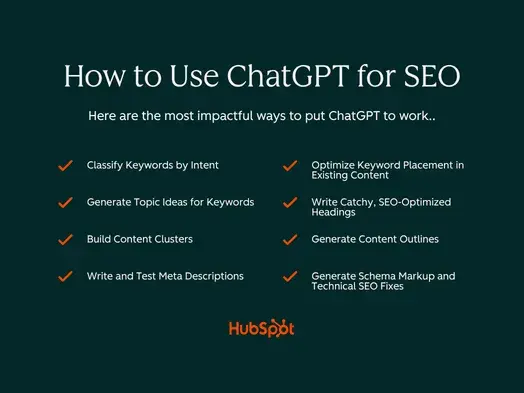
1. Classify Keywords by Intent
Understanding search intent is foundational to SEO. If a reader lands on a page that doesn’t match what they were looking for, they bounce — hurting your rankings. ChatGPT can classify large keyword lists by intent in seconds, whereas manual classification would take hours.
Example prompt: “Classify the SEO keywords in the attached spreadsheet by intent: informational, navigational, transactional, commercial, or general. Generate a summary table and a pie chart showing the percentage of each intent type.”
What we like: This is especially useful when auditing existing content to find gaps. For example, if 80% of your traffic comes from informational keywords but your product pages are the ones you actually want to rank for, ChatGPT can quickly surface that mismatch.
Always verify intent classifications for your top-10-ranking pages manually. ChatGPT does a solid job at scale but isn’t infallible with nuanced or niche keywords.
2. Generate Topic Ideas for Keywords
If you have a list of target keywords but aren’t sure which content angle will perform best, ChatGPT is a strong brainstorming partner. Provide context about your brand and ask for blog post ideas that would rank well for each keyword.
Example prompt: “I run a B2B software agency. I want to rank for ‘data management consultant.‘ Suggest three blog post topics that would be genuinely useful to my target audience and help me rank for this keyword.”
Treat the output as a starting point. Cross-reference suggested topics against what’s already ranking in the top 10 to identify differentiation opportunities. What can you cover that competitors are missing?
3. Build Content Clusters
Content clusters — a pillar page supported by a ring of related subtopic articles — are one of the most effective SEO structures available. ChatGPT can help you quickly map out a cluster architecture.
For more on the strategy, see HubSpot’s guide to topic clusters and SEO.
Example prompt: “I want to build a content cluster around ‘email marketing automation’ for a SaaS company. Suggest a pillar page topic, five supporting article topics, and the primary keyword for each.”
Pro Tip: ChatGPT doesn’t have access to live keyword difficulty or search volume data. Use its cluster suggestions as a structural framework, then validate each topic using tools like Semrush, Ahrefs, or HubSpot’s SEO tools before committing to a content calendar.
4. Write and Test Meta Descriptions
Meta descriptions aren’t a direct ranking factor, but well-written ones improve click-through rates, which signals relevance to Google. ChatGPT can draft meta descriptions in bulk, which is a real time-saver when you’re optimizing a large site.
Example prompt: “Write an SEO meta description of no more than 120 characters for the following URL: [URL]. Include the primary keyword ‘email marketing tips’ and a clear call to action.”
Review each output for accuracy and brand voice. ChatGPT often produces slightly generic phrasing, so use its draft as a starting point and add specificity.
5. Optimize Keyword Placement in Existing Content
If you’ve written an article and want to improve its on-page keyword usage without stuffing, ChatGPT can suggest where to naturally insert LSI (latent semantic indexing) and NLP keywords.
Example prompt: “Here are the first three paragraphs of my article [paste text]. I want to rank for ‘best CRM for small business.‘ Identify the top 5 related NLP keywords I should include and suggest where to place them in the text without making it feel forced.”
6. Write Catchy, SEO-Optimized Headings
A compelling H1 or H2 can make the difference between a click and a scroll past in search results and AI citations. When you’re stuck on a heading, ChatGPT is a fast way to generate options.
Example prompt: “Rewrite this heading to be more compelling and include the keyword ‘remote team productivity tools’: ‘Tools for Remote Teams.‘ Give me five variations.”
You don’t have to use ChatGPT’s suggestion verbatim. Often, you just need a phrase or angle from its output that sparks your own edit.
7. Generate Content Outlines
A strong outline is the difference between a focused article and a meandering one. ChatGPT can produce a detailed structure for almost any topic in under a minute, often including angles you may not have considered.
Example prompt: “Create a detailed SEO content outline for an article targeting the keyword ‘how to reduce customer churn.‘ Include an intro, 6-8 H2 sections with H3 subsections where relevant, and a conclusion. The article is for a B2B SaaS audience.”
What we like: ChatGPT outlines are comprehensive and fast. The best approach is to use its structure as a backbone, then rearrange sections based on your own subject-matter expertise and what you know the competitor’s content is missing.
8. Generate Schema Markup and Technical SEO Fixes
ChatGPT is surprisingly capable with technical SEO tasks. You can ask it to generate FAQ schema, write hreflang tags, create RegEx filters for Google Analytics, or produce robots.txt rules — all of which would otherwise require developer involvement or significant manual effort.
For more on AI and technical SEO, see HubSpot’s guide to AI technical SEO.
Example prompt: “Generate FAQ schema markup in JSON-LD format for the following five questions and answers: [paste Q&As].”
The State of AEO in 2026
Dive into data about how marketers around the world are adapting to AEO and learn how to implement AEO yourself.
- Optimizing for answer endings.
- Making purchases based on brands discovered through answer engines.
- Improving brand citation from doubling down on AEO.
- And more!
Download Free
All fields are required.
Form not available
How to Optimize Your Content for ChatGPT (AEO Strategies)
Optimizing a website for ChatGPT means making your content easy for AI systems to find, understand, and cite. SEO for ChatGPT depends on strong traditional SEO foundations, but adds specific structural and trust-building elements on top. Here are five strategies that improve your ChatGPT rankings and overall AI search visibility.
For a full overview of AEO page structure best practices, see HubSpot’s AEO page structure guide.
1. Prioritize Bing SEO
ChatGPT Search is powered primarily by Bing. That means Bing visibility can directly influence your ability to rank in ChatGPT. If you’ve historically focused entirely on Google, it’s time to extend your efforts. Start with Bing Webmaster Tools, submit your sitemap, review crawl errors, and check your index coverage.
Key actions to improve Bing SEO:
- Submit your XML sitemap in Bing Webmaster Tools
- Audit crawl and indexation errors and resolve them
- Review your Bing search performance data for high-impression, low-click pages — these are quick optimization wins
- Ensure your key landing pages load quickly and are mobile-friendly (Bing weighs these signals too)
- Build Bing-native backlinks by ensuring your brand is listed in Microsoft-adjacent directories
Pro Tip: Many sites that have strong Google rankings but weak Bing presence are essentially invisible to ChatGPT Search. A Bing audit often reveals quick wins — pages that rank well on Google but haven’t been indexed on Bing at all.
2. Get Featured on Aggregator and Review Sites
ChatGPT frequently synthesizes answers by pulling from third-party sources, such as review platforms and publisher roundups, rather than directly from brand websites.
Building a presence on these aggregator sites increases the chance that you’ll be cited in AI-generated answers.
Priority platforms to target:
- Review sites: G2, Capterra, Trustpilot, Google Reviews, Yelp (depending on your industry)
- Publisher roundups: Secure mentions in listicles like ‘best [category] tools’ on high-authority publications
- Niche directories: Industry-specific directories and association listings
- Comparison sites: GetApp, Software Advice, Clutch.co for B2B brands
The more consistently your brand is mentioned and recommended across these sources, the more likely AI systems are to treat you as an established authority worth citing.
3. Structure Content for AI Comprehension
AI-friendly content uses clear headings, direct answers, and structured lists. ChatGPT and other AI systems parse content by looking for clear signals: What question does this section answer? What are the key points? What is this brand’s position?
Content structure recommendations for AI visibility:
- Lead each section with a direct answer to the implied question — don’t bury the lede
- Use descriptive H2 and H3 headings (“How to do X” and “What is Y” formats perform well in AI citations)
- Add a summary or key takeaway at the start or end of long sections
- Include FAQ sections that mirror how real users phrase questions — these are prime citation material
- Use comparison tables when contrasting options. AI systems love structured comparisons
- Add schema markup (FAQ, HowTo, Article) to help AI systems understand your content’s purpose
For detailed guidance on content structure for AI search, see HubSpot’s answer engine optimization trends report.
4. Strengthen E-E-A-T Signals
E-E-A-T — Experience, Expertise, Authoritativeness, and Trustworthiness — is Google’s quality framework, but it also maps directly to how AI systems evaluate whether a source is worth citing. High E-E-A-T content is more likely to appear in AI-generated answers.
How to strengthen E-E-A-T:
- Add detailed author bios with credentials, relevant experience, and links to professional profiles
- Include first-hand examples, case studies, and original data in your content
- Cite reputable external sources when making factual claims
- Keep content regularly updated because AI systems favor freshness signals
- Earn backlinks from high-authority, topically relevant sites
- Display trust signals: privacy policies, security badges, customer testimonials, and contact information
What we like: The brands that consistently appear in ChatGPT answers tend to share one trait: they’ve invested in genuine subject-matter expertise. No AEO shortcut replaces actually knowing your topic deeply and documenting that knowledge well.
5. Optimize for Local ChatGPT Searches
If you have a local business component, local AI search optimization is non-negotiable. ChatGPT is increasingly surfacing local business recommendations, sourcing them from the same platforms that power traditional local SEO.
Local ChatGPT optimization checklist:
- Claim and optimize your Google Business Profile with accurate NAP (Name, Address, Phone), categories, and services
- Set up Bing Places for Business; this is especially important given ChatGPT’s Bing dependency
- List your business on Apple Maps Connect
- Build presence on Yelp and any niche local directories relevant to your industry
- Ensure NAP data is 100% consistent across all listings
- Actively collect and respond to customer reviews on all major platforms
- Add location-specific pages to your website with clear, structured information about services by area
Benefits of Using ChatGPT for SEO
Saves Significant Time
The clearest benefit of using ChatGPT for SEO is speed.
Tasks that previously took hours now take minutes. Digital marketing consultant Eric Holtzclaw documented saving 40 hours of work and $7,500 in costs in the first month of incorporating ChatGPT into his workflow, primarily through SEO research and optimization.
The key is deciding upfront which tasks benefit from automation and which require human judgment. ChatGPT accelerates, not replaces, strategic thinking.
Boosts Productivity Without Sacrificing Quality
When ChatGPT handles the repetitive structural work — outlining, keyword placement suggestions, meta description drafts — your team can redirect time toward the tasks that actually differentiate content: original research, expert interviews, unique data, and brand voice.
Democratizes Technical SEO
Many SEO professionals don’t come from technical backgrounds, which historically made tasks like writing regular expression (RegEx) formulas, creating structured data markup, or building complex Excel models difficult. ChatGPT removes that barrier.
You can describe what you want to accomplish in plain language and get functional code or formulas in return, then have a developer validate before implementation.
The State of AEO in 2026
Dive into data about how marketers around the world are adapting to AEO and learn how to implement AEO yourself.
- Optimizing for answer endings.
- Making purchases based on brands discovered through answer engines.
- Improving brand citation from doubling down on AEO.
- And more!
Download Free
All fields are required.
Form not available
Navigating ChatGPT SEO Challenges (And How to Overcome Them)
Using ChatGPT for SEO comes with real risks. Here’s how to recognize each one — and work around it.
Challenge: AI Can’t Replace Human Creativity
ChatGPT generates competent, structured text, but it produces derivative content by design. It synthesizes patterns from existing content, which means it can’t offer original research, lived experience, or contrarian takes that make content genuinely worth reading and citing.
The workaround: Use ChatGPT for drafts, outlines, and structural scaffolding. Then layer in your own expertise: proprietary data, direct quotes from subject-matter experts, case studies, and a brand-specific perspective. The human layer is what makes content worth reading for humans and worth citing in AI answers.
Challenge: Output Still Needs Fact-Checking
ChatGPT hallucinates. It presents fabricated statistics, misattributed quotes, and outdated information with the same confident tone it uses for accurate facts. Publishing AI-generated claims without verification is one of the fastest ways to damage your credibility and your E-E-A-T signals.
The workaround: Build a verification checkpoint into every AI-assisted workflow. Before any stat, claim, or source makes it into a published piece, confirm it independently. A simple rule: if you can’t find the source for a claim in under two minutes, cut it.
Challenge: You Still Need a Human in the Loop
AI-assisted SEO workflows fail when the human review step gets cut. ChatGPT doesn’t understand your brand’s positioning, can’t assess whether content aligns with your audience’s actual pain points, and lacks strategic context for your broader content plan.
The workaround: Treat ChatGPT as a capable junior assistant, not an autonomous content strategist. Keep human review at each stage: planning, drafting, optimization, and pre-publication. The editorial judgment layer is non-negotiable.
Challenge: Tracking ChatGPT Visibility Is Still Evolving
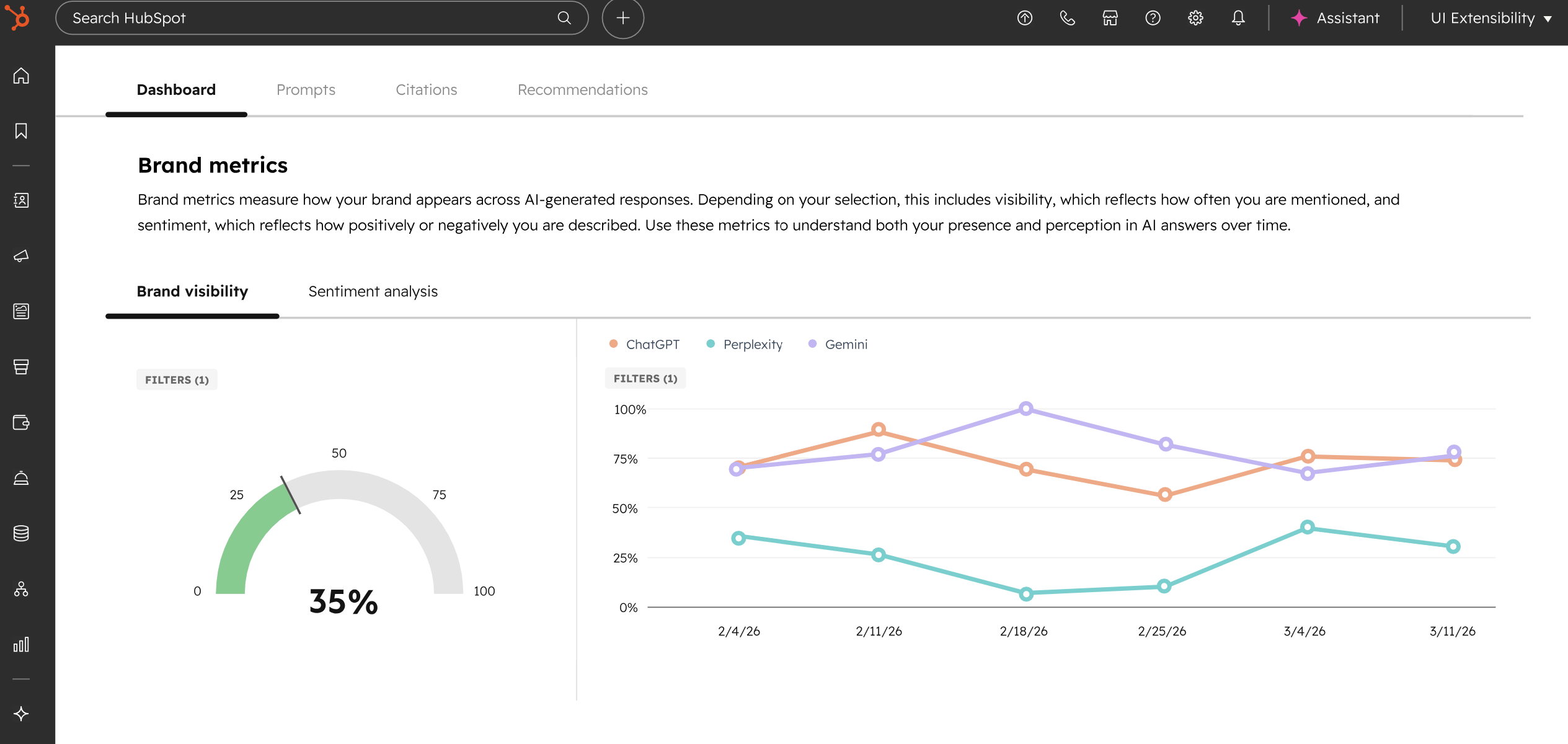
There’s no direct equivalent of Google Search Console for ChatGPT. You can’t see exactly which prompts surface your content, how often you’re cited, or what your “ranking” is in AI-generated answers. This makes measuring the ROI of AEO efforts genuinely difficult.
The workaround: Use proxy metrics while the measurement landscape catches up:
- Monitor your Bing rankings for key terms. Improvement here correlates with better ChatGPT visibility
- Track branded search volume in Google Search Console — if ChatGPT mentions your brand, expect branded search to lift
- Watch for referral traffic changes from Bing and other AI-powered surfaces
- Run manual prompt checks periodically. Search for your key topic areas in ChatGPT and note whether your brand appears
- Monitor third-party mentions and review site activity for citation signals
For teams that want a more systematic approach, HubSpot AEO is a dedicated tool that tracks and improves brand visibility in AI-generated answers. HubSpot AEO supports AI search visibility measurement by showing where and how your brand is surfacing across AI answer engines — helping teams move from manual spot-checks to structured AEO reporting.
Pro Tip: AI search visibility measurement is a fast-moving space. Tools that provide systematic AEO tracking will become as important as Google Search Console is today — start building that muscle now, even if the tooling is still maturing.
Challenge: Free and Paid Versions Have Different Capabilities
ChatGPT’s free tier has meaningful limitations for SEO work: no file uploads, a limited context window, no web browsing, and no access to the advanced data analysis features. Many of the most powerful SEO use cases — uploading keyword spreadsheets, analyzing large datasets, browsing competitor URLs — require a paid plan.
The workaround: Match your plan to your actual use case. For solo practitioners doing basic prompt-based tasks, the free tier may be sufficient. For teams running bulk keyword classification, data analysis, or structured workflows, ChatGPT Plus or the Team plan is worth the cost. Evaluate based on the specific tasks you plan to automate.
The Future of ChatGPT SEO: What’s Next?
ChatGPT changes content discovery without replacing SEO.
The brands that will win in AI search over the next few years are those building on a strong traditional SEO foundation while adding the structural and trust-building elements that make content AI-friendly. Generative engine optimization is an extension of traditional optimization — not a revolution that makes everything you’ve built obsolete.
What’s shifting is the definition of a “good result.” Traditional SEO optimized for a spot on the first page. GEO optimizes for a citation inside the AI’s answer, which increasingly appears before users ever scroll to the blue links.
For a forward-looking perspective on where this is headed, see HubSpot’s coverage of ChatGPT Search and answer engine optimization trends.
Three things to watch as ChatGPT SEO continues to evolve:
- Measurement tooling will mature. Expect dedicated AEO analytics platforms to emerge that track AI citations the way GSC tracks organic rankings. Early movers will have a data advantage.
- Google and Bing will converge further. AI Overviews on Google are expanding, and the optimization principles for ChatGPT Search and Google’s AI features are increasingly aligned.
- E-E-A-T will become more important, not less. As AI-generated content floods the web, the differentiating factor for AI citation will be genuine expertise and trust signals — exactly what E-E-A-T measures.
Frequently Asked Questions
Can you use ChatGPT for SEO?
Yes. ChatGPT is effective for a range of SEO tasks, including keyword intent classification, content outlining, meta description writing, schema markup generation, and keyword optimization in existing content. It’s most valuable as a productivity tool for repetitive tasks, not as a replacement for human strategy or original content creation.
What is SEO for ChatGPT called?
Optimizing content so that ChatGPT and other AI-powered search tools surface and cite your brand is most commonly called answer engine optimization (AEO) or generative engine optimization (GEO). Both terms describe the same goal: improving AI search visibility through structured content, strong E-E-A-T signals, and a well-optimized presence on Bing and third-party sources.
Will ChatGPT replace SEO?
No. ChatGPT changes how content is discovered and consumed, but SEO remains the foundation. AI systems like ChatGPT Search pull from the web — which means they rely on the same signals SEO has always targeted: authoritative, well-structured, crawlable content with strong trust signals.
AEO and GEO extend traditional SEO; they don’t replace it.
Your Next Steps: A 5-Step ChatGPT SEO Roadmap
Ready to put this into practice? Here’s a practical starting point:
- Audit your AI visibility. Run manual prompt checks in ChatGPT for your key topics. Note whether your brand or competitors appear in the generated answers. This is your baseline.
- Improve your content structure. Review your top 10 organic pages. Do they lead with direct answers? Do they have FAQ sections, clear H2/H3 headings, and comparison tables? Update at least one page per week.
- Strengthen trust signals. Audit your author bios, external citations, and schema markup. Add the FAQ schema to your top landing pages. Update any articles with outdated statistics.
- Build your off-site presence. Identify three to five high-authority review or aggregator sites where your brand should appear. Claim or update those listings. Prioritize platforms that AI systems actively cite.
- Integrate ChatGPT into your SEO workflows. Pick two or three tasks from this guide and test ChatGPT on real projects. Document what works for your team’s specific use cases and build from there.
For prompting best practices that apply across all of these tasks, see HubSpot’s guide to writing effective AI prompts.
The State of AEO in 2026
Dive into data about how marketers around the world are adapting to AEO and learn how to implement AEO yourself.
- Optimizing for answer endings.
- Making purchases based on brands discovered through answer engines.
- Improving brand citation from doubling down on AEO.
- And more!
Download Free
All fields are required.
Form not available