
Why do some marketing efforts succeed while others fall flat? As a marketer with over a decade of experience, I must say that the answer is rarely just “effort” or “budget.”
Learn More About HubSpot's Enterprise Marketing Software
The real problem usually begins with mixing up three related but distinct concepts: marketing techniques, tactics, and strategy. What makes this more difficult in 2026 is the explosion of new options, from AEO and AI-driven personalization to conversational commerce. It’s tempting to chase every new tool, but success depends on choosing the right mix for each company’s specific goals, audience, and funnel stage.
This guide walks through a wide range of techniques, from classic methods to the latest innovations, and explains the real purpose each one serves. Looking for a tool that helps across techniques? Marketing Hub Pro and Enterprise provide a full suite of solutions, including tools built for SEO, AEO, social media, and more.
Table of Contents
- Understanding Marketing Techniques vs. Strategies vs. Tactics
- Branding and Awareness Techniques
- Audience Engagement Techniques
- Techniques for Driving Traffic
- Conversion and Nurturing Techniques
- Choosing and Implementing Marketing Techniques
Understanding Marketing Techniques vs. Strategies vs. Tactics
People often use “strategy,” “tactic,” and “technique” interchangeably. However, treating them as the same thing is like confusing a map, a vehicle, and the skill of driving. To build a high-performing marketing engine, it’s necessary to understand how these three layers stack together:
- Strategy provides the map (the destination)
- Tactics represent the vehicle (the delivery method)
- Techniques constitute the driving skill (the execution style)
Understanding this hierarchy provides three major benefits:
- It prevents “shiny object syndrome.” It stops marketers from chasing a new technique (like a viral trend) if it doesn’t align with the broader brand strategy.
- It improves resource allocation. Companies prevent spending money on tactics that don’t serve the long-term “why.”
- It makes troubleshooting easier. If a campaign fails, a team can identify if the problem was a bad strategy (wrong audience), a bad tactic (wrong platform), or a poor technique (bad execution).
.webp?)
Free Marketing Software
Easy marketing tools that deliver fast time-to-value, unified in one place.
- AI Tools
- Email Marketing
- Social Media Management
- And More!
Branding and Awareness Techniques
1. Brand Storytelling
Neuroscience researchers have proven that storytelling is the best way to capture people’s attention, bake information into their memories, and resonate emotionally with them. Put differently, the human brain is programmed to crave, seek out, and respond to well-crafted narratives — and that’ll never change.
For instance, crafting a compelling narrative is a great way to uplevel a website’s About page and resonate with readers. For maximum effectiveness, consider following a storytelling framework such as the classic Hero’s Journey, Donald Miller’s Storybrand, or Simon Sinek’s Find Your Why methodology.
Before you green-light another slew of listicles, how-to posts, and ultimate guides, remember how powerful storytelling is. Consider crafting a story chock-full of conflict, surprise, and emotion that will help viewers relate to your brand, regardless of the channel you’re targeting them on.
Purpose: Capture attention.
2. Digital PR

In 2025, people spent an average of two hours and 21 minutes per day on social media. In response, public relations professionals are pivoting their strategy from solely focusing on placing their stories in news outlets’ publications to concentrating on driving traffic to their websites and social media profiles, too.
To successfully pitch stories to journalists and news outlets, businesses need to account for content that performs well on their social media profiles and their publications. Before pitching a story, make sure it’s relevant and interesting to the news outlet’s social audience.
Purpose: Reach new audiences.
3. The Surround Sound Method
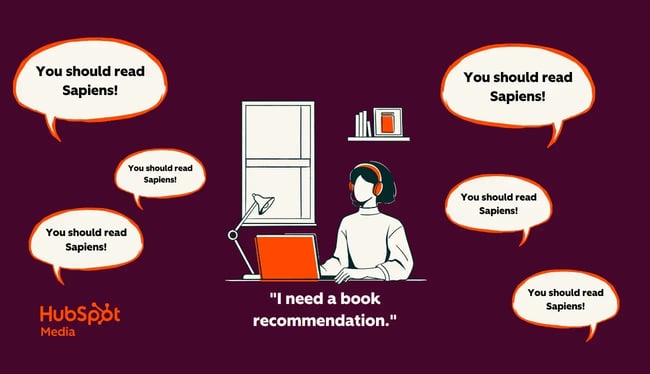
An ad’s effectiveness increases the more times it’s seen by a prospect. It’s also pretty safe to say that any marketing asset’s effectiveness increases the more it’s seen.
The surround-sound methodology takes this idea and amplifies it by challenging the notion that your owned channels and assets are not enough to create true brand awareness. You should also appear everywhere else someone goes to consider products. For example:
- Review websites
- The social timelines of prominent influencers
- Featured in the media they consume (articles, videos, podcasts)
According to Alex Birkett, Senior Growth Marketing Manager at HubSpot, if you can “get lots of people to talk about you favorably, preferably around the same time,” you can generate quite a bit of brand awareness.
Purpose: Generate buzz.
4. Brand Extensions

Big companies often extend their brand to develop new products in industries in which they don’t have any market share. These initiatives are called brand extensions, and they allow companies to leverage their brand awareness and equity to create more revenue streams. An example is Reese’s entering the cereal market with its peanut butter and chocolate “Reese’s Puffs” cereal product.
Historically, the most successful brand extensions are the ones that closely tie to the company’s flagship product or core brand, like Gerber’s baby clothes and Dole’s frozen fruit bars.
By entering tangential markets that can preserve a brand’s unique associations and perceived quality, companies can develop new products that consumers intuitively understand the benefits of, even though they’ve never seen them on a shelf.
On the flip side, a company can also exploit its brand and, in turn, damage it. If they develop a product in a market that isn’t closely tied to their flagship product or core brand, audiences might attach undesirable associations to a brand, weaken its existing associations, and hurt its established products’ perceived quality.
Purpose: Expand into tangential markets for increased awareness.
Free Marketing Software
Easy marketing tools that deliver fast time-to-value, unified in one place.
- AI Tools
- Email Marketing
- Social Media Management
- And More!
Traditional Brand Building Methods
5. Print Advertising
Print magazines and journals continue to generate substantial revenue for publishers, even as digital subscriptions expand. According to WAN-IFRA’s World Press Trends Outlook 2025-2026, print circulation and advertising together account for 43.6% of total publisher revenue among survey respondents. This makes print the largest single revenue source.

The secret? Physical publications, particularly specialized and industry-focused titles, deliver extended dwell time and a tangible sense of permanence that many digital formats do not replicate. Interestingly, print advertising revenue also stands at 21.2% of total publisher revenue, exceeding digital advertising, which is at 17.0%.
Readers engage with these titles as trusted sources in their fields, which supports deeper brand authority and message retention.
Purpose: Reach niche audiences.
6. TV and Radio
Broadcast media remains the primary method for achieving rapid, large-scale awareness, because they offer a unique capacity for simultaneous reach. Traditional linear television advertising continues to command significant volume, with global revenues projected to reach $260.98 billion in 2026.
These estimates are fueled by “must-watch” live events that bring massive audiences at a single point in time. For instance, the 2026 FIFA World Cup is expected to inject an additional $10.5 billion into the global advertising market. Global brands compete for this kind of high-impact visibility because it’s something only major tournaments can provide.

TV and radio also let organizations become part of a shared cultural experience. This approach creates a level of prestige and public recognition essential for top-of-funnel marketing.
Purpose: Achieve mass-market saturation and broad reach.
7. Direct Mail
Physical mail faces significantly less competition for immediate attention than digital messaging. Because a person must physically handle a postcard or catalog to sort it, the medium achieves an average response rate of 3.6%. This tactile engagement creates a sense of “psychological permanence,” as the asset often sits on a kitchen counter or desk, serving as a persistent visual reminder of the brand. This method is frequently used for high-value local services and luxury goods, where a tangible touchpoint can also boost the perceived quality.
I’ve noticed that while I might ignore a dozen digital ads for a local bistro, a well-designed menu appearing in my physical mailbox is often read in its entirety. There is a weight and presence to physical mail that digital formats rarely replicate.
Purpose: Break through information fatigue with tactile engagement.
8. Trade shows and physical events
Trade shows and physical events provide a platform for direct, face-to-face interaction and real-time product demonstrations. Experiential events like these create conversations, booths give companies the option to display innovations, and handshakes seal deals.
Few channels match the show floor when it comes to spontaneous discovery and genuine networking. For some B2B organizations, a single trade show serves as the primary source of high-quality leads for an entire fiscal year. Face-to-face interaction accelerates the vetting process, establishes a personal connection, and builds a foundation for a long-term partnership.

While the in-person exhibition industry faced some macroeconomic headwinds in 2025 (like slower attendance recovery), it remains a high-value channel for quality leads – especially in industries with complex sales cycles.
Purpose: Facilitate high-value networking and physical demonstration.
When do traditional methods outperform digital?
Traditional marketing tends to outperform digital when the goal is to establish a sense of permanence or undeniable local presence. These methods might be best for:
- Building local authority. For location-based services like real estate or specialized medical practices, physical billboards and local print ads provide constant, unskippable visibility. Unlike digital ads that software can filter or block, a physical presence in a community builds a sense of local commitment. Over time, these kinds of ads can build community trust.
- High-tactile engagement. Luxury brands turn to print because the physical quality of the paper and high-resolution imagery convey a prestige that digital displays often fail to replicate. The sensory experience of a physical catalog or invitation creates a psychological “dwell time” that far exceeds the seconds spent on a social media scroll. Texture provides quality, weight suggests value, and design commands attention.
- Mass-market saturation. For “household name” brands, television and radio remain the fastest ways to achieve massive reach across diverse demographics simultaneously. Broadcast media offers the unique ability to place a message before millions of people at once, creating a shared cultural moment. Simultaneous message delivery allows brands to achieve the “water cooler effect.” This is a phenomenon where a broad audience engages in collective discussion regarding a specific advertisement or campaign.
How do traditional methods complement digital?
While traditional methods dominate in specific niches, the most powerful results occur when these two worlds work together. Traditional methods shine in the awareness and consideration stages, while digital dominates the consideration-to-purchase and loyalty stages.
This synergy allows a brand to capture the high-level trust of the physical world while maintaining the measurement and speed of the digital one. Combining these environments helps in several areas:
- Driving brand valuation. Research from the University of New Hampshire notes that while paid search excels at boosting immediate sales, traditional media is significantly more effective at building long-term brand assets. In this relationship, traditional media builds the asset, brand equity creates the value, while digital tools extract the revenue.
- Amplifying trust and credibility. Traditional formats (print, TV, events, direct mail) are still among the most trusted by consumers. They lend authority that helps digital ads perform better. A strong offline presence makes online interactions feel more legitimate and reduces skepticism.
- Expanding reach in fragmented audiences. Traditional media reaches demographics or regions where digital penetration is lower (e.g., older consumers, rural areas, or low-competition local markets). It also drives traffic to digital assets via QR codes, URLs, or call-to-actions.
- Improving overall campaign performance. Hybrid strategies deliver higher ROI through better attribution and cross-channel reinforcement. For example, a TV or print ad followed by targeted digital retargeting, or an in-person event supported by social media amplification and email follow-up.
Audience Engagement Techniques
9. Podcasting

The popularity of podcasts has grown rapidly year after year. The number of global podcast listeners reached about 584.1 million in 2025, according to Limelight Digital.
Needless to say, the demand for audio content has exploded, but that doesn’t mean people will listen to your branded podcast just because it’s a podcast. In reality, they’ll only listen if it can hold their attention and, ultimately, entertain them.
Here’s where the technique part comes in: Many podcasts rely on a host/guest model. This model is wildly successful because hosts can tap into the audience that the guest brings in and vice versa. It’s a mutually beneficial arrangement so long as both sides promote effectively. That’s why it’s important to choose guests wisely and make it easy for them to promote the show and episode they appear in. With each guest that comes on, the podcast audience grows, and so does the engagement.
Purpose: Leverage audio content and reach new audiences.
10. Video Marketing
Video has overtaken blogs and infographics as the number one form of media used in content strategy, according to HubSpot’s 2026 State of Marketing Report. There are a couple of reasons for this:
- It’s flexible. You can create a video for YouTube, embed it on your blog as an inbound marketing technique, share it on social media, and more.
- It’s a different kind of organic play. Google shows videos in search engine results pages (SERPs). YouTube is also a search engine in its own right and is the second most visited site after Google.
- The engagement is rewarding. Video consumption continues to rise, outpacing television, and it’s more effective at conveying information.
Not only are consumers looking for audio content, but they’re looking for video content, too. And savvy marketers are getting ROI in the form of engagement and repurpose-ability.
Purpose: Leverage video content and reach new audiences.
11. Community Building

One of the best ways to increase engagement and brand awareness is to build relationships with prospects, users, customers, and other individuals in the industry.
Many brands are creating digital communities on social media, online boards, and their own hosted networks/forums. In fact, according to HubSpot’s 2025 Social Media Marketing report, 85% of marketers said building and investing in social media (including community) was important to their overall strategy.
With community management, teams are building relationships, giving back, and establishing the company as an authority in the industry. It can be as simple as answering questions on Quora or cultivating a hashtag on Twitter. Or, it can be as complex as creating a whole support network for a product. Either way, teams are improving the affinity their prospects and customers have with their brand.
If done correctly, the community may even expand beyond the brand and become a beneficial resource for everyone within it. For example, Women in Tech SEO, founded by Areej AbuAli, is a community focused on accelerating the careers of women in the SEO industry. The organization has a network with a discussion component, ongoing meetups, a newsletter, and more.
Purpose: Improve long-term engagement and build authority.
12. Contextual Marketing

Contextual marketing is the practice of delivering personalized website content to visitors based on where they are in the buyer’s journey. Content that speaks directly to a visitor’s current needs cuts through the noise. That relevance is what captures attention.
What does contextual marketing look like in practice? It can look like dynamic CTAs that only show visitors offers that are relevant to them. This cuts down on the amount of useless information visitors are taking in and decreases banner blindness, in part because the banners they do see are helpful and relevant.
It might also mean using smart forms so that website visitors don’t have to fill out the same information if they have cause to fill out multiple forms on a site. Then, teams can segment their database so that their leads receive email campaigns that are directly relevant to the visitor’s needs based on content that the visitor has already consumed on the website.
Purpose: Improve website engagement with personalized content.
Emerging Engagement Techniques for 2026
13. AI-Driven Personalization and Predictive Intent
Engagement drops quickly when content feels generic. AI-driven personalization addresses that by adjusting the experience based on what a visitor is actually doing. Instead of showing the same message to everyone, systems track signals like time spent on key pages or repeated visits to pricing.
From there, content shifts in real time. Someone exploring advanced features might start seeing in-depth use cases tied to their likely industry. This keeps attention focused because the content feels immediately relevant, which increases time on site and interaction depth.
Predictive intent adds another layer to AI-driven personalization. For example, HubSpot’s Marketing Hub uses machine learning to analyze CRM, behavioral, and historical customer data and assign each contact a probability score indicating how likely they are to become a customer within a defined timeframe. This helps teams spot the highest-converting leads and serve even more personalized actions across digital channels.
For example, if a visitor repeatedly visits the pricing page and compares plans, they might be shown a simplified pricing breakdown alongside testimonials from similar companies. This reduces uncertainty and helps move decision-making forward.

With AI-powered personalization, engagement improves because the experience adapts in real time. Lead quality also gets a boost because interest is proven through actual engagement.
Purpose: Increase engagement by matching content to real-time intent.
14. Interactive Content and Immersive Tools
People engage more effectively when they are collaborators rather than just observers. Interactive content like ROI calculators, diagnostic quizzes, and early augmented reality apps have already pushed engagement beyond passive consumption in the early-2020s.
However, while these technologies have been available for several years, they continue to evolve into sophisticated decision-making engines. A clear example is Sephora, which has shifted its digital strategy to focus on hyper-personalization, 3D realism, and seamless omnichannel integration. Through its Virtual Artist tool, the brand uses 3D facial recognition to allow users to test thousands of products in real time.

In March 2026, Sephora expanded this experience even further by launching its app within ChatGPT. This integration allows the brand to act as a trusted beauty advisor directly within conversational interfaces, providing tailored product recommendations linked to a user’s Beauty Insider profile.
The reason why immersive tools like these thrive lies in their mutual exchange model. When a user interacts with a product in their own environment or on their own face, attention stays focused longer. This shift from “information provider” to “service provider” removes the guesswork that often leads to cart abandonment.
Purpose: Increase dwell time and remove blockers.
15. Answer Engine Optimization (AEO) Tools
Knowing a brand should appear in AI-generated answers is one thing. However, verifying if it does (or why it doesn’t) is where most marketing teams are currently stuck.
The underlying logic is straightforward: the brands being cited across Reddit, YouTube, LinkedIn, review sites, and editorial blogs simultaneously are the ones being recommended. Brands that engage in AEO are most likely to spot and close citation gaps fastest. They’re the ones that shape the consensus before it solidifies around a competitor.
For example, if AEO surfaces topics where competitors are being cited and a brand isn’t, AI blog tools can help marketers create targeted content immediately. Similarly, if a different brand’s YouTube content is dominating citation results, integrated video tools can produce and publish a relevant video quickly.
Because of such multi-channel capabilities, I believe that AEO tools are going to be the dominating new marketing technique in the second half of the 2020s.
Pro tip: The most advanced AEO tools let marketers have a clear picture of their brand’s current citation footprint across answer engines, and then act on those findings immediately. Rather than sit in a separate analytics silo, AEO features in Marketing Hub Pro and Enterprise live inside existing CRM ecosystems.

Teams without a Marketing Hub subscription can use HubSpot AEO. The tool is free to start, with a paid plan at $50 per month for expanded prompt tracking across multiple answer engines.
Purpose: Capturing visibility in AI-curated environments.
Techniques for Driving Traffic
16. Blog Title Optimization

Increasing the effectiveness of blog titles can increase click-through rate (and, in effect, traffic). Tools like this headline analyzer can help teams rewrite and optimize headlines to capture attention. Better yet, teams can analyze existing blog posts to see which headlines aren’t doing enough heavy lifting. By improving the click-through rate, you’ll be able to get more traffic from that asset without a heavy editorial lift.
Purpose: Increase traffic to existing assets by improving click-through rate.
17. The Pillar-Cluster Model
Since people heavily rely on Google to provide accurate and relevant answers for most of their questions today, Google needs to understand the intent and context behind every single search.
Google has evolved to recognize topical connections across users’ queries, look back at similar queries that users have searched for in the past, and surface the content that best answers them. As a result, Google will deliver content that it deems the most authoritative on the topic.
The pillar-cluster model is a topic-based content strategy. This means that you generate and organize ideas for your blog by topic. Consider implementing the pillar-cluster model on a blog to help Google recognize the content as a trusted authority on marketing, sales, and customer service topics.
By creating a single pillar page (an ultimate guide, for instance) that provides a high-level overview of a topic and hyperlinks to cluster pages (subtopic blog posts) that delve into the topic’s subtopics, you can signal to Google that your pillar page is an authority on the topic.
Hyperlinking all of the cluster pages to the pillar page also spreads domain authority across the cluster, so the cluster pages get an organic boost if the pillar page ranks higher. Cluster pages can even help the pillar page rank higher if they start ranking for the specific keywords they’re targeting.
Looking for a CMS that supports a well-structured content strategy? Content Hub is a no-code option that allows teams to create sites that rank.
Purpose: Drive traffic by establishing topic authority.
18. Historical Optimization

In 2015, HubSpot made a revolutionary discovery about our organic monthly blog traffic — the overwhelming majority of it came from posts published prior to that month. In fact, 76% of monthly blog views came from these old posts.
Today, this revelation rings louder than ever — 89% of our monthly blog views come from posts that were published at least six months prior, and we’ve developed an entire strategy dedicated to refreshing and republishing these historical pieces of content.
These types of blog posts are called “updates,” and they comprise 35% to 40% of HubSpot’s editorial calendar. By refreshing posts with new information and effectively republishing them as new blog posts, HubSpot can build upon the existing organic value that these posts have accumulated through backlinks and user engagement and double or even triple these post’s traffic.
This process also helps HubSpot optimize our blog for efficiency, decreasing the amount of new content we have to create while increasing our organic traffic and conversions.
Pro tip: To understand what blogs are underperforming, teams need SEO and AEO tools. Marketing Hub Pro and Enterprise offer both. Teams can see their SEO performance and understand where traffic has dipped. Marketers can also use AEO features to see what content should be improved to earn citations.
Purpose: Drive traffic by improving existing assets.
19. Retargeting

A lot of content marketing techniques involve attracting new audiences rather than improving the effectiveness of the audiences you’ve already acquired. That’s why retargeting earns a place on this list as a vastly underutilized tactic.
I’ll explain retargeting with a scenario: A prospect comes to an ecommerce site and checks out a product. They decide it’s not the time to buy, and they leave.
Retargeting allows you to remind them of their initial interest by showing them ads for the product on other sites (e.g., banner ads or Facebook ads). In effect, your ads “follow them around” the internet, increasing the likelihood that they come back to make that purchase. This is also a great example of how paid advertising drives faster visibility and targeted traffic.
Purpose: Recapture lost traffic.
20. The Skyscraper Backlinking Method

Earning high-quality inbound links from websites and pages with high authority scores is crucial for boosting your domain authority. But, unfortunately, “If you write it, they will link to it” is not a viable SEO technique.
Teams can use Backlinko’s skyscraper method. The skyscraper method is an SEO strategy where marketers find content that ranks well for keywords they want to rank for and then create content that’s better than the top-ranking posts. Then, they use SEO tools to find all the sites that have linked to the competitor’s content and ask the most relevant sites to replace the competitor’s link with a link to the improved content.
Purpose: Obtain links for increased traffic and improved SEO signals.
Conversion and Nurturing Techniques
21. A/B Testing for CTAs

A/B testing allows you to experiment with two CTAs synchronously, eliminating variables and giving the best insight into which version performs better. For example, you can run an experiment to test a variable such as color. Let’s say you have a red CTA and a blue CTA. A/B testing allows you to identify which ones produce better results.
Marketing Hub and Content Hub can be used to conduct A/B tests. Plus, HubSpot has an A/B testing kit to guide the way. The kit includes guidelines for A/B testing, information on what variables to test, and access to a simple significance calculator to track your results.
A/B testing shouldn’t be confused with multivariate testing, though, which allows you to simultaneously test many variables. Every company has a different set of customers, so there’s no one-size-fits-all formula for designing the most optimal CTAs. It’s important to experiment to figure out which CTA design or copy will produce the best results.
Purpose: Improve conversion rate on existing assets by testing variables.
22. Value-Add Emails
Email marketing supports lead nurturing, conversion, and retention. The number of email users keeps growing year over year. Demand Sage estimates that, by 2027, there will be 4.89 billion users worldwide, rising from 4.73 billion the year prior. On top of that, 59% of consumers say that marketing emails have influenced their purchases.
Since it takes multiple touchpoints to gain the attention of prospects, persuading people to subscribe to emails and, in turn, constantly consume the content will generate more leads and revenue for a business.
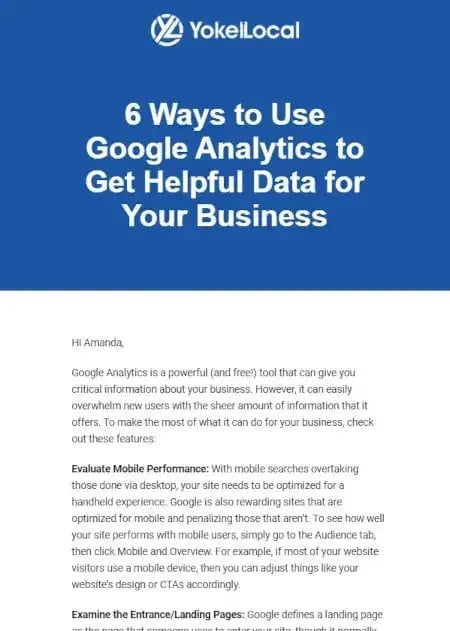
This is where the tactic part comes in. The last thing marketers want to do is clutter up an inbox with yet another sales email. Instead, consider emails that actually provide value along their paths to purchase.
Take the email above from Yokel Local, for example. It doesn’t matter if the recipient of the email is actively considering Yokel Local’s services; they still provide value that keeps their subscribers opening emails.
Growing an engaged, loyal subscriber base also speaks volumes about the quality of the content and its emotional resonance. If prospects actively engage with the email content, it’s a clear sign that they actually value it. This contributes to their impression of a brand and serves as the touchpoints along their paths to purchase.
Pro tip: Teams already on Marketing Hub have access to HubSpot’s email tools.
Purpose: Improve engagement and earn goodwill during the nurturing process.
23. Audience Segmentation
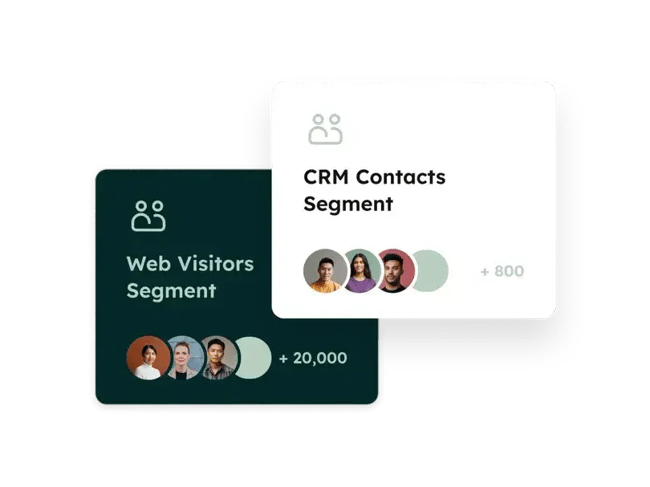
In a world overflowing with digital noise, creating irrelevant or unwarranted content won’t catch anyone’s attention. To email the right person the right content at the right time, consider leveraging audience segmentation. Audience segmentation separates subscriber databases into specific, accessible groups of people based on personal attributes like their demographics, psychographics, and behavioral information.
This technique allows teams to increase the value of their emails by ensuring that they’re more relevant to their subscribers. In other words, rather than creating messaging designed to appeal to everyone, you’ll be able to get much more specific with your messaging because you’ll have a narrower target audience.
To properly implement audience segmentation techniques into your email marketing strategy, you’ll need a CRM and marketing platform. HubSpot allows teams to gather information about customers and segment contacts into lists based on that information. This makes it easy to target the right customers in the database with messaging specific to them.
Purpose: Create a more personalized experience to improve nurturing.
24. Marketing Automation
Automation uses technology to complete repetitive tasks on its own, without requiring human intervention each time. Marketing automation applies this principle to CRM and email marketing activities, allowing teams to free up time and get their message out at scale.
Instead of sending one-off emails, use marketing automation to initiate a sequence of emails and actions, all without hitting the send button. Best of all, it can be applied to any of the following (and more):
- Lead nurturing marketing campaigns
- Auto-responder sequences
- Re-engagement campaigns
- Event reminders
- Client onboarding sequences
- Upsell campaigns
This allows teams to increase their organization’s touchpoints with a lead without tanking their productivity. To do so, you’ll first need to invest in tools like HubSpot’s Marketing Automation Software.
Purpose: Enhance the efficiency of email campaigns.
25. Lead Scoring
Lead scoring is an automation-based technique that rates (or “scores”) your leads based on certain attributes. The idea is that marketers will be able to better identify leads that are closer to a purchasing decision so that they can prioritize those leads for marketing and sales efforts.
Some marketing automation software can perform lead scoring using AI machine learning, but many allow you to manually designate the attributes that make a marketing or sales qualified lead. Once a lead meets the criteria, they will have a higher score (and thus higher priority for more direct marketing and sales conversations).
In addition, defining the criteria for lead scoring can lead to a better relationship between your marketing and sales teams. With a clear definition, marketing teams will be better focused on generating leads that meet those criteria, and sales teams will be happy with more qualified leads.
Purpose: See who's most likely to convert.
Choosing and Implementing Marketing Techniques
The most effective marketing techniques depend on business goals, audience, budget, resources, and sales cycle. Yet, not every technique belongs in every strategy. Getting it right requires evaluating how well a specific method integrates with the company’s objectives, the target audience’s needs, and the existing business ecosystem.
How to Evaluate Techniques for Your Business
A useful starting filter runs across three dimensions:
Validating audience readiness.- Where does the target audience actually spend time, and how do they prefer to consume information? A B2B buying committee researching enterprise software behaves very differently from a consumer impulse-shopping on TikTok. Techniques should follow audience behavior, not chase trends.
- Checking resource fit. Some techniques are high-ceiling but also high-cost. Interactive tools, video production, and influencer programs can deliver strong returns but require sustained investment to work. Data availability might be another sticking point. AI-driven personalization engines need clean, structured data and consistent human oversight to work well. Without a team that has the bandwidth to manage that, the result can feel the opposite of personal. Interactions can start to feel generic or robotic, and brand trust takes a hit.
An honest assessment of available budget, headcount, and internal capabilities should happen before adoption, not after.
- Funnel alignment. Each technique has a natural home in the buyer journey. AEO and thought leadership content build awareness and trust at the top. Comparison content, case studies, and ROI calculators accelerate consideration. Personalized nurture sequences and retargeting close at the bottom. Mapping techniques to the stages where the pipeline is actually leaking tends to produce faster, more measurable results than spreading effort evenly across all of them.
To make this actionable, rate each candidate technique on a simple one-to-three scale across three dimensions: audience fit, resource fit, and funnel stage fit. Score each dimension honestly: a three means strong alignment, a one means weak or uncertain.
Techniques scoring seven or above across all three dimensions are strong candidates for near-term investment. Anything scoring below a five is probably worth skipping, no matter how much industry buzz surrounds them.
This forces assumptions to the surface and keeps decisions grounded in strategy rather than trend-chasing. Revisit scores every quarter, since audience behavior, resource availability, and pipeline priorities all shift.
Measuring Technique Effectiveness and ROI
Every marketing technique warrants its own KPI set, matched to its objective rather than applied uniformly. That’s because channel-specific KPIs help measure whether a marketing technique is working.
Holding an awareness play to a conversion rate standard, or judging a nurture sequence by reach, produces misleading conclusions about what’s working. Here’s an overview of the potential KPIs aligned to specific goals:
The trickiest part of measurement, however, is finding out what actually deserves credit. Standard attribution models have a tendency to reward the last thing a customer clicked. This means that techniques like AEO or thought leadership, which shape a buyer’s thinking long before they visit a website, rarely get the recognition they’ve earned.
Balancing the numbers with qualitative input, like conversations with the sales team, win/loss debriefs, and running customer surveys, helps surface what the dashboards miss.
Pro tip: Review metrics on a regular cadence rather than reacting to every data point. Leading indicators like traffic and engagement are worth checking monthly, while revenue impact is better assessed quarterly. Consistent check-ins make it easier to tell the difference between a technique that simply needs more time and one that genuinely isn’t working.
Common Implementation Mistakes to Avoid
Most marketing technique failures aren’t caused by bad strategy. They’re caused by predictable execution errors that repeat across teams and industries. Here are some of the most common mistakes, drawn from practitioners’ real experiences.
Launching without a baseline
Teams frequently adopt new marketing techniques without documenting current performance first — and it’s one of the most costly oversights in marketing execution. Without a baseline, isolating what a technique actually contributed becomes impossible. Did organic traffic increase because of the new content strategy, or because a competitor went quiet? Did AEO efforts move the needle on brand citations, or was the brand already gaining mentions organically?
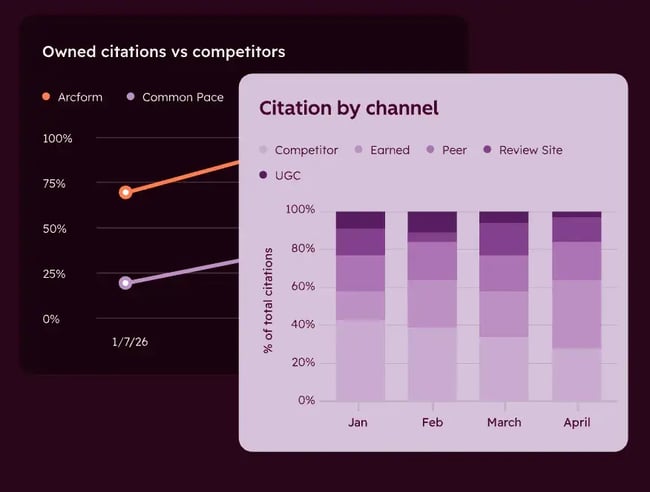
A baseline doesn’t need to be elaborate. Before rolling out any new marketing technique, document the metrics most likely to be affected by it specifically, not every metric on the dashboard. Launching a Reddit presence as part of an AEO strategy? Record current citation frequency, referral traffic from community platforms, and share of voice before the first post goes live.
Rolling out interactive content to reduce cart abandonment? Capture current abandonment rates, time on page, and conversion rates at that funnel stage first.
The consequences of skipping this step tend to surface at the worst possible moment: a quarterly review where a technique looks underperforming, but there’s no prior data to defend it or challenge that conclusion.
Pro tip: HubSpot users with Marketing Hub Pro or Marketing Hub Enterprise already have access to their current performance in answer engines. Reports show teams how they’re performing today across citations, brand sentiment, and more.
Those without a Marketing Hub subscription can use HubSpot AEO to see their performance in answer engines.
Lack of rigorous sales-marketing alignment
The “activity trap” is one of the most common pitfalls in B2B marketing. It’s also one of the hardest to recognize from the inside because the team is genuinely working hard. Paul Staten, CEO at Upward Engine, encountered it early in his agency’s growth.
His team was pushing high volumes of content and campaigns across client accounts. They assumed that sustained presence would eventually translate into results. However, it didn’t.
The missing ingredient wasn’t effort, but a lack of alignment between what marketing was producing and what sales actually needed to close deals. Without shared metrics and a clear definition of what a qualified lead looked like, the campaigns generated activity but not pipeline.
“We learned to relentlessly prioritize transparency and proven results to earn client loyalty, instead of just being busy,” Staten reflects. His team now anchors every campaign to what he calls “bang value”, i.e., a clear line between marketing investment and measurable business outcome.
For B2B teams especially, the lesson is straightforward: volume of activity is not a proxy for impact. Every technique should be evaluated against whether it moves a metric that sales actually cares about.
Applying the wrong playbook to a new channel
When a channel starts gaining strategic importance, the instinct is often to repurpose what’s already working elsewhere. On Reddit, which is now a significant source for both SEO rankings and AEO citations, that instinct tends to backfire.
Brent Csutoras, managing partner at Search Engine Journal and a Reddit marketing veteran, identified the root cause in an AMA session. He said: “Online marketers have been held to ROI numbers for so long, it’s how they look at their engagement on Reddit. There’s an interest in being on the platform because it’s popular and important, but there’s not enough time spent understanding why Reddit is important.”
The consequences are well-documented. Brands that import their LinkedIn or Instagram playbook (so, things like promotional tone, brand-first messaging, or broadcast-style posting) typically encounter downvotes, bans, and negative sentiment that spreads well beyond the platform.
Reddit communities are self-policing and unforgiving of content that feels extractive. I agree with Csutoras that, before deploying any technique on a new channel, the strategic question isn’t “how do we adapt our content?” It’s “do we understand this community well enough to show up authentically at all?”
Pro tip: Before diving into AEO, teams need tools to measure their performance. Marketing Hub users at the Pro and Enterprise tiers can use the familiar HubSpot interface to see their answer engine citations. HubSpot AEO is also available for teams without a Marketing Hub subscription for expanded prompt tracking across multiple answer engines.
Budget-ROI misalignment
I’ve worked for several SaaS brands in my career and noticed that referral programs have a reputation for being one of the lowest-risk marketing techniques available. The reason for this is that they’re performance-based, driven by word-of-mouth, and easy to frame as cost-efficient. However, Thomas Oldham, founder of WebMotion Media, says that without proper financial controls, even a well-intentioned program can become a liability fast.
Oldham’s team launched a client referral scheme offering a $100 bonus per new client with no upper payment limit. The assumption was that it would grow gradually, giving the team time to manage incoming volume. Unfortunately, costs exceeded the budget by 200%, and the influx of referrals brought in clients of lower value than anticipated. Also, the team lacked the operational capacity to handle the sudden spike.
Oldham made it clear that the technique itself wasn’t flawed, but the implementation was. Any incentive-based program needs a clear cap, a client quality threshold, and a realistic operational ceiling before it launches.
Issues that stem from rapid, uncontrolled growth are also significantly harder to explain to stakeholders than a campaign that simply underperformed.
Your Marketing Technique Plan
Choosing the right combination of techniques — and executing it consistently — matters far more than being present on every channel. Before evaluating any new approach, identify where the current strategy is leaking, whether that’s awareness, consideration, or conversion. From there, pick one or two techniques that fit the audience, the resources, and the funnel stage, and run a focused pilot before committing to scale.
Teams will also need the right tools to assess their performance and execute their strategy. That’s where Marketing Hub comes in. Marketing Hub Pro and Enterprise offer a wide suite of tools. Marketers can assess how often their brand is cited by AI, where they appear in traditional search, and how the company shows up on social — all in the same platform.
Bear in mind that many techniques with the highest long-term returns, like AEO, thought leadership, and community presence, rarely show dramatic results in the first month. That’s not a signal to abandon them. Consistency beats intensity, and the teams that stay the course when early results are modest tend to be the ones that pull ahead when the compounding kicks in.
Treat technique selection as a discipline, and the rest will follow.
Editor's note: This post was originally published in May 2019 and has been updated for comprehensiveness.
Free Marketing Software
Easy marketing tools that deliver fast time-to-value, unified in one place.
- AI Tools
- Email Marketing
- Social Media Management
- And More!
Marketing Strategy

-Dec-04-2025-05-17-34-7864-PM.webp)




![The state of inclusive marketing in 2025 [new data + expert insight]](https://53.fs1.hubspotusercontent-na1.net/hubfs/53/inclusive-marketing-report.webp)
![How marketers are navigating a possible recession (and advice about what you should do during it) [new data]](https://53.fs1.hubspotusercontent-na1.net/hubfs/53/image12-May-27-2025-02-18-19-8390-AM.png)