.png?width=112&height=112&name=Image%20Hackathon%20%E2%80%93%20Horizontal%20(64).png)

Not long ago, 91% of marketers across seven industries confirmed that SEO positively impacted their website performance and marketing goals, with organic search accounting for an average of 33% of all website traffic. However, today, the number of users who clicked on traditional search results is nearly half what it was before AI overviews and shifts in consumer search behavior.
This guide walks through a repeatable five-step SEO competitor analysis workflow: identifying your true search competitors, running a keyword gap analysis, evaluating the SERP and search intent, analyzing competitor content, and benchmarking backlink profiles.
I’ll also cover when to run these analyses and which tools make each step faster.
Table of Contents
- What is SEO competitor analysis?
- Why is SEO competitor analysis important?
- How to Do an SEO Competitor Analysis
- Example Competitor Comparison Chart
- When to Conduct SEO Competitor Analysis
- SEO Competitor Analysis Tools and Resources
- Putting Your SEO Competitor Analysis to Work
What is SEO competitor analysis?
SEO competitor analysis is the process of systematically reviewing websites that rank for your target keywords and identifying how they earn those rankings through keyword targeting, content quality, backlink authority, technical health, and SERP feature capture.
SEO Competitors vs. Business Competitors
Before we go further, there’s one big thing we need to remember: SEO competitors are not the same as business competitors. An SEO competitor is any website that ranks for the same queries you’re targeting, regardless of whether they sell a competing product.
For example, when I search “best CRM software,” thinking of HubSpot, the top results might include a G2 review page, a Forbes Advisor listicle, and a Reddit thread. None of these websites actually sells CRM software as a commercial rival, yet they’re the ones to beat in the SERP.
Not sure who your SEO competitors are? Search your top five target keywords in an incognito browser and note every domain that appears on page one. The sites that show up repeatedly across multiple queries. That’s your real SEO competitive set.
Why is SEO competitor analysis important?
The search landscape has never been more competitive or more fragmented. Backlinko’s research shows the #1 organic result captures 27.6% of all clicks, while position two earns just 15.8%. That gap is significant, but the bigger story is what’s happening above organic results.
Ahrefs’ February 2026 study of 300,000 keywords found that AI Overviews correlate with a 58% lower average clickthrough rate (CTR) for top-ranking content. That means ranking #1 for a query where an AI Overview appears delivers far fewer clicks than the same position used to.
What’s a marketer to do? Understanding who is winning, and through which channels, is the foundation of any strategy worth executing.
Discover Visibility Gaps
Competitor analysis surfaces the topics, keywords, queries, and content clusters where your rivals are earning traffic you’re not. This isn’t guesswork. Keyword gap tools compare your indexed keywords against competitors’ and find gaps where you need to catch up.
Even well-established sites have keyword gap ratios that surprise their teams. Learning that a competitor ranks for 850 keywords in the same topical space where you rank for 310 represents a concrete, but addressable opportunity.
These visibility gaps extend beyond traditional rankings into AI-generated answers, too. Ahrefs’ found that 76% of pages cited in AI Overviews ranked in Google’s top 10 for the same query, meaning strong organic rankings are still the most reliable path to AI citation.
If your competitors consistently rank above you and earn AI Overview citations while you don’t, you have a compounding visibility gap. HubSpot AEO helps surface exactly where that gap exists. It shows which prompts cite competitors instead of you, where your brand is absent entirely, and which content or structural changes are most likely to close the gap first.
Featured Resource: Zero-click searches and the future of your marketing funnel
Understand What Content Wins in Search
SERP analysis shows which content formats, lengths, and structures Google favors for specific queries. For some keywords, the winners are long-form guides. For others, it’s product comparison tables, video embeds, or FAQ-heavy pages.
Competitor content analysis tells you what’s already proven to rank, so you can build something even better, rather than guessing what depth or format to target.
Pro Tip: Pay attention to which “rich results” and SERP features appear for your target queries. For example, People Also Ask boxes now appear in roughly 64.9% of all searches, offering additional capture opportunities beyond the standard blue link for every query you’re analyzing. Knowing which features are triggered in the SERP for your target keywords gives you a chance to optimize with those in mind.
Uncover Backlink Opportunities
Backlinko found that the #1 ranking page has an average of 3.8x more backlinks than pages ranked 2 through 10. If a competitor has 3,200 referring domains and you have 640, you need to know where the gap is and which high-value domains are already receptive to linking in your niche.
Backlink competitor analysis identifies which domains link to your competitors but not to you. This is your most pre-qualified list of link-building prospects, as you already know they are looking for content like yours.
Benchmark Your SEO Performance
Without comparison data, SEO metrics can be hard to evaluate.
Is a 15% organic traffic decline over six months a crisis or a sector-wide trend? Is this keyword no longer highly searched, or is my competitor just covering it better than I am?
Competitor data answers those questions.
Benchmark your keyword count, estimated traffic, domain authority, and SERP feature capture against three to five competitors so you have a real performance baseline to determine whether a rankings drop reflects your own issues or an industry-wide SERP shift.
.webp)
10 Free Competitive Analysis Templates
Track and analyze your competitors with these ten free planning templates.
- SWOT Analysis
- Battle Cards
- Feature Comparison
- Strategic Overview
Download Free
All fields are required.
Form not available
How to Do an SEO Competitor Analysis
Here is the five-step workflow I’ve refined through running competitor analyses across industries ranging from SaaS to e-commerce to B2B services. Each step builds on the previous one, moving from identifying who you’re competing against to building a prioritized action plan.
.png?width=700&height=403&name=Copy%20of%20Copy%20of%20Copy%20of%20Copy%20of%20In-Post%20Blog%20Graphics_2025%20(6).png)
Step 1: Identify your SEO competitors
Before you can analyze competitors, you need to know who they are in search — not just in your market. Use these three methods in combination.
Manual SERP Research
Open an incognito browser and search your five to ten most important target keywords. Record every domain that appears in positions 1 through 10. After running this across multiple queries, look for domains that appear repeatedly. Those are your primary SEO competitors.
Pro Tip: Pay attention to non-obvious SEO competitors, such as Reddit threads, Quora pages, Trustpilot or G2 aggregator pages, and media publications. These often outrank direct competitors due to their domain authority and can be harder to displace.
Google Search Console
Search Console shows you which queries you already rank for. Export your top-performing queries by clicks and impressions, then cross-reference those searches manually to see who else ranks alongside or above you. This is the most reliable starting point because it’s based on your actual search footprint — not an estimated model.
Keyword Research Tools
Tools like Semrush and Ahrefs offer ‘Competing Domains’ or ‘Organic Competitors’ reports. Enter your domain, and the tool surfaces the sites with the most keyword overlap. Cross-reference these with your manual SERP research to build a definitive competitor set — typically three to five domains for ongoing tracking.
Using them together:
If you’re starting from scratch, use Google Search Console data first (free, based on real performance), then validate with a keyword tool’s competitor report. Manual SERP searches are best for surfacing new and unexpected competitors that tools may underweight.
Step 2: Run a Keyword Gap Analysis
Keyword gap analysis compares your site’s ranked keyword set against competitors’ to find queries they rank for that you don’t or where they rank significantly higher. This is the most valuable input in any SEO content strategy, because it surfaces proven topics rather than hypothetical ones.
How to Run a Keyword Gap Analysis
- Enter your domain and up to four competitor domains into a keyword gap tool like Semrush’s Keyword Gap, Ahrefs’ Content Gap, or Moz’s True Competitor tool.
- Filter results to “Missing’ keywords. These are queries where competitors rank in positions 1 through 20 and you don’t appear at all.
- Then filter to “Weak” keywords. These are queries where you rank, but competitors rank significantly higher.
- Sort by “search volume” and “keyword difficulty” to find quick wins. This is SEO 101; high-volume, lower-difficulty queries where a competitor ranks on page one and you don’t appear in the top 20 are a great place to start closing the gap.
- Export the list and prioritize by topical relevance to your site’s existing content clusters.
Pro Tip: When I run keyword gap analysis, I prioritize three key categories:
- (1) high-volume gaps where a competitor ranks in the top 3 and we’re absent
- (2) mid-volume gaps where we rank on page 2 and a competitor holds position 1
- (3) long-tail clusters where competitors have full topic hubs, and we have a single page.
But don’t just look at single-keyword gaps; look at topical clusters. If a competitor ranks for 40 keywords in the ‘project management for remote teams’ cluster and you rank for two, you have a content depth problem, not just a gap. Filling that cluster systematically almost always produces compounding gains in ranking.
Step 3: Evaluate the SERP & Search Intent
Before you create or update content to close a keyword gap, analyze the SERP to understand what kinds of content are being surfaced and the user intent. Here’s what I look for:
- Page types. Are the top results blog posts, product pages, comparison listicles, or forum threads? This tells you the dominant content format Google is rewarding.
- Content depth. Do the top results average 1,500 words or 4,000? If the ranking pages go deep, thin content will not compete.
- SERP features. Is there a featured snippet, People Also Ask section, image pack, or video carousel? Each represents an additional capture opportunity beyond the blue link.
- AI Overviews. Is one present? If so, which domains does it cite? Ahrefs’ July 2025 study found that 76% of AI Overview citations came from pages ranking in Google’s top 10 for the same query, so winning AI citations remains closely tied to organic ranking strength.
Pro Tip: Try Ahrefs SERP Overview, which I love. Ahrefs’ SERP Overview shows estimated traffic, referring domains, and keyword count for each ranking URL without clicking into every page. This makes it fast to benchmark content depth and authority side by side across multiple competitors in a single view.
Step 4: Analyze Competitor Content
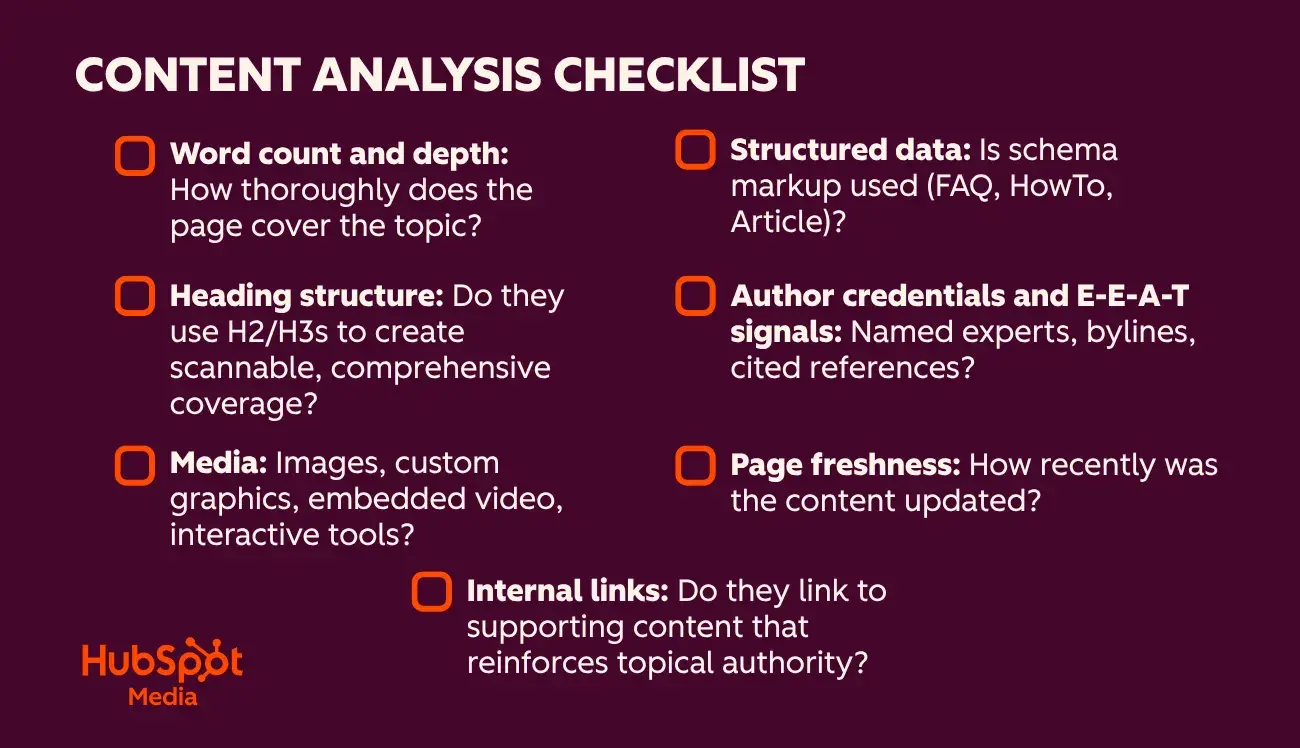
Once you know which content is ranking and what format it takes, do a qualitative content audit of your top two or three competitor pages for a target keyword. This is where you learn exactly what their content has that yours doesn’t. Use this Content Analysis Checklist to evaluate your competitors’ content:
- Word count and depth. How thoroughly does the page cover the topic?
- Heading structure. Do they use H2/H3s to create scannable, comprehensive coverage?
- Media. Images, custom graphics, embedded video, interactive tools?
- Internal links. Do they link to supporting content that reinforces topical authority?
- Structured data. Is schema markup used (FAQ, HowTo, Article)?
- Author credentials and E-E-A-T signals. Named experts, bylines, cited references?
- Page freshness. How recently was the content updated?
My experience has taught me that the most actionable insight from content analysis is often not word count or even media, but topical coverage gaps.
A competitor’s 2,500-word guide might cover subtopics your 3,000-word guide doesn’t mention. Those missing subtopics are frequently why they outrank you, and they’re easy to identify and close.
Pro Tip: Use the People Also Ask section in the SERP as research for your content. Each PAA question is a subtopic Google considers related to the main query. If your competitor’s page answers them and yours doesn’t, you have a clear, low-effort upgrade to make.
Featured Resource: How to Conduct Competitive Analysis to Step Up Your Content Strategy
Step 5: Perform Backlink Analysis
As we mentioned, backlink analysis reveals the authority gap between you and your competitors and, more usefully, where that gap can be closed. A domain that already links to your competitor is a warmer outreach prospect than a cold contact since they’ve already decided this niche is worth linking to.
How to Run Backlink Gap Analysis
- In Semrush, go to Competitive Research > Backlink Gap. Enter your domain and up to three competitors.
- Filter to the “Best” tab to see domains that link to all of your competitors but not to you. These are your highest-priority outreach targets.
- Sort by Authority Score to prioritize high-value domains.
- Open several competitor backlinks to examine context: Was the link earned through a guest post, data study, expert quote, or product mention? These patterns reveal which content and PR tactics drive links in your niche.
- Build a prioritized outreach list of 20 to 50 domains with the link-earning mechanism noted for each.
Backlinko confirms that top-ranking pages carry 3.8x more backlinks than pages ranked 2 through 10. Focus backlink efforts on earning links from highly relevant, authoritative domains rather than volume. Ahrefs’ research also found that 73.2% of SEO professionals believe backlinks influence AI search visibility, so strong link authority now compounds across both traditional and AI-driven results.
Pro Tip: The “Best” filter in Semrush’s Backlink Gap tool is the fastest path to a pre-qualified link prospecting list. You can see anchor text, link type (dofollow/nofollow), and how many times each referring domain has linked to competitors, giving you a clear signal of which prospects are most likely to respond to outreach.
Check for AI Visibility Gaps
Traditional SEO competitor analysis focused on Google rankings, but today, a complete analysis must also account for AI search visibility. You want to know whether your competitors are being cited in AI Overviews, ChatGPT, Perplexity, or other AI-powered answer engines, while you are not.
I’ve added this as a dedicated step in every competitor analysis I run.
Ahrefs’ study of 1.9 million AI Overview citations (July 2025) found that 76% of cited pages ranked in Google’s top 10 for the same query. However, a follow-up Ahrefs study from February 2026 found that share had dropped to 38%, as Google’s AI began pulling from a wider range of sources through query fan-out.
This means competitive AI visibility is increasingly detached from traditional rankings and needs to be tracked separately. Here’s what to check.
- Search your target queries in ChatGPT, Perplexity, and Google’s AI Overview. Note which domains are cited most frequently.
- Compare those citations against your organic ranking data. If competitors rank below you but earn more AI citations, examine their content structure, schema markup, and factual density. Those signals drive AI citation.
- Look for your brand name in AI responses. If you’re not appearing when a user asks a question your product or content should answer, you have an AI visibility gap worth closing.
HubSpot AEO tracks where your brand appears in AI-generated answers and how your share of voice compares to competitors across AI platforms. This makes the step repeatable rather than manual.
Example Competitor Comparison Chart
Use a framework like this to document your top competitors across the five key dimensions of SEO competitor analysis. Replace the sample values with your actual data from Google Search Console and your preferred SEO tool.
Sample data for illustration. Populate with your exports from Semrush, Ahrefs, or equivalent.
Download Your SEO Competitor Analysis Template: Use HubSpot’s free Competitive Analysis Templates to track competitor domains, target keywords, ranking URLs, backlink notes, and content gaps in one structured worksheet.
When to Conduct SEO Competitor Analysis
SEO competitor analysis is an ongoing effort. But the actual cadence depends on the pace of change in your industry and the competitive intensity of your target keywords.
Here are four situations in which I recommend running an SEO competitor analysis.
1. Routine Quarterly Reviews
A full competitor analysis should run at least quarterly.
This is long enough to showcase meaningful changes in competitor strategies and ranking positions, and short enough to catch shifts before they turn into larger traffic losses.
Aim to:
- Update your competitor set (new entrants appear regularly, especially in fast-moving categories)
- Refresh keyword gap data
- Reassess which action items from the previous quarter have been addressed.
- Review AI share of voice alongside traditional SEO metrics using a tool like HubSpot AEO
2. Quick Ranking Drops
Any time you observe a significant (or sudden) ranking drop, run a targeted competitor analysis for the affected keywords to figure out what you need to do next.
In many cases, your rankings didn’t fall because your page got worse. Perhaps a competitor published a more comprehensive update, a new entrant earned authoritative links, or a Google algorithm update shifted which content type it rewards for that query.
Identifying the specific competitor and specific change that displaced you is far more actionable than guessing at technical fixes. Backlink gaps, SERP feature gaps, and content depth gaps each require different remediation strategies, and confusing them wastes time.
3. Major Content Launches
Before publishing any high-priority page (i.e., a cornerstone guide, a product page targeting a competitive keyword, or a new content hub), run a targeted competitor analysis for that specific query set.
This tells you the content depth, format, and backlink authority required to compete on day one rather than discovering six months later that your new page can’t rank against entrenched competition.
4. Strategic Planning
Build competitor analysis into any planning cycles as a standard input. When prioritizing content roadmaps, SEO budgets, or link-building campaigns, a current competitor benchmark prevents effort from going toward keywords where the competitive gap is too wide to close with available resources, and surfaces lower-competition opportunities that can drive near-term wins.
SEO Competitor Analysis Tools and Resources
Essential Tools for SEO Competitor Research
The right tools depend on what you’re analyzing. Let’s take a look at some of my favorites accordingly.
Keyword and Content Gap Analysis
- Semrush Keyword Gap: Compare up to five domains side by side. The “Missing” and “Weak” filters are the fastest path to actionable gaps. Paid, with limited free access.
- Ahrefs Content Gap: Strong at surfacing keyword gaps at the domain, subfolder, or URL level. Especially useful for cluster-level analysis. Paid.
- Google Search Console: Free. Shows your actual rankings and query data. Cross-reference with manual SERP searches to identify competitor pages outranking yours.
- HubSpot’s keyword research guide: A strong starting point for understanding keyword difficulty and volume for your target terms.
Explore more keyword tools here.
Backlink Analysis
- Semrush Backlink Gap: Best for generating a pre-qualified outreach list of domains linking to competitors but not to you.
- Ahrefs Site Explorer: Comprehensive backlink profile data, including new/lost links, anchor text distribution, and referring domain authority.
- Moz Link Explorer: Good for spot-checking Domain Authority and comparing referring domain counts. Offers limited free searches.
SERP and Technical Analysis
- Google Search (Incognito): The original SERP analysis tool. Still the most accurate signal for content format, page type, and SERP features.
- HubSpot Website Grader: A useful starting point for comparing technical SEO baseline (performance, mobile, security, SEO) against competitors. Free.
- Screaming Frog SEO Spider: For technical gap analysis, crawl competitor sites to check page structure, internal linking patterns, and schema usage. Free up to 500 URLs.
- Google PageSpeed Insights: Compare Core Web Vitals scores against competitor URLs. Free.
Explore the best website SEO tools here.
How to Get Started Without Premium Tools
Premium tools are powerful, but they’re not a prerequisite for a useful competitor analysis. Here’s how to run a solid baseline using only free resources:
- Use Google Search Console to export your top 50 queries by clicks and impressions.
- Search each query in incognito and record the top 5 ranking domains. Build your competitor list from the sites that appear most frequently.
- Open each competitor’s ranking URL and manually assess: approximate word count, heading structure, media types used, and whether schema markup is present (right-click > View Page Source, search for ‘schema.org’).
- Use Ahrefs’ free backlink checker or Moz Link Explorer’s free tier to get a rough referring domain count for each competitor.
- Use HubSpot Website Grader to run a free technical check on your site and compare the results against what you observe on competitor pages.
Most premium tools offer 7 to 14-day free trials. For smaller teams, I recommend running a comprehensive competitor analysis during a free trial (one focused sprint using the full toolset) followed by a return to free-tier monitoring. That approach stretches limited budgets without sacrificing the quality of the initial analysis.
On a budget? Prioritize Google Search Console, free SERP research, and Ahrefs free backlink checker. This combination covers the three most important inputs without spending anything: your keyword footprint, your competitors’ content, and their link authority.
Download an SEO Competitor Analysis Template
A consistent tracking format is the difference between a one-time research project and a repeatable competitive intelligence system. Use a structured worksheet to document for each competitor:
- Primary domain and estimated monthly organic traffic
- Top ranking keyword categories and total keyword count
- Keyword gap count (Missing + Weak relative to your domain)
- Referring domain count and Domain Authority/Rating score
- Top linked content types (guides, tools, data studies, etc.)
- SERP features captured (featured snippets, PAA, image packs)
- AI Overview citation presence (yes/no, frequency)
- Notable content or technical advantages observed
Download HubSpot’s free Competitive Analysis Templates for a pre-built worksheet that covers these dimensions, plus a framework for tracking how the competitive gap changes quarter over quarter.
Putting Your SEO Competitor Analysis to Work
The purpose of SEO competitor analysis is not to replicate what your competitors are doing; it’s to understand the standard you’re competing against and identify the specific gaps where you have the best chance of winning.
Every step in this process produces a concrete, actionable output, from a prioritized keyword gap list to a pre-qualified backlink outreach list to a content upgrade checklist.
My experience has taught me that the teams that get the most from this process are the ones who build it into a regular cadence rather than treating it as a one-time project.
Ready to start? Try HubSpot’s free Competitive Analysis Templates to begin documenting your competitive set, and use the five-step workflow in this guide to turn that data into a prioritized SEO action plan.
10 Free Competitive Analysis Templates
Track and analyze your competitors with these ten free planning templates.
- SWOT Analysis
- Battle Cards
- Feature Comparison
- Strategic Overview
Download Free
All fields are required.
Form not available
Competitive Analysis