
In this guide, I'll break down the best sales forecast software available in 2026, explain what features actually matter, and share frameworks for evaluating which solution fits your organization. I’ve worked with sales teams across industries, from SaaS startups to enterprise consulting firms, and I've seen firsthand how the right forecasting approach transforms pipeline management and revenue predictability.
Table of Contents
- What Is Sales Forecasting Software?
- Benefits of Sales Forecasting Software
- The 10 Best Sales Forecasting Software
- What to Look for in Sales Forecasting Software
What Is Sales Forecasting Software?
Sales forecasting software predicts future revenue by analyzing historical sales data, current pipeline opportunities, and market trends. These programs use historical data and the current sales pipeline to create time-bound sales estimates.
Simply put, sales forecasting software helps the organization predict how much they'll make and when. It looks at things like:
- Past sales trends
- Current opportunities in your pipeline (including deal size, stage, and probability to close).
- Seasonal patterns and market trends (like how Q4 always spikes for retail, or how B2B deals often slow down in summer).
- Sales rep performance history.
- Customer buying behaviors and cycles.
- External factors like market conditions or economic indicators.
For example, a SaaS company’s sales forecasting software might illustrate that enterprise deals typically take 120 days to close. It might also show that those deals have a 40% higher close rate when starting with a well-run discovery call rather than jumping straight into a product demo.
Deal velocity also tends to slow during budget season in Q4. By analyzing these patterns, organizations can build more accurate predictions about when deals will close and for how much.
Free Sales Software
Built for productivity, powered by relevance.
- Sales Automation
- Call Tracking
- Lead Prospecting
- And More!
Benefits of Sales Forecasting Software
Sales forecasting software delivers measurable returns across multiple dimensions of sales operations. The benefits extend beyond simple prediction accuracy to include improvements in strategic planning, time savings, and reduced organizational risk.
Accuracy and Revenue Impact
Forecast accuracy directly correlates with revenue performance. The gap between accurate and inaccurate forecasters is substantial, and the financial implications compound over time.
According to Xactly's 2024 Sales Forecasting Benchmark Report, four out of five sales and finance leaders missed their quarterly sales forecast at least once in the past year — and over half missed it multiple times.
Pro Tip: Track forecast accuracy over time as a leading indicator of sales operations health. A declining accuracy trend often signals CRM hygiene issues or process gaps before they impact revenue.
Time Savings and Efficiency
Manual forecasting consumes significant time across sales organizations. Sales managers commonly spend 2-3 hours per week gathering data, validating rep inputs, and building forecast reports. Purpose-built forecasting software automates data aggregation and analysis, returning those hours to coaching and deal execution.
As David Beitler, Director of Solution Architecture and Head of RevOps at Atrium.ai, explains, “Forecasting tools should reduce friction for sellers. Updating forecasts isn't the highlight of a salesperson's day, so look for software that integrates seamlessly with existing sales data and tools. This helps sellers stay focused on selling rather than manually entering forecast data.”
In my sales work at BC Solutions, I've observed that automated forecasting reduces the average time spent on administrative reporting by roughly 40%, freeing capacity for customer-facing activities.
Strategic Planning Benefits
Reliable forecasts unlock strategic planning capabilities that uncertain predictions cannot support. The effects of inaccurate forecasts go far beyond missing sales targets — they ripple throughout an organization in various ways.
Specifically, accurate sales forecasting enables confident decisions in:
- Resource allocation and territory planning
- Inventory and supply chain management
- Financial planning and cash flow management
- Hiring timelines and headcount decisions
- Risk mitigation through scenario planning
What we like: HubSpot's forecasting tool integrates directly with pipeline data, allowing sales leaders to scenario-plan against different close rate assumptions without exporting to spreadsheets.
The ROI of Forecasting Software
The return on investment for forecasting software comes from multiple sources: reduced variance in revenue predictions, time savings from automation, and improved deal outcomes from better pipeline visibility.
Organizations commonly report payback periods of 3-6 months when measuring reduced forecast error against software costs. For a mid-market sales team, even a 5% improvement in forecast accuracy can prevent hundreds of thousands of dollars in misallocated resources annually. And 97% of sales and finance leaders agree that the right data would make it significantly easier to deliver accurate forecasts.
Predicting accurately enables planning effectively. In my experience as a sales leader, a reliable forecast is key to making proactive decisions and adjusting strategy before things go too far off course.
The 10 Best Sales Forecasting Software
The following platforms represent the strongest options available for sales forecasting in 2025. Each tool has distinct strengths suited to different organizational needs, technical environments, and budget constraints.
The table below offers a high-level snapshot of how each platform compares before diving into detailed reviews.
1. HubSpot Forecasting Software
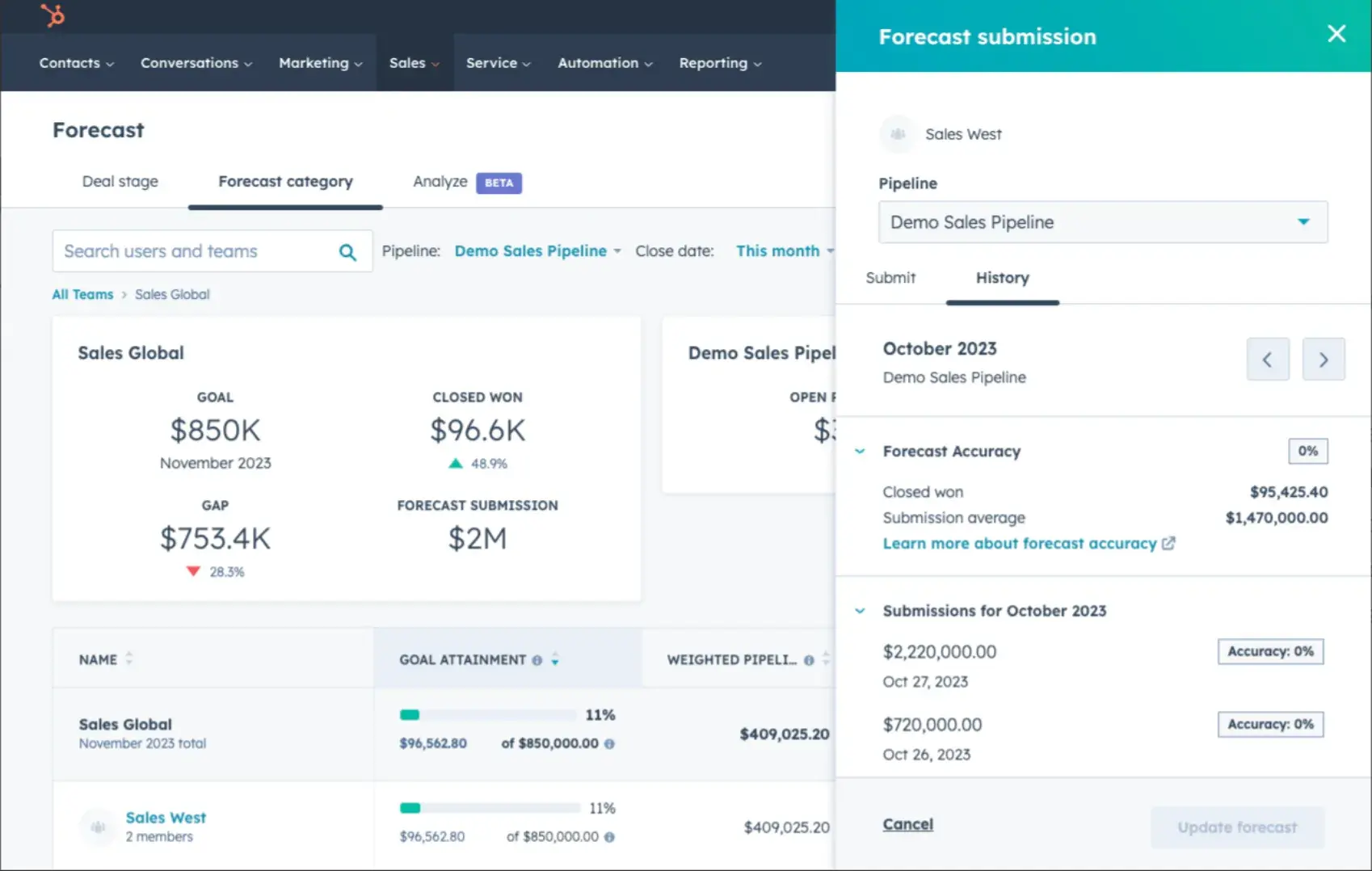
At BC Solutions, we’re avid fans of HubSpot's forecasting software, which helps our team forecast future revenue and monitor our pipeline. Both management and individual reps rely on HubSpot to track progress toward achieving forecasted goals and enjoy real-time visibility.
Forecasting in HubSpot comes with Sales Hub, a suite of AI-powered tools for sales engagement, deal management, reporting and analytics, CPQ, and coaching. One of the standouts here is the platform's AI-guided selling tools — they maximize efficiency through AI-powered deal summaries, email follow-up generation, and task prioritization recommendations.
FYI: Sales Hub integrates seamlessly with HubSpot’s Smart CRM to provide unified customer data management.
Key Features
- Timely business forecasts on a monthly or quarterly cadence.
- Easy-to-use interface for painless forecast planning.
- Efficient 1:1s for sales, service, and success teams.
- Seamless integration with the HubSpot suite of tools.
How Forecasting Works
HubSpot's forecasting tool is easy to navigate. Here are four steps to make accurate predictions:
1. Choose a preferred “forecast deal amount.”
The tool offers three default forecast deal amount options that determine how deal amounts will be displayed: total amount, weighted amount, and forecast amount.
2. Set up a forecast submission status indicator.
This will alert users who have not updated their forecasts within the specified period.
3. Set up the pipeline's forecast categories.
By default, this tool uses deal stages to forecast revenue. Deal stages can be edited, and custom forecast categories can be created. Categories can also update automatically when a deal moves to a different stage by toggling the “Automate forecast categories” switch.
4. Assign revenue goals for the team.
This feature tracks how close the team is to hitting targets for the month, quarter, or year.
What we like: HubSpot‘s forecasting tool is housed within a powerful CRM, which allows it to directly leverage the platform’s sales analytics. This means teams can pull data points via fully customizable sales reports to help build more accurate, advanced forecasts.
User Review
“I love how I can utilize this tool to forecast and track the progress toward achieving internal goals for our sales team. It also helps us navigate which deals need to be pushed along if anything has been stagnant, and reconnect the deal to help it progress.” – Katie B., G2 review
Pricing
Forecasting is only available in premium editions of Sales Hub. Prices vary by tier and number of users:
- Free: $0/month
- Starter: $20/month per seat
- Professional: $100/month per seat
- Enterprise: $150/month per seat
2. Aviso Predict
Aviso Predict is a revenue forecasting solution that promises 98% sales forecasting accuracy. This tool is designed to help users create forecasts that are highly customizable and powered by AI-driven pipeline insights.
Key Features
- A Time Series AI engine.
- “WinScore Insights” predicts the probability of successfully closing a deal and suggests levers that could influence deal success.
- Scenario forecasting, which allows you to factor “what-if” situations into your forecasts.
What we like: Aviso takes a very “data-focused” approach to revenue forecasting, which is visible in the amount of data the platform provides to users. The actionable guidance layer transforms insights into recommended actions.
Best for: Organizations seeking prescriptive guidance alongside predictive forecasting.
User Review
“Aviso replaces an extremely manual, painful, and repetitive process to collect sales forecasts at the rep, manager, and company level. It provides excellent visibility into the performance of the sales team and even highlights key deal movement throughout the pipeline.” – G2 review
Pricing: Pricing is available upon request.
3. Salesforce Sales Cloud
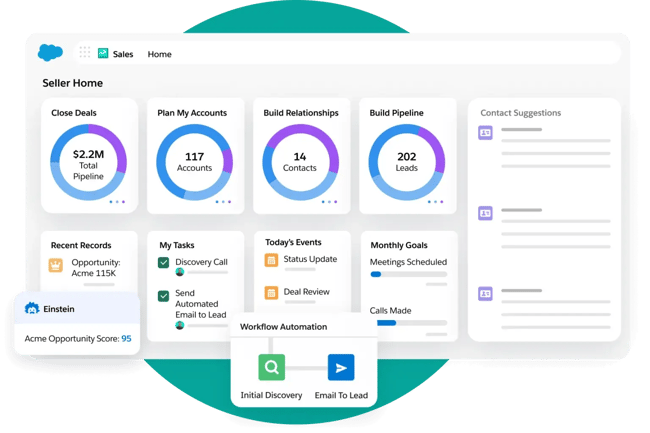
Salesforce Sales Cloud is a sales automation software that leverages data, automation, and artificial intelligence to help teams improve their efficiency. This suite includes a forecast management solution designed to help teams increase prediction accuracy.
Overall, it‘s an advanced platform that can be helpful for large companies, but if you’re looking for a simpler, more affordable tool, you might be better off with another option on this list.
Key Features
- The ability to factor product families into your forecasts.
- The ability to switch between four different types of forecasts, each with its own quota and adjustment data.
- The ability to leverage Einstein AI to drastically improve forecast accuracy.
What we like: Customers can use Sales Cloud AI, called Einstein, to determine new and existing opportunities that are likely to close during the current forecasting period. Reps can also access insights into how and why Einstein assigned the score.
Best for: Large enterprises with complex sales structures that need granular forecast segmentation and reporting.
User Review
“I love how Salesforce Sales Cloud provides a holistic view of our entire sales pipeline. The ability to customize reports, create automation through workflows, and track customer interactions makes managing sales processes incredibly efficient.” – Jigna K., G2 review
Pricing
To access forecasting features, you'll need an enterprise plan or higher:
- Enterprise: $175/user per month
- Unlimited: $350/user per month
- Agentforce 1 Sales: $550/user per month
4. Zoho CRM
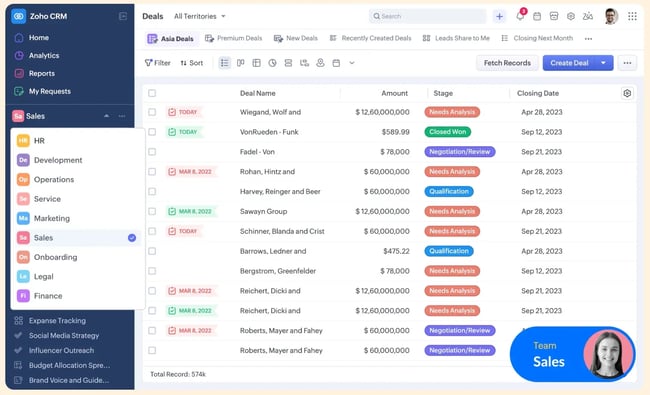
Zoho is a CRM that offers forecasting as part of its performance management suite. The platform allows you to build custom forecasts based on conditionals specified in your CRM, monitor forecasts (achieved deals, pipeline deals, pipeline shortages), and automatically create reports based on forecast numbers.
Key Features
- A warning system that alerts users about discrepancies in their forecasts, such as sales target mismatches and pipeline shortages.
- Drill down analysis to monitor pipelines and performance.
- AI-based predictive forecasting and recommendations.
- Includes contact management, sales funnels, workflow automation, task management, and more in one platform.
What we like: Zoho's predictive AI, Zia, can be configured for custom predictions. As long as the prediction matches one of the supported data types and the user can provide 200 records to “train” Zia, the possibilities are extensive.
Best for: Cost-sensitive organizations seeking capable forecasting within a broader CRM suite.
User Review
“Zoho CRM distinguishes itself through its flexibility and extensive customization options. Being able to tailor modules, workflows, and automation to fit specific business needs without requiring significant development work is a significant benefit … Furthermore, the platform’s reporting and analytics tools offer valuable insights into sales and customer data, supporting more informed decision-making.” – Ritik G., G2 review
Pricing
Prices start at $14/user each month. Note: Forecasting is only available in professional, enterprise, and ultimate plans.
5. Pipedrive
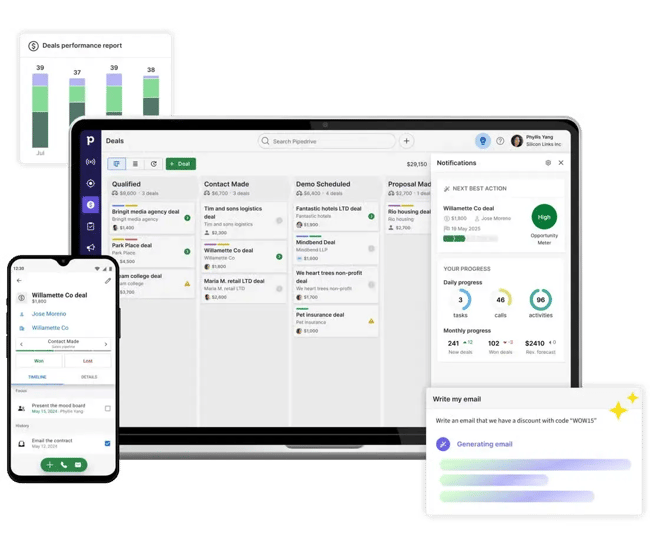
Pipedrive is particularly focused on building a healthy pipeline — hence the name. The platform's revenue forecast view allows you to set up and monitor forecasts, while the forecast reports feature allows users to generate reports based on conditionals such as forecast periods, deal status, pipeline, probability, team, and more.
Key Features
- A visual sales pipeline with a drag-and-drop editor.
- AI-powered insights and activity recommendations to help sales reps prioritize tasks.
- Focuses on activity tracking, encouraging teams to complete specific actions that drive sales.
- Built-in communication tools (email and calling integration).
What we like: Pipedrive is easy to use. Although the program is a very powerful platform, most users find it very intuitive, which is one area where a lot of advanced sales tools fall short.
Best for: Small to mid-sized sales teams seeking straightforward forecasting without complex configuration.
User Review
“I find Pipedrive to be excellent for managing my clients and calls. I really like how it allows me to organize information and contact clients, all while keeping track of who I've called, how many times, and the reasons for each call. I also value the ability to take notes on my interactions, which helps me stay organized with every client.” – Courtney M., G2 review
Pricing
- Premium: $59/month per user
- Ultimate: $79/month per user
Note: Revenue forecasting is only available in professional and power plans.
6. Freshsales by Freshworks
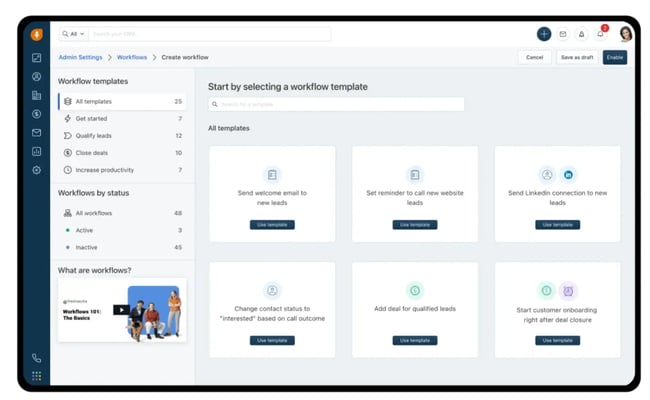
Freshworks CRM is a popular CRM with strong AI capabilities, built-in communication tools, and flexible automation options, making it particularly popular with small to mid-sized businesses focused on optimizing lead management and sales processes. Freshsales has its sales forecasting feature, powered by Freddy, an AI assistant that runs across the entire CRM.
Key Features
- A unified database that gives you a real-time 360° view of your leads.
- Workflows and sales sequences.
- Lead scoring tools.
- Kanban-style board views.
What we like: Freshsales AI-based commit suggestions are unique to the platform. Freddy uses historical data to recommend deals that are likely to convert within a set period. The simplicity of Freshsales is a big draw, especially compared to the complexity of some other platforms.
Best for: Small to mid-sized businesses focused on lead management with straightforward forecasting needs.
User Review
“The platform's pipeline and contact management have improved the way we manage our client relationships. Most of all, I like that Freshsales gives me the tools I need without overwhelming me with too much.” – Chris F., G2 review
Pricing
- Pro: $39/month per user
- Enterprise: $59/month per user
Note: Forecasting Insights by Freddy AI is only available at the enterprise level.
7. Outreach
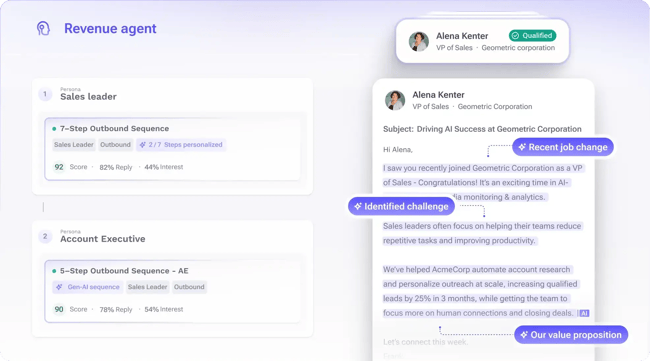
Outreach is a leading sales engagement platform that focuses on improving sales productivity by automating and optimizing communication workflows.
Key Features
- Accurately measuring coverage using AI that analyzes past shortages and surpluses.
- AI that monitors over 100 signals to proactively identify at-risk deals.
- A scenario planner that can prepare your team for best- and worst-case scenarios.
What we like: Many of the features in Outreach are very “proactive” — historical coverage analysis, scenario planning, deal signals, etc. This makes it a great tool for maintaining a healthy pipeline and reaching revenue goals.
Best for: Sales teams that prioritize proactive pipeline management and deal risk identification.
User Review
“Easily the most robust and capable platform for sales engagement — sequences and governance are highly customizable, and it's easy to ensure personalization at scale. Their growing platform, including Kaia and forecasting, is impressive.” – Jordan G., G2 review
Pricing
Pricing is available upon request.
8. Gong
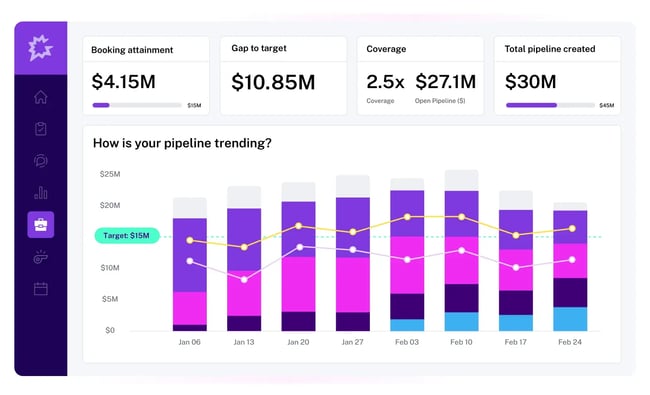
Gong is a sales conversation analytics and revenue intelligence platform. Its forecasting solution helps salespeople predict, deliver, and defend reliable forecasts. Gong is best known for its ability to analyze and transcribe sales calls and meetings, so the forecasting feature is an added bonus.
Key Features
- Conversation analytics.
- Deal intelligence with real-time insights into deal health and potential risks.
- Opportunity scoring based on conversation data.
- “Deal Boards” offer a customizable view of your pipeline.
What we like: Gong offers users a reality-based approach to forecasting. With Gong's insights, you can understand where you realistically stand with every opportunity in your pipeline based on what buyers actually say during calls.
Best for: Sales organizations that conduct frequent calls and demos where conversation analysis can meaningfully inform deal predictions.
User Review
“Gong's forecasting and reporting truly simplifies what's going on within your business from a sales perspective. Their dashboard is much easier to read and collaborate in than any report in Salesforce.” – Kristi F., G2 review
Pricing
Prices are available upon request.
9. BoostUp
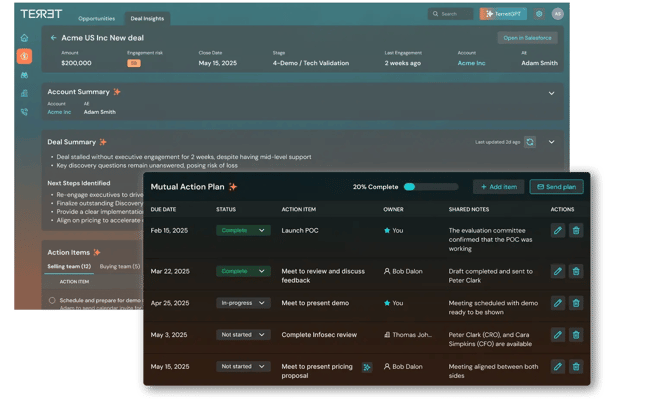
BoostUp is a flexible sales forecasting and pipeline management platform. This program allows businesses to build custom processes that adapt to their unique needs.
Key Features
- Time series analytics.
- AI predictions and pipeline risk scoring.
- Automated pipeline coverage risk analysis.
- Live forecast trend monitoring and change analysis.
What we like: BoostUp's toolkit seems particularly well-suited to sales professionals in management positions. The platform offers advanced features for high-level forecasting and forecast management, including maintaining pipeline health and optimizing team performance.
Best for: Sales teams where managers drive forecast accuracy and need tools designed for their specific workflow.
User Review
“Coming from other competitors, this was definitely a great experience knowing that forecasting is easy, tracking progress and renewals are easy, as well as new business accounts and rollup.” – Kelly W., G2 review
Pricing
Prices are available upon request.
10. Clari
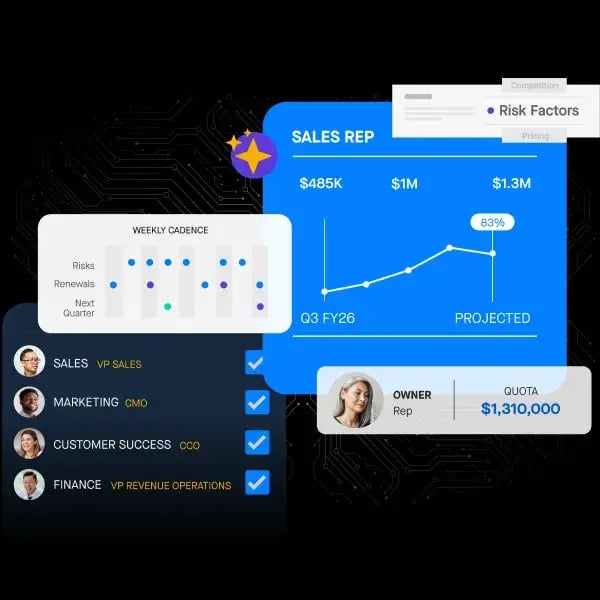
Clari is a leading sales forecasting solution that allows users to build forecasts based on real-time data and predictive insights.
Key Features
- Real-time forecast visibility for all users, with managers having visibility into entire team rollups.
- A deal inventory dashboard for reps to see information about deals in their forecast.
- A mobile app for tracking and updating forecasts on the go.
- History tracking to see changes made to the forecast within a specific time frame.
- Multiple forecast rollups across teams, product lines, geographies, and market segments.
What we like: Clari instantly reflects changes in the user's CRM. This means users can avoid the hassle of switching back and forth between platforms.
Best for: Revenue operations teams seeking comprehensive pipeline intelligence beyond basic forecasting.
User Review
“Clari is by far the EASIEST forecasting tool out there. Coming from a smaller company with fewer sales tools and resources (where we forecasted verbally or in spreadsheets), Clari is a breath of fresh air!” – Chris R., G2 review
Pricing
Pricing is available upon request.
What to Look for in Sales Forecasting Software
Selecting sales forecasting software requires evaluating capabilities against the organization's specific needs, technical environment, and growth trajectory. The following features represent the core functionality that separates effective platforms from basic reporting tools.
Accurate and Predictive Analytics
AI-powered forecasting has moved from differentiator to expectation. Machine learning models analyze patterns across historical outcomes, engagement signals, and deal characteristics to generate predictions that improve over time.
HubSpot Sales Hub includes AI-powered deal insights that surface opportunities requiring attention and help teams understand which deals are most likely to close.
Pro Tip: Be skeptical of AI claims without specificity. Effective ML forecasting requires substantial historical data — typically 12+ months of closed deals — to train accurate models.
Integration with Your Tech Stack
Seamless CRM integration is foundational. Forecasting software must pull real-time data from the system of record without manual exports or batch uploads that introduce latency and errors. Native integrations with major CRMs eliminate data synchronization issues.
HubSpot's forecasting tool is built into the CRM, eliminating integration complexity entirely. For teams already using HubSpot, this native approach ensures forecasts always reflect the current pipeline state without additional configuration.
Scenario Forecasting
The ability to model different outcomes separates strategic forecasting from simple projection. What-if analysis allows leaders to understand forecast ranges under different assumptions — accelerated close rates, delayed deals, or market shifts.
In my experience, scenario planning becomes especially valuable during periods of economic uncertainty or rapid growth, when historical patterns may not hold. Having a range of forecasts rather than a single number gives leadership appropriate context for decision-making.
User-Friendly Dashboards
Dashboard flexibility matters. Different stakeholders need different views — reps want deal-level projections, managers need team rollups, and executives require portfolio-level trends. Configurable reporting ensures each user sees relevant insights without information overload.
What we like: HubSpot's Sales Analytics tracks team performance and productivity with detailed insights into individual and group metrics, all within an intuitive interface that teams actually use.
Real-Time Data Updates
Static weekly forecasts cannot keep pace with modern sales cycles. The best forecasting tools update continuously as deals progress, new opportunities enter the pipeline, and engagement patterns shift. Real-time reporting enables proactive intervention rather than reactive analysis.
Clear ROI Tracking
The software should make it easy to measure the impact of improved forecasting. Look for tools that track forecast accuracy over time, compare predicted versus actual outcomes, and surface the financial impact of improved predictions.
The biggest trend in sales software right now? The AI hype is everywhere. Every solution claims it‘s AI-powered and will "transform" all of your processes. Don’t be distracted by the shiny object — look for software that solves your specific challenges rather than chasing the latest buzzwords.
Pro Tip: Take the time to train the team properly and maintain data quality — because that will go further than any sophisticated software. The best forecasting tool is useless without clean CRM data.
Choosing the Right Sales Forecasting Software
Selecting the right sales forecasting software requires matching platform capabilities to the organization's existing processes, technical environment, and specific forecasting requirements. There is no universal best choice — only the best fit for the current context and growth trajectory.
The best starting point is evaluating the existing tech stack, team size, sales cycle complexity, and budget constraints before comparing platforms. Peer perspectives from review aggregators like G2 or professional communities add valuable context that product landing pages rarely provide.
Organizations that succeed with forecasting software share common traits: they commit to CRM hygiene as a prerequisite, train managers to use insights rather than just view them, and treat forecasting as an iterative capability rather than a one-time implementation. The software matters, but the organizational commitment matters more.
Free Sales Plan Template
Outline your company's sales strategy in one simple, coherent sales plan.
- Target Market
- Prospecting Strategy
- Budget
- Goals
Download Free
All fields are required.
Form not available
![Modern sales orgs are leaning into marketing behaviors — here's what that means for you [new data]](https://53.fs1.hubspotusercontent-na1.net/hubfs/53/sales-team-marketing-behaviors-1-20251117-5976195.webp)
![Why your sales enablement content needs real-world credibility [new data]](https://53.fs1.hubspotusercontent-na1.net/hubfs/53/sales-enablement-content-credibility-1-20251028-1482008.webp)


.webp)

.png)