

Ever start writing a piece and wonder if anyone's even gonna read it?
Not to make you paranoid, but ... you should be paranoid.
Chartbeat conducted a study in 2013 that indicates most readers are only getting about 60% of the way through a piece of content. The other 40% of the stuff you wrote? Well, you could've gone home early that day. (You can read more about that study here.)
Download Now: Free Content Marketing Planning Kit
So why are people only reading a little more than half of the content they click on? If I was a betting woman, I'd probably lay some money on short attention spans -- but I don't think writers can place all the blame on an increasingly distracted readership. Writers need to shoulder some of the blame, too, if we're putting out stuff that is just painfully, dreadfully, mind-numbingly boring.
Some writers are given a stacked deck when it comes to business writing. Content creators working in "sexy" industries (travel, tourism, food, culture) don't have to dig too deep to write something interesting. But what about those of us in more ... ahem ... "boring" industries?
Well, I know a thing or two about boring industries. (Sorry boss, but software isn't the sexiest topic.) Here are some of the tricks I've picked up along the way -- both from my own experimentation and from reading the content others in our industry publish -- that helps transform a snooze-worthy topic into a more engaging read.
Download real examples of remarkable content marketing in "boring" industries here.
Content Marketing Tips for "Boring" Industries
1) Remember that helpful things are rarely boring. (Even if they are, objectively, pretty boring.)
Be genuinely helpful. That's a trite and exhaustingly overstated tip, but the point stands that "boring" content isn't actually boring to the people that need it. In other words, if you're writing educational content, then it's interesting to those whose question you're answering -- bells and whistles be damned.
For example, if someone needs an answer to a mundane question like how to unclog a toilet, how to negotiate a lower cable bill, or how to refinance a home, content that answers that question is incredibly interesting -- or at the very least, it's not actively boring. If you're worried you don't have the writing prowess to make a boring topic interesting, focus instead of making the most educational piece of content possible.
2) Eliminate business babble, and write like you speak.
You establish professionalism by providing solid advice, not by sounding like you got hit in the face with a briefcase. Write naturally, removing business babble that makes it more difficult for readers to understand what you're saying. Let's do a little translation to demonstrate:
Look for a provider who delivers scalable marketing software solutions to adapt to the diverse and evolving needs of organizations from SMB to enterprise across all industry verticals.
Huh? How about ...
Look for a marketing software provider that addresses the needs of companies of all sizes, and that serves all industries.
Ultimately, those two statements say the same thing; but isn't the second easier to read? Why make life harder for people?
3) Write with specificity.
At the intersection of being helpful and eliminating business babble lies writing with specificity. Your content will be far more helpful if you've taken the time to think of specific angles, scenarios, and examples that relate to your reader. You'll be able to do this more easily if you have defined personas because you'll have identified readers' pain points during the persona creation process. (If you haven't created buyer personas yet, read this blog post to get started.)
What's the difference between a generic piece of content and a specific, detailed one? It all starts with the topic. Let's take this very blog post as an example. In retrospect, I could have written something like "Best Practices for Blog Copy" or "How to Write Good Blog Content" -- but that's so broad and generic that it applies to everyone, and yet nobody at all. Instead, I came up with a specific angle on those topics after hearing time and again from leads and customers that their industry is way too boring to write blog content about. Instead of talking generically about what makes good blog content, this post addresses one specific facet of blogging that has presented itself as a recurring problem to our audience.
So yes, maybe this post excludes a segment of our audience who sells puppies or promotes supermodels -- they probably don't struggle with making their content interesting because it inherently is. But by addressing a specific problem that hits close to home to many of our regular readers, this post is far less likely to be glossed over.
4) Let your sense of humor show.
Infusing a light, humorous tone throughout your content can help add some life to an otherwise boring topic. Bonus: It can make it more fun for you to write, too. Don't be afraid to crack a joke, be a little colloquial, or draw upon silly pop culture references. If it's natural and doesn't detract from your content's meaning, a lighthearted tone can keep your audience's attention for much longer.
5) Use relatable analogies to explain complex concepts.
If you work in an industry some might deem boring, consider that "boring" might simply be code for "confusing." A great example is physics: There are plenty of people willing to watch Through the Wormhole and listen to Morgan Freeman explain Dark Matter. But would they be willing to read an article from a PhD on the same subject matter? Probably not ... unless she had a knack for explaining concepts in terms novices can understand. (Reading it in Freeman's deep, soothing timbre wouldn't hurt, either.)
If you work in a similarly complex industry and market to people who aren't subject matter experts, consider introducing new concepts to readers through relatable analogies that explain things in terms they can understand.
For example, though not as complex as Dark Matter, some businesses are still unclear how inbound marketing works. To make it easier to digest, we've come up with several analogies that put it into relatable terms. One of my favorites? "Blogging is like jogging: You have to do it consistently and over a long period of time if you expect to see results." (For more marketing analogies, check out this blog post.)
6) Edit for brevity.
If your topic isn't inherently interesting, people will be even less willing to devote time to it. Invest in an editor who can say what it takes most people to say in 100 words, in 20. The less time it takes to get through a paragraph, the less likely you are to experience reader drop-off.
This becomes even more important if you consider the rise of mobile readers. Consumers spend 60% of their internet time on mobile devices, meaning content that's difficult to read is even more likely to be abandoned. An easy-to-read mobile experience doesn't include just responsive design; a speedier reading experience with less scrolling is important, too.
7) Give readers little mental breaks.
Part of not boring your audience is simply not making them feel overwhelmed. That means any written content has to look easy to read, even if it's well-written and fascinating. Break up your text into smaller, more easily digestible chunks so readers feel capable of tackling a more difficult piece. This is particularly important if, even after editing for brevity, you're still left with a necessarily lengthy piece.
For example, I used big, bold headings in this post because it lets readers scan over each section and read only those that apply to them. You can also make use of bullets, numbered lists, images, and other formatting devices to help dense content (in subject matter, at least) look less overwhelming for readers.
I'll level with you: In an ideal world, none of these formatting devices are necessary because the writer has crafted a narrative so fascinating and expertly executed readers can breeze through it effortlessly, regardless of subject matter complexity. However, we know the real world isn't always ideal. In those cases, lean on formatting.
8) Tell your story visually, or via different mediums.
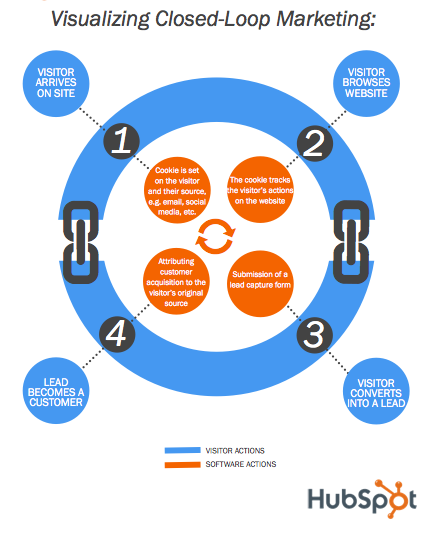 Instead of words, many content creators rely on visuals to tell a ho-hum story. For example, we've accumulated quite the library of blog posts and ebooks about closed-loop marketing.
Riveting, I know.
But sometimes, a picture is worth a thousand words, which is why we eventually developed this visual to help explain it more succinctly.
Keep in mind there are mediums outside the blog post, too. For instance, we've recently launched a podcast (called The Growth Show) because we're aware not everyone is apt to read a blog post to learn about business growth. Similarly, we invest in video, interactive content, GIFs, tools, reports, and other asset types and mediums that help us communicate concepts in the least boring and most accessible way possible.
9) Interview inherently interesting people.
Speaking of podcasting ...
Who wants to hear a talking head spout facts? Not many, which is why broadcast news has used the interview for years to grab their audience's attention. Bring on an authority figure or celebrity who can speak to a particular subject matter, and you'll have more eyes and ears than if you tackled the subject matter yourself.
We turn to experts in blog posts from time to time, and every week on our podcast -- not just because we know our audience likes to hear from people other than us, but because other people know things that we don't.
So, does your industry have a superstar that would strike your audience's fancy? Get them on the horn so their celebrity can help add some spice to your content.
Pro Tip: There's a good chance some of your readers are subject-matter experts and would be willing to provide quotes or interviews every so often. You could solicit their opinion to help feed your content and show appreciation for their participation in your community. (And because, hey, people love to see their name in lights.) The easiest way to do this is to tap into your social networks to crowdsource answers to questions you'd like to feature in your content. Just make sure to publicize the content once it's written and let your contributors know when their answers will be featured.
10) Shock people's pants off.
You know what's only mildly interesting (unless you're a marketing geek, in which case it's awesome)? Lead generation via social media. You know what's way more interesting? Knowing that LinkedIn is 277% more effectiveat generating leads than any other social network.
You guys. That is way more effective.
If you can take a relatively "blah" topic and find a surprising facet of it around which to center your content, your audience will be hooked.
You don't need to rely solely on data points to shock people, either. If you have the stomach for it, you could take on a bit of controversy, too. We do this every once in a while. Ever read our blog post telling the USPS to stop encouraging direct mail? Yeah, readers came down on all sides of that issue, and not all of them were the author's. That's alright. At least people were reading about and interested in industry issues, which is the whole point of creating all this content, anyway.
Are you a marketer in a "boring" industry? How do you make your content interesting?
Editor's Note: This post was originally published in July 2012 and has been updated for freshness, accuracy, and comprehensiveness.


Content Marketing
-1.webp)
![How to create a content style guide [+ free guide & examples]](https://53.fs1.hubspotusercontent-na1.net/hubfs/53/image1-May-07-2024-07-15-58-1152-PM.webp)