

One of the most heated arguments that I've been a part of was about whether or not Taylor Swift is a good dancer.
The first thing you should know about me is that Taylor Swift is my favorite artist. So you'd have a hard time convincing me she's bad at anything (because she isn't).
SEO experts are probably the same way when debating whether subdomains or subdirectories are better for SEO. As a marketer, that debate can cause confusion and analysis paralysis.
In this article, you’ll learn the differences between a subdomain and subdirectory and how they affect SEO. There are pros and cons to both, and you’ll want to consider all of these factors before moving forward with your website project.
Free Guide: How to Run a Technical SEO Audit

What is a subdirectory?
A subdirectory is a type of website hierarchy under a root domain that uses folders to organize content on a website. A subdirectory is the same as a subfolder and the names can be used interchangeably.
Subdirectory URL
In a URL, the subdirectory comes after the root directory or domain name. For example, HubSpot’s root domain is hubspot.com. So a subdirectory URL might be hubspot.com/pricing. Or it might be something more complicated like hubspot.com/pricing/sales. Below is an illustration of one possible subdirectory structure.
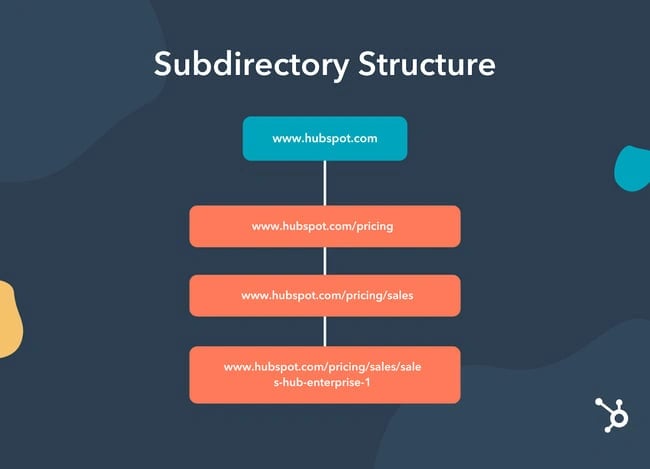
When it comes to subdirectories, think of a structure similar to nesting dolls. Each folder can build off of one another almost indefinitely. That means you could have a subfolder within a subfolder within a subfolder until you’re dozens, potentially hundreds, of layers deep.
But just because you can doesn’t mean you should.
Too many layers of subfolders can become an SEO nightmare. The URL string becomes long and confusing, the user experience is at risk with every click it takes to get to the next piece of content, and search engine crawlers will find it nearly impossible to crawl your site for new content and other SEO wins you may have added.
On the other hand, subfolders can be great for SEO as they keep any earned backlinks, domain authority, and page authority closely tied to the root domain. And when the site is fairly easy to navigate, the URLs are short and simple, like hubspot.com/careers, which means you can market specific webpages or landing pages by their URL without confusing your audience.
What is a subdomain?
A subdomain is also a type of website hierarchy under a root directory, but instead of using folders to organize content on a website, it kind of gets a website of its own. This subdomain is still closely associated with the root directory, but it will usually have a separate content management system, template, analytics tools, and more.
The structure of a subdomain is fairly flat at the top levels. You’ll have your root directory, then all the subdomains underneath it in a horizontal row. All subdomains are on the same level. You won’t have a subdomain within a subdomain like you would a subfolder within a subfolder.
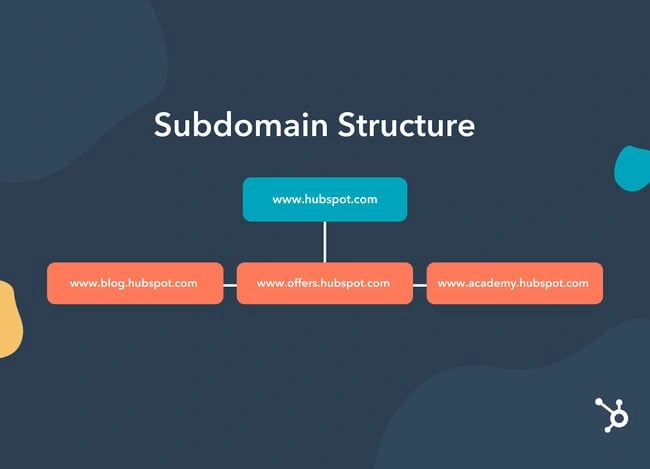
SEO and Subdomains
A subdomain can be great for SEO, but it will require a dedicated person or team that can manage it. Unlike subdirectories, a subdomain’s domain authority won’t automatically trickle down from the primary domain name. You might also pay extra for tools or subscriptions if you’re billed per domain name since each subdomain will typically count as a separate website. Keeping these challenges in mind, let’s take a closer look at the benefits of using a subdomain.
Why use subdomains?
Subdomains are ideal if your business houses a lot of content that would be difficult to manage all on one website. You may also find this structure beneficial if you run several large recurring campaigns that need separate landing pages or if you plan to do a partnership with another organization and want to split the branding on the project.
In short, subdomains make sense if you have a relevant business need to separate content on your website.
When to Use Subdomains
- Support
- Different Regions
- Blog
- Ecommerce Store
- Events
There are a number of instances when a company should use a subdomain. Below are the most common.
1. Support
Sometimes it doesn't make sense to have your customer support on your main site. For instance, Google uses support.google.com instead of google.com/support. The main reason is probably because of the site structure. Google.com is a search engine, and Google’s Support line doesn’t belong to its Search business line. Therefore, it needs its own subdomain to properly connect with and serve its users.
2. Different Regions
If you serve multiple regions, whether nationally or internationally, using a subdomain would be a good idea. If you had a site in German and one in English, it wouldn't make sense to list those as subdirectories. For instance, Craigslist uses subdomains for the different regions it serves. Here are two of its subdomain sites: orangecounty.craigslist.org/ or stgeorge.craigslist.org/.
3. Blog
Many companies choose to have their blog as a subdomain. In fact, that's what HubSpot does. If you'll notice, the page you're on right now is a blog.hubspot.com page. However, this specific article is in the Marketing subdirectory of the blog.hubspot.com subdomain. Sites may choose to have their blog as a subdomain if they have a content campaign in mind that’s large enough in volume to deserve its own hierarchy and growth path (more on that in a minute). Additionally, a subdomain is useful for a blog if you want to create a niche authority.
4. Ecommerce Store
For companies that sell merchandise, in addition to their regular product or service, they can put their ecommerce store on a subdomain. HubSpot does this as well. Aside from our main software hubs, HubSpot merchandise is available at shop.hubspot.com.
5. Events
If your company hosts events, it might be a good idea to partition that section of your site into a subdomain. Again, this is helpful when you want to distinguish a section of your site from your regular product or service. Microsoft does this with its events.microsoft.com.
Subdomain vs. Subdirectory
A subdomain compartmentalizes your website so you can establish specific content types that are distinct from your root domain. On the other hand, a subdirectory is a pathway within your site. Subdirectories are a level within the domain’s hierarchy. Subdirectories branch off from the subdomain they belong to.
Technically, a website can use both a subdomain and a subdirectory structure. Subdomains will usually have at least a few subfolders within them to organize content, but likely not as many as a subdirectory. That’s because there is a smaller variety of content covered on a subdomain than a root domain with subfolders.
So it’s important to understand what the primary structure of your website will be. To decide this, let’s take a closer look at how subdomains and subdirectories impact SEO.
How do subdomains and subdirectories affect SEO?
Some SEO experts believe that Google's crawlers could confuse a subdomain for an entirely different website from the main domain. However, others say its crawlers can recognize subdomains as extensions of parent domains.
According to Google, the site crawls, indexes, and ranks subdomains and subdirectories the same way.
In the video below, Google Webmasters Trends Analyst John Mueller says, subdomains generally don't hurt a site's rankings. In fact, he says Google is smart enough to see your main domain and subdomain as being tied to the same website.
Some SEO professionals argue that subdomains don’t share the authority they receive from inbound links (or backlinks) with the root domain. The reverse can also be true; because subdomains are considered separate entities from your root domain, they may not inherit any of the link authority you’ve already built to your core website content.
Additionally, if you're optimizing pages for the same keywords on your main site and subdomain, you could be competing against yourself.
On the other hand, other SEO experts argue that subdomains make it easier to navigate your site. Ultimately, this leads to a better user experience, which could result in better engagement rates, therefore improving your SEO.
Subdomains can be beneficial if you have a large corporation and the subdomains serve a different purpose and essentially function as a separate business.
For example, Disney has subdomains such as cars.disney.com, shop.disney.com, and movies.disney.com.
Since these subdomains serve very different purposes, it doesn't matter if the sites don't share the same authority from backlinks, because they probably aren't targeting the same keywords.
According to some SEO experts, another benefit is that subdomains can help build niche authority. For instance, you might want your blog to be considered a separate entity from your product or service.
Conversely, if your site doesn't have any extensive verticals on your navigation, then you might not need to use a subdomain because you want as many links going back to your main site as possible. If you don't have a compelling reason to use subdomains, then subdirectories work just fine.
Which is Better: Subdirectory or Subdomain?
Although this topic can often be confusing, ultimately the decision depends on your website's needs. Subdomains can provide organization and structure to your site if you have a lot of different, but important content to share. Subdirectories can be helpful for smaller websites that don’t have a large variety of content. No matter which structure you choose, you’ll want to stay abreast of SEO best practices in order to meet your website goals. The free guide below will help you improve your site with a free SEO audit tool kit.
Editor's note: This post was originally published in February 2020 and has been updated for comprehensiveness.

Technical SEO
![The top search engines other than Google [+ some you might not expect]](https://53.fs1.hubspotusercontent-na1.net/hubfs/53/other%20search%20engines%20header%20image%20.jpg)