Yes, that's me -- steaming over the leaks from my brand-new roof installed by a name-brand, big-box home improvement center. It's bad enough that the roof leaked when it hadn't before. And, it was made even less palatable to deal with when one of the leaks was over my side of the bed.
Repeated telephone calls to the sales person, the sales manager, the customer service manager, the regional manager, and the divisional manager all resulted in a total lack of response. For. Five. Months.
The Twitter Complaint
So, what did I do? I went to Twitter and started asking @BigBoxCares why my roof was leaking not in one place -- but several. And, with the Tupperware bowls littering my house to catch the inches of water flowing from the newly installed roof, a couple of Twitpics to share my annoyance.
Their tweeted response after my five moderately snarky tweets? "Please send an email to the @BigBoxCares customer service team with the name of the store that you purchased the roof, the installation date, and a complete history of the entire communication process. Oh, and by the way, please stop tweeting about your customer service concern because, you know, we care."
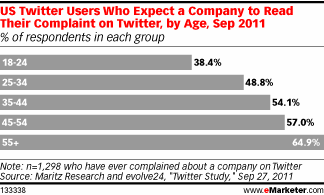
My tale of woe and subsequent turn to Twitter as recourse is not uncommon in today's highly socialized world of customer service. According to customer experience research company Maritz Research, nearly half of consumers who tweeted a complaint directed toward a brand expected the company to respond—or at least to read their tweet. However, only a third of those consumers received a tweeted response from the mentioned brand. I was lucky, I guess, if that is considered the norm that they bothered to answer.
Most people expect a response to their complaints. And because many consumers are using Twitter to talk about their experiences with brands, from time to time, they share their grievances. As more and more brands have joined Twitter, consumers’ expectation for interaction with brands has risen. The Maritz study indicates that 86% of Twitter complainers would have liked or loved to hear from the company regarding their complaints.
Expectations of Twitter Complainers
Here is a chart from eMarketer showing the age of the folks expecting a response from the brand they've tweeted. As you can see, the younger you are, the lower your expectations. I fall within the >50% population that expects a response.
Marketing Takeaway
Many brands are responding to tweets and mentions in order to maintain their reputations and sustain important customer relationships. Are you one of them? What are you doing to monitor your Twitter and other social media accounts to respond to and proactively prevent customer complaints?
Smart marketers understand the importance and impact of good customer service -- especially online customer service -- and how it can affect brand perception. Spend time monitoring your social media presence and reacting to both positive and negative mentions of your brand. Your prospects and customers will thank you.
Do you believe that consumers view brands that respond via Twitter positively?
Sergei Dolukhanov 3:32 PM on October 28, 2011
Although I'm biased, I use EvoApp to make sure all the complaints are accounted for.. not just on Twitter but the entire social web.
That's actually how I found this post.
Cheers,
- Sergei Dolukhanov
@sdolukhanov (twitter)
www.evoapp.com
Lydia Sugarman 6:55 PM on October 28, 2011
That's pretty egregious behavior by a major retailer, so it's not surprising you got that kind of response when you tweeted. What's surprising is that you got any response at all!
In my experience, using Twitter to get satisfaction from a vendor has to be done sooner, rather than later. The longer you wait, and 5 months is a looong time, the less inclined they are to respond with a real solution. After all, they've already been stringing you along for 5 months. With the first leak, start tweeting and keep tweeting multiple times per day. Include the Twitter accounts of other sources, e.g. BBB, newspapers, bloggers, local TV reporters, when you tweet.
I promise, you *will* get attention and the situation will be quickly rectified.
I've collected debts, gotten service appointments, refunds, shut down a racist Meetup group, and more using this technique.
Dana Tan 7:17 PM on October 28, 2011
I call the process of getting pestered by complainers via social media channels "getting Yued." I made up this term last week when I wrote a post about how Dennis Yu was using Facebook and Twitter to whine publicly about SEOMoz because they wouldn't do exactly what he wanted.
I think there is a time and a place to complain. I don't think there is anything wrong with a company requesting that the conversation moves offline and continues via phone or email. Back and forth between arguing parties is really not useful content for the rest of the world. However, if a complaint, compliment or review might assist other people, then social media is the right place for it.
For example, today I discovered that an E-commerce platform we were considering cannot calculate sales tax properly for CA. I found one that did. I posted this information in a Tweet because it might help other business owners choose the right platform. It wasn't a complaint as much as it was a "heads up."
Complaining or not, social media is not a place to whine, belittle, slander or cuss at anyone. A little collegiality will go a long way.
Glenn 10:17 PM on October 28, 2011
I'm almost speechless about this post. First of all it's great that you point this out to us as consumers, but also that you say it so that any brands that are listening can change their behaviour. I'm speechless because I can't believe how bad the statistics are for response. 1/3 respond?! That's just not acceptable.
Here are the things that jump off the page for me:
1) 1 in 3 brands respond to tweets. What?!?! That's like answering 1 of every 3 phone calls to your business. Does anyone think that would be acceptable?
2) The fact that it's a tweet makes it MORE important to respond to than phone calls or emails, because tweets are PUBLIC! Everyone can see your comment/complaint which means it's that much more important to respond to the tweet.
Thanks for this Jeanne.
John 7:31 PM on October 30, 2011
I once made a snarky comment online about @oncor and had a twitter reply within 1 hour and a phone call with an explanation within 2. I do view them differently now, and so does everyone I tell the story to.
Essex SEO 11:38 AM on October 31, 2011
This is something we started to keep an eye on after I found that on occasions the only way to get a company to deal with a problem was to mention it on Twitter.
I only go to Twitter once I've exhausted all other channels of communication with a company.
Fast Host responded immediately, but I was too far gone by then and moved to a different company. They obviously keep an eye on any mention of their company name as I had not # tagged them or used thier @Name
The other didn't respond and will not get a mention here :)
-Chris
Jeanne Hopkins 12:07 PM on October 31, 2011
Hi Lydia -
I wanted to give them the benefit of the doubt. And, the installer was a nice enough guy, while having little power.
They wanted me to email their @cares email account, which did not accept the emails (I guess this is a whole other blog post).
Hi Dana - I agree with you that it was not the place but I figured that someone other than the regional folks would be watching. And, I was right. But, they weren't doing it correctly.
Thanks everyone for your comments. It was not fun, and I believe that the Marketing dept. was trying to monitor but had no recourse to help. A lack of integration on the store to corporate level, and the poor communication is what caused this unhappiness.
Josh 9:25 PM on October 31, 2011
companies that respond to their twitter complaints or comments in a timely manner as well as not just giving a generic response will be viewed in a positive light and will have much happier customers at least from their customers that use twitter.
Danusia 5:28 AM on November 01, 2011
I cannot fathom why any brand would choose to tweet, and then choose NOT to respond to 2 out 3 twitter complaints they come across?
If a brand twitter account has been setup, surely that means you're paying attention to your brand mentions online? So if someone does make a complaint, you're then in an excellent position to offer an immediate (or at the very least a prompt) opportunity to get the issue resolved.
Ray Abram 5:00 PM on November 01, 2011
In this day and age companies should be monitoring twitter relentlessly. Talk about real time CRM with very little, if any additional cost.