
Once you've created a killer product and have identified your target market, company growth can take off — and it's important to dedicate just as many resources to retaining existing customers as to selling to new customers.
And that's what your customer success team is for — to help customers see value and achieve goals using your product or service.
Download Now: Free Customer Success Playbooks
But there's more to it than just answering their phone calls and helping them onboard with your software — it's about creating a process from the very beginning that fosters communication, trust, and mutual growth.
Read this guide to learn all about customer retention — how to measure it, why it's important, and how to foster it with every new customer you attract.
Customer Retention
Customer retention is a company's ability to retain its customers over time. It's a percentage-based metric measuring how many customers are retained by the end of a given time period.
Customer retention refers to the ability of a company to — you guessed it — retain customers. Customer retention is impacted by how many new customers are acquired, and how many existing customers churn — by canceling their subscription, not returning to buy, or closing a contract.
Before diving into specific customer retention management strategies let’s cover the basics.
What is customer retention management?
Customer retention management is the process of maintaining relationships with your current customers to delight them long after they purchase your product or service. In doing so, you encourage these customers to remain loyal to your business.
Who manages customer retention?
Customer retention is typically managed by customer success. The role of this team is to work with and delight your customers throughout the duration of their relationship with your company (no matter how long or short this time frame might be).
Customer success teams should not only work directly with your customers to improve and maintain retention rates, but work with other teams within your organization to do so as well.
For example, customer success should help teams like sales or customer service and support — roles that have the potential to directly impact retention — organize, manage, and improve all aspects of the customer experience. This way, your entire business works together towards consistently improving customer retention.
Over the course of a given time period, customer retention is measured by customer retention rate — more on that below.
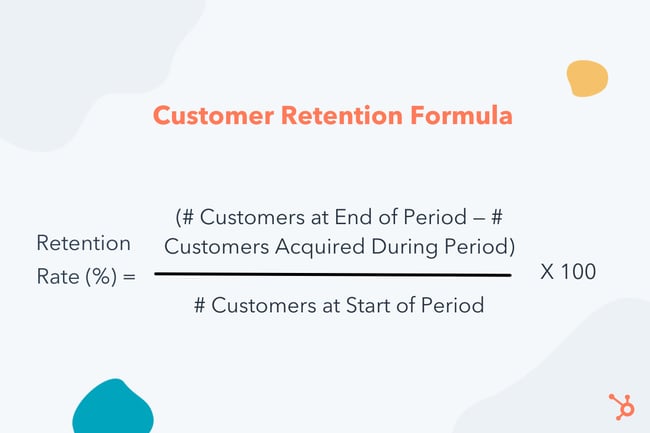
Customer Retention Formula
Customer retention rate is calculated using the following formula: [(# Customers at End of Period — # Customers Acquired During Period) / # Customers at Start of Period] x 100
Before you begin to consider a retention strategy, understand what your current customer retention rate is.
First define a period of time, e.g., quarterly or yearly. Then, follow this formula:
[ (# Customers at End of Period — # Customers Acquired During Period) / # Customers at Start of Period] x 100
 For example: Imagine you start the year with 20 customers, gain five new customers in the first quarter, and have one customer churn.
[ (24 - 5) / 20 ) ] x 100 = 95% retention
Here's another example: You have 44 customers, you gain 12 new customers, and 13 customers churn:
[ ( 43 - 12 ) / 44 )] x 100 = 70% retention
Once you know your rate, consider doing an audit of your churned customers to determine similarities in reasons for leaving or types of customers that leave. You might find that customers with a certain budget or at a certain company size are more likely to churn than others.
Why is customer retention important?
Customer retention measures not only how successful a company is at acquiring new customers but also how successful they are at satisfying existing customers. It also increases ROI, boosts loyalty, and brings in new customers.
It's also easier and more cost-effective to retain customers than to acquire new ones, returning customers spend more and buy more often, and refer friends and family. Only a 5% increase in customer retention can increase company revenue by 25-95%.
The numbers don't lie: Retaining customers brings companies a ton of ROI.
There are a few reasons why customer retention is critical to company growth and success:
- Affordability: It's 6 to 7 times more expensive to acquire a new customer than it is to retain an existing customer.
- ROI: A 5% increase in customer retention can increase company revenue by 25-95%.
- Loyalty: Retained customers buy more often and spend more than newer customers. They've learned the value of a product or service and keep coming back, again and again.
- Referrals: Satisfied, loyal customers are more likely to sing a company's praises and refer their friends and family — bringing in new customers, free of charge.
It might seem obvious — of course, companies should want to retain customers — but when companies start growing quickly and struggle to implement a solid customer support program, proactive customer support for existing customers can slip through the cracks.
Customer Retention Rate by Industry
The average customer retention rate varies across industries, according to this 2020 roundup of Statista's industry retention rates. Those average rates are:
- Retail: 63%
- Banking: 75%
- Telecom: 78%
- IT: 81%
- Insurance: 83%
- Professional services: 84%
- Media: 84%
Use the industry retention benchmarks above to assess whether or not you are meeting customer expectations.
When you dedicate time, resources, and creativity to improving your retention, your current customers will be delighted and want to continue doing business with you.
We'll review strategies that will help you improve retention next.
Customer Retention Management: How to Improve Retention Rates
- Highlight case studies during the sales process.
- Set expectations early and often.
- Communicate results on a regular basis.
- Create a roadmap for the future of the relationship.
- Make memories around your shared successes.
- Ask for feedback and act on this information.
- Map out a consistent customer experience.
- Create a customer relationship marketing strategy.
- Keep a record of communication and any past problems.
- Make sure that the customer has a relationship with the entire team.
- Use reciprocity to increase loyalty.
- Build a customer loyalty program.
- Empower customers with the tools they need to succeed.
Now, let's look at those strategies to help you with customer retention management.
1. Highlight case studies during the sales process.
A significant portion of the sales process should be focused on determining if your company and the prospect are the right fit.
Share previous case studies that reveal your company's style of communication and collaboration with customers and the results you achieved for customers. You could also share testimonials from current customers to really bring it home for them just how much you partner with them.
It's similar to researching any big buying decision. You want to know if and how it will work before you make a purchase. If the customer truly understands this, they will be more likely to properly set expectations and be happier with their experience once they sign on.
2. Set expectations early and often.
If you don't set expectations and communicate these clearly, customers can easily become upset. They might believe you can deliver on certain results, while in reality, those results are only seen in month six or with additional initiatives and work input.
In addition, your customers are coming from very different businesses. One customer might feel that your prices are high, and therefore, they expect an extremely high amount of expertise and "white glove" customer service, while for another customer, you might be one of many different company partners, and the customer cares more about your ability to collaborate than care for their brand.
Understanding these points of view and communicating deadlines, progress toward goals, what's included in a project, your process, your communication style, etc., is essential for making sure expectations are met. This, in turn, will keep customers happy with the relationship, longer.
3. Communicate results on a regular basis.
Customers are more likely to stay with your company if your product or service is delivering results and ROI for them. If a customer can point to the fact that your company has influenced or increased leads, MQLs, SQLs, lifetime value, their own customer retention, etc., then it will be much more difficult for the customer to say goodbye.
That means you need a good system for tracking and reporting on the metrics that really matter to the customer, which should relate to the goals you established together.
Be transparent about the activities you executed last month, the results you saw, where you see opportunities for improvements, and what you will work on next month. In addition, use a project management tool so that the customer can easily see how far along the team is in a project.
4. Create a roadmap for the future of the relationship.
Many people compare the customer-company relationship to dating — and this isn't that far off. And it's especially true when you consider the lifecycle of dating. At some point, one person in the relationship wants to know that this is "going somewhere." He or she wants to know what the "plan" for the future looks like.
This desire to know that you are working toward a "next step" can also be applied to business relationships. It can be easy for the customer-company relationship to fall victim to routine — everything is going great, you know what type of work the customer wants (and will approve), and you understand what works to reach their goals.
That gets boring quickly though, and it's easy for the customer to wake up one day and realize how uninspired and unmotivated the company team is.
Your customer success managers should create and revise on a regular basis a relationship roadmap. Build in steps for initiatives and projects that both parties can look to and be excited about the current and next stage of the relationship.
5. Make memories around your shared successes.
It's known that people tend to remember negative experiences. Even if there are more positive events overall, the bad occurrences may be the longest-lasting memories — not to mention those people with those experiences may share them with members of their personal and professional networks.
So, customer success teams need to consider how they can create better, more memorable experiences around positives and successes. When something negative occurs — a goal or deadline is missed for example — the company team overly communicates, discusses plans for fixing the issue, and apologizes.
But, when something truly great happens, how much of an emphasis do you place on the event?
6. Ask for feedback and act on this information.
You can't improve customer retention without first understanding why customers leave your company. Once you know the reasons and the correlating signs, you can work to prevent customer churn by proactively dealing with issues.
Ask for regular feedback from the entire customer team, including the decision-maker. Use a customer feedback tool to track trends by either the customer or the individual.
For example: By tracking by project, you can identify customer happiness trends and work to improve processes or ask for more qualitative feedback on what exactly is contributing to the fall in customer satisfaction.
Being able to identify and address these issues as early as possible will help you to prevent customers from leaving you in the first place. The voice of the customer is a powerful customer retention tool — so use it.
7. Map out a consistent customer experience.
Consistency builds trust with customers. They know what to expect and can rely on your team to get the work done and deliver the results they need.
Without this, most interactions are a surprise, and in reality, customers don't like surprises — even if they say they want to partner with a more "innovative, fun, risk-taking company."
Build out processes for onboarding new customers and kickoff meetings to create a smooth customer experience. Examples include setting agendas for meetings and building workflows around projects and sharing these with customers.
By having a process for each of these activities, your team will be more efficient and customers will gain insight into what needs to be done, and when.
8. Create a customer relationship marketing strategy.
Have you considered what the communication from your company looks like once a customer signs on? Yes, she emails and works with her customer success manager, but how often does she hear from the new business director who convinced her to buy from you?
Think about creating a newsletter sent from the company CEO for monthly or quarterly check-ins. Consider any education or training needs of the customer you should address. Come up with interesting, light-touch ways to continue to build up the credibility of your company's brand with the customer.
9. Keep a record of communication and any past problems.
Your company's culture, leadership, and business practices all contribute to retention, but another way to prevent disruption in changes in personnel is by adopting a CRM where you can store notes from meetings and phone calls, ongoing issues, personal preferences of the customers, etc.
With detailed notes and a complete history of the relationship recorded, a new customer success manager will be ready to be a true authority for the customer much more quickly.
10. Make sure that the customer has a relationship with the entire team.
Typically, customers mainly communicate with their primary customer success manager. These individuals form a bond during hundreds of meetings, phone calls, and emails. They know each other's favorite restaurants, what sports their kids' play, and other seemingly inconsequential details.
But change puts these relationships at risk — and, in turn, your company's customer retention rate. If the customer success manager leaves or is promoted, the relationship is at risk. If the relationship is extremely friendly, the customer might not be happy with anyone else.
The bottom line is, if the customer's sole connection to the company is based on one relationship, there's a risk of churn during periods of employee turnover — a natural part of professional development within an organization that customers just aren't always privy to.
This is a risky place to be in terms of retention, so your company needs to make it a goal that customers build relationships with multiple members of the team for cases like these.
Send the customer pictures of the entire team working on the latest project, or whenever there is a customer lunch, make sure there is another member of the team present.
11. Use reciprocity to increase loyalty.
Reciprocity is a social construct that has been found to increase loyalty. Acts of kindness create a feeling of obligation in the person who instinctively wants to repay the kindness.
There are two types of reciprocity: surprise and trumpeted. Both of these can be used in customer service to increase loyalty.
Surprise reciprocity is obviously a surprise gift or gesture. An example of this would be when your company sends over tickets for a game the day of or when a goal is achieved earlier than anticipated.
Trumpeted reciprocity is when the person giving or doing something beneficial does so in a way that reveals that they are going above and beyond. It doesn't mean you document and put all the great things you do in a monthly report, but it is obvious to the customer that what you are doing is outside the normal scope of the relationship. This could be as simple as taking behind-the-scenes photos at a video shoot and packaging them in a memorable way as a gift for the customer's team.
12. Build a customer loyalty program.
One of the wisest ways to foster customer loyalty and retention is by providing even more value to them — and this can take the form of a customer loyalty or rewards program.
You are probably familiar with these programs as they’re popular with airlines, hotels, eCommerce, restaurants, and other retailers.
User-generated content, loyalty bonuses, gamification, and rewards for customer referrals are simple customer retention tools that can go a long way towards fostering loyalty — read about more examples of successful customer loyalty programs in this blog post.
13. Empower customers with the tools they need to succeed.
Nobody likes to wait around for support or assistance. Nobody likes to sit around searching how to accomplish specific tasks on their own either. So, instead of creating long customer support and service waits for your customers (and creating more work for your support team), empower them with the tools and resources they need to succeed.
There's a wide range of ways you can empower your customers to help themselves and find the support they need individually. To do this, you might send emails or newsletters with tutorials that cover details about your company or your product/ service's newest features. You may also share a list of your blog articles to help them accomplish their specific business goals.
Improve Your Customer Retention
Ready to get started making your customers happy to improve your company's outcomes? Follow the customer retention management strategies we covered and consistently keep track of your business's retention rates to keep an eye on how you're doing.
Editor's note: This post was originally published in October 2019 and has been updated for comprehensiveness.

![7 Customer Acquisition Challenges You Might Face This Year [New Data]](https://www.hubspot.com/hubfs/customer%20acquisition%20%20%281%29.webp)




![Big Brands That Lost Customers' Satisfaction in 2023 [Where CX Went Wrong + Data]](https://www.hubspot.com/hubfs/companies%20that%20lost%20customers_featured.png)


![How to Calculate Churn Rate in 5 Easy Steps [Definition + Formula]](https://knowledge.hubspot.com/hubfs/ai%20customer%20service%20predictions%20%283%29.webp)