
After months of hard work, multiple coffee runs, and navigation of the latest industry changes, you've finally finished your next big marketing campaign.
Complete with social media posts, PPC ads, and a sparkly new logo, it's the campaign of a lifetime.
But how do you know it will be effective?
Free Download: A/B Testing Guide and Kit
While there's no sure way to know if your campaign will turn heads, there is a way to gauge whether those new aspects of your strategy will be effective.
If you want to know if certain components of your campaign are worth the effort, consider conducting a marketing experiment.
Marketing experiments give you a projection of how well marketing methods will perform before you implement them. Keep reading to learn how to conduct an experiment and discover the types of experiments you can run.
What are marketing experiments?
A marketing experiment is a form of market research in which your goal is to discover new strategies for future campaigns or validate existing ones.
For instance, a marketing team might create and send emails to a small segment of their readership to gauge engagement rates, before adding them to a campaign.
It's important to note that a marketing experiment isn't synonymous with a marketing test. Marketing experiments are done for discovery, while a test confirms theories.
Why should you run a marketing experiment?
Think of running a marketing experiment as taking out an insurance policy on future marketing efforts. It’s a way to minimize your risk and ensure that your efforts are in line with your desired results.
Imagine spending hours searching for the perfect gift. You think you’ve found the right one, only to realize later that it doesn’t align with your recipient’s taste or interests. Gifts come with receipts but there’s no money-back guarantee when it comes to marketing campaigns.
An experiment will help you better understand your audience, which in turn will enable you to optimize your strategy for a stronger performance.

How to Conduct Marketing Experiments
- Brainstorm and prioritize experiment ideas.
- Find one idea to focus on.
- Make a hypothesis.
- Collect research.
- Select your metrics.
- Execute the experiment.
- Analyze the results.
Performing a marketing experiment involves doing research, structuring the experiment, and analyzing the results. Let's go through the seven steps necessary to conduct a marketing experiment.
1. Brainstorm and prioritize experiment ideas.
The first thing you should do when running a marketing experiment is start with a list of ideas.
Don’t know where to start? Look at your current priorities. What goals are you focusing on for the next quarter or the next year?
From there, analyze historical data. Were your past strategies worked in the past and what were your low performers?
As you dig into your data, you may find that you still have unanswered questions about which strategies may be most effective. From there, you can identify potential reasons behind low performance and start brainstorming some ideas for future experiments.
Then, you can rank your ideas by relevance, timeliness, and return on investment so that you know which ones to tackle first.
Keep a log of your ideas online, like Google Sheets, for easy access and collaboration.
2. Find one idea to focus on.
Now that you have a log of ideas, you can pick one to focus on.
Ideally, you organize your list based on current priorities. As such, as the business evolves, your priorities may change and affect how you rank your ideas.
Say you want to increase your subscriber count by 1,000 over the next quarter. You’re several weeks away from the start of the quarter and after looking through your data, you notice that users don’t convert once they land on your landing page.
Your landing page would be a great place to start your experiment. It’s relevant to your current goals and will yield a large return on your investment.
Even unsuccessful experiments, meaning those that do not yield expected results, are incredibly valuable as they help you to better understand your audience.
3. Make a hypothesis.
Hypotheses aren't just for science projects. When conducting a marketing experiment, the first step is to make a hypothesis you're curious to test.
A good hypothesis for your landing page can be any of the following:
- Changing the CTA copy from "Get Started" to "Join Our Community" will increase sign-ups by 5%.
- Removing the phone number field from the landing page form will increase the form completion rate by 25%.
- Adding a security badge on the landing page will increase the conversion rate by 10%.
This is a good hypothesis because you can prove or disprove it, it isn't subjective, and has a clear measurement of achievement.
A not-so-good hypothesis will tackle several elements at once, be unspecific and difficult to measure. For example: "By updating the photos, CTA, and copy on the landing page, we should get more sign-ups.
Here’s why this doesn’t work: Testing several variables at once is a no-go when it comes to experimenting because it will be unclear which change(s) impacted the results. The hypothesis also doesn’t mention how the elements would be changed nor what would constitute a win.
Formulating a hypothesis takes some practice, but it’s the key to building a robust experiment.
4. Collect research.
After creating your hypothesis, begin to gather research. Doing this will give you background knowledge about experiments that have already been conducted and get an idea of possible outcomes.
Researching your experiment can help you modify your hypothesis if needed.
Say your hypothesis is, "Changing the CTA copy from "Get Started" to "Join Our Community" will increase sign-ups by 5%." You may conduct more market research to validate your ideas surrounding your user persona and if they will resonate better with a community-focused approach.
It would be helpful to look at your competitors’ landing pages and see which strategies they’re using during your research.
5. Select your metrics.
Once you've collected the research, you can choose which avenue you will take and what metrics to measure.
For instance, if you’re running an email subject line experiment, the open rate is the right metric to track.
For a landing page, you’ll likely be tracking the number of submissions during the testing period. If you’re experimenting on a blog, you might focus on the average time on page.
It all depends on what you’re tracking and the question you want to answer with your experiment.
6. Execute the experiment.
Now it's time to create and perform the experiment.
Depending on what you’re testing, this may be a cross-functional project that requires collaborating with other teams.
For instance, if you’re testing a new landing page CTA, you’ll likely need a copywriter or UX writer.
Everyone involved in this experiment should know:
- The hypothesis and goal of the experiment
- The timeline and duration
- The metrics you’ll track
7. Analyze the results.
Once you've run the experiment, collect and analyze the results.
You want to gather enough data for statistical significance.
Use the metrics you've decided upon in the second step and conclude if your hypothesis was correct or not.
The prime indicators for success will be the metrics you chose to focus on.
For instance, for the landing page example, did sign-ups increase as a result of the new copy? If the conversion rate met or went above the goal, the experiment would be considered successful and one you should implement.
If it’s unsuccessful, your team should discuss the potential reasons why and go back to the drawing board. This experiment may spark ideas of new elements to test.
Now that you know how to conduct a marketing experiment, let's go over a few different ways to run them.
Marketing Experiment Examples
There are many types of marketing experiments you can conduct with your team. These tests will help you determine how aspects of your campaign will perform before you roll out the campaign as a whole.
A/B testing is one of the popular ways to marketing in which two versions of a webpage, email, or social post are presented to an audience (randomly divided in half). This test determines which version performs better with your audience.
This method is useful because you can better understand the preferences of users who will be using your product.
Find below the types of experiments you can run.
1. Website
Your website is arguably your most important digital asset. As such, you’ll want to make sure it’s performing well.
If your bounce rate is high, the average time on page is low, or your visitors aren’t navigating your site in the way you’d like, it may be time to run an experiment.
2. Landing Pages
Landing pages are used to convert visitors into leads. If your landing page is underperforming, running an experiment can yield high returns.
The great thing about running a test on a landing page is that there are typically only a few elements to test: your background image, your copy, form, and CTA.
3. CTAs
Experimenting with different CTAs can improve the number of people who engage with your content.
For instance, instead of using "Buy Now!" to pull customers in, why not try, "Learn more."
You can also test different colors of CTAs as opposed to the copy.
4. Paid Media Campaigns
There are so many different ways to experiment with ads.
Not only can you test ads on various platforms to see which ones reach your audience the best, but you can also experiment with the type of ad you create.
As a big purveyor of GIFs in the workplace, animating ads are a great way to catch the attention of potential customers. Those may work great for your brand.
You may also find that short videos or static images work better.
 This Instagram ad from We're Not Really Strangers uses multimedia to make its post stand out. If you're testing out PPC advertising, try diversifying those ads to capture the interest of more audiences.
Additionally, you might run different types of copy with your ads to see which language compels your audience to click.
To maximize your return on ad spend (ROAS), run experiments on your paid media campaigns.
4. Social Media Platforms
Is there a social media site you're not using? For instance, lifestyle brands might prioritize Twitter and Instagram, but implementing Pinterest opens the door for an untapped audience.
You might consider testing which hashtags or visuals you use on certain social media sites to see how well they perform.
The more you use certain social platforms, the more iterations you can create based on what your audience responds to.
You might even use your social media analytics to determine which countries or regions you should focus on — for instance, my Twitter Analytics, below, demonstrates where most of my audience resides.
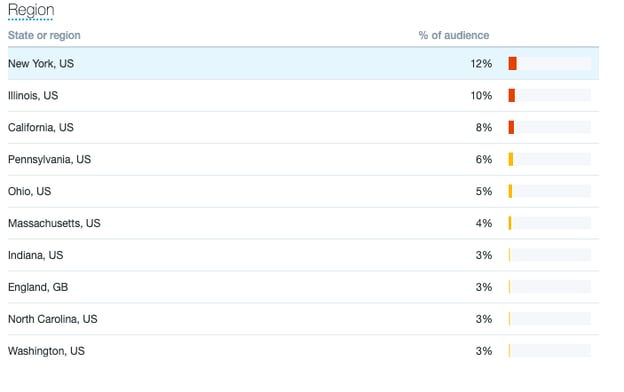
If alternatively, I saw most of my audience came from India, I might need to alter my social strategy to ensure I catered to India's time zone.
When experimenting with different time zones, consider making content specific to the audience you're trying to reach.
5. Copy
Your copy — the text used in marketing campaigns to persuade, inform, or entertain an audience — can make or break your marketing strategy.
If you’re not in touch with your audience, your message may not resonate. Perhaps you haven’t fleshed out your user persona or you’ve conducted limited research.
As such, it may be helpful to test what tone and concepts your audience enjoys. A/B testing is a great way to do this, you can also run surveys and focus groups to better understand your audience.
6. Email
Email marketing continues to be one of the best digital channels to grow and nurture your leads.
If you have low open or high unsubscribe rates, it's worth running experiments to see what your audience will respond best to.
Perhaps your subject lines are too impersonal or unspecific. Or the content in your email is too long.
By playing around with various elements in your email, you can figure out the right strategy to reach your audience.
Ultimately, marketing experiments are a cost-effective way to get a picture of how new content ideas will work in your next campaign, which is critical for ensuring you continue to delight your audience.
Editor's Note: This post was originally published in December 2019 and has been updated for comprehensiveness.
a-b-testing

![How I Use Landing Page Split Testing to Find Untapped Marketing Potential [+ 12 Places to Start]](https://53.fs1.hubspotusercontent-na1.net/hubfs/53/landing-page-split-testing-1-20250121-3573417.webp)
![How to Understand & Calculate Statistical Significance [+ Example]](https://53.fs1.hubspotusercontent-na1.net/hubfs/53/how-to-calculate-statistical-significance-1-20250106-7754856.webp)