
Similar to the offers we create, we here at HubSpot have also found that more than 65% of the leads we generate from our blog each month come from older articles that weren't published in the last six months.
In other words, old content and offers you've created months -- even years -- ago has a huge potential to continue generating new leads now and in the future. (Doesn't inbound marketing rock?)
SEO and Lead Generation
The content you're creating now shouldn't only consider your current campaigns and goals; it should also be optimized to generate leads months and years into the future.
But how do you make sure your content is getting found and generating leads long after you've stopped promoting it through channels like email, calls-to-action, and social media? The same way you'd make sure of it on a blog post: by optimizing it for search engines.
Organic search traffic is considered the most consistent source of quality leads across all the traffic channels available to you. At times, it's up to seven times more likely to convert a visitor than a traffic source you paid for. Why?
I'm sure you already know that millions of people turn to search engines every day to solve their problems. About two-thirds of the search traffic we see coming into HubSpot.com is from non-branded terms like "lead generation" and "marketing software" -- both of which are viable keywords for which to optimize landing pages that can offer people more information on these topics.
People are looking for answers to their problems, and they are finding our content. And for us, having web pages that rank well for these terms generates thousands of new leads for us each and every month, without any additional effort on our part.
That's why it's so critically important to keep SEO best practices in mind whenever you're creating a new piece of content or offer. Because doing the right things now will pay dividends long into the future.
Below are eight tips to optimizing your landing pages for organic traffic and lead generation.
Landing Page SEO Best Practices
- Create a short but keyword-optimized page title.
- Structure your landing page URL correctly.
- Create a heading tag that matches the page title.
- Write a clear and direct meta description.
- Optimize the title. (wait, what?)
- Use structured data to qualify for rich snippets.
- Be careful with how many form fields you have.
- Have a link-building strategy.
When looking to optimize your website for lead generation, landing pages are especially great targets, since a high-ranking landing page will almost certainly drive new leads for you each month. After all, that's what landing pages are for: to help the people who are already looking for your information actually find it in a portable, downloadable format.
Let's walk through some of the most important parts of a landing page that you should be focusing on from an SEO standpoint so you can start turning your landing pages into long-term conversion points for your business.
1. Create a short but keyword-optimized page title.
The most important element for any on-page SEO is the title of the page, according to data from Moz. The page title is the description of the webpage that shows up at the top of your browser (or in the tabs if you have more than one open in your browser window):
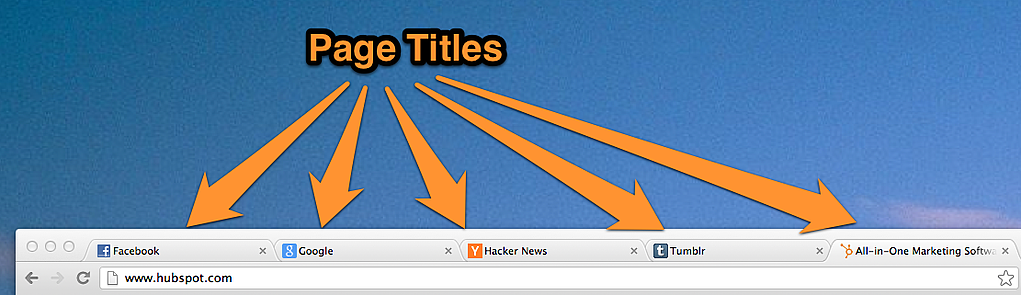
Page titles are one of the most effective ways to indicate what the content on a given page is to search engines, and they're also a key component to consider when following SEO best practices. Specifically, follow these rules when creating page titles for your landing pages:
Keep it short.
Search engines generally only show the first 60 characters in search results, and your page title doesn't need to be the full title of the content or offer you're promoting. Instead, focus on keywords by removing any unnecessary words. Just be sure it's also still easy to read and clear to a human what the content of the page is all about.
Include high-quality keywords first.
Search engines place more emphasis on keywords that appear closer to the left of the page title. Because this is the case, you should start your page title with your most important keywords first, and include your less important ones later.
Use vertical pipes to separate concepts and phrases.
This is a good best practice since it helps search engines break apart multi-word phrases and figure out which keywords go together. For example, you'll notice that we use a vertical pipe in the page title of this blog ("Internet Marketing Blog | HubSpot").
Don't include your company's name in every single page title.
You should aim to optimize your landing pages for long-tail search visitors who are simply seeking information on a topic and haven't necessarily heard of your company. Don't worry, even if you leave out your company's name, you can still rank well for branded searches because of your root domain name and the rest of the page authority your site has built up. There's no need to waste valuable SEO real estate on things you'll already rank for.
2. Structure your landing page URL correctly.
The URL of our landing page is its next-most important on-page SEO element. Your URL helps communicate even more information to search engines about the content on the page. Furthermore, URLs also convey site structure and how this page fits among the other content on your site.
The rules for landing page URLs are actually similar to page titles:
Keep it short.
Most search engines only show about 65 characters in the URL portion, and some of these will be taken up by your domain name (e.g. http://www.hubspot.com...), leaving you with only a few dozen characters to work with if you don't want your URLs truncated in search results.
Use slashes to separate concepts and phrases.
Ideally, each level of depth in your URL has its own page that visitors can check out. So, for example, if you're promoting an offer about generating leads through social media in 2020, your URL for the landing page might be:
/lead-generation/social-media/2020-predictions/
According to the above URL, you'd also have a page on generating leads through social media at the following URL:
/lead-generation/social-media/
Then, the most more general page you have published on lead generation is at this URL:
/lead-generation/
The examples above show how you can "nest" your landing page inside more general webpages from which you can navigate to your landing page. In web development, the paths of text between each forward slack are known as subdirectories, or subfolders, and they help search engines understand how your content is organized.
Information architecture is a key part of landing page SEO. Making sure your landing pages -- and all the rest of the content on your site -- are well organized helps both search engines and humans find the content they're looking for, at the level of depth and specificity they expect.
Put more important keywords closer to the left.
Just like with page titles, keywords that appear earlier in a URL are given more weight than ones that appear later. This follows from the last point about nesting concepts in your URL. If someone is searching for "lead generation," you want to make sure they find your /lead-generation/ page and not necessarily one of the other, more specific pages.
3. Create a heading tag that matches the page title.
There should always be a single "H1" heading tag on your landing page. It should succinctly describe your offer and explain what the page is about. But be forewarned: Don't try to stuff your keyword into this page element -- Google is wise to it.
In fact, a keyword for a headline, with no other context, can confuse your visitors and cause them to bounce back to the search engine result page. When a search engine detects that people clicked on your website, but then came back to the search results and clicked on another result, the search engine takes that as a sign that your content probably didn't answer their question, and thus, doesn't deserve to rank for that term.
That's why it's important to make sure search engine visitors can figure out exactly what you're offering on your landing page very quickly, before they lose interest and bounce back. A good way to ensure readers stick around on your landing page -- something that can increase your ranking over time -- is to make your H1 heading as similar (if not identical) to the page title as possible.
You should also consider using a subheading, graphics, and bulleted lists to help visitors understand your offer quickly and keep them engaged with your content.
4. Write a clear and direct meta description.
The content of a webpage's meta description is not a direct ranking factor for Google, but what you put here can greatly influence a person's willingness to click on your search result. And the more people who click through to your content, the more likely search engines are to take that as a signal to rank you higher.
So, write a meta description for your landing page, and make it snappy.
We use the word "snappy" on purpose, here. Landing pages have much greater lead-generation potential than blog posts and other educational content. This means people who are looking for landing pages can be much more skittish when reading a result's meta description. If this description isn't quick, snappy, and to the point, they'll move on.
When writing a meta description, tell your readers what they'll receive. Are you promoting an event? Tell them they'll be able to register as an attendee. Are you offering an ebook? Tell people what's inside that ebook. Here's an example of a meta description for a HubSpot landing page promoting an ebook about basic SEO. (Psst: You can download that very same guide right here.)
 5. Optimize the image. (wait, what?)
Visual content is much harder for search engines to scan and understand, but that doesn't mean you can't use images to help your page rank for certain keywords.
Plus, many topics common to landing pages are highly searched for in image form. For example, If the landing page is promoting an event, for which you want people to register, consider the fact that many people might be searching for snapshots of this event -- and therefore their search is taking place in Google Images.
How do you get Google to find these images? Well, because it's so difficult for search engines to "read" visual content on a webpage, many search engines take clues about what an image contains from its file name and the alt text you provide.
The file name should be short and include words separated by dashes. The alt text should describe either the content of the image, or the content the image is illustrating. Alt text is used by screen readers and is displayed when an image fails to load, so it should clearly describe the images on your page so viewers know what they're missing. For example, if we included an image of the sales and marketing funnel on a landing page for an offer about sales and marketing alignment, the file name might be sales-marketing-funnel.jpg, and the alt text might be "sales and marketing funnel." Read more about alt text best practices here.
An image's alt text and file name can also be great places to include synonyms or variations of your keywords (as long as they appropriately describe the image). They're not content that visitors usually see, but they can still help you rank for permutations and variations of your targeted phrases.
6. Use structured data to qualify for rich snippets.
Rich snippets enhance search engine result listings, like the ones pictured below. They give searchers more information about your content -- such as authors, music, reviews, events, products, etc. -- making your page stand out from the other pages provided in search results, and thus, garnering you more search traffic.
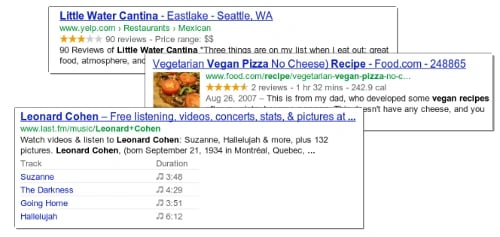
To see if your page qualifies for rich snippets, run it through Google's free structured data testing tool. The tool will automatically scan your page and generate a preview of what it could look like in search results. What this tool is looking for is specific markup in the HTML of the page that helps search engines identify the content of a given page, like an image, a video thumbnail, a star rating, or a price. The type of rich snippet generated depends entirely on the content of the page. For example, a listing for an ecommerce site might have the product's price, category, and 5-star rating, while a listing for a video streaming service might display a video thumbnail and the length of the video.
The specifics of the markup are defined on schema.org, which is a joint effort by Google, Bing and other major search engines to come up with a common set of markup that they'll all use for generating rich snippets. If you're comfortable editing HTML, then it's definitely worth reading the specification on schema.org and figuring out how to best mark up your content to create the appropriate rich snippets.
7. Be careful with how many form fields you have.
Remember when we talked about the concept of bounce rate in tip #3, earlier in this blog post? A high bounce rate indicates that your readers are "bouncing" from the webpage at a high frequency, and this can drop your ranking on search engines over time. Well, here's another tip to prevent people from leaving your landing page too soon.
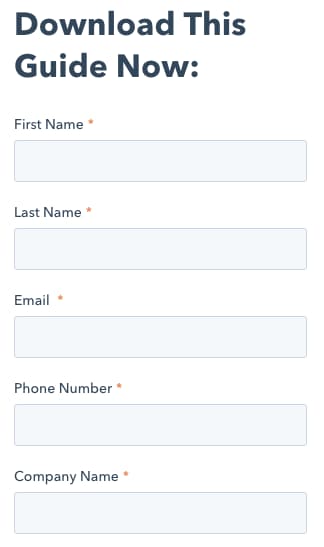
Landing pages typically have forms for readers to fill out with their contact information in exchange for an asset -- like an ebook, an event ticket, or a lottery entry. However, keep in mind forms aren't the most beloved part of a buyer's journey, and a form that asks for too many things can scare your readers off.
If your landing page has a form, minimize the type of contact information you're asking of your readers. If you find yourself with a form longer than the one below, examine the page's organic traffic and bounce rate, and consider if you're asking for too much of potential leads.
8. Have a link-building strategy.
Of course, while it's a good idea to follow all of these on-page SEO guidelines, you still might not make it to page one of the search results for your targeted phrase(s). That's because the majority of a page's authority comes from off-page sources. The most important thing search engines consider when ranking a given page is whether or not other people on the internet are vouching for that piece of content by linking back to it. This includes actions like linking to your page from within a blog post, or sharing that page on Twitter.
Since these off-page signals are so valuable, it's important to design your landing pages in a way that encourages people to link back to them. This can include things like offering a "Tweet to Download" option or some other kind of social sharing trigger like social media sharing buttons. Another option to consider is allowing your offer to be embedded on other websites, and ensuring that the embed code you provide includes a link back to your landing page.
There are many other tactics for building inbound links that we've written about in dedicated posts like this one. It's always a good idea to spend some time thinking about how you can build more links into your landing pages to get more SEO juice out of them.
Following these tips will help your content to rank high in search engines for months and years into the future. As a result, you'll be able to turn each new landing page you create into a long-term asset that keeps driving leads long after your initial campaigns around them have ended. Talk about a return on investment.


Structured Data