.webp)
Think about it: These subscribers have already shown interest in your brand. Maybe they bought from you before, maybe they signed up for your list full of good intentions. Either way, the relationship isn’t dead; it’s just dormant. And that means you have an opportunity to reignite it.
A smart re-engagement strategy doesn’t just try to salvage disengaged subscribers; it can recover revenue, improve deliverability, and keep your list healthy.
Table of Contents
- What are re-engagement emails?
- What is the importance of re-engagement emails?
- Common Types of Re-Engagement Emails
- 6 Real Life Examples of Re-Engagement Emails
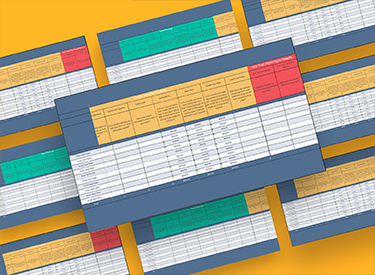
Email Marketing Planning Template
Organize your email marketing strategy and metrics with this free template.
- Gather data
- Summarize results
- Manage A/B tests
- And More!
Download Free
All fields are required.
What are re-engagement emails?
A re-engagement (or re-activation) email is a message sent to subscribers who haven’t opened, clicked, or interacted with your emails in a while; it’s your brand’s way of tapping them on the shoulder and saying, “Hey, still interested?”
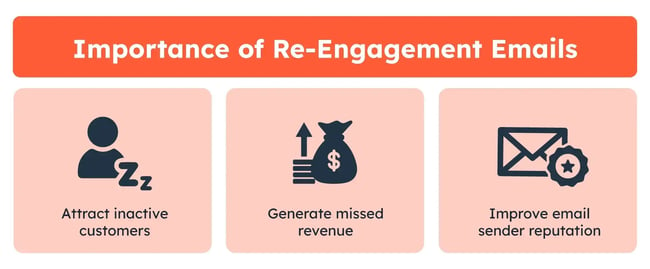
What is the importance of re-engagement emails?
Done well, re-engagement emails can rekindle attention, rebuild trust, and remind people why they signed up for email from your brand in the first place. It’s part relationship repair, part second chance – and it works best when it feels more like a conversation than a campaign.
Common Types of Re-Engagement Emails
1. “We Miss You” Warm Nudge
I see a lot of these in my inbox. That’s because it’s the classic re-engagement message for good reason. It’s low-pressure, emotionally intelligent, and gently reminds the subscriber that you noticed they’ve gone quiet.
These messages often take a human, conversational tone (“It’s been a while,” “Haven’t heard from you lately”) and rely on warmth over urgency. The goal isn’t to push a sale, it’s to re-open the line of communication. These emails work best when they sound like someone actually noticed the absence, not like automation finally caught up.
Why I think it works: This category leads with empathy instead of marketing speak. It’s the equivalent of saying “Hey, just checking in” instead of “BUY NOW.” And that human tone can go a long way when someone’s already drifting.
2. Incentive-Based Win-Back
I get that sometimes people need a reason to come back, and an offer can do the trick. Still, while I do sometimes use these with my clients, I am not a big fan.
These emails pair the re-engagement message with a tangible reward: a discount code, free shipping, or a limited-time bundle. But the best ones don’t just scream SALE. Instead, they remind the reader of why they loved the brand in the first place, then sweeten the deal.
Why I think it works: Incentives create urgency and relevance. And when paired with well-branded creative, they feel like a thank-you gift, not a bribe. But here’s why I try not to do this. You have to be careful. If you train your audience to only engage when there’s a discount, you’ll have ongoing retention problems.
3. Product Updates or “What’s New” Check-Ins
I love this approach. Sometimes the best way to re-engage isn’t to look backward, but to offer something new. If you’ve launched new features, released a fresh collection, or improved your experience since they last interacted, tell them! A re-engagement email framed around updates says, “We’ve evolved and we think you’ll want to see what’s changed.”
Why I think it works: This approach is great for product-led businesses and SaaS. It shifts the message from “You disappeared” to “We’ve got something exciting you might’ve missed.” It taps curiosity and relevance without shaming the lapse.
I also love that they offer a new reason for people to engage with your email – and your brand.
4. Exclusive or Emotional Appeal
You have to be careful with these types of re-engagement emails; they are my least favorite type. They play the urgency card, but you have to do it carefully.
These emails use exclusivity, personalization, or emotion to prompt action: “Your 20% offer expires soon” is fine and may work, but see the notes above about incentive-based win-backs.
“This is the last email you’ll get from us” is the worst – it’s like a threat. And if they have stopped opening and/or clicking on your emails, why would they care? “We’re pausing your subscription” is perhaps a little better – but will absence make your subscribers’ hearts grow fonder? I doubt it.
Done well, this type of re-engagement email feels like a thoughtful closure, or a final chance to stay connected. Done poorly, it feels manipulative.
Why I think it works: There’s power in scarcity, but only when paired with respect. These emails work when they come from a place of “We value you” rather than “We want to hit our Q3 numbers.”
5. Benefit-Focused Reintroduction
I love creating emails that remind the subscriber of the value they are missing out on by not engaging with a brand’s emails.
Sometimes subscribers don’t disengage because they’re mad, they just forgot the value you bring. A benefit-led email reminds them of how your product, content, or service improves their life. It’s a mini re-pitch: Here’s what we offer, here’s why it matters, and here’s how to get back into it.
Why I think it works: This strategy is especially strong for brands with a values-based mission or a utility-driven product. Instead of centering the subscriber’s inactivity, it refocuses on the brand’s relevance and benefits. It says “Here’s what we do, and why it’s worth your time again.”
6. Brand Update or Story-Based Reconnect
Another great approach that I use with my clients. If your brand has changed, grown, or evolved, tell your audience. This type of re-engagement email uses narrative to re-spark the relationship. It could be a new product line, a recent milestone, or a behind-the-scenes update that makes people feel part of the journey. It’s particularly effective when paired with personal storytelling and strong brand voice.
Why I think it works: Sometimes people disconnect from brands that go quiet or lose relevance. A narrative email reminds subscribers there’s a real business with real people behind the logo and that the story is still unfolding.
6 Real Life Examples of Re-Engagement Emails
1. Slack
I really like this email where Slack nails the warm nudge approach. The headline makes it clear: “Your team is waiting in Slack.” It’s personal, direct, and framed around what the recipient is missing, not what Slack is missing. That subtle shift makes it about the reader’s relationships and role, rather than the product alone.
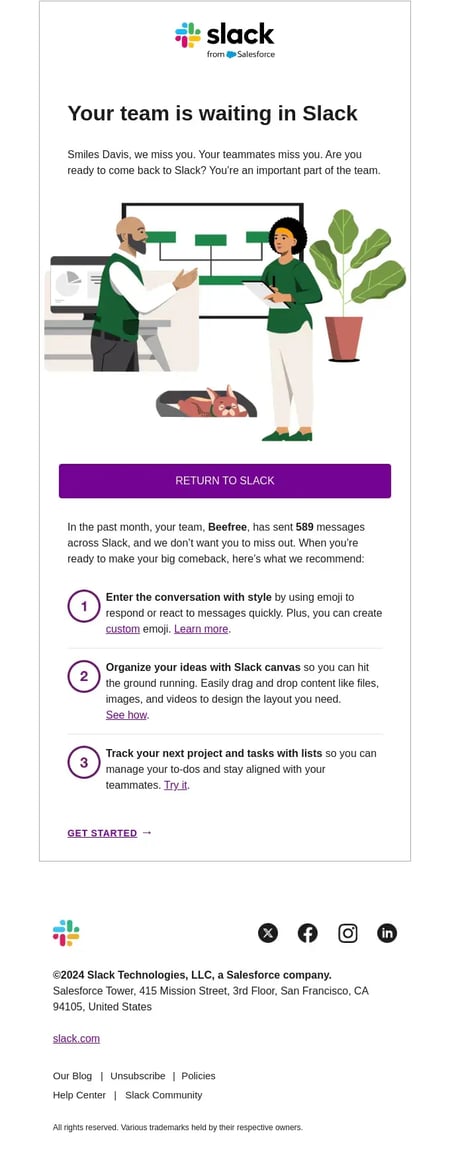
The copy leans into emotional appeal: “Smiles Davis, we miss you. Your teammates miss you.” It positions Slack as a place of belonging and importance. For anyone who’s drifted away, that reminder of being part of a team is a powerful motivator to re-engage.
It also includes data-driven context: “Your team has sent 589 messages this month.” This adds urgency and a little FOMO. It’s not just abstract; the recipient now knows they’ve been out of the loop.
Finally, Slack gives readers easy next steps. Instead of overwhelming them with a sales pitch, it breaks re-engagement down into three simple actions (use emoji, organize with canvas, track tasks). Each step includes a link, so the subscriber can dive right in. Paired with a bold “Return to Slack” CTA, it removes friction and makes coming back feel easy.
This is a great example of a “We Miss You” campaign that blends emotional pull with practical value. It acknowledges absence, reminds the reader why Slack matters, and provides a clear path to reactivation, all in one approachable, brand-aligned message.
Email Marketing Planning Template
Organize your email marketing strategy and metrics with this free template.
- Gather data
- Summarize results
- Manage A/B tests
- And More!
Download Free
All fields are required.
2. DoorDash
I love that DoorDash goes straight to the point in this incentive-based win-back email. “Here’s 20% off.” It’s bold, benefits-first, and easy to understand at a glance. The headline works to frame the offer as both urgent and appealing; “Knock, knock” is playful, while the discount is the real hook.
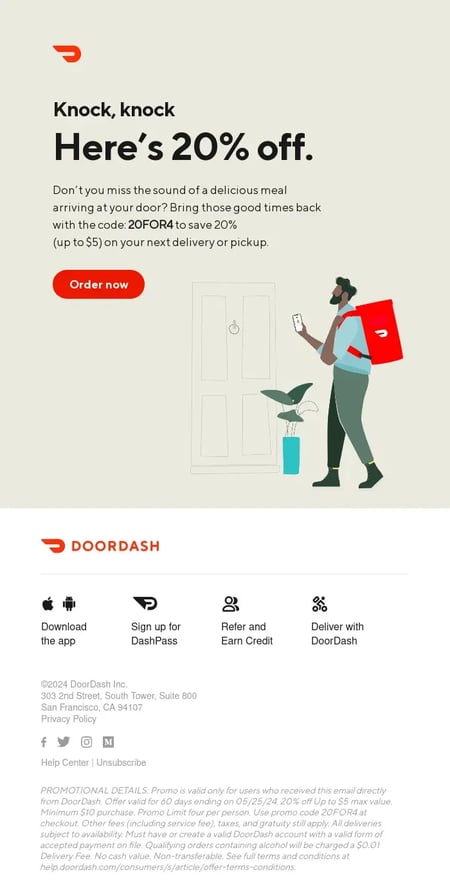
The email also taps into nostalgia and sensory memory: “Don’t you miss the sound of a delicious meal arriving at your door?” That phrasing brings back the positive experience of using the service, pairing the incentive with an emotional reminder of convenience and satisfaction.
Design-wise, it’s clean and focused. The bright red CTA button (“Order now”) draws the eye immediately and leaves no doubt about the desired action. By limiting the copy to a short paragraph and putting the promo code front and center, DoorDash removes friction and makes redemption simple.
This is a textbook incentive-based win-back: It leverages a discount to spark action while reinforcing the brand’s value proposition (convenience, comfort, and good food delivered fast). For lapsed users who may have simply forgotten or needed a nudge, this straightforward approach can be exactly what gets them back.
3. YouTube TV
I am always up for watching the big game. Doesn’t matter who’s playing – for me it’s about the commercials. So this email would definitely have made me consider reactivating my YouTube TV account.
YouTube TV uses a major cultural moment, the Super Bowl, to pull inactive subscribers back in. The headline is clear and compelling: “Come back and watch Super Bowl LVII live on FOX.” That’s not just a product feature, it’s an event people care about, which makes the reactivation pitch immediately relevant and time-sensitive.
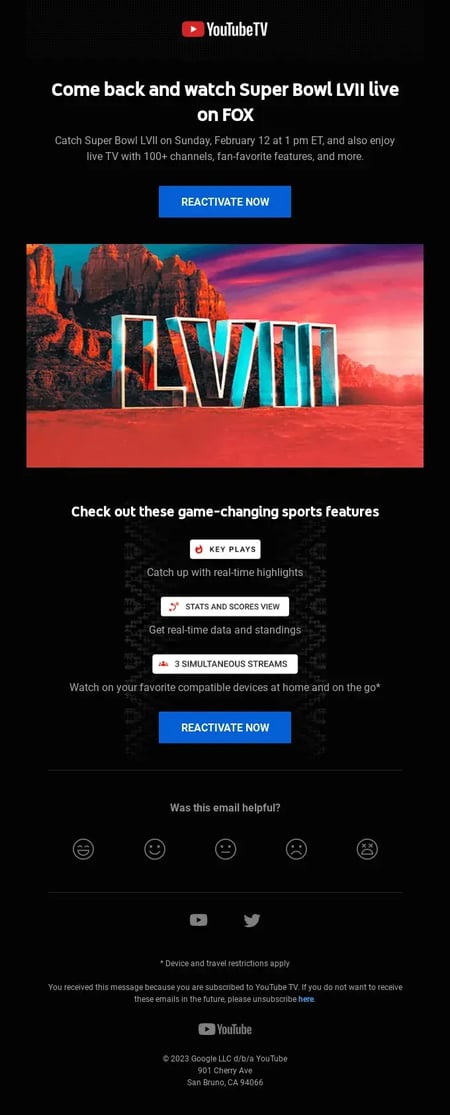
Beyond the event hook, the email doubles down by highlighting new or improved features that make the experience better: real-time highlights, live stats and scores, and the ability to stream on multiple devices. Each feature is framed in simple, benefit-focused language and paired with icons for easy scanning, so even a quick glance reinforces the product’s evolution.
The design is straightforward but effective: bold imagery from the game, a clear “Reactivate Now” CTA button (repeated twice for emphasis), and minimal copy. It makes it easy for the reader to understand both why they should return (don’t miss the Super Bowl) and how YouTube TV has improved since they left.
This is a strong product update campaign because it doesn’t just remind users of what they had before, it shows them what’s new, better, and more relevant right now. It taps into urgency (the Super Bowl date), curiosity (features they may not know about), and ease (one-click reactivation).
4. All About Email
This example is actually from my own inbox. Spoiler: I did click to stay subscribed.
This reactivation message leans on emotional connection and exclusivity. The subject line, “Is it time to say goodbye?” frames the email as a personal crossroads, while the body copy reinforces that tone: “I miss having you around.” It feels like a one-to-one message rather than a mass blast, which can be effective in reminding the reader that their presence matters.
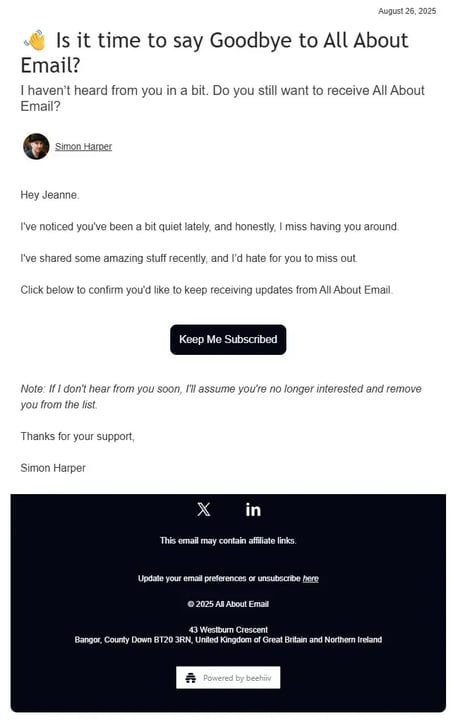
It also uses an exclusive framing; if the subscriber doesn’t click to stay, they’ll be removed from the list. That scarcity creates urgency, while the single “Keep Me Subscribed” button makes the desired action clear and easy. The note at the bottom (“I’ll assume you’re no longer interested and remove you from the list”) doubles as a list-cleaning mechanism, a win for sender reputation, even if the subscriber doesn’t re-engage.
Where this email could be stronger is in execution. The sender tells readers what they’ve missed (“I’ve shared some amazing stuff recently”), but doesn’t show it. A few headlines or links to recent content could have added a benefit-focused reintroduction layer, making the case more compelling. As is, it succeeds on emotional tone but leaves some persuasive power on the table.
This is still a solid example of the exclusive/emotional appeal category, especially for smaller publishers or creators who want to keep their lists clean while keeping the message personal. But pairing emotion with proof of value would likely drive even more clicks.
5. New York Magazine
I love this email — it’s a great example of a benefit-oriented reintroduction, which is the type of reactivation email that I’ve found works best. Because a re-engagement win isn’t just about getting a click today – it’s about getting your emails engaged with on an ongoing basis going forward.
New York Magazine leans into benefits and value rather than absence or urgency. The headline, “We were just getting started,” positions the lapse not as failure, but as unfinished business. It’s a subtle but smart framing: The reader hasn’t “missed out,” they still have the chance to rejoin the conversation.
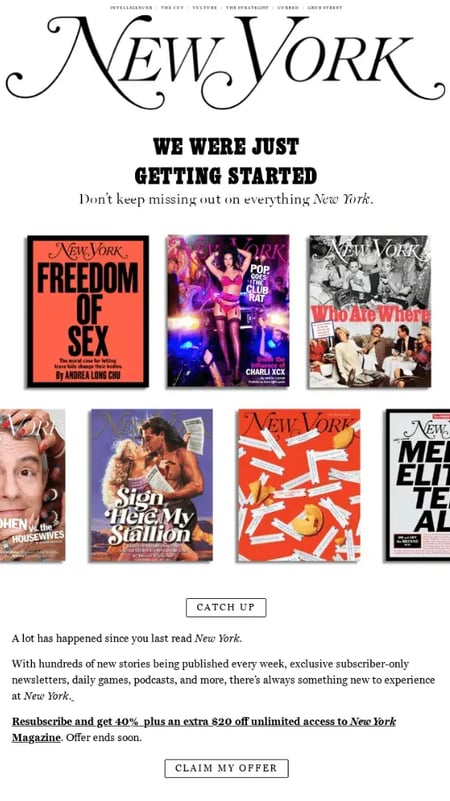
The email showcases what the subscriber gains by coming back: access to exclusive newsletters, hundreds of new stories every week, daily games, and more. It’s not just “resubscribe because we want you back.” It’s “resubscribe because here’s everything you’ll get.” That benefits-first positioning is what makes this message so persuasive.
The design supports the strategy with visual proof of value: vibrant magazine covers, bold headlines, and a curated list of “Stories You Might Have Missed.” By surfacing specific content, the email reminds readers of the brand’s cultural relevance and quality. It’s essentially saying, “Look what you’re not reading, and imagine what you could be.”
Finally, the incentive (“Resubscribe and get 40% plus an extra $20 off unlimited access”) seals the deal, but it doesn’t carry the whole weight of the email. The benefits lead, the offer supports. That balance makes this a great example of a benefit-focused reintroduction campaign: it builds desire to reconnect by emphasizing what’s valuable and unique about the experience, not just dangling a discount.
6. AllTrails
I really like this email; anytime you update your membership options, it’s a great opportunity to regain lapsed subscribers. AllTrails takes the brand update approach, positioning their new membership plan as a fresh reason for lapsed users to come back. The headline “We took exploring to a whole new level” immediately signals evolution and improvement. Instead of focusing on what the user has missed, it highlights what’s new and exciting about the brand.
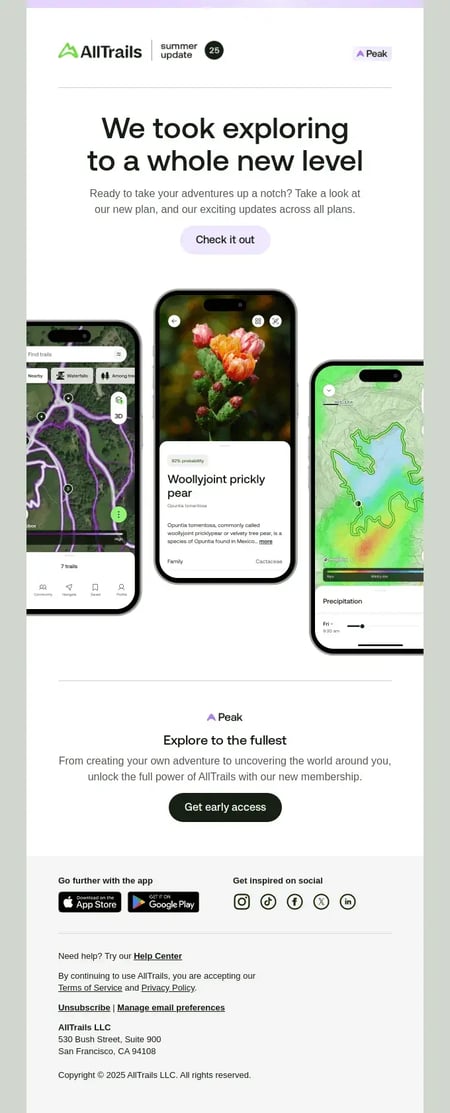
The visuals reinforce that message with crisp app screenshots that show off new features (trail maps, plant IDs, precipitation overlays). This makes the update feel tangible, not abstract. Subscribers can see what’s changed.
The email also does a nice job of tying the update to user benefits. “From creating your own adventure to uncovering the world around you” connects the product improvements back to the subscriber’s real-world goals. That benefit-first framing turns a product announcement into a re-engagement nudge.
Finally, the CTA, “Get early access,” adds an element of exclusivity and urgency. Instead of passively informing, it actively invites the reader to experience the brand’s next chapter before everyone else.
This is a strong brand update/story-based reconnect because it makes product evolution the reason to return. For subscribers who drifted away, the implicit message is: “AllTrails is better than when you left; come see for yourself.”
Final Re-engagement Advice: Strike Early, Strike Often
At the end of the day, re-engagement campaigns are about respect. Respect for your subscriber’s attention, respect for their inbox, and respect for the relationship you once had. The best ones don’t beg or guilt; they remind, they invite, they show value, and they make it easy to come back.
And one more thing: Don’t wait too long. The longer a subscriber stays inactive, the harder it is to win them back. That’s why the most effective re-engagement campaigns aren’t one-off Hail Marys; they’re automated, strategic, and triggered fairly early in the dormancy window (think 30 to 60 days of no activity, not six months of silence).
And yes, the best-performing campaigns are a series, not a single message. One email might get ignored; a thoughtfully sequenced nudge, like a warm reminder, then a value offer, and a final call, has a much better shot at bringing them back before it’s too late.
Re-engagement isn’t just list hygiene; it’s an opportunity to remind people why they said yes to you in the first place, to recover relationships (and revenue), and to strengthen your program overall. Don’t waste it.
Editor's note: This post was originally published in October 2019 and has been updated for comprehensiveness.
Email Marketing Planning Template
Organize your email marketing strategy and metrics with this free template.
- Gather data
- Summarize results
- Manage A/B tests
- And More!
Download Free
All fields are required.
Email Examples
![12 great examples of welcome emails for new customers [templates]](https://53.fs1.hubspotusercontent-na1.net/hubfs/53/welcome-email-examples-1-20251024-7984960.webp)
![4 types of emails that get the most engagement [+ 4 emails that fail]](https://53.fs1.hubspotusercontent-na1.net/hubfs/53/Untitled%20design%20(56).jpg)