.png?width=112&height=112&name=Image%20Hackathon%20%E2%80%93%20Horizontal%20(24).png)
I am a long-winded writer by nature, and this habit often filters over from my personal writing to my work writing. This means that for some of my initiatives, I really have to make a conscious effort to make my writing more concise.
![→ Free Download: 5 Customer Survey Templates [Access Now]](https://no-cache.hubspot.com/cta/default/53/9d36416b-3b0d-470c-a707-269296bb8683.png)
Survey introductions are one of those initiatives, as I’ve found that the survey introduction can really make or break a survey’s success rate.
If you’re trying to improve your survey’s response rate, looking at your survey introduction is a great place to start. In this article, I’ll show you how to write a great survey introduction, and I’ve included a few templates and examples for inspiration.
Table of Contents
- What is a survey introduction?
- What makes great survey instructions?
- How to Write a Survey Introduction
- Survey Introduction Template
- Good Survey Introduction Examples
.webp)
5 Free Customer Satisfaction Survey Templates
Easily measure customer satisfaction and begin to improve your customer experience.
- Net Promoter Score
- CSAT Score
- Customer Effort Score
- And more!
Download Free
All fields are required.

What is a survey introduction?
A survey introduction is the opening text that readers see before they begin a survey. This text explains what the survey is for, why the reader should consider completing it, and what you plan to do with the collected information. It’s common for a survey introduction to be included in the outreach email that asks for survey participation or as the first section of the survey itself. Since the survey introduction is your first impression to potential participants, it should be crafted in a way that’s both informative and compelling to encourage participation.
What makes great survey instructions?
Great survey instructions are clear, actionable, and provide respondents with any directions they need to complete your survey. Here are three key guidelines to follow that will help you craft great survey instructions.
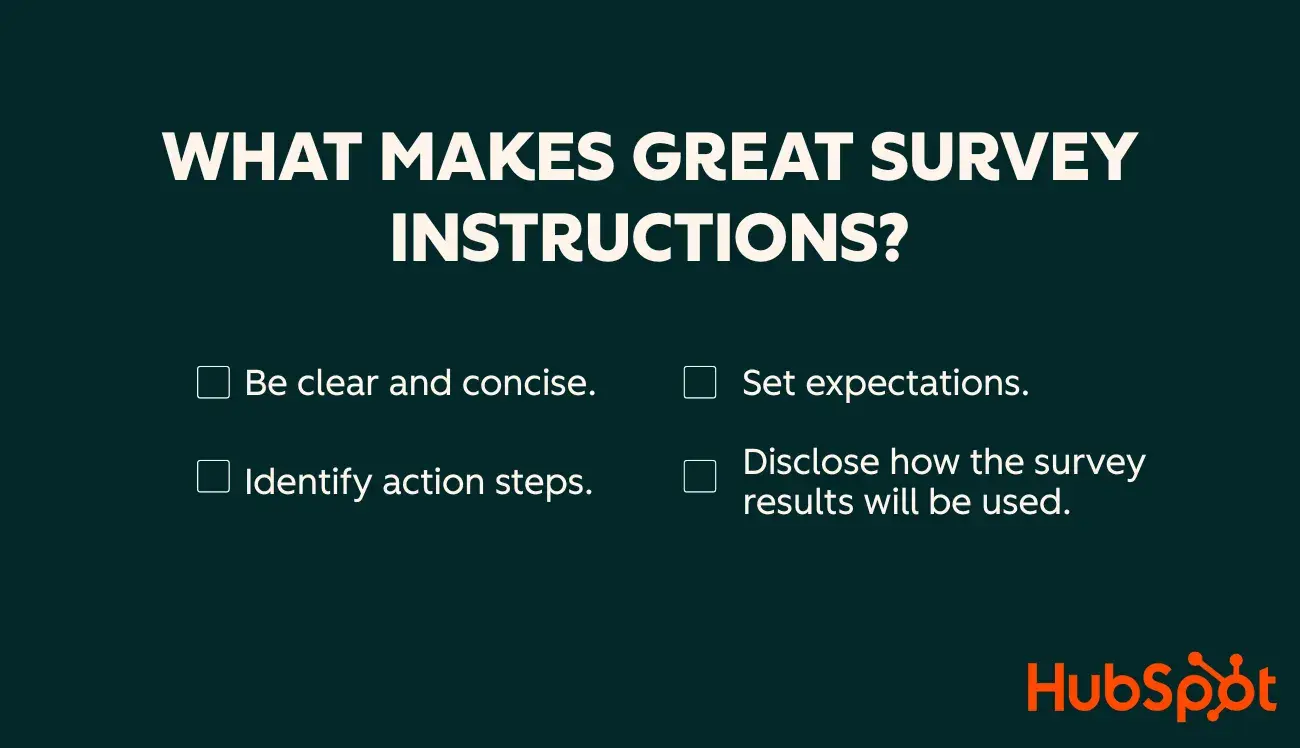
1. Be clear and concise.
By using clear and concise language, you avoid confusion and get straight to the point. Attention spans are short, and keeping your instructions concise helps ensure you don’t lose your participants’ attention early on in the survey process.
Write easy-to-read sentences, use neutral language, and avoid giving too many details if not necessary. Be careful to avoid abbreviations, jargon, or other language that could be misinterpreted.
By keeping your instructions concise and using easy-to-interpret language, you improve the chances of respondents remembering the instructions which leads to better quality survey results.
2. Identify action steps.
Since surveys can include a variety of question types, the instructions section gives you a chance to explain how you expect participants to answer questions (or to take other actions).
Be clear about what you’re asking participants to do, and be specific with where they need to take action. Specify how they should answer questions (e.g., select one option, rate on a scale from 1 to 5, etc.).
I also suggest including definitions for your rating scales, e.g., “1 is not valuable, 5 is very valuable.” Don’t assume that participants will automatically understand the rating scale or other question structure that you’ve put in place, and instead take the time to educate them.
I’ve participated in surveys where the rating scale changed from page to page, and I didn’t notice the change until I was already a few questions in. Be sure to call things like this out for the participant so that they can give you the best quality data.
Finally, let participants know if there are any open-ended questions as well and whether or not any questions are required.
3. Set expectations.
The instruction section is a great place to let your participants know what to expect as they begin your survey. I suggest including the estimated time it will take them to complete the survey, as this can determine their interest or availability to complete it. You may list the number of questions included, the type of questions, or just the approximate time it will take to complete the survey in its entirety.
If there’s anything you want your customers to avoid doing during the survey, set those expectations up front. For example, you might want to ask participants to avoid certain topics or sensitive information in their responses to open-ended questions.
4. Disclose how the survey results will be used.
Finally, briefly let your participants know how the survey results will be used. Include things like a privacy statement so they feel comfortable sharing their data with you and how the results will be beneficial. I recommend framing the benefits as “taking this survey will help us better serve you.”
How to Write a Survey Introduction
1. Introduce yourself.
The feedback loop is a process that relies on human connection. When you ask for feedback from people, you’re telling them you care about what they think and are keenly interested in their insights. Additionally, you create a better connection with potential participants by letting them know there’s a human behind the scenes of this request.
In most circumstances, people are less likely to hand over information to a total stranger than they would be to someone they’ve been introduced to. By introducing yourself or your company, you help build trust with your audience and help them feel more comfortable with participating in the survey.
Including your company logo in your survey introduction is another easy way to introduce your brand to your audience.
Pro tip: An example I’ve seen land well for this is something along these lines: “My name is Ashley and I’m a Senior Researcher here at XYZ company. We’re looking to understand our customer’s preferences...” By including a person’s name and title in the introduction, you humanize the experience. And by including the name of the company (very important — never skip this!) you build credibility with your audience.
2. Explain the goal of the survey.
My customers are busy, and if I want them to participate in a survey I need to quickly explain to them what the goal or purpose of that survey is. If I’m surveying them on their live event preferences, I’ll need to help them understand that I’ll use those insights to enhance their live event experience and create new event programming that benefits them directly.
By including the purpose of the survey, I (hopefully) get them excited about participating and the survey will resonate with them more. They’ll be more likely to participate if they know their feedback will have a direct impact on something that they care about.
If you’re doing a product survey, you could tie the purpose statement to the end goal of your project, like future product improvements. Or if you’re doing an HR survey, explain how the results of the survey will be analyzed and implemented across different programs at your company.
At the end of the day, people like knowing that they’re making an impact. By including the purpose of your survey in the introduction, you help get your audience excited about the potential impact that their participation may have.
Pro tip: Try to include some level of specificity when describing your goal or purpose. Just stating “your feedback will help us improve our product” is fine, but telling customers “your feedback will help us improve the usability of our new reporting feature” feels more compelling to participants.
3. Don’t forget the “WIFM.”
Don’t forget to include the WIFM — or the “what’s in it for me” — in your survey introduction. Good surveys always include some sort of benefit for the respondents, so make sure you highlight any incentives or benefits that you’re offering to participants in your survey introduction.
Some people find contributing to research on a topic they’re interested in to be a benefit, so you can clearly outline that their feedback will contribute to industry research on a key topic.
But for the vast majority of people, having a tangible benefit is more likely to pique their interest. Financial incentives are a common tool to use here, like entering participants into a drawing or awarding them a gift card directly. You could also offer other tangible benefits that aren’t financial, such as early access to content or new product launches.
Here’s an example of how you could word the “what’s in it for me”:
“By completing this survey, your insights will shape our newest product launch and ensure we roll out features that directly support the work of marketing directors. As a respondent, you’ll receive exclusive early access to the new feature when it launches and you’ll be entered to win a free trip to our annual user conference in October.”
Pro tip: When deciding on a benefit for your survey participants, consider what resonates most with your customers. Depending on your customer persona, like their role in the organization or the industry they are in, you may need to differentiate the benefits.
For example, if you’re running an industry-level survey that culminates in a “State of the Industry” report, you may offer to directly quote or credit certain VP or C-level stakeholders in the finished writeup.
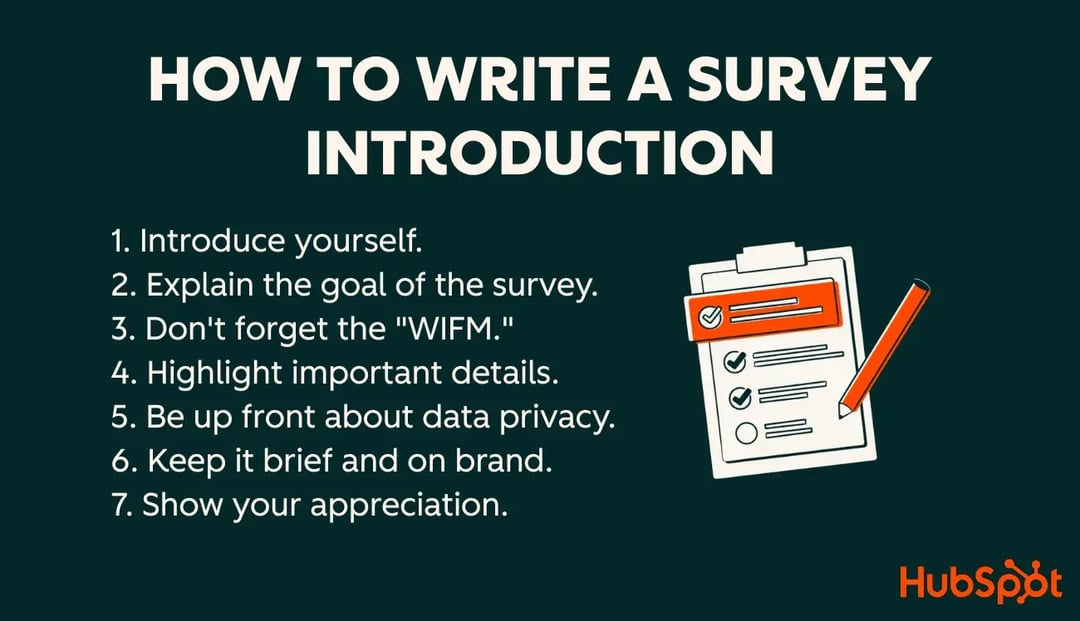
4. Highlight important details.
Anytime I’m asked to complete a survey, the first thing I look for is how long it will take me to complete it. I recently opted into a survey that didn’t have this information listed up front, and I ended up quitting halfway through because it was taking too long.
People want to know exactly what is expected of them when they’re asked to participate in something, so including all the critical details up front helps customers decide whether or not to opt in.
Including important details like the estimated time for completion, the total number of questions, and the submission deadline helps your audience know what to expect up front. You can also include a quick note with contact information so customers can reach out to your team if need be.
Here’re a few examples of how to include this type of information in your survey introduction:
- This brief five-question survey should take about 10 minutes to complete.
- Click below to take our quick two-question survey. For additional details or to share feedback, reach out to our support team at help@company.com.
- The survey will remain open until [Month Day, Year]. Please take a few minutes to share your feedback before then.
Pro tip: Make sure you have a true understanding of how long your survey will take for participants to complete it. When I recently dug into the ideal survey length, I learned that just because a survey only has a few questions doesn’t mean it will always be quick to complete.
If your questions require a lot of thought (like sorting questions or open-ended questions), or your survey has multiple branches based on response logic, your survey might take more time to complete than you think.
5 Free Customer Satisfaction Survey Templates
Easily measure customer satisfaction and begin to improve your customer experience.
- Net Promoter Score
- CSAT Score
- Customer Effort Score
- And more!
Download Free
All fields are required.
5. Be up front about data privacy.
Data breaches continue to make national headlines, and now more than ever consumers remain conscious about the privacy of their data online. Understandably, people want to know what happens to data they submit to companies and whether or not that data will be confidential.
Participants may respond differently depending on what data you decide to collect and what you intend to do with the data afterwards. For example, if a survey I participate in collects my email address, I would not be happy if I was automatically added to their marketing campaigns afterwards.
This need for transparency around data privacy is especially applicable if your survey involves sensitive information, is taking place within a security-sensitive industry, or requires confidentiality.
You’ll want to be up front with your audience on what data you collect, what you’ll do with that data, and whether or not their responses will be anonymous. For example, if you collect email addresses with the intention of following up with participants, you’ll need to let them know that.
Here’re a few examples of how to include this information in your survey introduction:
- Your feedback is completely anonymous and helps us improve our customer service.
- All responses will be anonymized and included in our upcoming report on how consumers view online shopping with ecommerce companies. If you’d like to receive a copy of the final report, please provide your email address.
- We read every survey response and follow up when needed to make sure you’re happy with your experience.
6. Keep it brief and on brand.
When it comes to crafting your survey introduction, aim for something concise and to the point. Your goal is to engage the reader and provide important information while not losing their attention.
Including a lengthy survey introduction increases the risk of drop-off. Additionally, if the survey introduction feels too wordy or seems complex, your audience may feel overwhelmed and opt out of the experience.
You’ll also want to keep your survey messaging on brand. If you normally use formal or corporate language, stick to that. On the flip side, if you tend to lean more casual or conversational, write your introduction in that style.
My company tends to use fairly casual language, so it’s common for us to say things like “we’d love your input,” but that might not work for a company that typically uses more corporate language.
By keeping the introduction true to your brand voice, you speak to your readers in a tone they’re familiar with and ensure they know the survey is truly coming from your company.
Pro tip: You might be wondering, “How long should my survey introduction be?” I did some research and the general consensus is that a survey introduction should be 3-4 sentences or a few short paragraphs at the most.
7. Show your appreciation.
I consider saying “thank you” the most important rule of any request you make. By participating in your survey, respondents took time out of their day to give your company insights, often receiving very little in return.
Participants who respond to surveys are showing loyalty to your brand and they’re clearly invested in whatever the outcome of the survey will be.
Because of this, you should always take the time to show your appreciation.
Here are some phrases you can use to show your appreciation:
- Your input helps us build better features. Thanks for taking a few minutes to share your feedback!
- We review every comment you share, and we appreciate your feedback.
- Thank you for your time and valuable insight — we truly appreciate it.
If you collect email addresses, consider following up with a few respondents to thank them personally. If you notice negative feedback or see comments about customers having a poor experience, make sure that feedback gets surfaced to someone who can reach out to them.
Pro tip: When I wrote an article on the ideal survey length, one of the experts I interviewed mentioned that they create a specific path within the survey for customers who express negative feedback. They do this as a way to build trust with customers, so that they can ask the customer for more information about their experience and follow up with them.
I personally like this approach because it shows customers that you’re taking their feedback seriously and would like to try and help resolve it.
Need help remembering what to include in your survey introduction? Save this handy checklist of the most important elements to include.
- Introduction: Introduce yourself and/or your company to your audience.
- Purpose: Explain why you’re conducting the survey and what you hope to learn.
- Time commitment: Let respondents know how long it will take (in minutes or number of questions).
- Incentive: Share why it’s worth their time — whether it’s helping improve your product, entering a giveaway, or another incentive (e.g., a drawing for a $50 Amazon giftcard).
- Data Privacy: Describe how the responses will be used and whether they’ll remain anonymous.
- Survey Timeline: Specify when the survey closes and any key dates.
- Additional Context: Include any definitions or background information participants may need before responding.
- Contact Information: Provide a contact email or link for questions or additional feedback.
- Gratitude: Thank participants for their time and input.
Pro tip: One great way to keep track of all your customer insights is with Hubspot’s customer feedback software.
Survey Introduction Template
[Your Survey Title]
Hello [audience/respondent group]!
Thank you for considering taking part in our survey on [topic or issue you are surveying]. This survey will [explain the purpose and aim of your survey]. Your feedback will help us [mention the outcome you are hoping to achieve and act upon].
Key details about the survey:
- Time commitment. This survey will take about [number] minutes to complete the [number] questions.
- Incentives (if any). All respondents could win a [mention incentive].
- Privacy. Your responses will be [mention anonymity, e.g., “completely anonymous”] and will only be used for research.
- Deadline. The survey remains open until [closing date].
- Publishing. We expect to share the results on [date] on the [name of the website].
Before You Begin:
- Please note that [mention any special definitions or details] to ensure consistent and accurate responses.
If you have questions or additional feedback, please reach out at [contact email].
Thank you very much for your time and input. Your feedback helps us create a more insightful and valuable resource.
Good Survey Introduction Examples
I’ve compiled a quick list of some great survey introductions to use as inspiration. If you’re looking to create your own, check out these free customer satisfaction survey templates.
Customer Success Leadership Study
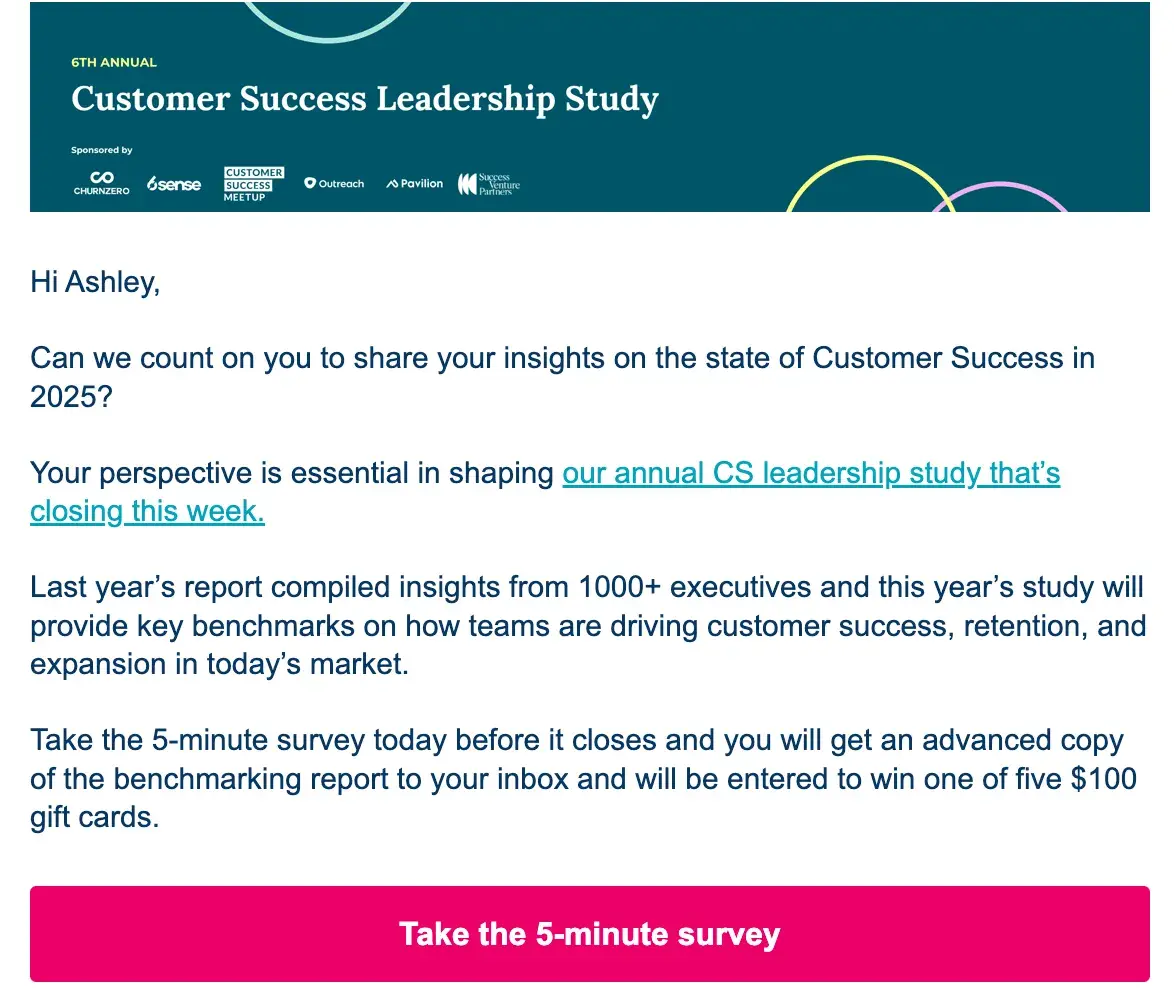
- This intro really leans into the participant’s expertise and makes it feel like their insights would be a valued contribution to the industry. It feels casual but also pushes a little bit of urgency with the “can we count on you” line in the introduction.
- This intro does a nice job of highlighting the purpose and the benefits of participating, stating that respondents’ input will provide key benchmarks to the industry.
- I like how this intro makes it really clear that the survey only takes 5 minutes, and lists out the financial incentive to encourage participation.
Squamish Off-Road Cycling Association (SORCA)
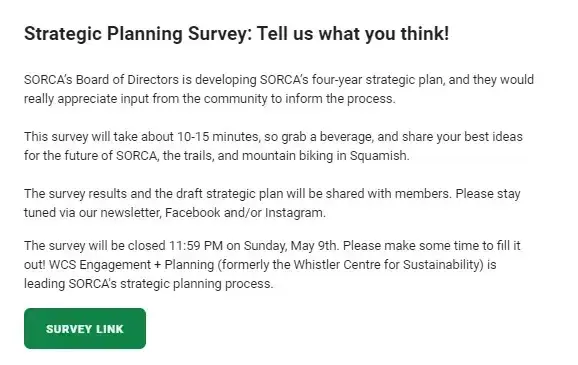
- This intro is clear about how long the survey will take so customers can set expectations. Even though this is a longer survey, SORCA is upfront about it, suggests grabbing a beverage, and tells recipients how long the survey will be open for if they want to schedule a time to do it later.
- Mountain bikers in Squamish are passionate about their sport, so this survey introduction is very compelling. By seeking input before creating their four-year strategic plan, the team at SORCA is going to receive valuable feedback from opinionated members of the community.
Tanaaz Khan
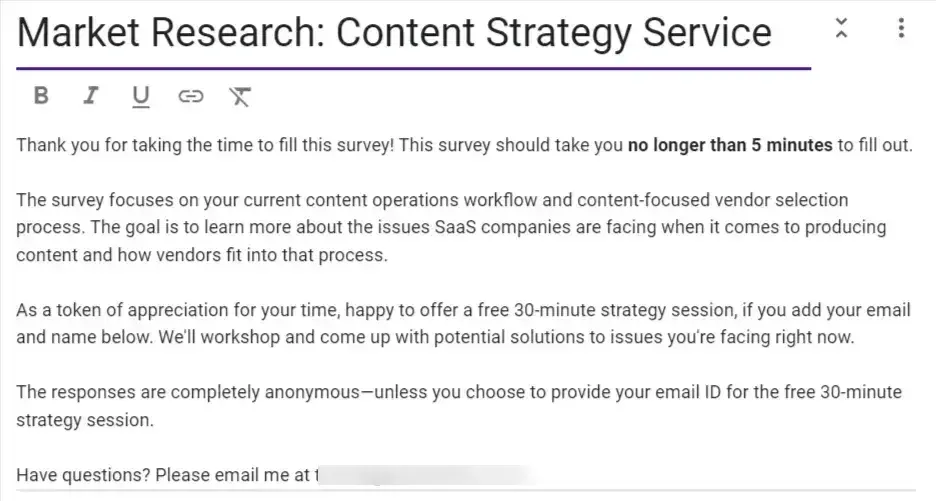
- This example from Tanaaz Khan offers respondents a way to contact her if they have questions within or outside the scope of the survey. This makes participants feel like Khan is there for them.
- It's clear from the survey introduction that these responses are anonymous, so respondents can be as direct as they want.
Boast.ai
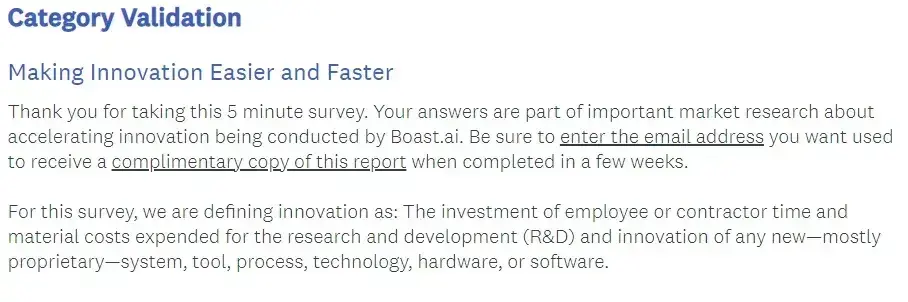
- Adding a definition to the survey introduction makes it more likely that respondents will provide helpful information. If they don‘t meet the criteria or don’t understand the terminology in the survey, your data will be flawed.
- This survey offers respondents the opportunity to get a free copy of the final report. This can provide an added incentive for customers to complete the questionnaire and potentially make them comfortable about the usage of their data.
Mantis Research
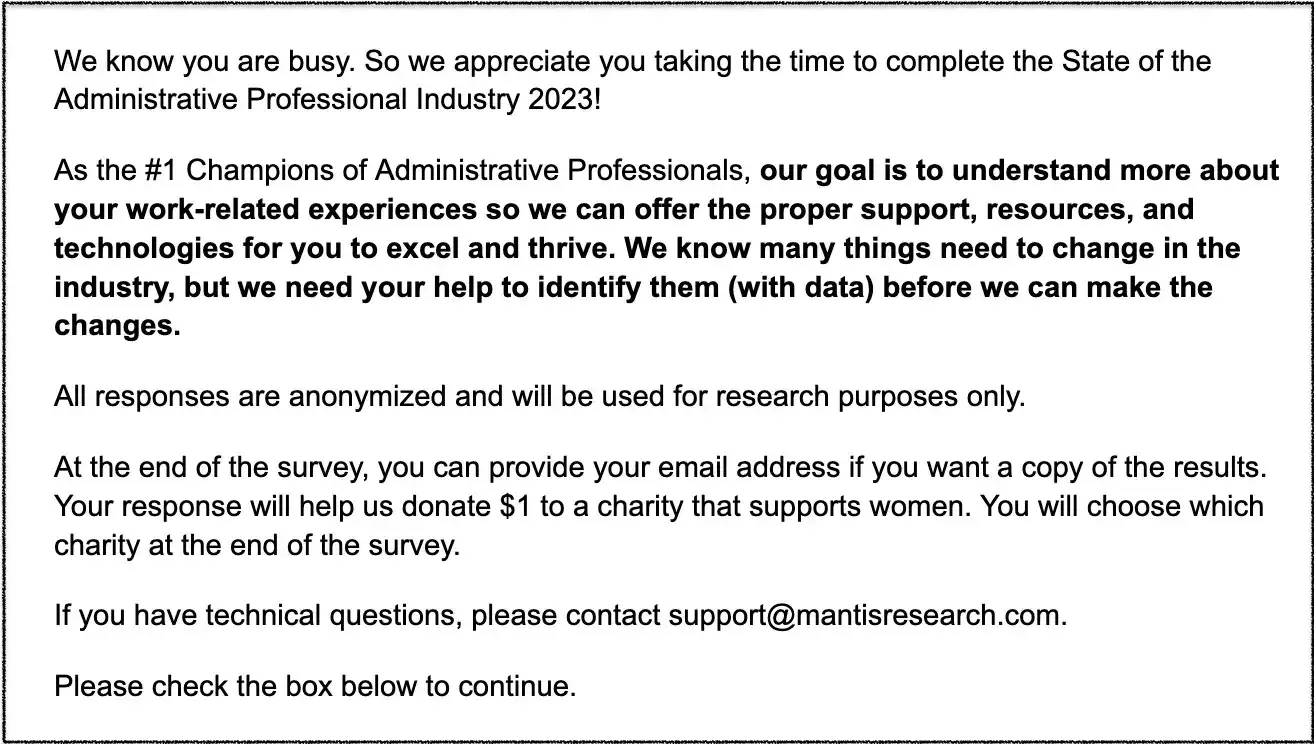
- This brilliant example from Nneka Otika shows respect by acknowledging the busy schedule of participants from the get-go. When people feel respected, they are compelled to act.
- The introduction also positions Mantis Research as champions of its audience.
- The incentive to complete the survey is brilliant. Allowing participants to choose their preferred charity at the end of the survey not only makes it better, but can improve the survey completion rate.
The Importance of a Good Survey Introduction
Something I’ve learned during my time in the customer experience space is that customers almost always have feedback for you, and 9 times out of 10 they truly care about helping your company improve.
However, I’ve also learned that customers are extremely busy. This means that they expect your interactions with them to be a good use of their time and to provide value to them.
This is why it’s critical to keep your survey introductions concise and benefit-focused. By opening your survey in a clear and concise manner that highlights why the customer should participate, you increase the chances of gathering quality responses.
Remember, the survey introduction is like a first impression to your audience. So make sure to follow these guidelines to craft an introduction that’s brief, compelling, and aces the first impression.
Editor's note: This post was originally published in August 2021 and has been updated for comprehensiveness.
5 Free Customer Satisfaction Survey Templates
Easily measure customer satisfaction and begin to improve your customer experience.
- Net Promoter Score
- CSAT Score
- Customer Effort Score
- And more!
Download Free
All fields are required.
Survey Creation
![16 best free online survey makers and tools [+ recommendations]](https://53.fs1.hubspotusercontent-na1.net/hubfs/53/free-online-survey-maker-1-20251028-2654831.webp)


![How to conduct survey analysis like a data pro [all my tips + secrets]](https://53.fs1.hubspotusercontent-na1.net/hubfs/53/survey-results-1-20241031-6355381.webp)
![Leading questions: What they are & why they matter [+ Examples]](https://53.fs1.hubspotusercontent-na1.net/hubfs/53/leading-questions-hero.webp)
![How long should a survey be? The ideal survey length [New data]](https://53.fs1.hubspotusercontent-na1.net/hubfs/53/how%20long%20should%20a%20survey%20be_featured.png)