Inbound Internet Marketing Blog

SEO, Blogging, Social Media, Landing Pages, Lead Generation and Analytics

SUBSCRIBE

The HubSpot Inbound Internet Marketing blog covers all of inbound marketing - SEO, blogging, social media, lead generation, email marketing, lead nurturing & management, and analytics. Join 57,702 others and subscribe now!

Subscribe to RSS feed Add us on Facebook! Follow us on Twitter

Get Free Marketing Info!

Get the world's best marketing resources right to your inbox! Join more than 817,000 inbound marketers!

Subscribe by email

Your email:

HubSpot's Inbound Internet Marketing Blog

Current Articles | RSS Feed RSS Feed

How to Get Ahead of the Marketing Learning Curve With Mobile PPC


.

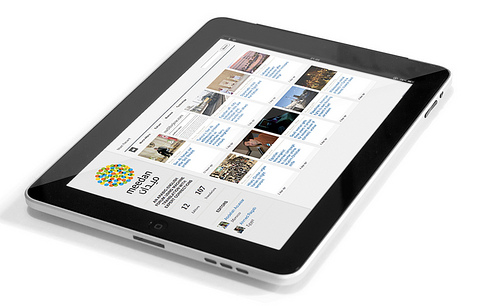
ipad imageGoogle recently updated AdWords with functionality that allows its users to segment PPC ads serving tablets and mobile phones. Although this may not seem very thrilling on the surface, this new functionality could have a serious impact on how the world views marketing on mobile devices, especially since it’s no secret that tablet adoption is booming.

How to Set Up PPC Campaigns to Target Mobile Devices

In AdWords, you can select which devices you want to show your PPC ads by accessing 'Campaigns Settings' and scrolling down to 'Network and Devices.' Then, you can opt to show your ads on all devices and carriers, or you can manually select which devices and carriers you want to display your ads. The availability of such a deep level of device and carrier segmentation is quite beneficial, because you can set up campaigns for each carrier and device and test the combinations that provide the best results for your business. Not to mention, you can quickly see which devices or carriers are not worth your time.
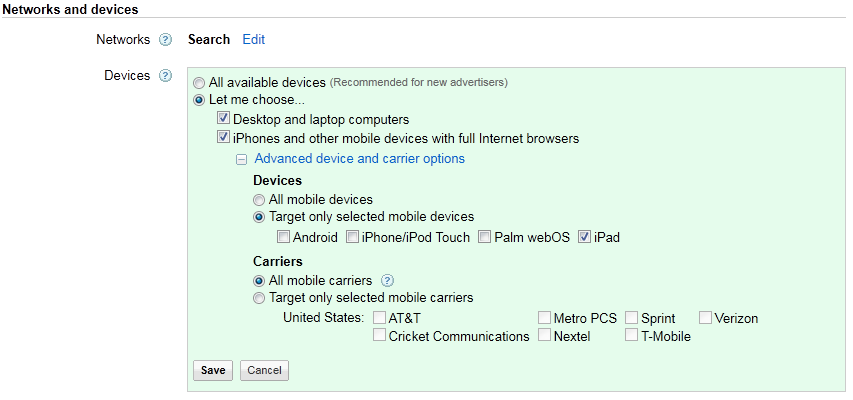
PPC Mobile Devices Settings

What does mobile PPC advertising mean for marketers?

1. You can target techies where they're playing. Although smartphones are quickly becoming the norm, tablets are still only in techies' hands for the most part. If you have products or services that appeal to the technically advanced, using PPC ads targeted to iPads, for example, will have some serious advantages.

2. You can target local consumers when they are ready to buy. The ability to target by geographic location (down to the zip code) has existed forever in AdWords. However, combining this capability with mobile device segmentation gives local businesses an opportunity to target people who are searching on their phones. Consumers who are searching on their phones are most likely on the go, so you can target them with specific offers to get their business!

3. Make sure your website is optimized for mobile. The ability to segment mobile devices for PPC is new. If you don’t have a website that is designed for mobile use, it’s easy enough to opt out of showing your PPC ads on mobile devices all together. However, this does not protect you from showing up in organic search results. Whether participating in PPC or not, any serious marketer should make sure its business has a website that is mobile ready. (Note: All websites using HubSpot are mobile-ready) It’s important to note that websites built with Flash are no good on iPhones, because Apple doesn’t recognize Flash at all.

4. Get ahead of the mobile learning curve. Testing various campaigns targeted toward mobile device usage will help you learn how different keywords, ad copy, and landing pages perform on different devices. If you start testing now, there is no doubt you will be way ahead of the curve when the rest of the business world starts getting in on the action.

It will be interesting to see how fast businesses adopt different forms of mobile media like PPC. What do you think are the biggest advantages or disadvantages?

Photo Credit: meedanphotos
Free Video: How Companies Adopt & Measure Mobile Marketing

Webinar On Demand: How Companies Adopt and Measure Mobile Marketing

Learn the latest trends dictating how maketers are adopting and measuring mobile.

View this webinar to learn the results from a new survey about the way companies are using mobile to grow their profits.

Posted by Drew Fortin on Fri, May 27, 2011 @ 08:00 AM

COMMENTS

Thanks for the information on mobile marketing. Keep it coming - mobile is big now and will get bigger in the future.

posted on Friday, May 27, 2011 at 8:18 AM by Ross Davis


My company has been working with Google as a beta user partner for PPC hand held devices. We currently manage airport parking reservations systems at Newark Airport for Vista Parking. Since airport parking has a lot of action via hand helds this is working well for us. We actually broke up the PPC campaign into two and created a group for hand helds only so we can track it effectively.  
 
We also use Google Analytics - Goals to see where the order are coming from, that's how we know what PPC group is really converting. It is working like a charm. I do recommend taking the time to make your site so it's user friendly from a hand held perspective. In addition to marketing to our email lists for newark airport parking we have great success with Google PPC and Google Maps Booster service. We also use the radius to zip feature but it sounds like now we target by zip code specifically. This is new to us as well so feedback is appreciated regarding this comment.

posted on Friday, May 27, 2011 at 8:25 AM by Email Lists Dude


Great article. Mobile ppc is a wonderful extension of advertising, for internet marketers. Promotion is essential!

posted on Saturday, May 28, 2011 at 6:04 PM by Hajii Brown


The twitter statement is a bit misleading. The only way they have grown such a large "following" is by setting up auto-follow then following lots of random people who do the same. Look at their numbers... So therefore the bulk of these followers will be adding no value to his business.

posted on Sunday, May 29, 2011 at 10:41 PM by Ralph Vugts


Comments have been closed for this article.