

Inbound Internet Marketing Blog

SEO, Blogging, Social Media, Landing Pages, Lead Generation and Analytics

SUBSCRIBE

The HubSpot Inbound Internet Marketing blog covers all of inbound marketing - SEO, blogging, social media, lead generation, email marketing, lead nurturing & management, and analytics. Join 57,702 others and subscribe now!

Subscribe to RSS feed Add us on Facebook! Follow us on Twitter

Get Free Marketing Info!

Get the world's best marketing resources right to your inbox! Join more than 817,000 inbound marketers!

Subscribe by email

Your email:

HubSpot's Inbound Internet Marketing Blog

Current Articles | RSS Feed RSS Feed

Blog Conversations Don't Lead to More Views or Links [New Data]


.

For more mythbusting and social media science, don't forget to register for my Science of Social Media webinar.

My favorite unicorns and rainbows myth to pick on is "engage in the conversation." While it can be useful for customer service, from a results-driven marketing perspective, I believe conversations aren't very important.

To continue proving that point, I analyzed comment, view and link data on over 100,000 blog posts. What I found may surprise some.

There is no correlation between the number of comments on a post and the number of views that post got. There's also no correlation between comments and the number of links that post got. There is some positive correlation between views and links. To view the linear correlation and scatter-plot data see the graphs below.

With your blog, comments should not be a goal. They don't lead to views or links, which is what leads to actual revenue. Enagaging in the conversation doesn't work.
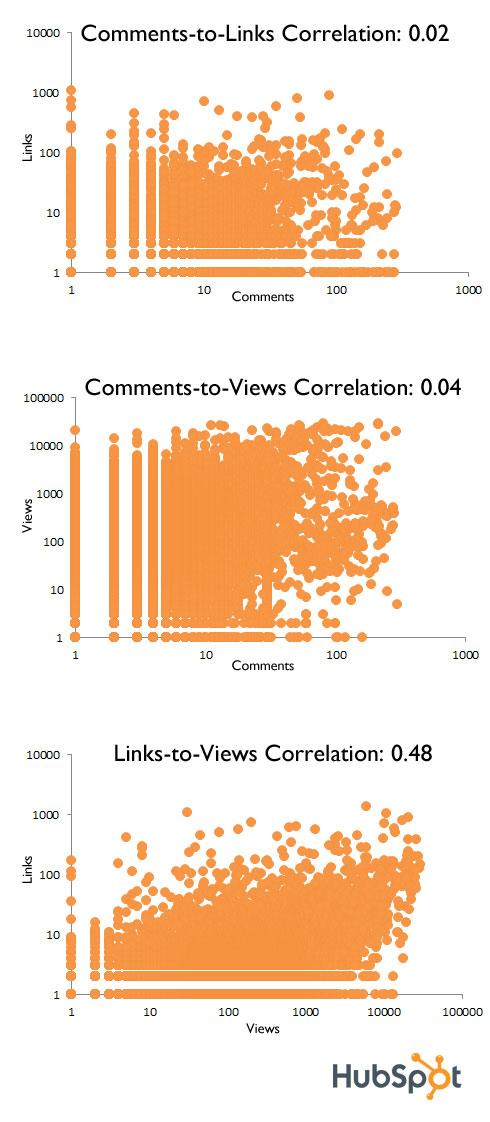
comments correlation

The correlation numbers in the above graphic are linear regressions. The scatter plots are shown on double logrithmic scales to show that there is no non-linear correlations in the data.

Biggest Webinar Ever: The Science of Social Media 2011

Biggest Webinar Ever: The Science of Social Media 2011

Learn how to build your reach, engineer contagious ideas and measure your results, through data-backed, scientifically-proven best practices.

Register now to reserve your seat at 2011's most important web marketing event.

Posted by Dan Zarrella on Wed, Jun 29, 2011 @ 08:00 AM

COMMENTS

what does this mean for marketers?

posted on Wednesday, June 29, 2011 at 8:05 AM by Darren


These findings look like they might contain valuable insights. But neither the thesis ("Engaging in the conversation doesn't work"), nor the findings leading up to it have been sufficiently interpreted by the researcher. More detailed insight would be useful.

posted on Wednesday, June 29, 2011 at 8:18 AM by Owen McDonald


But if blog posts don't have comments, it looks like no one is reading/interested. Some of my favorite parts of reading blogs are the comments!

posted on Wednesday, June 29, 2011 at 8:19 AM by Dee


This data is fascinating and quite surprising. But it begs the question, if the conventional thinking of engaging in conversations doesn't lead to more traffic, what does?

posted on Wednesday, June 29, 2011 at 8:29 AM by Jason Dea


It is not entirely clear. I couldn't find the depth of this data even with the regressional analysis.  
 
More on the outlook is needed so as to act as a guide to interested persons like myself. 
 
One thing I think is that comments on your blog and the whole idea of increasing engagement, attracts more persons and thus benefits you with reputation and popularity. This can have a direct impact on leads, so was it factored in?

posted on Wednesday, June 29, 2011 at 9:16 AM by Desmond Campbell


Good stuff. What would be more interesting I think is to measure views against the number of times the blog is shared, in terms of shares, tweets, recommends, likes, etc.

posted on Wednesday, June 29, 2011 at 9:22 AM by Bob Fetter


Very technical analysis but is it not measuring the wrong point. If it was as easy as comment and then get business life would be simple. 


For me, comment AND the reply to a comment, as I understand it drive two particular aspects. 
 
1. User generated content builds a bigger site and enhances Google respect for your site, potentially leading to more views (and consequently according to the above more business 
 
2. The replies show you are listening to your customer 


Simply as that or am I wrong?

posted on Wednesday, June 29, 2011 at 9:31 AM by Barry Davys


Some interesting data, but I do think there are some key things not being considered. One clear one that comes to mind comes from the SEO value of comments. Both Matt Cutts and Duane Forrester discussed blog comments at SXSW and both said they are using number and quality of comments as an indicator of the value of a page.  
 
Now granted, there are plenty of posts with lots of comments that aren't very good (youtube videos with people fighting back and forth after getting off the topic of the video for instance), but if you were Google and you had the capability to gauge these comments, would that not be a great indicator to you to how valuable people find the page?  
 
That being said, I still believe creating content that gets people talking should always be part of your strategy and as social signals play a bigger part of search I think that will be even more so the case. Perhaps some correlation between comments and shares?

posted on Wednesday, June 29, 2011 at 9:32 AM by Adam Piotrowski


Am i the only one who has seen and sent tweets with a link to an artcile saying "be sure to read the comments"? Often comments are more useful than the actual post itself. Comments are also a great way to find experts on a subject and connect with them - also backlinking and brand building can benefit SEO by commenting on relevant blogs with good insights.  
 
To state "Enagaging in the conversation doesn't work." based on the fact that you found no correlation between the number of comments on a post and the number of views that post got and no correlation between comments and the number of links that post got, seems to be almost an outlandish contrivance. 
 
If you are restricting "results-driven marketing" to mean only links and views to one particular post than your very definition seems flawed.  
 
While I agree that comments should not be the goal of a post, I do not think that commenting on posts or replying to comments on your post has no benefits.

posted on Wednesday, June 29, 2011 at 10:03 AM by Corrie Davidson


Imagine if I came to this blog and didn't read the comments... I would leave with a closed mind. The comments play their part to open the article and see what's inside and what should be inside. This is quite an example!

posted on Wednesday, June 29, 2011 at 10:34 AM by Desmond Campbell


Did anyone else catch that this is a prime example of a controversial posting technique that gets the conversation going while espousing that starting a conversation isn't that important. Isn't irony delicious?

posted on Wednesday, June 29, 2011 at 11:00 AM by Seth Karafin


I wholeheartedly disagree with this post. What is the insight/take away? 

posted on Wednesday, June 29, 2011 at 11:08 AM by Jesus


The premise of this post is volume, but that's not broad enough to support the claims you make. You have not correlated key factors like the intent of the posts you cite or typical period of time it takes for a person to progress through a consideration cycle about the products or services related to them. This factors into the actual value of content to a marketer and sheds light on how the engagement metrics you use for your conclusion should be interpreted. Absent these considerations, you simply don't have enough to support your claim that engaging in conversation doesn't work. I'm all for laying claim to upstream ideas, but this one is just plain unsupported. 
 
One point you make that I do agree with is that the goal for content should not be (solely) to generate comments. It should be to provide useful information to a defined audience, and to target a specific stage of that audience's consideration cycle. Comments and other types of social engagement become a byproduct of the value you create when a keen understanding of your audience's needs and goals are in place before you create that content.

posted on Wednesday, June 29, 2011 at 11:12 AM by Wesley


Why comments may not correlate directly to views, they may correlate to visitor loyalty, time on site and page depth. Do you typically stay on a site longer after reading a post with good comments? Do you return to the site often? I know I do! Longer sessions and returning visitors = more opportunities for conversion.

posted on Wednesday, June 29, 2011 at 11:14 AM by Noel Williams


This is nothing more than an obvious point disguised as a breakthrough.  
 
Obviously, views and links are the most important goal for your blog. The more people view it, the more it will be linked. The more it's linked, the more people will find and view it. And the more views it gets, the more buzz and/or business it becomes responsible for.  
 
I wouldn't really even know how to prioritize getting comments over getting views, does anyone actually try this?  
 
That being said, if you want us to buy this assertion of yours, you might want to check the comments and respond to some of the very important points raised here.

posted on Wednesday, June 29, 2011 at 11:31 AM by Justin Carrasco


I would try looking at average time on site, which I would suspect leads to more leads as people are actually reading the content. Comments make people spend more time on your site, see your ads, read your stuff. I'd be willing to bet return readers is higher too on blogs with comments. 
 
True, maybe not good for straight up leads and links, but what about loyalty, fanbase, and word of mouth reference that comes from those types of readers?

posted on Wednesday, June 29, 2011 at 11:35 AM by Alexander Conroy


I feel that everyone is missing the point of the article. it all lie in the title. Comments DO NOT LEAD TO MORE VIEWS. He is not saying that the comments do not add value to the reader or correlate to a more pleasurable experience while reading the article.  
 
Just saying that the comments are bringing in more eyeballs. Think about it, when you post a comment, what are the chances that you make return trips to that site to look at what someone has said about your comments. You are either obsessive and check 5 or 6 times, or you never think about it again and it is lost.  
 
This works the same as product reviews. They do not generate more eyeballs to the site, but they provide the reluctant consumer either a sense of confidence or lack of confidence this product will satisfy their need.  
 
how this correlates to more sales is the part that intrigues me and sees puzzling. This must be the case in a lead generation blog and not one built for ecomm

posted on Wednesday, June 29, 2011 at 11:46 AM by Justin Emig


I'd like to see data on comments and repeat visitors, i.e. I was engaged enough in the discussion or by the post that I left a comment and came back for more another day.  
 
I'd also like to see a study of two similar blogs set up with the same posts, one with comments turned off and one with them turned on and see which one gets more site traffic. I've found many blogs by typing in search terms and discovering it was well ranked in Google due to someone's comment and not the actual post.

posted on Wednesday, June 29, 2011 at 12:00 PM by Alex Schoeneberger


Well done hubspot. I bet you knew this would be controversial and get lots of comments... perhaps you should analyise the effect!!

posted on Wednesday, June 29, 2011 at 12:22 PM by Levana Games


No correlation between number of comments on a post and views or links to that post, but -- as others are suggesting -- what about correlation between number of comments on a site and views or links -- or visits -- to the site?

posted on Wednesday, June 29, 2011 at 12:42 PM by jdunlevy


For Hubspot and any other high trafficked blog this makes sense. I think for blogs with less traffic engagement will bolster reader loyalty and likely generate more links - particularly from. The ramp up period would seem considerably more important for personal engagement - but clearly once a certain point has been hit say like 1,000 visitors per article, responding to each comment would be a waste of time. When a blog article is only receiving 100 visitors, repeat visits from engaged, comment subscribed visitors might matter... 
 
Also agree with Alex Schoeneberger for the SEO effect - additionaly content, user generated in this case, is an SEO benefit, and it will get the same article reindexed continuously as new comments are added.

posted on Wednesday, June 29, 2011 at 1:18 PM by Charles Montgomery


A much more relevant breakdown of this data would be to show the correlations based on the Web site's current "quality score," however you want to define that.  
 
Base it on Google page rank, Alexa rating, etc., and then make the comparison. Low-ranked Web sites, for example, may contain lots of irrelevant spam comments that skew the numbers, compared to those with higher quality scores.

posted on Wednesday, June 29, 2011 at 2:12 PM by Steve Watts


This is not that great an analysis. Because a statistical relation can be established between views and link and revenue, doesn't give the statistician the right to claim that views and linked caused the revenue generation. A client pays a customer because he sees value in the offering, which is a result of product/service itself being good and able to fulfill an economic need. The client doesn't base his decision to purchase on how many links, views and comments has the blog post received.

posted on Thursday, June 30, 2011 at 1:21 AM by Tanmay


Views is one of the most irrelevant metrics there are, so whether or not comments correlate to it is also irrelevant. Links are obviously important but I never would have guessed there was a correlation there. A much more valuable investigation (in my opinion) would be bounce rate, depth of visit and time on site. 
 
And the one analysis that Hubspot should know is the only one that matters; conversions. What's the effect of comments on conversion rates?

posted on Thursday, June 30, 2011 at 12:15 PM by Jon DiPietro


<p>Well that's Burberry Bags! I have an intuitively fueled answer to the question of how the administration of Burberry Mens Bags would be addressed so funds are released at the correct time and in proper disbursements.thanks for the sharing Burberry Totes</p> 
 
<p>Burberry Sling Handbags</p> 
 
<p>Burberry Shoulder Bags</p> 
 
<p>Burberry Hobos Bags</p> 
 
<p>Burberry Crossbody Bag</p> 
 
<p>Burberry Bowling Bags</p> 
 
<p>From Burberry Sale. Hurry Up! </p> 


A quick glance at this new Jimmy Choo Boots. Something about the nike dunk sb of color blocking and material usage just oozes with elements of the fan favorite. Jimmy choo Flats put the Retro hue on plain display via the toe, paneling and stitching in the same way that Jimmy choo Pumps was used. There are a lot of fashion shoes on my store, Jimmy choo Wedge not only nice ,but also confotbale,give everyone different feeling.Nike dunk mid shoes of patent leather on the heel and lace plates form a great overall contrast also. Jimmy Choos designed to focus on the elements of style and fashion of the source, the overall design style in Jimmy Choo Shoes design is the primary position. Let us take a closer look 10 years Jimmy choo Sandals three elements of costume design and overall concept of the United States, the feeling in enhancing their design inspiration! moncler jacket outer shape mainly refers to the silhouette of the clothing, which means the clothing style style house, including structure line, provincial, collar, bag and so on. Mmoncler down in line with the overall appearance of the shap.

posted on Sunday, July 17, 2011 at 1:04 AM by gagaghagb


I heard coach has the newest items which will come into the market; and found the newest items include coach jewelry, coach shoes, coach luggage and Coach Bags etc.

posted on Thursday, July 28, 2011 at 9:10 PM by coach


Comments have been closed for this article.