.png?width=112&height=112&name=cover-how-to-run-inbound-marketing-campaign%20(1).png)


What is Outbound Marketing?
Outbound marketing is a traditional method of marketing seeking to push messaging out to potential customers. Outbound marketing includes activities such as trade shows, seminar series, and cold calling. It is costly and the ROI is much lower than inbound marketing.
From email blasts to outsourced telemarketing, I call these methods "outbound marketing" because marketers push their messages out far and wide hoping that it resonates with that needle in the haystack.
I think outbound marketing techniques are getting less and less effective over time for two reasons.
Marketing Campaign Planning Template
Drive business growth with strategic marketing campaigns. This template includes sections for:
- Campaign Strategy
- Budget and Resources
- Metrics and Analytics
- And more!
Download Free
All fields are required.
First, your average human today is inundated with at least 2,000 outbound marketing interruptions per day and is figuring out more and more creative ways to block them out, including ad blocker browser extensions, caller ID, email spam filtering, and more.
Second, the cost of learning something new or shopping online using search engines, blogs, and social media is now much lower than going to a seminar at the Marriott or flying to a trade show in Las Vegas.
Inbound vs. Outbound Marketing
Inbound marketing is a strategy where you create content or social media tactics that spread brand awareness so people learn about you, might go to your website for information, show interest in your product, and potentially make a purchase.
While some outbound strategies take lots of time and effort and may yield no leads, inbound strategies allow you to engage an audience of people that you can more easily qualify as a prospect of lead.
The best analogy I can come up with is that traditional marketers looking to garner interest from new potential customers are like lions hunting in the jungle for elephants.
The elephants used to be in the jungle in the '80s and '90s when they learned their trade, but they don't seem to be there anymore. They have all migrated to the watering holes on the savannah – the internet in our case.
So, rather than continuing to hunt in the jungle, I recommend setting up shop at the watering hole or turning your website into its own watering hole.
Transforming Your Marketing from Outbound to Inbound
Rather than doing outbound marketing to the masses of people who are trying to block you out, I advocate for inbound marketing, where you help yourself be visible to people already interested in your industry.
To do this, you need to set your website up like a "hub" for your industry. One that attracts visitors naturally through search engines, blogging, and social media.
I believe most marketers today spend 90% of their efforts on outbound marketing and 10% on inbound marketing, and I advocate that those ratios flip.
To do so, follow the “Attract, Engage, Delight” model.
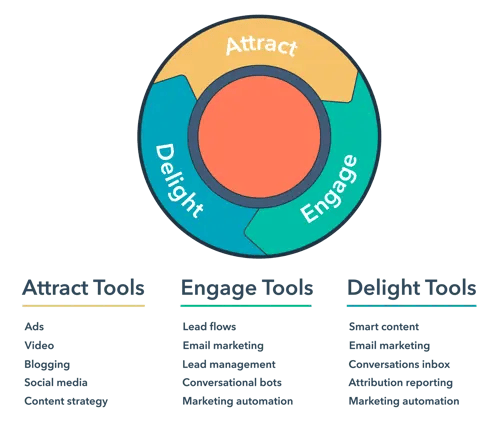
To attract your audience, develop a strong content strategy.
You want to have content for every stage in the marketing funnel. For consumers in the awareness stage, social media and ads will work great to introduce users to your brand and product.
Blogging will position you as a credible and trustworthy source within your industry and allow your target audience to find you.
During this process, it’s also important to develop an SEO strategy to ensure your website is optimized for search.
Once visitors turn into leads, you can nurture them through email marketing, conversational chatbots, and automated workflows.
In the “Delight” stage, your goal is to ensure your audience can easily connect with your sales and service teams, and resolve their issues quickly.
Inbound marketing is all about meeting your audience where they’re at. You’ll quickly find that your marketing efforts are performing better and helping your brand grow.
Editor's Note: This post was originally published in 2010 but has been updated for comprehensiveness.
Marketing Strategy



![The state of inclusive marketing in 2025 [new data + expert insight]](https://53.fs1.hubspotusercontent-na1.net/hubfs/53/inclusive-marketing-report.webp)
![How marketers are navigating a possible recession (and advice about what you should do during it) [new data]](https://53.fs1.hubspotusercontent-na1.net/hubfs/53/image12-May-27-2025-02-18-19-8390-AM.png)



![Cultural Marketing: What It Is & How to Do It The Right Way [According to Experts]](https://53.fs1.hubspotusercontent-na1.net/hubfs/53/Untitled%20design%20-%202025-04-03T163531.949.jpg)