.png?width=112&height=112&name=Image%20Hackathon%20%E2%80%93%20Vertical%20(84).png)
This wasn’t just a list of naughty words. It came with spam scores — weights assigned to each phrase based on how likely it was to get your email flagged by filters. Before any copy went to the client for review, I’d comb through every line of the message against that list, making sure we weren’t setting off any content alarms.
It was a pain in the neck, but it was necessary. Because back then, the majority of spam filters were content-based. One too many “Frees” or “Buy Nows” and boom — straight to the junk folder.
I did similar work for Reed Scientific, and it was even trickier. Many of the words they had to use — clinical, technical terms — also showed up on the spammy list. They weren’t being deceptive, but spam filters couldn’t tell the difference between “legitimate medical journal topic” and a Nigerian prince scam. Which meant I spent a lot of time finding strategic workarounds for entirely innocent language.
In this post, I’ll go into more detail about spam trigger words — and how to avoid them.
Table of Contents
- What are spam trigger words?
- How to Avoid the Spam Folder
- Spamming Examples
- Spam List: Words to Avoid When Possible
.png)
A Beginner's Guide to Email Marketing
How to execute and measure successful email marketing campaigns
- Growing an email list.
- Remaining CAN-SPAM compliant.
- Using email automation.
- Segmenting your audience.
Download Free
All fields are required.
What are spam trigger words?
Spam trigger words are terms historically used to identify junk email, back when filters relied mostly on language to catch spam. Think “Buy now!” and “FREE!!!” These days, filters are smarter and look at other things first, like authentication, sender reputation, and engagement. But overusing these old-school red-flag words can still tip the scales against you if other elements are shaky.
How to Avoid the Spam Folder
These days email spam filters are smarter (thankfully) than just looking at problem words. They look at authentication, sender reputation, and engagement, too. Here’s what you need to do in all three areas to keep your messages going to the inbox, rather than the spam folder.
1. Confirm you have authentication in place.
Authentication isn’t as difficult as it sounds, and it’s the best place to start if your goal is to reach the inbox.
Back in the early days of email, authentication was optional. Today, it’s mandatory. Not just to avoid the spam folder, but to even get considered for inbox placement.
Authentication is how you prove to mailbox providers that you are who you say you are – and that no one’s pretending to be you. It’s not about content or cadence; it’s infrastructure. DNS records. Policies. Cryptographic signatures. Sounds difficult – but it’s not.
There are four main protocols you need to know: SPF, DKIM, DMARC, and BIMI. Each one plays a different role in helping you build trust with mailbox providers. The first three are required by all four of the major email inbox providers; BIMI is not (yet). Here’s an overview:
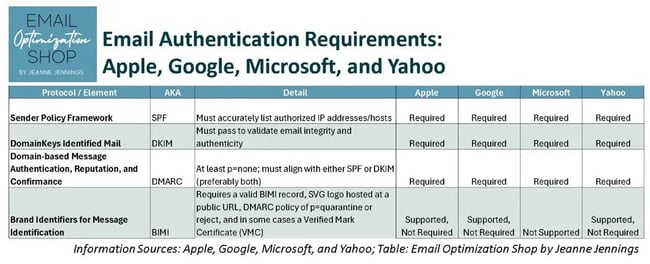
And here’s a little more detail on each:
SPF: Your Email Bouncer
Sender Policy Framework (SPF) tells mailbox providers which servers are authorized to send email on behalf of your domain. It’s your way of saying, “Only these senders are allowed at the door.” If an email shows up from your domain and it’s not on the SPF list, red flags go up.
What to do: Make sure your SPF record is up to date and includes all your legitimate senders — your ESP, your CRM, your support system, anyone sending on your behalf. Here’s more detail.
DKIM: The Tamper-Evident Seal
DomainKeys Identified Mail (DKIM) adds a digital signature to each email, so the receiving server can verify that the message hasn’t been altered in transit and that it came from you. Think of it as your wax seal on the envelope.
What to do: Publish a public DKIM key in your DNS, and ensure your ESP is signing outgoing email with the matching private key. Here’s more detail.
DMARC: Your Inbox Policy
Domain-based Message Authentication, Reporting and Conformance (DMARC) is the protocol that ties it all together. It tells mailbox providers what to do if an email fails SPF and/or DKIM, either monitor, quarantine, or reject that message.
What to do: Start with p=none so you can monitor. But the long-term goal is p=quarantine or p=reject, because most major inbox providers (like Google and Yahoo) require enforcement for full trust and things like BIMI.
Bonus: DMARC reports give you visibility into who’s sending email from your domain. Sometimes you’ll find unauthorized senders; sometimes you’ll discover your own dev team forgot to authenticate something. Here’s more detail.
BIMI: Show Your Logo, If You’ve Earned It
Brand Indicators for Message Identification (BIMI) is where authentication meets branding. If you’ve passed DMARC with enforcement and set up the right DNS records, BIMI lets your logo appear next to your emails in supported inboxes.
What to do: Publish an SVG logo, set up a BIMI record, and if you're sending to Gmail or Yahoo users, you’ll also need a Verified Mark Certificate (VMC). Yes, that’s a paid third-party certificate — welcome to enterprise email. Here’s more detail.
Authentication: Final Words
All four protocols require DNS configuration. If that’s not your lane, loop in your IT or dev team. But don’t skip this step. Without proper authentication, you’re starting every send with a deficit. Even your most beautiful, best-segmented campaign will be suspect if the infrastructure doesn’t check out.
And remember: passing authentication isn’t a gold star, it’s the baseline. You’re not getting rewarded for doing it right, but you will be penalized if you don’t.
2. Maintain a good sender reputation.
Once your authentication is squared away, the next big inbox gatekeeper is sender reputation. If authentication says you are who you say you are, reputation tells mailbox providers whether you’re someone worth trusting.
Think of it like a credit score, but for your domain or IP address. Have you been sending responsibly? Are people opening and clicking? Or are you racking up bounces, unsubscribes, and spam complaints?
Mailbox providers track all of this. And they use it to decide whether your emails go to the inbox, the spam folder, or nowhere at all.
Check your score before you wreck your score.
There are a few ways to check your sender reputation. And none of them require guessing or vibes.
- Sender Score by Validity: A free tool that gives you a score between 0 and 100 based on your sending IP and/or domain. Think of it as a general reputation report card. Anything above 80 is solid; below 70 and you might want to investigate.
- Google Postmaster Tools: If you’re sending any real volume to Gmail users, this is a must. You’ll see data on spam complaint rates, IP/domain reputation, authentication status, and even delivery errors. But fair warning: You need to have DKIM and SPF set up and be sending at a consistent volume to access meaningful data.
- Microsoft SNDS (Smart Network Data Services): It’s not pretty, but it’s useful — especially if your email isn’t making it into Outlook or Hotmail inboxes. You’ll get data on complaint rates, spam trap hits, and how Microsoft sees your IP’s reputation. You’ll need to register your IP(s) to gain access.
- Cisco Talos Intelligence: Offers reputation lookups for IP addresses and domains. This includes spam score, blacklist status, and email volume history. Great for a quick health check if something feels off.
Reputation Killers: A Non-Exhaustive, But Highly Relevant List
Even a well-intentioned sender can damage their rep. Here's what to watch out for:
- High hard bounce rates (sending to invalid email addresses).
- High spam complaint rates (Gmail considers anything above 0.1% as a red flag).
- Sudden spikes in volume without warming up first.
- Sending to purchased or scraped lists where there’s no explicit opt-in permission (don’t do it).
- Ignoring lack of engagement; continuing to send to people who haven’t opened in months (or ever).
The Fix: Warmth, Consistency, and Good Hygiene
There’s no overnight fix for a damaged sender reputation, but you can turn things around with consistency and list hygiene.
- Gradually ramp up volume (especially after downtime or switching IPs).
- Decrease frequency, remove, or suppress unengaged subscribers.
- Make unsubscribing easy (yes, really).
- Monitor complaints like it’s your job. (Because … it kind of is.)
Bottom line: Sender reputation is invisible until it starts hurting you. But once your emails start missing the inbox, it’s the first place to look. Use the tools, check the metrics, and treat your domain reputation like the asset it is. Because mailbox providers certainly do.
3. Keep your readers engaging.
Engagement isn’t just a nice-to-have anymore. For mailbox providers, it’s a core signal, maybe the core signal, that your email is wanted, welcomed, and worth delivering to the inbox.
Think of it from their perspective: If a recipient never opens your email, or worse, deletes it without reading or marks it as spam, why should they keep delivering your messages to the inbox? They’re in the business of happy subscribers (your recipients), not senders with a quota (your organization).
So yes, engagement matters. A lot.
What counts as “engagement”?
Short answer? Anything that signals interest.
Things like:
- Opens (Yes, even with Apple’s MPP complicating things … more on that in a sec.)
- Clicks (links, buttons, CTAs — these are gold)
- Replies (especially for B2B senders or service emails)
- Forwards or “Add to Address Book” actions (a strong positive signal)
- Marking messages as “Not Spam” (if your subscribers are recovering them from the junk folder)
Mailbox providers are using this engagement data to make decisions about future delivery. So if your audience is tuned out, your future campaigns are more likely to skip the inbox … even if they’re technically flawless.
But wait … What about Apple MPP?
Ah yes, Apple’s Mail Privacy Protection (MPP). Introduced in 2021, it pre-loads the tracking pixels that signal opens, which can artificially inflate open rates for recipients receiving your messages in Apple inboxes (like the native Mail app on iPhones). For most email marketers, this means that open rates have become a bit … fuzzy.
Here’s the thing. There’s always been a margin of error in open rates, due to the use of tracking pixels. If a recipient reads an email once, or even 10 times, with images blocked, no open will be recorded. But if someone scrolls past an email with images enabled, and it appears in the preview pane of their inbox, it will register an open, even if they did not look at it.
So they’ve always been fuzzy, and now they are even fuzzier. But fuzzy doesn’t mean useless. Opens can still be a directional indicator. A sudden decrease in open rates may mean you’re not reaching the inbox (messages delivered to the spam folder or not delivered at all will not register an MPP open).
Just don’t assume opens are an absolute measure of who is and is not engaging with your email – they aren’t and never were.
How to Track and Improve Engagement
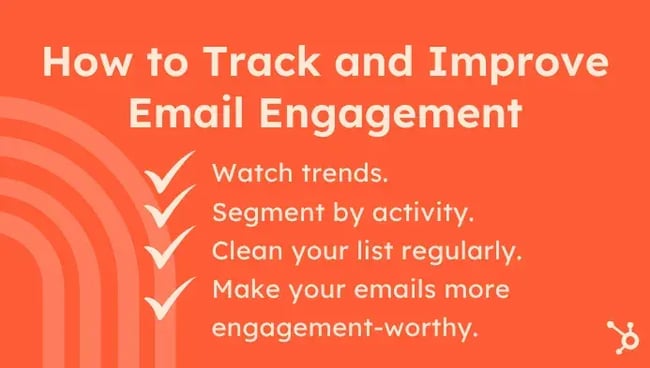
- Watch trends, not just isolated metrics. Are opens declining across multiple sends? Are fewer people clicking your CTAs? That’s worth investigating.
- Segment by activity. Send re-engagement campaigns to lapsed subscribers. Lower the frequency on your inactive recipients. Send more frequent emails to your most active ones.
- Clean your list regularly. If someone hasn’t opened or clicked in 3-6 months (or whatever time frame makes sense for your cadence), decrease your send frequency. Maybe only send during your high seasons (for Hasbro that was pre-Chistmas, pre-Easter, and pre-Summer). You might even suppress or sunset them if they still continue not to engage, because sending to long-term unengaged recipients drags down your reputation.
- Make your emails more engaging. I know. Obvious. But if your subject lines are vague, your CTAs are buried, or your content reads like a terms of service doc, you’re not giving people much to engage with or click on.
Pro tip: If you’re sending only promotional content, like discounts, sales, and offers, you’re less likely to earn sustained engagement. Mix in value-based content like tips, insights, inspiration, and resources. Something worth reading, even when someone’s not ready to buy.
Bottom line: Engagement is the clearest way to prove your emails are wanted; lack of engagement is the fastest way to get penalized when they’re not. If you’re ignoring this, inbox placement will eventually ignore you.
Spamming Examples
Before CAN-SPAM was passed back in 2003, I worked for a large company that, like many at the time, was still figuring out how to run a commercial email program that didn’t infuriate people.
One day, customer service asked for a meeting. I was heading up the email program, and they were fielding a rising tide of calls from people who were upset about the emails we were sending. Not confused. Not curious. Angry.
Apparently, someone (before I got there, thank you very much) had armed the team with a document titled “10 Reasons the Emails We Send You Aren’t Spam.” I don’t remember all 10, but here’s the greatest hits:
- “We’re a legitimate company.”
- “You have a business relationship with us.”
- “We only send emails that are of interest to you.”
- “This is a benefit to you.”
Customer service was told to read all 10 points to anyone who called in to complain. Only after they had gone through the list in its entirety were they allowed to unsubscribe someone from our emails.
So I asked: How’s that working for you?
They said they rarely made it past item five. Most people got more agitated as the list went on, and many hung up before they got to the part where they were finally allowed to unsubscribe them. So, effective at keeping people on the list: yes. Effective at creating subscribers who welcomed our messages: no.
A Beginner's Guide to Email Marketing
How to execute and measure successful email marketing campaigns
- Growing an email list.
- Remaining CAN-SPAM compliant.
- Using email automation.
- Segmenting your audience.
Download Free
All fields are required.
Spam is in the eye of the beholder.
That story may sound dated, but the dynamic behind it is still 100% relevant. Spam is often about perception, not policy. The legal definition of spam (from the U.S. CAN-SPAM Act) is email sent without meeting certain requirements: a working unsubscribe link, a physical mailing address, honest subject lines, no deception, and so on. It doesn’t even require opt-in (though your deliverability team and inbox placement would really prefer that you get it).
But for your recipients, defining spam is way simpler:
“I didn’t want this.” “I don’t like this.” “Why are they sending this to me again?”
Even if someone did opt in, and even if you’re technically compliant, if they feel like your email is irrelevant, repetitive, pushy, or just plain annoying … they may mark it as spam anyway. And when they do, that hurts your sender reputation, inbox placement, and your ability to reach people who do want your messages.
So yes, you should be compliant. But that’s just the floor. What really matters is whether your email feels like spam to your subscribers.
Because in 2025, permission doesn’t guarantee attention — and compliance doesn’t guarantee inboxing. Welcome to reality.
So now, without further ado (or storytelling), here are some examples of what I consider spam from my own inbox.
The Phishing Scheme
This one’s a head-scratcher, and a classic example of why “spam” is often in the eye of the beholder.
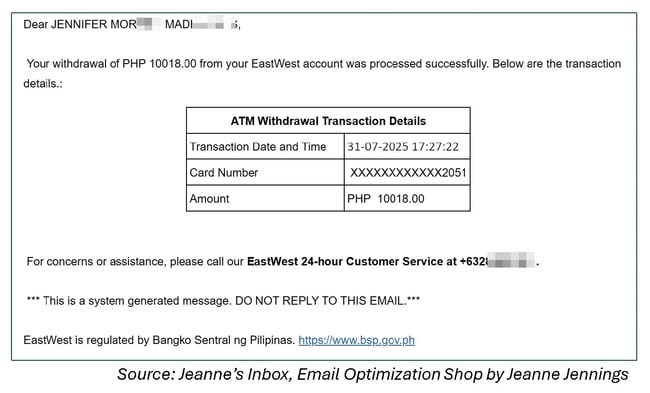
Let’s start with the obvious: my name isn’t Jennifer. It’s Jeanne. My middle and last names don’t start with “Ms” either. I don’t have an account with EastWest Bank. And I don’t live in the Philippines. In fact, I’ve never even visited the Philippines.
So why did I receive an apparently system-generated email confirming a 10,018 PHP ATM withdrawal, complete with masked card number and timestamp? Good question. This is most likely a phishing attempt. A fake transactional email trying to stir up panic and get me to call, click, or respond.
It checks the classic phishing boxes: a plausible-looking format, real-world branding, and a vague call to action to “contact customer service.” And yes, there’s a disclaimer telling me not to reply to the email, which is usually code for “don’t expect anyone to notice this is fake.”
Spam? Absolutely. Whether or not this technically violates CAN-SPAM or was even sent to a purchased list doesn’t really matter. It is irrelevant, misdirected, and sketchy. And if it walks like spam and quacks like spam … you know the rest.
The “All About Us” Newsletter
I get way too many of these. The B2B newsletter below landed in my inbox and featured the organization mentioning its own name thirteen times in a single message. I’ve covered each instance with a red box, to protect the identity of the organization.
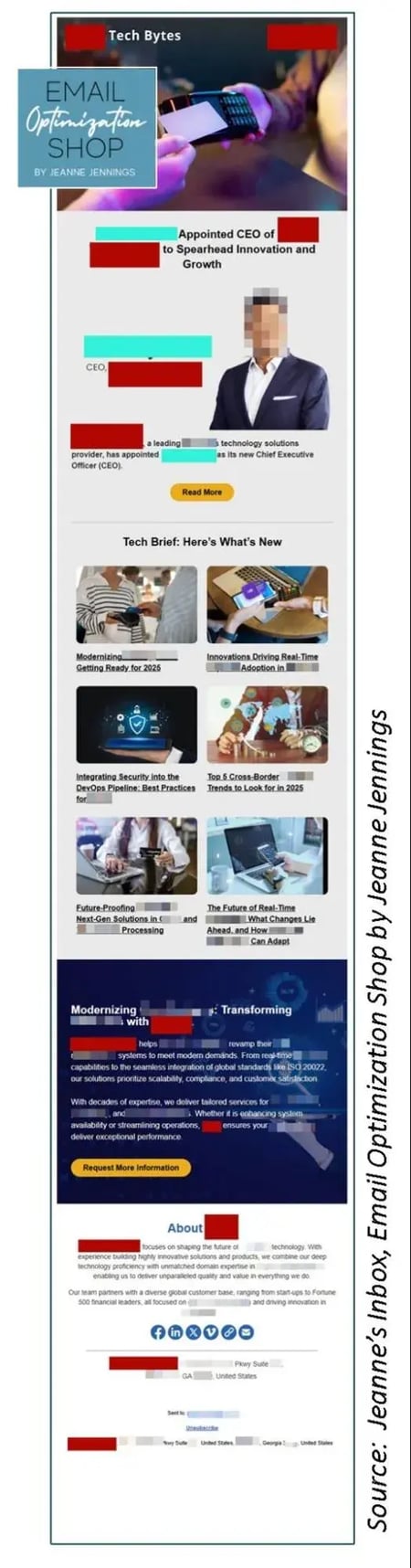
The entire email was the organization talking about itself. Its awards, its milestones, its latest press release … without any clear reason why I, the reader, should care. The only potential value-add, a link to a white paper, was buried at the very bottom.
It’s a textbook “All About Us” newsletter: no hook, no reader benefit, and no attempt to make the content relevant to the recipient. It’s also a missed opportunity to engage, and a good reminder that your emails should feel like they’re for your audience, not just about your organization or for your CEO.
Are they a legitimate company? I think so. Is their newsletter effective? No. Did I opt-in? Maybe. I do know who they are and I have spoken to people there. Can it be fixed? Yes – here are my recommendations. Is it spam? Technically no, but realistically? Probably yes.
The Frequency Issue
Even valuable content can start to feel like spam when it shows up too often. Frequency on its own isn’t inherently bad. Daily emails can work, if your audience wants them. But when the cadence is out of sync with recipient expectations, even well-crafted, on-brand messages can start to feel like inbox clutter.
Take the example below. Although the friendly from addresses are different, all are from Groupon (see the link in the preheader text). And all have the same subject line.
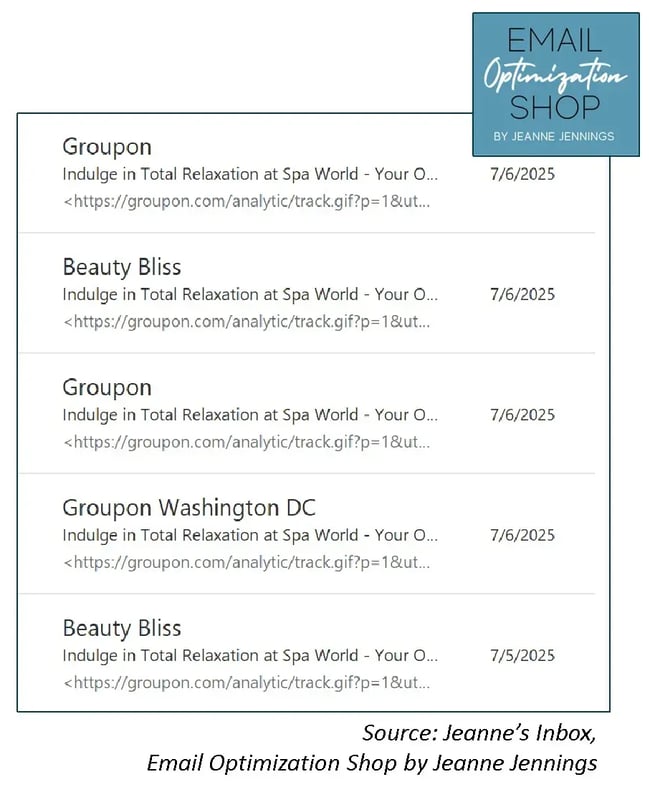
I received 133 emails in a single month from Groupon, a brand I’ve purchased from exactly once in the last year. That’s 4.3 emails per day. And most of them (58%) had the exact same subject line (the one above). It wasn’t malicious. It wasn’t deceptive. But it was excessive. And after a while, I stopped noticing the messages altogether.
That kind of repetition, especially in the subject line, can train recipients to tune out. If every subject line looks the same, they’ll assume the content is the same too (even if it isn’t) and start skipping or deleting without opening. And once that pattern sets in, engagement drops … and your deliverability may follow.
Here’s the thing: Volume isn’t strategy. Frequency needs to be intentional and aligned with actual subscriber behavior. Otherwise, even “good” emails that are compliant, relevant, and promotional (or not), can become indistinguishable from spam in your recipient’s eyes. And when that happens, they may not just ignore it. They might actively report it.
Check out the blog post this experience drove me to write to learn more.
Spam List: Words to Avoid When Possible
As I said, some words and phrases are easier to avoid than others. At the very least, you'll want to ensure you use some of these only if you absolutely need to and as little as possible.
Commerce
- As seen on
- Buy
- Buy direct
- Buying judgments
- Clearance
- Order
- Order status
- Orders shipped by shopper
Personal
- Dig up dirt on friends
- Meet singles
- Score with babes
- XXX
- Near you
Employment
- Additional income
- Be your own boss
- Compete for your business
- Double your
- Earn $
- Earn extra cash
- Earn per week
- Expect to earn
- Extra income
- Home-based
- Home employment
- Home-based business
- Income from home
- Make $
- Make money
- Money making
- Online biz opportunity
- Online degree
- Opportunity
- Potential earnings
- University diplomas
- While you sleep
- Work at home
- Work from home
Financial - General
- $$$
- Affordable
- Bargain
- Beneficiary
- Best price
- Big bucks
- Cash
- Cash bonus
- Cashcashcash
- Cents on the dollar
- Cheap
- Check
- Claims
- Collect
- Compare rates
- Cost
- Credit
- Credit bureaus
- Discount
- Earn
- Easy terms
- F r e e
- Fast cash
- For just $XXX
- Hidden assets
- hidden charges
- Income
- Incredible deal
- Insurance
- Investment
- Loans
- Lowest price
- Million dollars
- Money
- Money back
- Mortgage
- Mortgage rates
- No cost
- No fees
- One hundred percent free
- Only $
- Pennies a day
- Price
- Profits
- Pure profit
- Quote
- Refinance
- Save $
- Save big money
- Save up to
- Serious cash
- Subject to credit
- They keep your money — no refund!
- Unsecured credit
- Unsecured debt
- US dollars
- Why pay more?
Financial - Business
- Accept credit cards
- Cards accepted
- Check or money order
- Credit card offers
- Explode your business
- Full refund
- Investment decision
- No credit check
- No hidden Costs
- No investment
- Requires initial investment
- Sent in compliance
- Stock alert
- Stock disclaimer statement
- Stock pick
Financial - Personal
- Avoid bankruptcy
- Calling creditors
- Collect child support
- Consolidate debt and credit
- Consolidate your debt
- Eliminate bad credit
- Eliminate debt
- Financially independent
- Get out of debt
- Get paid
- Lower interest rate
- Lower monthly payment
- Lower your mortgage rate
- Lowest insurance rates
- Pre-approved
- Refinance home
- Social security number
- Your income
General
- Acceptance
- Accordingly
- Avoid
- Chance
- Dormant
- Freedom
- Here
- Hidden
- Home
- Leave
- Lifetime
- Lose
- Maintained
- Medium
- Miracle
- Never
- Passwords
- Problem
- Remove
- Reverses
- Sample
- Satisfaction
- Solution
- Stop
- Success
- Teen
- Wife
A Beginner's Guide to Email Marketing
How to execute and measure successful email marketing campaigns
- Growing an email list.
- Remaining CAN-SPAM compliant.
- Using email automation.
- Segmenting your audience.
Download Free
All fields are required.
Greetings
- Dear [email/friend/somebody]
- Friend
- Hello
Marketing
- Ad
- Auto email removal
- Bulk email
- Click
- Click below
- Click here
- Click to remove
- Direct email
- Direct marketing
- Email harvest
- Email marketing
- Form
- Increase sales
- Increase traffic
- Increase your sales
- Increase visibility
- Internet market
- Internet marketing
- Marketing
- Marketing solutions
- Mass email
- Member
- Month trial offer
- More Internet Traffic
- Multi-level marketing
- Not spam
- One time mailing
- Online marketing
- Open
- Opt-in
- Performance
- Removal instructions
- Sale
- Sales
- Search engine listings
- Search engines
- Subscribe
- The following form
- This isn't junk
- This isn't spam
- Undisclosed recipient
- Unsubscribe
- Visit our website
- We hate spam
- Web traffic
- Will not believe your eyes
Medical
- Cures baldness
- Diagnostic
- Fast Viagra delivery
- Human growth hormone
- Life insurance
- Lose weight
- Lose weight spam
- Medicine
- No medical exams
- Online pharmacy
- Removes wrinkles
- Reverses aging
- Stop snoring
- Valium
- Viagra
- Vicodin
- Weight loss
- Xanax
Numbers
- #1
- 100% free
- 100% satisfied
- 4U
- 50% off
- Billion
- Billion dollars
- Join millions
- Join millions of Americans
- Million
- One hundred percent guaranteed
- Thousands
Offers
- Being a member
- Billing address
- Call
- Cannot be combined with any other offer
- Confidentially on all orders
- Deal
- Financial freedom
- Gift certificate
- Giving away
- Guarantee
- Have you been turned down?
- If only it were that easy
- Important information regarding
- In accordance with laws
- Long-distance phone offer
- Mail in order form
- Message contains
- Name brand
- Nigerian
- No age restrictions
- No catch
- No claim forms
- No disappointment
- No experience
- No gimmick
- No inventory
- No middleman
- No obligation
- No purchase necessary
- No questions asked
- No selling
- No strings attached
- No-obligation
- Not intended
- Obligation
- Offshore
- Offer
- Per day
- Per week
- Priority mail
- Prize
- Prizes
- Produced and sent out
- Reserves the right
- Shopping spree
- Stuff on sale
- Terms and conditions
- The best rates
- They’re just giving it away
- Trial
- Unlimited
- Unsolicited
- Vacation
- Vacation offers
- Warranty
- We honor all
- Weekend getaway
- What are you waiting for?
- Who really wins?
- Win
- Winner
- Winning
- Won
- You are a winner!
- You have been selected
- You’re a Winner!
Calls-to-Action
- Cancel at any time
- Compare
- Copy accurately
- Get
- Give it away
- Print form signature
- Print out and fax
- See for yourself
- Sign up free today
Free
- Free
- Free access
- Free cell phone
- Free consultation
- Free DVD
- Free gift
- Free grant money
- Free hosting
- Free installation
- Free Instant
- Free investment
- Free leads
- Free membership
- Free money
- Free offer
- Free preview
- Free priority mail
- Free quote
- Free sample
- Free trial
- Free website
Descriptions/Adjectives
- All natural
- All new
- Amazing
- Certified
- Congratulations
- Drastically reduced
- Fantastic deal
- For free
- Guaranteed
- It’s effective
- Outstanding values
- Promise you
- Real thing
- Risk free
- Satisfaction guaranteed
Sense of Urgency
- Access
- Act now!
- Apply now
- Apply online
- Call free
- Call now
- Can't live without
- Do it today
- Don't delete
- Don't hesitate
- For instant access
- For Only
- For you
- Get it now
- Get started now
- Great offer
- Info you requested
- Information you requested
- Instant
- Limited time
- New customers only
- Now
- Now only
- Offer expires
- Once in lifetime
- One time
- Only
- Order now
- Order today
- Please read
- Special promotion
- Supplies are limited
- Take action now
- Time limited
- Urgent
- While supplies last
Nouns
- Addresses on CD
- Beverage
- Bonus
- Brand new pager
- Cable converter
- Casino
- Celebrity
- Copy DVDs
- Laser printer
- Legal
- Luxury car
- New domain extensions
- Phone
- Rolex
- Stainless steel
Your Brand Reputation: The Big Picture
At one time, avoiding the spam folder felt like a math problem. You had your trusty list of spam trigger words, a little scoring system, and a decent chance of landing in the inbox if you followed the rules. (Simpler times, honestly.)
But today, getting your email delivered and opened isn’t just about content. It’s about reputation. And not just your sender reputation, but your brand reputation.
For many people, your email and website may be the only interaction they ever have with your organization. That online experience — along with your social content, SMS messages, and even your paid advertising — shapes their perception of your brand. If your communications feel unwanted, repetitive, irrelevant, or disruptive, you’re not just risking a spam complaint. You’re risking your credibility.
This is why engagement and deliverability are so closely linked. When people engage with your emails, it signals trust. When they ignore, delete, or mark them as spam, it erodes that trust, both with the recipient and with mailbox providers watching those behaviors in aggregate.
Whether you're emailing prospects, customers, donors, volunteers, or anyone else in your audience, it comes down to relationship and relevance. Are you showing up in ways that are useful, welcome, and aligned with their expectations? If not, no amount of clever copy or compliant sending is going to save your placement.
The good news? Building that relationship benefits everything, not just deliverability. It improves click-through rates, conversions, loyalty, and long-term impact. And yes, it keeps your brand where it belongs: in the inbox, not the junk folder.
Editor's note: This article was originally published March 2013 and has since been updated for comprehensiveness.
A Beginner's Guide to Email Marketing
How to execute and measure successful email marketing campaigns
- Growing an email list.
- Remaining CAN-SPAM compliant.
- Using email automation.
- Segmenting your audience.
Download Free
All fields are required.
Email Deliverability
![Why email whitelisting is important for marketers [+ detailed steps on how to do it]](https://53.fs1.hubspotusercontent-na1.net/hubfs/53/%5BUse%20(1).webp)

![How to Bypass the Toughest Email Spam Filters [Infographic Checklist]](https://53.fs1.hubspotusercontent-na1.net/hubfs/53/marketer%20getting%20email%20past%20spam%20filter.jpg)
![4 Easy Steps to Get a Custom Email Domain [+ Key Features to Look For]](https://53.fs1.hubspotusercontent-na1.net/hubfs/53/custom-email-domain.jpg)


![Email Deliverability: 5 Quick & Effective Ways to Increase It [+IG]](https://53.fs1.hubspotusercontent-na1.net/hubfs/53/email-deliverability-1.jpg)