Everyone makes mistakes. Even (especially?) marketers. Usually, we learn from them and move on with our lives, maybe escaping with just a touch of public shaming. But what happens to those companies that make mistakes on a much greater scale and cost their company millions in clout or (gulp) dollars?
They go down in history as the biggest marketing mistakes of our time. It's hard to move on when you're being cited as the example of what not to do, huh?
We looked into the biggest mistakes from many popular brands -- but glossed over any smaller companies because we don't want to hurt the little guy ;-) Keep reading for a little entertainment, and some reminders of what you should never do to ensure you don't repeat these mistakes yourself.
Turner Broadcasting
In 2007, Cartoon Network launched a guerilla marketing campaign in which they set up LED signs in various places throughout cities to promote one of their cartoons. A resident in Boston, however, thought the devices were bombs and called the police. This turned into a terrorism scare, resulting in the shut-down of many public transportation lines, bridges, and roads. The problem cost the head of Cartoon Network his job, and the broadcasting company $2 million in compensation for the emergency response team.
This campaign is a symptom of thinking in a silo -- marketers must always be aware of current events and public sentiment when crafting campaigns. Most people, particularly city dwellers, are on high alert for signs of something fishy. I guess you can say hindsight is 20/20, but large-scale guerrilla marketing campaigns of this nature should really consider all possible outcomes before launch.
Kenneth Cole
In early 2011, a tweet was sent out from Kenneth Cole's Twitter account trying to promote their new spring collection. No big deal, right? Except when it's offensive, insensitive, and offends millions of people. The tweet was a poor play on the political turmoil happening at the time in Egypt:
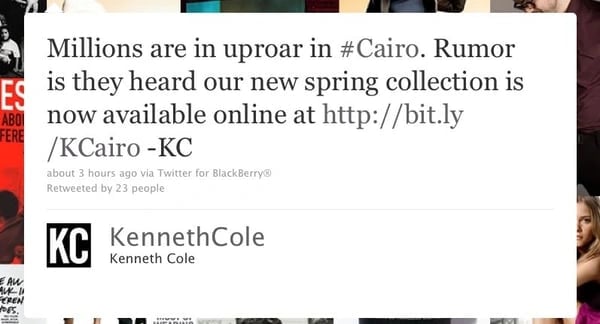
The tweet came from the Kenneth Cole corporate Twitter account -- actually, from the chairman himself, as indicated by the "KC" in the tweet. The company received negative feedback immediately, and they soon took the tweet down in response and apologized to anyone offended by the tweet. The lesson social media marketers can learn from this awful mistake is that humor doesn’t work if you're newsjacking something contentious.
Gap
In October 2010, Gap launched a new logo in an attempt to be more modern. Guess how long that lasted?
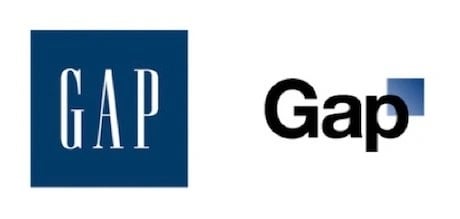
A whopping two days.
Gap quickly put the old logo back into place after unbelievable backlash from the public. Gap, known for everyday basics, tried to redo their image to appeal to a more hip crowd. Unfortunately, they didn’t understand who their target market is -- the people who want the basics and aren't interested in trendy styles. Their loyal customers felt that Gap was changing their image for the worse and lost a connection with the brand. Gap was also unsuccessful at attracting the younger, trendy generation with the redesign (albeit only a two day redesign), resulting in a failure on two fronts with this new logo.
It wasn't so awful for Gap to pursue a logo redesign, the lesson is simply to stay in touch with your buyer personas so you can ensure your new design reflects them. Marketers focus a lot on metrics -- for good reasons -- but never underestimate your audience's feelings towards your brand. They're harder to quantify, sure, but boy will people speak out when their sensibilities are offended.
Netflix
In 2011, Netflix had a $16 billion market value with their mail order DVD rental. They decided to enter the digital streaming market with a brand called “Qwikster,” an easy alternative to mail order DVDs. Unfortunately splitting the company between Netflix's mail order DVDs and Qwikster's DVD streaming made things more complicated -- not to mention it resulted in a 60% price increase for those who wanted both services.
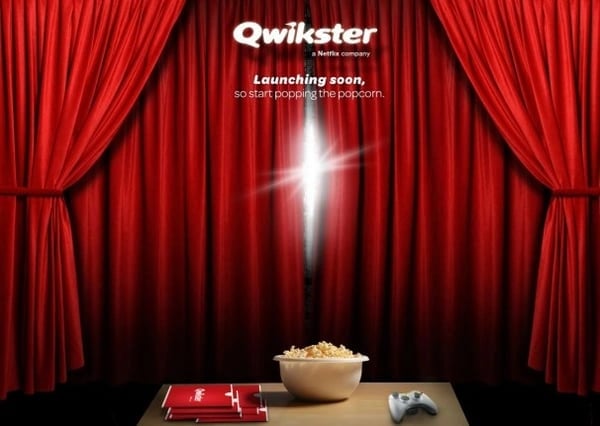
Even worse, current customers weren't grandfathered into the new price structure at the old rate, causing serious negativity amidst all the general confusion. Oh, also, the Qwikster Twitter handle was already owned by someone ... a pot smoker who discussed boredom, smoking, and partying. According to CNET, the company lost 800,000 subscribers and its stock price dropped 77% in four months.
Businesses need to remain agile and fast-moving to stay relevant -- just make sure you communicate those changes to your audience clearly before making them. Oh, and don't forget to show gratitude to your current customers instead of giving them the short end of the stick!
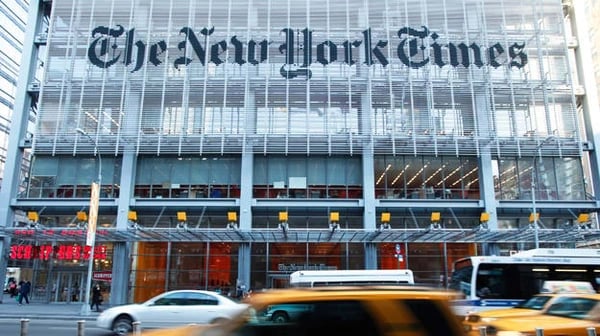
The New York Times
In December 2011, the New York Times sent an email to people who recently cancelled their subscription asking them to reconsider, and giving them a discount to sweeten the deal. Sounds like a good idea to get a customer back, right? Too bad an employee accidentally sent it to 8 million subscribers instead of the list of 300 that it was meant for.
Subscribers instantly assumed that this spam email was the result of hackers, and some were even mad that they weren't getting the same discount as a loyal customer. Of course, employees responded immediately apologizing and telling people it was an unfortunate human error. Still, this is every email marketer's nightmare, and it serves as a much-needed reminder to always double check your list before clicking 'Send' on any campaign!
Timothy’s Coffee
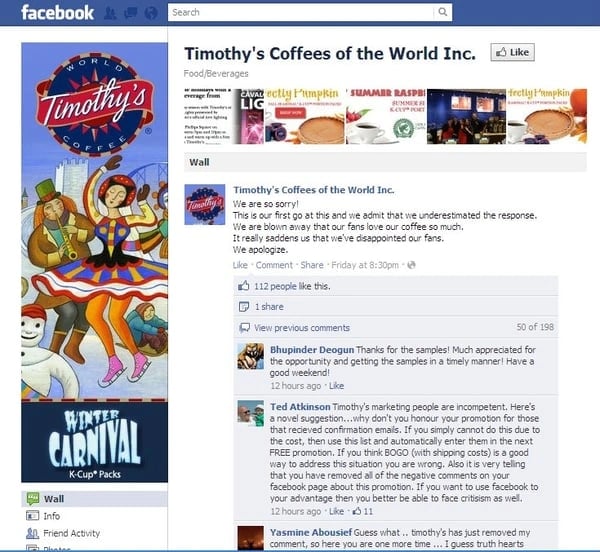
Timothy’s Coffee did what many brands have done to increase their social media reach -- offer a coupon or free sample for following them on social media. Unfortunately, Timothy’s offered more than they could deliver, depleting their supply of free K-cup packs after only three days. Two weeks later, they sent out a message saying it was first come first serve. Talk about too little too late. Despite an apology video and the potential for receiving a free coupon in the mail, Timothy's is still trying to recover from the fan backlash on social media.
When running a contest on social media, don’t underestimate the impact of your offer -- especially if it's meant to grow reach. Think about it ... if your contest works (and you're designing a contest based on the premise that it will work, I presume) your reach will get bigger with each new participant. If you can't actually back up your end of the contest bargain, all that new reach will be used to hurt your brand instead of sing its praises.
Coca-Cola
In 1985, Coca-Cola tried to introduce a new, sweeter version of their beverage to combat their new competitor, Pepsi. As people preferred the taste of Pepsi over Coke in blind taste tests, Coke felt the need to regain market share with a new recipe. So, how did it turn out?
Not well. Public response was so negative, in fact, that people were actually hoarding the old Coke and selling it on the black-market for grossly inflated prices!
Why were people so upset? Coke’s brand embodied classic American traditions -- they didn't want new Coke! They wanted that classic beverage whose secret recipe is guarded under lock and key in Georgia! After finally retiring the “New Coke” recipe, sales of the old classic -- actually renamed “Coca-Cola Classic” to make it extra clear to consumers -- rose significantly. What do we take away from this marketing mistake? Learn what your customers want before spending time and money on a top-secret product or service change!
Pepsi Expands to China
Coke isn't the only one to muck up, though. When Pepsi expanded their market to China, they launched with the slogan, "Pepsi brings you back to life." What they didn’t realize is that the phrase translated to “Pepsi brings your ancestors back from the grave.”
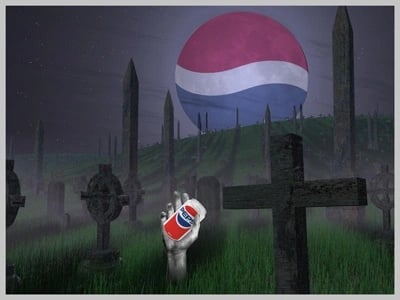
Okay, this is a pretty funny mistake ... but it's a huge mistake when you're making a big move like going international. If you're launching in a new market, be sure you do some cultural research. And for goodness sake, ask native speakers of the language what your slogan means!
This can't be all of the marketing mistakes! Share your favorite flubs -- from other brands or your own -- in the comments! Just play nice, please ;-)
Image credit: amboowho?, courtneyluv, CNNMoney, NYDailyNews, 15-bar, powerhousebiz, Glantz, WebUrbanist


Maxam Media 4:39 PM on July 17, 2012
It's incredible how small changes can really become a huge deal! Especially for large established brands. Thanks for the post Amanda
Matt
Des Tucker 4:48 PM on July 17, 2012
I really enjoyed this post! The first example about Cartoon Network had me laughing so hard I'm sure my coworkers thought I was having a seizure. Awesome post!
Andrea 4:57 PM on July 17, 2012
I like these kinds of emails better when the majority of the examples aren't from the past 5-6 years. Marketing has been around a lot longer than that.
Chuck Kent 5:41 PM on July 17, 2012
Speaking of a faux pas related to international communication... how many Chinese ancestors do you think Pepsi would be raising from the overtly Christian graves your illustration depicts?
Greg Linnemanstons 5:56 PM on July 17, 2012
Entertaining, Amanda, and a great subject to approach, but I think you missed some of the best. Could be my age showing, but I agree with Andrea, marketers have been screwing up for a long time. GM introduced Nova into South America without understanding that in Spanish Nova meant...no go! Good name for a car, right? And Gerber introduced baby food into Africa with pictures of babies on the label. The normal convention in Africa is to always portray the product inside on the label, because of the vast number of languages involved. Ooops! Strained baby, anyone!
And I would encourage you to check your numbers. Netflix never made it to $16 billion in revenue. Their best year was 2011 at $3.2B.
Cristina Vetere 7:03 PM on July 17, 2012
The GAP logo story is an example of why in marketing it is just as important to measure the value of your brand but also why your brand is representative of what your target market is. For B2B buyers, a well known and successful brand is what buyers as security and strength for a company, and a "persona" of the company that they can relate to. Aspects about the brand that seem small like logo and color are a huge part of a company's brand. Here is a fun infographic about what your brand colors say about your business:http://blog.marketo.com/blog/2012/06/true-colors-what-your-brand-colors-say-about-your-business.html
- Crissy at Marketo
Jon Turino 8:02 PM on July 17, 2012
Don't forget Osborne Computer back in the 1980s. They pre-announced, by 6 months, that a new, lighter and cheaper "luggable" computer would be forthcoming. Sales of existing models stopped immediately and the company went out of business,
Amanda Sibley 8:54 PM on July 17, 2012
I apologize for any confusion on the Netflix numbers. Netflix had a $16 billion market value in 2011, which dropped due to the problems in 2011, especially Qwikster. I miss spoke saying they had a $16 billion market share instead of value. I have added in the source within the post and have added the link here to the report of a $16 billion market value, which also has other interesting marketing mistakes I didn't add in this blog post. I hope you enjoy reading!
http://www.watchmojo.com/index.php?id=10864
I also have the Wall Street Journal Article that goes further into the problems of Netflix in 2011, attributing the drop in market value to multiple mistakes including Qwiskter.
http://online.wsj.com/article/SB10001424052970204644504576651481528038762.html
Steve 10:55 PM on July 17, 2012
What about magazines like OMNI and even Popular science. They sent letters out canceling all their subscribers. They were going to produce an On-Line magazine, to jump into the Internet in a Big way. What a bust. OMNI backtracked pretty fast but it took Popular science more than 2 years to even try and re-kindel their magazine. and I liked getting my Pop Sci. they ticked me and a lot of others off.
Patrick 11:11 PM on July 17, 2012
Terrific content! Though there are a number of examples of marketers making errors, I think your blog did a great job of illustrating a few examples. I have enjoyed your previous blogs and Im looking forward to your blogs in the future.
Amber King 12:47 AM on July 18, 2012
When doing social media marketing, companies should be careful. Before implementing a campaign, thorough analysis should be done.
Charlotte Barrett 3:09 AM on July 18, 2012
What about the McDonalds "McStories" Hashtag. McDonalds encourage staff and customer to tweet there views on Thier products, but it just ended up being a stream of negative thoughts and complaints. Nice work McD!
Cameron Nicol 4:36 AM on July 18, 2012
With communication channels shifting away from traditional advertising, TV, bilboard, radio etc, and towards two-way channels like social media, it's definitely becoming a lot easier for companies (marketers?) to unintenionally sabotage their brand.
That being said, I think one old gem is missing from this list; the Hoover disaster in 1992. For every Hoover vacuum cleaner purchased, Hoover gave away a free plane ticket. I can't remember the finer details, but since it was cheaper to buy a Hoover than a plane ticket, people began to buy Hoovers instead of plane tickets, costing Hoover a LOT of money.
Definitely a great example of how underestimation of the popularilty of deal can create a few problems
Murray 8:45 AM on July 18, 2012
Thanks for this, it's a great reminder. I remember the Turner Broadcasting fiasco...yes, you really do need to think through your campaigns and check it from every angle - especially your email campaigns, 'cause there's no turning back.
Hillary 9:14 AM on July 18, 2012
In June 2012, Korean Airlines celebrated it's entrance into the Kenyan Market with a new ad that directly referred to Kenya at "Land of primitive energy". The backlash was so bad that they had to pull down the ad. To date #primitiveenergy is still in use on twitter.
inseo 9:18 AM on July 18, 2012
I have a new candidate for your list of fails.
When Shell decided to go social with their "Let's go! Arctic" campaign I don't think this is what they had in mind:
http://arcticready.com/social/gallery
My favourite is the "We still haven't noticed we're being trolled" one.
Anne 10:57 AM on July 18, 2012
Excellent post and entertaining answers. Looking at these bigtime
bloopers reminds me of the mega mess caused by outsourcing of security for the Olympics to the private sector. To hear some of these guys is unreal. So now government has had to call in 'The Cavalry. You may think that I find this funny. No I don't, I remember Munich 4th September 1972.
Trine Nielsen 1:22 PM on July 18, 2012
Just to put things straight...
The Shell campaign mentioned above was actually quite a clever and successful marketing stunt. As it turns out it was made by Greenpeace, not Shell ;)
Tim McGraw 2:57 PM on July 18, 2012
The Coca-Cola "ancestors" story has never been corroborated in any media. The Chevy Nova and Gerber baby food in Africa story mentioned by Greg are both urban legends. As Trine points out, the “Arctic ready” ad campaign is a spoof by Greenpeace.
Joshua Tao 2:49 AM on July 19, 2012
Love this faux pases folks.
Alice Kirby 12:06 PM on July 19, 2012
What about Hoover and the free flights giveaway which was so totallly oversubscribed and cost the company a fortune.
Great read - but you can't help but feel sorry for the poor employees who no doubt got the sack for what seemed like a clever idea at the time!
Pawel Grabowski 9:04 AM on July 20, 2012
Ha ha, great post, especially for early Friday afternoon.
And, do you remember PriceWaterhouseCoopers deciding to change their name to something more funky and calling themselves .... Monday?
One immediately thinks of the great Boomtown Rats song, no?
:)
Molly 9:46 AM on July 20, 2012
Loved this, and I recently sent out a first-ever newsletter mistakenly as 'June' at the end of June, when should have been a July newsletter. Rushed, etc. and casual, not many subsribers (no one unsubbed, have very high stats) but this made me think how to be MUCH more careful as my site/brand grows. Good stuff, thanks!
Aisulu 4:15 AM on July 23, 2012
Scandinavian vacuum cleaner campaign with a slogan, which they translated into "nothing sucks like an Electrolux" :)))
Carolina Calandriello 8:59 PM on July 24, 2012
Insightful examples, definitely so much to learn! In the same line of the KC failure, Cacique (well-known Venezuelan rum and DIAGEO brand) used a campaign in Italy saying “The rum from the worst Caracas’ neighborhoods” because the idea was to show masculinity, however, the claim was really offensive for Venezuelans considering that is the leader of the market as well as a symbol of tradition and quality. As a consequence, local DIAGEO managers had to retract and sent an apology to their Venezuelan peers.