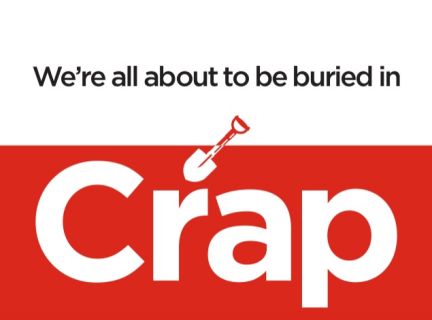

When we at Velocity Partners published our latest SlideShare rant, “Crap: The content marketing deluge,” we got a big, big response.
The rant is all about how the rush to content marketing in every industry will make it harder and harder for your content to rise above the noise -- and how the only defense is to build a Great Content Brand.
If you didn't see the slideshow, take a quick look. It's light on copy, you should be able to breeze through it quite quickly.
All caught up? Great.
The content trickle is not yet a flood.
A lot of people responded by saying that the "content deluge" isn’t on its way; it’s already here. Which made me think.
In many ways, of course, it’s true -- using content for marketing is well underway in many markets. The top vendors have active blogs. Many have published ebooks. Others have produced videos about the issues shaping the market. But I’m still convinced that the pretty dramatic increase in content we’ve already seen is really just the first trickle before the coming tsunami. Here's why:
1) More markets are discovering the power of content.
We marketers are hyper-sensitive to the content in our own space, but there are many markets out there that are still dipping their toes in the content waters (and we all know what the toe bone is connected to).
2) More vendors in each market are entering the Content Arms Race.
Once a single vendor creates a buzz with their sexy new ebook, the others are never far behind. They can’t afford to be.
3) Each competitor needs to generate more and more content.
An ebook or white paper every six months might have been good enough last year. This year, it will be one a month. Per persona. And next year, the content machines really start ramping up.
4) Every marketing discipline is becoming content-powered.
Search, social, email, web advertising ... they’ve all discovered that success depends on great content. The stuff that earns inbound links, shares, and clicks. In short: here come the agencies.
5) We’re all getting more efficient.
What used to be an alien discipline is now developing its own set of processes and metrics. So marketing departments can create more content with the same budgets (for better and, often, for worse).
If this sounds daunting, here’s an even more sobering thought:
In the content marketplace, you’re not just up against your direct competitors. You’re up against everyone who’s producing content on the same issues.
If you’re a software vendor, your content isn’t just fighting for Google shelf space against the four or five competitors who do the same things you do. You’re also up against every reseller, integrator, consultant, analyst, advisor, association, pundit, blogger, and smart-arse with a point of view and a Wordpress, SlideShare or YouTube account.
And don’t forget the former kings and queens of the content castle: journalists and editors (they haven’t all taken jobs as Head of Branded Content yet).
Or the Tyrannosaurus Rex of content: Wikipedia.
You’re competing against all of these in an epic battle for the scarcest resource on Earth: people’s attention. And the thin slice of attention that might be called your addressable mindshare -- the part that people reserve for the issues you’re talking about -- is getting smaller and smaller. Because every prospect is being targeted by even more content across many more issues that have nothing to do with you.
Now, for the really scary part.
To your prospects, the first few waves of content purported to be written for the sole purpose of helping them do their jobs were really welcome.
But when the deluge hits, all this content is going to start to look a hell of a lot like something we’ve all become really, really good at ignoring. It’s going to look like advertising. (I know, I know: even hearing the word makes your eyes turn into Xs and your thumb reach for the zap button.)
By now, you’re probably poking around for the little vial of cyanide all marketers keep under their tongues.
So it’s time for some better news.
A Lesson From History
Back in the fifties, TV advertising was new (as was TV).
The first companies to jump into this exciting new medium discovered something big. They discovered that they could use TV ads to build something called brands, and that these brands would soon become the company’s most valuable assets.
Even the not-so-great products benefited from the new brand glow. And the great products turned into unstoppable brands that generated massive profits for decades.
Well, we’re in a similar place right now. There’s a window of opportunity for marketers to create what the ‘Crap’ rant mentioned above calls "Great Content Brands." If you build such a brand now, before the tidal wave hits, your content will survive the impact. Because you will have secured a space in the minds of your prospects as, “Those guys who put out that great stuff.” You’ll be known in the market as real thought leaders: intelligent contributors to the conversations around the issues that matter most.
It’s still possible to build a Great Content Brand. But it’s going to get harder and harder -- just as it got harder for TV advertisers to build great new soap brands.
So stop reading this, and go build a Great Content Brand. Do it by working hard. Not just to create more content but to create great content. When the waters come, and they will come, you’ll be bobbing around on the surface instead bumping along the bottom.
Doug Kessler is co-founder and creative director of Velocity, the B2B content marketing agency. He’s written a lot about content marketing, including the Content Marketing Strategy Checklist and the B2B Marketing Manifesto.


Marcus Sheridan 9:15 AM on January 21, 2013
Doug, it appears you and I are cut from the same cloth as we look into the future of this industry and see where content is going.
Keep up the great work, tremendous article sir.
Marcus
InfinMarkets 9:22 AM on January 21, 2013
impressive post
Nathan K Smith 9:27 AM on January 21, 2013
Google talks about devaluing sites with bad content (e.g. add no value) however it seems that some of those sites remain at the top of the serps. It will be nice to see when sites will get rewarded for sharing good quality (HELPFUL) content, because that kind of content takes more time to write.
Mike Bayes 9:52 AM on January 21, 2013
Content marketing isn't crap. Crap content is.
Ralph 9:54 AM on January 21, 2013
But how will Google be able to judge whether a site "adds value" or is "helpful"? Sounds like a recipe for censorship. Value is in the eye of the recipient, not Google.
Ed Chapkowski 9:58 AM on January 21, 2013
Great article, and yes we're already knee-deep in crap. Take a look at some of today's facebook pages, they're sloppy and written by people with no clue about engaging with their audience and creating good content. Usually it's just some team member with admin status, not a social media pro. Tons of them are still leaving URLs in the post after the link has posted. That drives me nuts! I also see a lot of blog posts that are about a paragraph long. Just when they start touching on a point the whole thing is over. There's a lot of laziness out there too. A screengrab of a twitter argument is not content to me.
Create good content, say something, don't be sloppy, take another 10 minutes to shine it up... those are my mottos.
Doug Kessler 11:30 AM on January 21, 2013
Thanks for the shares and kind comments. Much appreciated.
It feels like this one hit the spot for a lot of fellow content marketers: we all know we're competing now with a lot of... well, crap.
Quality will rise!
Lynn Albro 11:31 AM on January 21, 2013
Amen to all of the above.
D 12:37 PM on January 21, 2013
Excellent post.
Looking at my own online niche (dating advice), there are very few people who actually have any kind of expertise who also do well in the content competition. Most of the top ranking sites tend to be professional marketers re-hashing each others content.
We've found that by being extremely good at what we do (giving good dating advice that helps people) we've been able to carve out a loyal readership and client base without ever resorting to the same black/gray hat backlinking tricks that I see many of the bigger names in my niche use.
The trick for us is simply getting our good content in front of more people than the poor content / highly optimized (gray hat/black hat) content.
Again, excellent article.
In the long run, great and useful content will win out, especially as the search engines inevitably get better at their stated goals of connecting people with great content.
Lauren Waters 1:37 PM on January 21, 2013
I think your presentation says it all, especially your mention of consistency. Each piece of content added to a site should have a purpose and should have required some THOUGHTFUL research, writing, and (for goodness sake's) editing. As an SEO agency, we hope that Google does its part in keeping the 'crap' at bay and letting quality sources rise. One thing we can all do is find and surround ourselves with quality brands in order keep their web authority high!
Thanks for the post!
Doug Kessler 1:45 PM on January 21, 2013
D: Quality is a long game. Glad you're playing it.
Lauren: Totally agree. Google invests billions to spot the best content. Why waste money trying to fool the algorithm when you can just focus on making great content?
Seaton McLaney 3:40 PM on January 21, 2013
I think more people are coming to the understanding that if their website is helpful and acts as a resource for learning, that company then establishes itself as an industry leader. A great example is making a glossary.
Brent Baltzer 4:33 PM on January 21, 2013
This post is a nice grain of salt to season all of the charts n' graphs (from Hubspot) that imply that by increasing the frequency/quantity of content your leads and revenue will increase exponentially. Not if it's craptastic! That crap will work less and less, lord willing and the creek don't rise.
Dan Tyre 6:24 PM on January 21, 2013
Very accurate, well defined and compelling; there are a lot of opinions out there, quality content sends a very distinct message
Glenda Pagan 6:35 PM on January 21, 2013
This makes me sad. What happens to the small business owner who only started a blog because it was almost pounded into him/her? The one that spends hours brainstorming and in the end comes up with 4 sentences? The one who is truly making a great effort to be in the content bandwagon but hates writing?
Does this mean they will have to make room for another business expense? Non-crappy content creators? Let's face it, many small businesses are struggling now, with the expenses they have on hand!
I think many small businesses, especially old school small businesses that have been reluctant to include the newest marketing strategies, will definitely get lost in the crap!
My question is, is there any other way other than content marketing? There has to be! I'm equally to blame, because any time someone asks me, how can I promote or market my product? My first reply is: Start a blog!
Harry Fassett 7:29 PM on January 21, 2013
There are so many amateur bloggers online nowadays, the "Crap content" has reached critical mass almost. :)
Day 1 Charity Fundraising
Nikki 7:45 PM on January 21, 2013
Yeah, I'm hearing all the time about how "content is King" which is why more and more businesses are creating blogs and producing content.
Nikki 7:47 PM on January 21, 2013
Yeah, I'm hearing all the time about how "content is King" which is why more and more businesses are creating blogs and producing content. Those are also the rules that Google plays by and ranks sites by.
Nina 10:39 PM on January 21, 2013
Good contents are great! But when every where is flooded with great content who has the time to read all?
jbosvark 4:02 AM on January 22, 2013
WhileI want to agree with the idea that great content will win. I must say that I'm not so sure. Of course, if your marketing is aimed at the discerning buyer, then great content will win, but a quick look at the movie and music industry today tells a whole other story. There are a few top "content creators" and MANY middle class content creators who seem to do very well. No one can seriously think that Gangnam Style is quality content, but it is definitely entertaining and engaging. This holds true for almost every one of the recent hit TV series, they're all just more of the same, yet people eat it up. To me it seems like entertainment value is the main thing, as a prominent politician once said: "Give the people cake!"
Doug Kessler 4:44 AM on January 22, 2013
What a great discussion.
Dan's cry for help points to a real problem: how will smaller businesses compete in the content arms race?
I don't know the answer except to suggest that quality of thought and ideas can be captured and presented in ways that don't cost a fortune or take weeks to produce.
Maybe the thing is to try to build a really low-cost process for getting your unique perspective out there, then taking time to drive the right people to it. Sounds simple but I know it's a challenge.
jbosvark makes an interesting point too: doesn't Crap actually rise to the top these days?
While I know that Lowest Common Denominator content tends to rule in entertainment-land, one definition of quality is 'that which hits the target'.
It's not that Stallone movies are crap, it's just that I'm not the target. So Gangnam is quality satire.
prashant ranjan 8:16 AM on January 22, 2013
Content marketing itself is a ongoing process and you can't just be miopic even if you have establish a great brand of your business. Its hard but not impossible to penetrate for new entrants under given slackness. Its not different from what we have seen with many global brands dominating the market in their arena like a synonyms of their product range but the time came they started loosing their market share.
Christina 9:08 AM on January 22, 2013
I'm already getting sick and tired of content, even blogs I've subscribed to are boring me. Industry "experts" are contradicting each other all the time so I am learning nothing new from blogs.
Am I the only one going back to text books and starting to trash the majority of the content being emailed to me?
Marc Zazeela 11:48 AM on January 22, 2013
Doug,
It would seem that the wise path is to separate yourself from the clutter. Just like competition in any business, the cream always rises to the top. If your content is like everyone else's, you might as well give up now. If you are innovate and creative AND genuine, you will thrive.
Cheers,
Marc
Sahil 2:26 PM on January 22, 2013
Quality Content marketing via guest posts etc have become the order of the day especially post penguin and panda. Google is so intelligent these days that it can easily separate the weed out.
Randall Cronk 4:21 PM on January 22, 2013
With respect to the tech market specifically, i don't think the problem is poor content; it's not enough content. Tech companies, by and large, do not blather on. Most just don't have the bandwidth to get everything they need done and still write enough content to mount an effective campaign.
Riqueza Honore 10:43 AM on January 23, 2013
I believe that google uses the rule of spotting the best content first.
Paul Chaney 12:04 AM on January 24, 2013
OMG! That's all I can say. Well, not all, but that was the first thought that entered my mind after reading this.
I'm sure I'm guilty as charged when it comes to creating crappy content, but this gauntlet that you've thrown down is a wake up call to me to make more of an investment in my content creation efforts.
Jake 1:02 AM on January 26, 2013
"Content marketing isn't crap. Crap content is." - Mike Bayes
Yup, Google says it is important, because searchers find it important.
Cal 11:27 AM on January 28, 2013
Content truely is key to email marketing. Its all about being relevant
Rebecca Tucker 12:24 PM on January 28, 2013
This post hits home on so many sentiments that I believe should be founding principles for anyone creating content for their business. Not only will the user be more appreciative of the content being relevant, easy to read, and remarkable, the business will not be droning on and on about mindless topics that IMO devalue their websites. Thanks for the lovely read and reinforcing the value of quality content.