
In other words, it’s all about return on investment (ROI) — how are ad spending and customer conversion linked? Understanding this makes the amount you spend less important and instead lets you focus on the impact of your social ads.
In this piece, I’m taking a look at how to measure social media marketing ROI, how to improve it, and offering a look at eight tools to help you streamline the process.
Table of Contents
- What is social media ROI?
- How to Measure Social Media Marketing ROI
- Expert Tips on Measuring Social Media ROI, According to Experts
- Social Media ROI Formula
- How to Improve Social Media ROI
- How Much Should You Spend on Ads?
- 8 Best Social Media ROI Measurement Tools
What is social media ROI?
Social media ROI is a measure of the benefits delivered by social media marketing campaigns compared to the total investment in these campaigns — including money, time, and effort.
ROI is a measure of spend versus value: If I spend “X” amount, how much do I get back? The best-case scenario is an ROI greater than one, where companies get back more than they spent on an investment.
Consider a manufacturing company buying a new piece of production line equipment that costs $10,000 but brings in $20,000 worth of revenue each year. The result is a positive ROI and a worthwhile investment.
While measuring social media ROI isn’t quite as straightforward since companies need to account for the reach and impact of specific ad campaigns, the underlying concept is the same: Over time, the goal is to get back more than you spend.
While specific measurement timelines and media metrics will differ, the role of ROI remains the same.
How to Measure Social Media Marketing ROI
One of the most popular and data-driven ways to measure social media marketing ROI is through paid advertising. The problem arises, though, when there isn't a sound strategy in place to yield a positive return on investment.
How does this happen? Typically, social media marketers build a Google Ads campaign to rank for important search terms. The campaign drives clicks, traffic, and leads, but ultimately the ad spend outweighs the impact of the ads which is bad news for ROI.
These marketers end up learning a really expensive lesson, one that could be easily prevented by following these simple steps:
.png)
Free Advertising Planning Kit
Plan and launch an effective and profitable advertising campaign with this guide and set of templates.
- An Overview of Popular Advertising Methods
- The Pros, Cons, and Costs of Advertising Types
- A Planning Template to Outline Timeline, Budget, and Goals
- A Project Pitch Presentation Deck to Share With Stakeholders
Download Free
All fields are required.
1. Develop a budget.
Ads aren’t right for everyone. Some industries have extremely high competition with astronomical CPCs. Some products have too low of an average sales price for the economics to work.
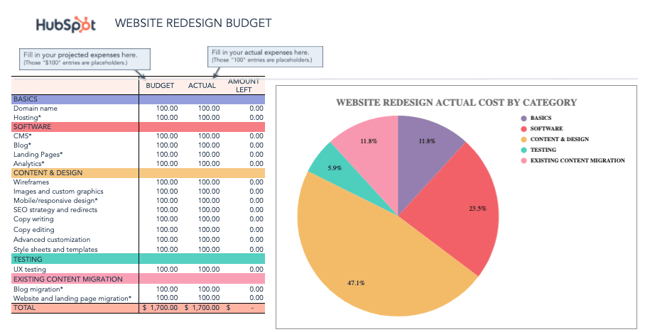
To determine if ads are worth your time, I recommend you start by building a budget. This isn’t always an easy task, especially considering the hit many marketing budgets have taken over the past two years. According to Tequia Burt, Editor in Chief of the LinkedIn Marketing Solutions Blog, market knowledge is a key component of this process. “As marketing leaders evaluate their budgets and organize their plans for the year ahead,” she says, “a bit of context and clarity can lend helpful structure.”
Consider that 55% of social media marketers plan to boost spending across areas such as branded influencer content, ads in social media stories, and ads in social media feeds. Knowing where and when this spending brings in the most returns is critical to driving ROI.
Featured Resource: Budget Templates To Manage Your 2024 Spend
Download Free Marketing Budget Templates
2. Continually evaluate ad performance.
Try not to look at ads as a shortcut. It’s possible to get to a place with ads where they become a recurring source of profit, but typically that’s not how things start.
Don’t be surprised when a week after your campaign launches your ads aren’t generating tons of profit. “Around 80% of businesses online feel that they deliver great assistance via social media, but only 8 percent of their customers agreed,” says John Kopanakis, professor of Business Intelligence at Hellenic Mediterranean University. “Despite putting in a lot of effort, many marketers hardly reach their targeted sales. It is because they struggle to measure the impact of their social media efforts on their sales.”
As a result, incremental improvements in clickthrough rates and conversion rates can have a huge impact on profit. I recommend using the ads calculator to explore the impact these changes could have. Watch your ads like a hawk for the first month and you’ll avoid big mistakes.
3. Make sure you’re amplifying the right message.
Ads act like a megaphone to amplify your marketing campaigns and content. The more complete and well-developed your campaigns are, the better your ads will perform.
As Samuel Bu, Marketing Director at FortuneNote Chinese Business Magazine noted in a recent LinkedIn Pulse post, finding the right channel for your business is critical. While he highlights LinkedIn as a great way to generate leads and calls out Facebook’s huge impact on the social market, he also highlights challenges with platforms such as Instagram. Why? Bu says “Most likely, Instagram falls short of producing strong ROI due to its more intangible metrics — such as brand awareness, reputation, loyalty, and consumer engagement.”
Think about it: Which ads do you think perform better? Those promoting your homepage or those promoting a remarkable piece of content that helps someone?
Bingo. Those promoting awesome content.
Campaigns that use ads should be treated like other campaigns. Establish your goals first, build great content, focus your message and optimize your landing pages, then figure out how ads can help amplify your message. Taking this combined approach and only using ads as a strategic component of your marketing campaigns will pay off.
Expert Tips on Measuring Social Media ROI, According to G2 and Dropbox, and an Expert Social Media Consultant
To further investigate how to effectively measure social media ROI, I spoke with G2 and Dropbox, and an expert Social Media Consultant.
Let's dive into their tips now.
1. Determine goals for each channel, and re-evaluate those metrics often.
Measuring ROI requires understanding how your social efforts contribute to the company's bottom line — but this isn't always a straightforward, one-to-one link.
For instance, the first time someone engages with a social post, they might not immediately purchase a product. Instead, maybe they decide to follow your brand on Instagram, and end up purchasing a product later on.
To accurately measure ROI, then, it's vital you determine which social media metrics matter most to your team.
As Jenny Gardynski, Director of Communications at G2, told me, “When it comes to our organic social media presence, we look at metrics that demonstrate both our reach and engagement – in support of driving G2’s brand awareness. Key metrics we measure include follower count, impressions, and post link clicks."
Already a HubSpot customer? Click here for 20% off eligible G2 plans, and receive a free tour of G2 Buyer Intent data for your business.
Identifying specific goals for each campaign will help you accurately measure your social ROI. For instance, if your goal for your upcoming organic social campaign is to increase follower count by 3%, then hitting or exceeding that number demonstrates positive ROI.
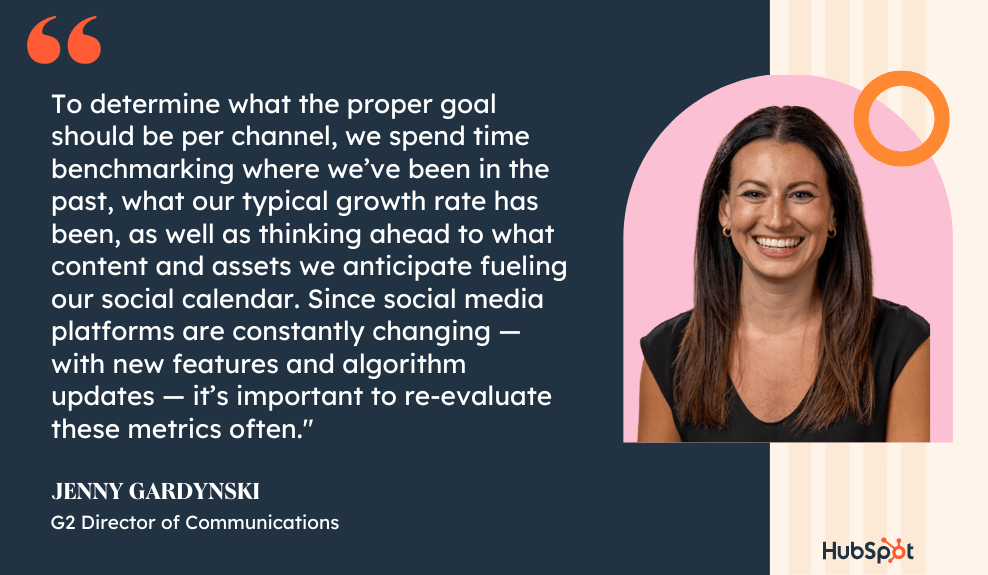
Gardynski continues, "To determine what the proper goal should be per channel, we spend time benchmarking where we’ve been in the past, what our typical growth rate has been, as well as thinking ahead to what content and assets we anticipate fueling our social calendar. Since social media platforms are constantly changing — with new features and algorithm updates — it’s important to re-evaluate these metrics often.”
Determining historical data is a vital component of measuring ROI. This enables you to measure how your content typically performs on a given channel, and determine which area(s) of your social strategy are most effective.
Free Advertising Planning Kit
Plan and launch an effective and profitable advertising campaign with this guide and set of templates.
- An Overview of Popular Advertising Methods
- The Pros, Cons, and Costs of Advertising Types
- A Planning Template to Outline Timeline, Budget, and Goals
- A Project Pitch Presentation Deck to Share With Stakeholders
Download Free
All fields are required.
2. Identify which metrics best translate into success for your social team.
There isn't a one-size-fits-all approach to measuring ROI because ROI depends on each social team's individual goals.
Susan Chang, Dropbox's Director of Social Media, told me, "Anyone that works in social media knows that there is no shortage of metrics to track, which means that there are many different ways to measure ROI."
Couple common metrics you might measure include:
- Audience Growth Rate
- Social Media Impressions
- Social Media Conversion Rate
- Social Media Engagement Rate
- Customer Response Rate
- Influencer Campaign Metrics
- Traffic to Brand’s Website
Ultimately, each social team has its own unique objectives. For instance, Chang says, "It's up to the social media team to design a program and set goals that are customized to their brand's objectives and priorities. Sometimes, a brand will prioritize engagement rate, because their goal is to build community and create two-way conversations between their brand and their customers."
"Other times," she continues, "a brand cares most about conversions because they've invested in paid social as a viable source of revenue. Or, maybe the highest priority metric is traffic or CTR to an owned website because their goal is to educate their users and raise awareness about their brand's capabilities."
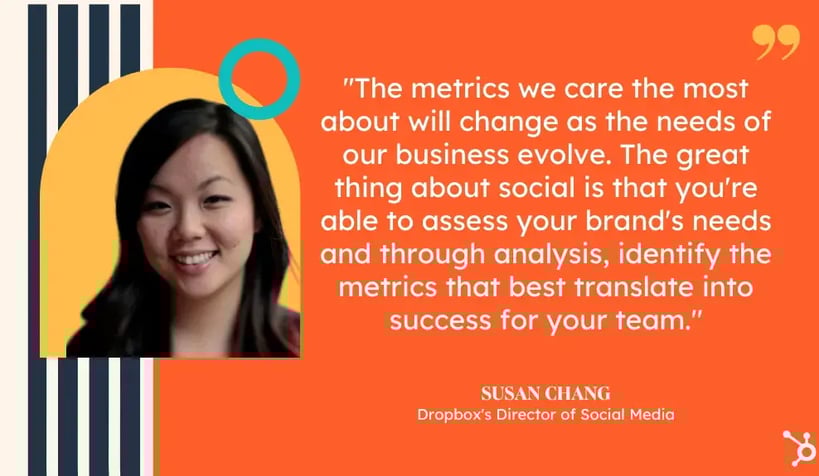
Chang adds, "The metrics we care the most about will change as the needs of our business evolve. The great thing about social is that you're able to assess your brand's needs and through analysis, identify the metrics that best translate into success for your team."
3. Evaluate a paid campaign's impact on Marketing Qualified Leads (MQLs).
To measure the ROI of a paid campaign, you'll want to evaluate the leads or customers you converted through your ad.
Achieving positive ROI on a paid campaign can be difficult. Oftentimes, brands end up spending more money than they get back. That's where intent-based targeting becomes critical.
Laura Grass, G2's Senior Marketing Manager, Enterprise & ABM, says, “When it comes to paid social, our primary focus is evaluating a campaign’s impact on Marketing Sourced Pipeline — which is evaluated by measuring the number of Marketing Qualified Leads (MQLs) — as well as the MQL to Sales Qualified Lead (SQL), conversion rates, and later on, the number of open opportunities and their contract values."
Grass adds, "We also look at metrics that reflect efficient campaign performance (including click-through rate, cost-per-click, and cost-per-lead or cost-per-conversion). Because we’re big believers in meeting people where they are in their buying journey, we leverage our own G2 Buyer Intent Data to retarget audiences that have engaged with our product page and other software in our categories on G2."
I'd recommend considering leveraging intent data in your next social media campaign to target a smaller, more qualified subset of people. This can help you minimize the chance of a negative ROI by ensuring you're reaching people who've already shown interest in your brand.
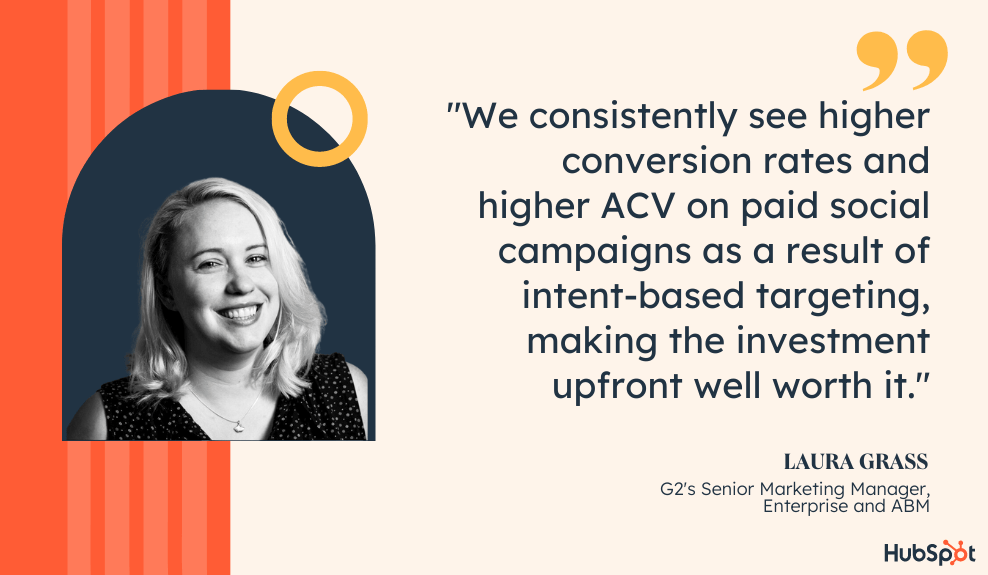
As Grass puts it, "This tends to narrow the campaign audience to in-market prospects, thus often increasing CPC and CPL from the get-go. But we tend to see the payoff in the pipeline. We consistently see higher conversion rates and higher ACV on paid social campaigns as a result of intent-based targeting, making the investment upfront well worth it."
Sync your G2 Buyer Intent Data with HubSpot to enhance your sales process and close new customers.
4. Monitor your customer acquisition cost from organic and paid media.
Robert Benjamin, a Social Media Consultant, says, “My favorite tip for measuring my social media ROI is looking at blended CAC (cost of acquiring a customer) from both organic and paid media.”
Yes, I mentioned above that one of the most popular ways to understand your social media ROI is from paid campaigns, but you also get important information from your organic impact.
Benjamin says that a large organic base lowers your CAC and can make you much more competitive with your paid marketing efforts. He says, “Brands that are crushing organic marketing tend to do much better on the paid marketing front because they aren’t ‘creating ads’ - they’re creating posts that consumers organically engage with and then throwing gasoline on the fire with their paid marketing efforts.”
He adds, “Brands that are still only creating ads without testing them organically are simply increasing the rate at which consumers are seeing ads that they don’t want to interact with / resonate.”
Social Media ROI Formula
Chang mentioned above that there are multiple metrics you can use to measure ROI, and it’s true. You can also get a concrete answer about your ROI by using the social media ROI formula and actual monetary values.
Math isn’t my strong suit, so if you’re anything like me, you’ll be happy to know that the social media social media ROI formula is straightforward:
(Total Revenue - Total Investment) / Total Investment x 100
- Total Revenue: the amount of money generated from your campaigns
- Total Investment: the amount of money you put in when creating the campaign, like resources, labor cost, CPC, etc.
When you run your calculation, a negative result means you spent more money on your campaigns than you got back, and a positive result means the opposite.
What’s considered a good ROI varies, but the consensus among marketers is that a 5:1 ratio is a good ROI, as it translates to earning $5 for every $1 spent.
Here’s an example. Let’s say I spent $2,300 on my Instagram campaign, and when it wrapped it generated $10,000 in revenue. Here’s what my equation looks like:
(10000-2300) / 2300 x 100 = 334%
Results show that I have a positive return on investment. Numbers-wise, I made $3.34 for every dollar spent (3:1 ratio).
Free Advertising Planning Kit
Plan and launch an effective and profitable advertising campaign with this guide and set of templates.
- An Overview of Popular Advertising Methods
- The Pros, Cons, and Costs of Advertising Types
- A Planning Template to Outline Timeline, Budget, and Goals
- A Project Pitch Presentation Deck to Share With Stakeholders
Download Free
All fields are required.
How to Improve Social Media ROI
So you’ve calculated your social media ROI and found room for improvement, or maybe you’re satisfied but want to make sure your strategies are as effective as possible.
Whatever the case, I’ll now review key strategies to improve your social media ROI.
1. Understand your audience.
In my opinion, the best way to positively impact your ROI, above all else, is to understand your audience. It affects everything you do on social media, from the format of the content you share to the time of day you post that content.
When you know what your target audience likes and what they don’t like, you know the type of content they’re more likely to enjoy. Audiences who see content aligned with their interests are more likely to be inspired to take your desired action.
Understanding your audience is especially important if you’re running paid ads. If you’re spending money, you likely want to target the right audience with ads more likely to drive results.
Dan Stillgoe, Marketing Manager at Blend, agrees with the importance of audience targeting. He told me: “Proper audience targeting is also crucial. Poor audience setup often leads to wasted ad spend by showing ads to people outside your target market who won’t convert.”
His top tip for success? “Implement tight exclusions, continuously monitor audience insights to see who your ads are reaching, and refine your targeting and exclusions accordingly to ensure ads reach the right people.”
2. Be consistent.
Being consistent on your social channels makes a meaningful impact on your ROI. One to two posts per month likely won’t help your campaigns succeed and probably won’t help you stand out with your audience.
I can give you a cheat sheet to get you started here. Most marketers who responded to our 2024 State of Marketing & Trends survey told us they post content multiple times per week. I’d recommend leveraging their advice and testing your publishing frequency to see what brings the most engagement (I’ll talk more about testing below).
Unfortunately, consistency can be undermined if you’re not strategic with when you post content. For example, a standout Instagram Reel won’t do a lot to improve your ROI if you share it when most of your audience is asleep
When it comes to when you should post, the best times to post for social media marketers' most used platforms are:
- 12 PM - 3 PM on Facebook
- 12 PM - 3 PM on YouTube
- 12 PM - 3 PM and 6 PM - 9 PM on Instagram
3. Foster meaningful engagement.
For Adriane Grunenberg, HubSpot Automation & Analytics Expert at Pinetco, prioritizing engagement is the best way to improve social media ROI. She said: “Focus on creating content that sparks conversations, encourages interaction, and builds genuine connections with your audience. By fostering meaningful engagement, you not only drive higher ROI but also cultivate a loyal community that advocates for your brand."
4. Always include clear CTAs.
CTAs look different on social media than on, say, your email footers, but they’re a just as effective way to improve your ROI.
Svitlana Kviatkivska, Senior CX Consultant at Huble Digital, champions this tip, calling the clear use of CTAs on social media a highly actionable, low-lift, and low-cost strategy that is sometimes overlooked.
Kviatkivska says, “CTAs serve as crucial signposts for your audience, directing them toward actions such as visiting a website, signing up for a newsletter, making a purchase, or following your page. Their strategic placement can significantly influence conversion rates and, by extension, improve your ROI.”
Two of her guidelines for making the best use of CTAs on social media are clarity, simplicity, and personalization.
About clarity, she says “Direct and simple CTAs like “Shop Now,” or “Learn More,” are ‘old but gold’ and perform well.” Simple text like this is straightforward and tells your audience exactly what action you want them to take.
Personalizing CTAs is even more proof of the importance of having a well-rounded understanding of your audience. Kviatkivska told me that “Tailoring your call to action to align with the user's interests or their stage in the customer journey can significantly increase the conversion rate.”
The State of Social Media in 2025
Explore the top trends in social media for brands to know and optimize your social strategy.
- AI Content Creation
- Community Building
- Social Media Shopping
- Social Vs. Search Engine
Download Free
All fields are required.
5. Always test, iterate, and optimize.
Testing your social media strategies is a must for high ROI. When you know what produces results, you know what you need to continue doing to meet your goals.
For example, you can run A/B tests on Facebook to see which posts audiences prefer most. You can also vary the type of content you post to see what gets the most engagement. If you assume your X audience likes long-form posts, but they actually prefer you use less characters, you’re losing out on essential engagement opportunities.
Even though I shared a brief breakdown of the best times to post on social, you can also test the top times on your channels to see what works with your unique audience.
When you run tests, the most important advice I can give is to actually take action and optimize your social media campaigns by implementing what you’ve learned — it’s the only way to bring the positive ROI changes you’re looking for.
How much should you spend on ads?
Assuming you’ve run the numbers and now know what you can expect in terms of profit and ROI, it’s time to launch a campaign. To do this you’ll have to make two budget decisions, regardless of where you are advertising:
- Total campaign budget or duration: How much do you plan to spend in total? How long will the ads run for? Be aware that if you don’t set a limit there will be no maximum or end date.
- Daily budget: How much do you want to spend a day?
There are two ways most marketers use ads, short-term and long-term. Let's take a look at both.
Short-term ads. Budget = at least a few hundred dollars over a month.
When marketers use ads for a short-term goal, it’s usually to jump-start a campaign or boost content that needs a bump. These ad spends are generally smaller and shorter, but can be large.
If you have a few hundred dollars to spend, spend it this way. Create a social post that promotes a piece of content and then use your ads to boost the post. Facebook, Twitter, and LinkedIn all have good solutions for this. Make sure you use the social network that gives you the best targeting for your persona and returns the most valuable leads. Measure this by assessing the quality of the leads generated after the campaign.
Long-term ads. Budget = at least a few thousand dollars over a quarter.
Ads can be a great solution in a pinch but if you really want to use ads strategically build them into your overall marketing strategy. This means more consistent, quarterly ad spends.
Consider how potential customers make purchase decisions and use ads to influence them. This may mean always relying on search ads or retargeting to make sure prospects find you when they are ready to buy. You’re more likely to accumulate better data taking this approach, which will allow you to get more sophisticated in how you optimize your ad spend.
8 Best Social Media ROI Measurement Tools
- HubSpot
- Hootsuite
- Sprout Social
- Cyfe
- Google Analytics
- Buffer
- Keyhole
- Calculator Soup
Given the quickly changing nature of social media platforms and posts, it’s worth considering social media ROI tools to help stay on top of spend and revenue measurements.
Here’s a look at eight great options.
1. HubSpot
Price: Free to use, no account required
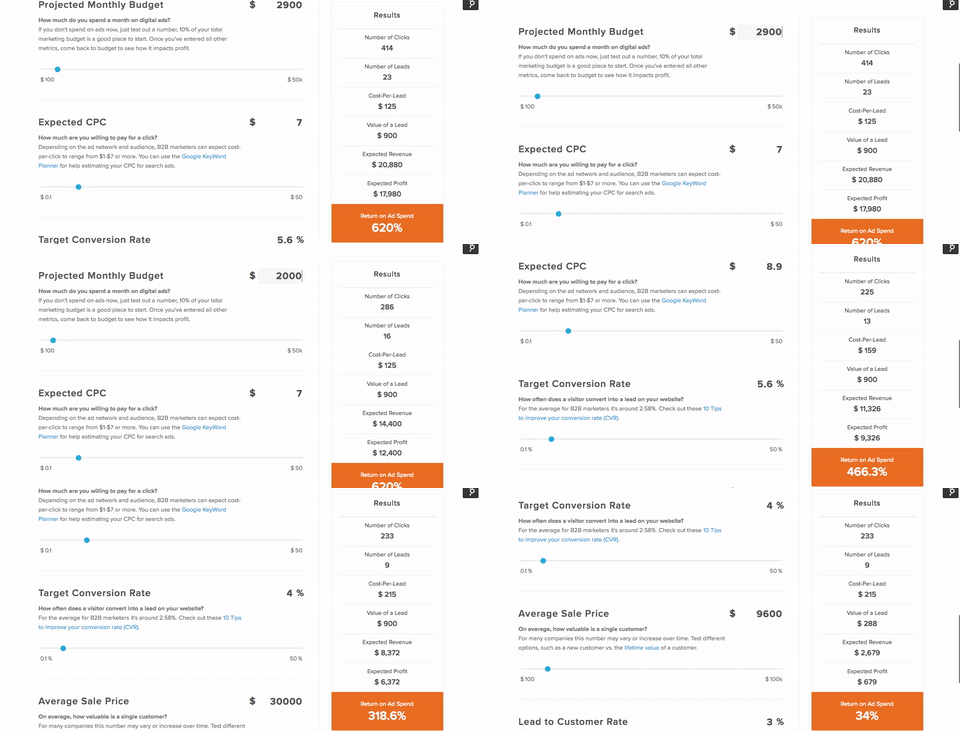
The HubSpot Advertising ROI Calculator makes it easy to narrow down when and where it’s worth spending on social ads.
Why I Like This Tool
I like this tool because it’s easy to use and gets right to the point.
You start by inputting your projected monthly budget, then your expected cost-per-click (CPC), target conversion rate, average sale price, and lead-to-customer rate to get a general idea of your ROI on advertising spend.
You don’t even have to click ‘calculate’ to get your result; it updates automatically in the results column on the right-hand side of your page.
I recommend using the calculator regularly to reevaluate your campaigns to make sure they’re delivering on key metrics.
2. Hootsuite
Price: Free to use, no account required
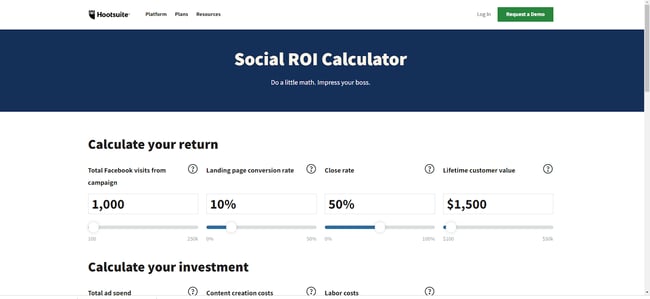
Hootsuite also offers a free Social ROI Calculator that lets you input ad spend data to determine potential ROI.
Why I Like This Tool
While it uses slightly different metrics and has a different setup than the HubSpot calculator, the general function of this tool is the same: Input your data to see where it makes sense to spend on ads and where the return may not justify the investment.
You have seven different metrics to input into the tool, and your ROI is displayed as a percentage and dollar amount.
The calculator is primarily for analyzing ROI for paid or organic campaigns on Facebook, which is the main drawback of the tool. If you want to measure the performance of other channels, you’d have to use its paid analytics tool.
3. Sprout Social
Price: 30-day free trial; Standard plan starts at $249/mo per seat
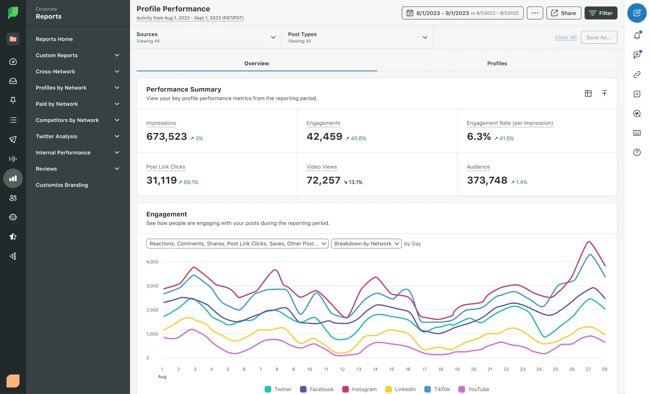
Sprout Social’s ROI calculator helps you learn what resonates with your customers and drives ROI.
Why I Like This Tool
I like Sprout Social’s ROI tool because you can view your overall social media ROI, get more granular, and look at the performance of your campaigns, profiles, and even individual posts. It accommodates all major social media platforms, so you won’t need a separate tool for each channel.
My favorite feature is that you can benchmark yourself against competitors to see how you measure up. This knowledge lets you know if your efforts resonate with your audience as much as it does for your competitors. If your performance is lower, you can conduct further competitor analysis, uncover what’s working, and update your strategies.
Sprout Social has a higher price tag, so I recommend it for those at larger organizations with a budget for more expensive tools.
However, depending on your current ad campaign and ROI goals, the cost may be worth it. Sprout’s tool offers message-level insights to see which posts are proving their worth, along with follower, engagement, and keyword analytics that cover the entire publishing process from draft to queue to posting.
4. Cyfe
Price: 14-day free trial; Starter plan is $19/mo for two dashboards and one user
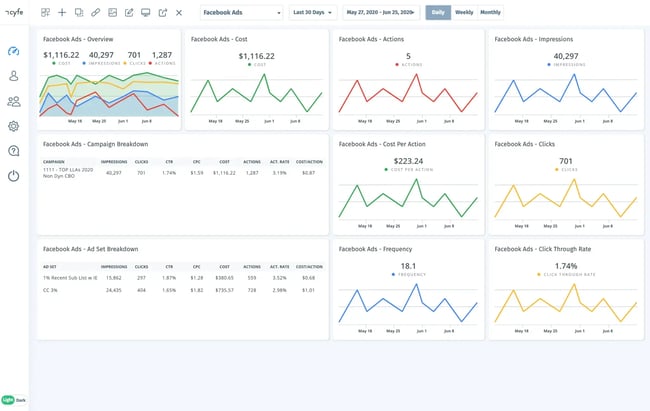
Cyfe provides a set of all-in-one business dashboards that provide insights across key social platforms.
Why I Like This Tool
Cyfe can help you monitor ROI for your social media channels, tracking performance per channel or on a campaign-by-campaign basis. You can easily monitor ads, their performance, and how users interact with your campaign efforts.
It’s a standout tool for me because you can customize your dashboard to focus on your key metric (ROI) across your platforms.
I have to note that it isn’t as feature-rich as some of the other tools on this list, but it perfectly aligns with the needs of a smaller team or individual social marketers with less in-depth analytics.
5. Google Analytics
Price: Free
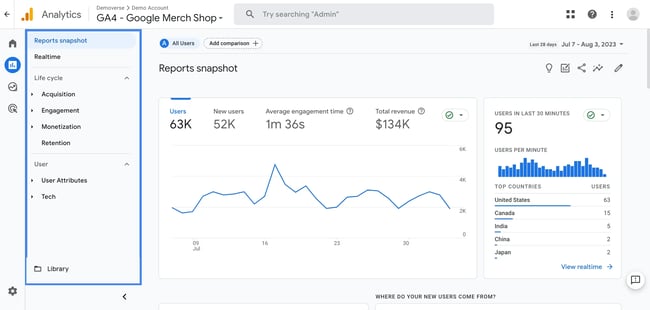
Google Analytics is familiar, free, and functional.
Why I Like This Tool
While Google Analytics doesn’t have the same laser focus on social media as some of the other tools on the list, I still like it for measuring social media ROI. It comes with the advantage of massive data sets and helps inform social advertising SEO, which is critical to any effective campaign.
Most attributions to any activity originating from your social accounts start by batting UTM parameters to the links you share on socials. From there, you can view conversion and conversion path reports to see what originated from your social campaigns, and conversion reports let you know how your social media efforts have impacted your overall conversion rate.
If you’re already using Google Analytics, it’s easy to see how your social ads are performing at a high level. Log into your dashboard, select ‘Acquisition,’ then ‘Traffic,’ then Channels. You’ll get a list of your traffic sources, including those from social sites, helping you get a general sense of how social ads are working to drive revenue.
Featured Resource: The Ultimate Google Ads PPC Kit
.png?width=300&name=Image%20Hackathon%20%E2%80%93%20Vertical%20(59).png)
6. Buffer
Price: Free plan and 14-day free trial; Essentials plan starts at $6/mo per channel
.webp?width=650&height=350&name=buffer%20(1).webp)
Buffer is an all-in-one social media marketing and ROI tool that simplifies measuring and managing ads.
Why I Like This Tool
Buffer streamlines the creation of social ad content and lets you measure impact in just a few clicks to see what’s working, what isn’t, and what needs to improve.
You can track performance and engagement metrics for your Instagram, Facebook, X (Twitter), and LinkedIn Pages (not individual profiles) in an overview dashboard and dive into deeper insights for each channel for more specific understanding.
I do have to call out that Buffer’s analytics offerings aren’t as comprehensive as other tools on this list and you can only leverage it to analyze the four channels I mentioned above. Also, you can measure organic, paid, and promoted performance on all supported channels except for LinkedIn.
However, that also makes this tool a valuable option for individual social media managers or smaller marketing teams that don’t need the advanced analytics functions that come with a higher-priced tool.
7. Keyhole
Price: Free trial available; Individual plan starts at $89/mo with analytics for three profiles
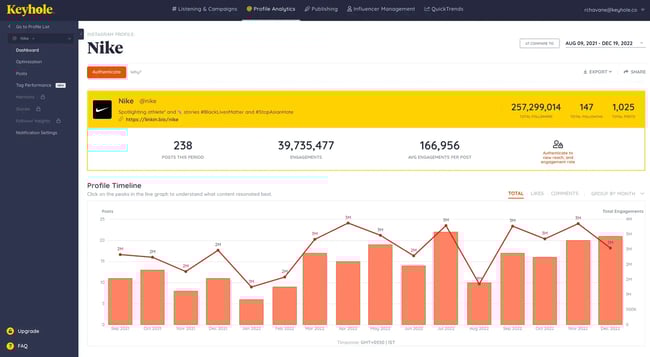
Keyhole’s analytics tool helps you dive deep into the ROI of your marketing efforts.
Why I Like This Tool
Keyhole made it onto my list because of its influencer marketing platform.
It helps you view performance metrics for your influencer content and the ROI of your partnerships. Since you’re spending money on these campaigns, staying on top of performance is crucial. You can also keep tabs on influencer partners who exist outside your business ecosystem but offer potential benefits for your brand.
It also offers the analytics features you’d expect for any other kind of social media marketing, including channel-by-channel metric visualizations for the profiles you probably already have on Instagram, Facebook, X (Twitter), TikTok, LinkedIn Pages (no individual profiles), and YouTube.
8. Calculator Soup
Price: Free, no account required
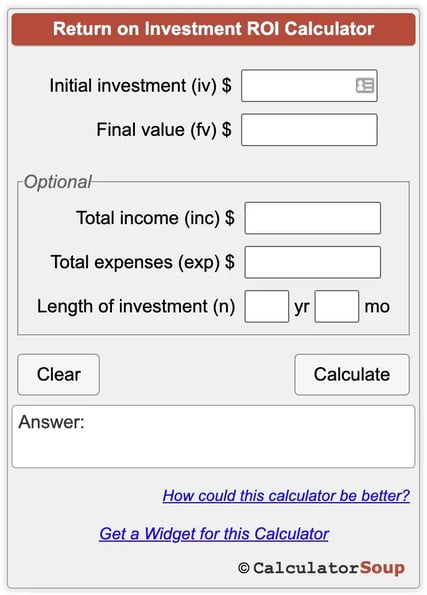
Calculator Soup offers a basic, no-frills ROI calculator to use for your social media marketing analysis.
Why I Like This Tool
Remember how I mentioned that I’m bad at math? Well, Calculator Soup is my saving grace. In fact, I used it to run the sample equation when I went over the social media ROI formula.
The calculator isn't specifically for social media marketing but works just as well. You simply input your initial investment and total income and get your result. If you want to understand the ROI of your campaigns for a specific duration, you can also input monthly and yearly timelines.
Getting the Biggest Social Impact for Your Spend
Bottom line? There’s no single way to spend your social marketing budget. Some companies may prefer to keep spending low and handle most of their ads through free platforms and word of mouth, while others are willing to spend top dollar for on-demand results.
Whatever budget you choose and whichever approach you take, however, here’s my rule of thumb: ask lots of questions about your ad spend, and make sure ads are performing as intended.
Why? Because even targeting the right market with the right approach, it’s easy to burn through money fast. Safeguard yourself by knowing what to expect, having clear expectations, and using the right tools to measure social ad ROI.
Editor's note: This post was originally published in July 2016 and has been updated for comprehensiveness.
Free Advertising Planning Kit
Plan and launch an effective and profitable advertising campaign with this guide and set of templates.
- An Overview of Popular Advertising Methods
- The Pros, Cons, and Costs of Advertising Types
- A Planning Template to Outline Timeline, Budget, and Goals
- A Project Pitch Presentation Deck to Share With Stakeholders
Download Free
All fields are required.
Social Media Analytics
![How to Create a Social Media Report in 7 Simple Steps [+ Free Templates]](https://53.fs1.hubspotusercontent-na1.net/hubfs/53/social-media-report-1-20240724-2630720-1.webp)



![Blog Conversations Don't Lead to More Views or Links [New Data]](https://53.fs1.hubspotusercontent-na1.net/hubfs/53/analytics-1.jpg)



![What Makes Top Company Blogs So Successful? [New Data]](https://53.fs1.hubspotusercontent-na1.net/hubfs/53/Inboundrank_data/Blogging_data_top_10.png)