

The key to any relationship is communication. This includes romantic relationships, of course, but it also applies to friendships, coworker relationships, manager-team relationships, and even brand-customer relationships.
Any scenario that requires you to convince, inform, entertain, or engage with another involves communication. In this guide, we’ll go over communication styles, share ways to improve your communication, and how to better understand how your colleagues and customers communicate.

Keep reading to get started, or use the chapter links below to jump around.

What is communication?
Communication is how people interact and exchange information with others. It stems from the Latin word commūnicāre, meaning: to share. It happens through a variety of channels using mutually understood signs and symbols.
In simpler terms, communication is said to be the “creation and exchange of meaning.” Communication is also a process … a series of actions. It’s not a single phenomenon, and it varies based on method, channel, and person.
As a partner, friend, coworker, boss, and brand, you have a responsibility to learn how to best communicate. Let’s talk about how to communicate effectively.
How to Communicate Effectively
Not all communication is good communication. In fact, not communicating at all is better (in some circumstances) than communicating poorly.
Not adhering to effective communication practices can exacerbate or worsen a communicative environment, break trust, and make messages harder to receive.
.png)
Crisis Communication and Management Kit
Manage, plan for, and communicate during your corporate crises with these crisis management plan templates.
- Free Crisis Management Plan Template
- 12 Crisis Communication Templates
- Post-Crisis Performance Grading Template
- Additional Crisis Best Management Practices
Download Free
All fields are required.
Effective Communication Skills
Effective communication isn’t just speaking clearly and honestly. It also involves creating a safe, comfortable space for communication — even if you’re not the one talking. Employ these effective communication skills to give and receive information successfully.
1. Listening Actively
Effective communication is less about talking and more about listening. Active listening isn’t just hearing what the other person has to say; it also involves understanding their emotions and point-of-view.
The goal of effective communication is to empathize and understand the person or party with whom you’re communicating. Here’s how:
- Focus on the other person. Don’t look at your phone, look around the room, or begin speaking to someone else. You can’t pick up on voice inflection or nonverbal cues if you’re not paying attention.
- Show interest in what the other person is saying by nodding your head or saying “yes.”
- Try not to judge or assume as the other person speaks. We talk more about these barriers in the next section.
- Ask questions and provide reinforcing feedback, such as “What I’m hearing is…” or “Is this what you mean?”
When you practice active, engaged listening, you become fully in-sync with what the other person is saying and feeling. That’s the point of effective communication.
2. Asserting Yourself
Being assertive means considering your thoughts, opinions, and feelings and communicating them in a clear, respectful way. It doesn’t mean being demeaning or aggressive. (We talk more about the different communication styles in the next section.)
Asserting yourself can help you stay clear on your own goals while empathizing with others. Here’s how:
- Get clear on your own values and opinions before you engage with someone else so that you don’t get confused or change your mind to make a conversation easier.
- Positively express negative thoughts or opinions. Try to avoid outright anger or demeaning language or attitudes.
- Be comfortable enough to say “no” or “I don’t agree.”
Although effective communication is about understanding the other person, it doesn’t mean we should forget about our own perspectives.
3. Minimizing Stress and Communication Barriers
Whether you’re speaking or listening, minimizing stress in communication helps create a healthy, effective environment. Here’s how:
- Stall or pause to collect your thoughts. This can help you avoid outbursts or speaking before you think … and saying something you might regret.
- Make one point at a time so that you or the other person don’t get confused or overwhelmed.
- Don’t interrupt or make unnecessary comments or noises while the other person is speaking.
- Try to stay objective and upbeat as you speak and listen. Keep the mood and tempo of the conversation elevated.
It’s also important to recognize and remove any communication barriers like the ones we describe below. Anyone with a perceived “upper hand” in a relationship — like managers, executives, or parents — should especially keep these in mind.
Common Barriers to Communication
Here are a handful of common communication barriers that may be hindering communication in your relationships. I’ve also included an example of how these might apply in the workplace.
Language/Cultural Communication Barriers
Language or cultural barriers occur when two parties don’t speak the same language or perhaps have different understandings of the same language.
Example: An international intern is shirking his duties to coworkers. The team lead gives feedback by saying “You’re passing the buck.” The intern doesn’t understand the jargon. He isn’t sure how to improve in his role and continues making his mistake, further frustrating the team and team lead.
Today’s workplace environments are more diverse than ever, meaning collaboration happens among all kinds of cultures. The best way to remove cultural or language barriers is by choosing common, clear phrases that are universally understood. If you’re speaking with someone who speaks a different language, try to use a translator or a verified translation tool.
Psychological / Attitudinal Communication Barriers
Psychological barriers happen when one or both parties carry cultural assumptions or are restricted by emotional hurdles or taboos. They also happen when there’s a lack of trust, attention, or empathy.
Example: A female employee is returning from maternity leave and needs a place to pump breast milk. In her previous job, her male manager wasn’t accommodating to her needs as a new mother, so when she approaches her current male superior with her request, she’s defensive and nervous … thus creating a tense, tough conversation.
In this specific case, if the male superior was aware of her previous experience, he’d be able to inject more empathy and patience to make the employee more comfortable. Otherwise he might be uncomfortable with her defensiveness. While the female employee can’t help her previous experience, she could try to approach the new manager without any assumptions.
Everyone’s mind is different, as is their upbringing. When it comes to psychological and attitudinal barriers, the responsibility falls on both parties to set aside expectations and prejudices and prioritize empathy, patience, and understanding.
Physical Communication Barriers
Physical barriers refer to anything that physically stands in the way of clear communication. These barriers typically exist through email, social media, text, or phone communication (anything that isn’t face-to-face) or when hearing or speaking handicaps are present.
Example: A remote employee is awaiting important feedback on a new project. His superior replies, via email, in a way that could be construed as cold or harsh — even though she was quite happy with the results. The remote employee assumes she’s unhappy with the project and loses confidence in his ideas and progress.
In today’s world, digital and text-based communication is very common, especially with remote work.
Receivers can avoid these barriers by not assuming the meaning behind a message or by simply asking for clarification. Also, senders can make their messages easier to receive by adding clarifying punctuation or words when communicating nonverbally.
Lastly, always be aware of personal handicaps with which others might be dealing.
Crisis Communication and Management Kit
Manage, plan for, and communicate during your corporate crises with these crisis management plan templates.
- Free Crisis Management Plan Template
- 12 Crisis Communication Templates
- Post-Crisis Performance Grading Template
- Additional Crisis Best Management Practices
Download Free
All fields are required.
The Four Communication Styles
Personality tests, like DiSC and Myers-Briggs, help others better understand your needs, strengths, and weaknesses.
The same goes for communication styles. Understanding the different styles below gives you a better understanding of how and why others communicate the way they do.
Passive Communication Style
Passive communicators act indifferent and often yield to others. On the outside, they may seem meek, quiet, or flexible. They likely aren’t good at saying "no” or dealing with conflict, but they’re easy to get along with as they typically “go with the flow.”
Phrases you might hear from passive communicators are:
- “It doesn’t matter to me.”
- “This isn’t worth fighting over. Let’s just keep the peace.”
Aggressive Communication Style
Where passive communicators are meek and quiet, aggressive communicators are loud, brash, criticizing, and physically aggressive. Their communication style reverberates through their behavior, volume, and wording. Aggressive communicators issue commands, interrupt and often talk down to people.
Phrases you might hear from aggressive communicators are:
- “You’re wrong.”
- “This is your fault. Fix it.”
Passive-Aggressive Communication Style
The passive-aggressive style displays a mixture of both. On the surface, this type of communicator might seem passive, but they probably harbor an aggressive side underneath. Behaviorally, they might seem agitated and display facial expressions or nonverbal cues that don’t match what they’re saying.
Phrases you might hear from passive-aggressive communicators are:
- “Whatever, but don’t blame me if the team doesn’t agree.”
- “That’s fine.” (and then proceeds to do the opposite)
Assertive Communication Style
Assertive communicators are said to follow the most effective and healthiest communication style. These communicators can express their own needs, opinions, and commands while also considering the needs and opinions of others.
They typically communicate to reach a compromise or win-win situation, and will often employ “I” statements to take ownership of feelings while still expressing a need or desire.
Phrases you might hear from assertive communicators are:
- “I respect your opinion, but I disagree and here’s why …”
- “I feel frustrated when you miss deadlines.
Understanding your own communication style, as well as your team’s and colleagues, can be helpful when conversations get tough. It can also alert you to ways in which you can improve your own communication skills and challenge others to do the same.
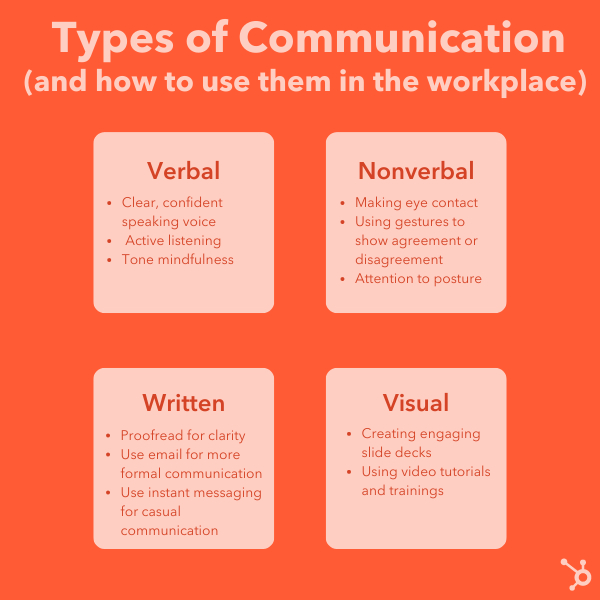
The Four Types of Communication
Communication isn’t limited to face-to-face speaking conversation; it applies to any exchange of information. Below, we walk through the four main types of communication and how you might see them in the workplace.
Verbal Communication
This type of communication is exactly what it sounds like: verbal conversation that includes sounds, words, and language. Verbal communication is said to be the most effective way to express emotions, feelings, opinions, and needs. If used correctly, words can help you be very straightforward and concise while leaving little room for question or assumption.
There are four types of verbal communication.
- Intrapersonal, which is when we communicate to ourselves through our thoughts or out loud.
- Interpersonal, which is when we communicate one-on-one with someone else.
- Small group, which is when two or more people are involved. Team meetings, small presentations, and press conferences are examples of small group communication.
- Public, which is when one person communicates to a large group. Public speeches, company-wide meetings, and TV commercials are examples of public communication.
Nonverbal Communication
Nonverbal communication happens when messages are sent and received without words. It typically applies to body language, tone of voice, inflection, facial responses, and other gestures.
It also includes creative or aesthetic means of communication such as dance, painting, and pottery. (Note: Nonverbal isn’t the same as visual, which is explained below.)
Some examples of nonverbal communication include:
- Making eye contact (or lack thereof)
- Shaking hands
- Crossing or uncrossing legs
- Folding or unfolding arms
- Fidgeting
- Hugging
- Moving eyebrows
- Smiling or frowning
Written Communication
Written communication is any message sent through written words or text. This form is unique because, unlike verbal or nonverbal communication, written communication can be edited and changed before messages are sent.
Written communication also encompasses components of visual communication when sent through electronic means, such as phones or computers.
Examples of written communication include memos, emails, letters, reports, articles or blog posts (like this one!), social media posts, and print advertising.
Visual Communication
Visual communication involves sending and receiving a message with the help of visual aids. While visual communication encompasses some written communication, it mostly refers to symbols, images, and video.
Movies, TV shows, videos, and plays are all visual communication as receivers need to watch them to receive their messages. Icons and emojis are also considered visual communication. The most common form of visual communication, though, is the internet, which sends us messages using a combination of text, colors, images, symbols, and design.
Communication Examples
Communication in Business
Whether you know it or not, you’re communicating right now by reading this guide. You’re the recipient of this message that I’ve written and transmitted via blog post.
Communication happens all around us, and it’s especially important in business. Not only are we communicating non-stop with colleagues and teammates, but through marketing, advertising, sales, and support efforts, we’re also sending and receiving messages with our customers and consumers.
Communication in the Workplace
This section is about internal communication, meaning communication that happens within the workplace. This communication can refer to conversations with your boss, project collaborations with teammates, or perhaps reading your company’s internal wiki to learn about another team’s updates.
Regardless, here are some tips on communication in the workplace.
Crisis Communication and Management Kit
Manage, plan for, and communicate during your corporate crises with these crisis management plan templates.
- Free Crisis Management Plan Template
- 12 Crisis Communication Templates
- Post-Crisis Performance Grading Template
- Additional Crisis Best Management Practices
Download Free
All fields are required.
Communication as a Manager
As a manager or team lead, you’re dealing with a lot, right? Not only do you have your own responsibilities, but you also have to oversee and organize those of your team.
One of the hardest parts of managing can be figuring out how to systematize and catalog important communications happening within and around your team.
Building an internal communications strategy can help you manage this. Here’s how.
1. Assign a communication medium for specific types of communication.
It’s hard to speak up at work. People aren’t always sure who to trust. They also aren’t sure which information will stay private, and which information will come with consequences if shared.
This is where it’s up to you, as a manager, to create a safe, healthy environment for effective communication. One way to do that is to “assign” specific media or channels for specific types of communication. This could include in-person or online communication.
For example, constructive criticism or feedback should take place in person and privately. Instead of sending random emails or criticizing employees during team-wide meetings, consider scheduling one-on-one feedback sessions every quarter. This reassures your employees that hard conversations will remain private, and it also builds trust by showing your employees that you respect them enough to speak in person.
Here are some other types of communication that might need their own medium or channel.
- Praise
- Collaboration or Project Updates
- Strategies or Processes for Cross-Team Collaboration
- Concerns or Questions
- Important Business Updates
2. Encourage your team (and other teams) to adhere to these processes.
Once you define these communication processes, write them down and share them with your team. Encourage your team — and other teams — to adhere to the processes in respect of themselves and their colleagues.
Where appropriate, record your communication. This creates a record for others to reference and makes it easier to review and improve your processes … which is the next step.
3. Review every six months to see how you can improve.
Twice a year or so, survey your team and colleagues to make sure your internal communications strategy is working for everyone. Carve out time to receive feedback from your own employees. Remember, communication is a two-way street.
Communication Across Generations and Cultures
Whether you’re a brand new employee or a CEO, it’s crucial to understand that we all communicate differently. In the beginning of this guide, we reviewed some common communication barriers, namely cultural barriers.
The vast diversity of today’s workplaces (something to be celebrated!) means that people of all backgrounds, upbringings, and ages are collaborating. It also means that workplaces will have a myriad of communication styles and preferences.
Here’s how to prepare and stay aware of those differences.
- Educate yourself on how others communicate. Based on our upbringings and education, we all prefer to receive praise, feedback, and instruction in different ways. Take the time to ask your employees and colleagues how you can best communicate with them.
- Define communication as it applies to each culture. What does silence mean to each employee? How do they prefer to collaborate? What does disagreement look like? How do they like to receive praise? Start the discussion and foster an open environment within your team and company. Stay diligent and work to meet everyone’s preferences.
Communication to the Consumer
This section is about external communication, which refers to communication that your business has with consumers and customers. This communication includes marketing and advertising efforts, sales pitches, support conversations, and any public relations and crisis communications.
When it comes to any communication you have with the consumer, it’s wise to have a strategy to keep your business functions aligned and keep brand communication strong.
Whether you're posting on social media, publishing a press release, or building a new marketing campaign, all communication to the consumer — whether words, images, or video — should be consistent in tone, personality, and overall branding.
Over to You
Communication really is the key to any relationship. It may be a broad, vague topic, but it’s still able to be mastered in the workplace. Prioritizing communication among your team and company can help resolve conflict, strengthen collaboration, clarify strengths, and prepare you to do the same with your customers and clients.
Editor's note: This post was originally published in August, 2017 and has been updated for comprehensiveness.
Communication
![33 Little Ways to Improve Your Nonverbal Communication Skills [Infographic]](https://53.fs1.hubspotusercontent-na1.net/hubfs/53/00-Blog_Thinkstock_Images/nonverbal-communication.jpg)
![International Communication Tips: How to Have Better Conversations With People All Over the World [SlideShare]](https://53.fs1.hubspotusercontent-na1.net/hubfs/53/00-Blog_Thinkstock_Images/global-communication-tips.png)