

Despite those differences, one thing remained constant: the focal point was always showcasing the product’s power and value.
Putting together a compelling case study is one of the most powerful strategies for showcasing your product and attracting future customers. But it's not easy to create case studies that your audience can’t wait to read.
In this post, I’ll go over the definition of a case study and the best examples to inspire you.
Table of Contents
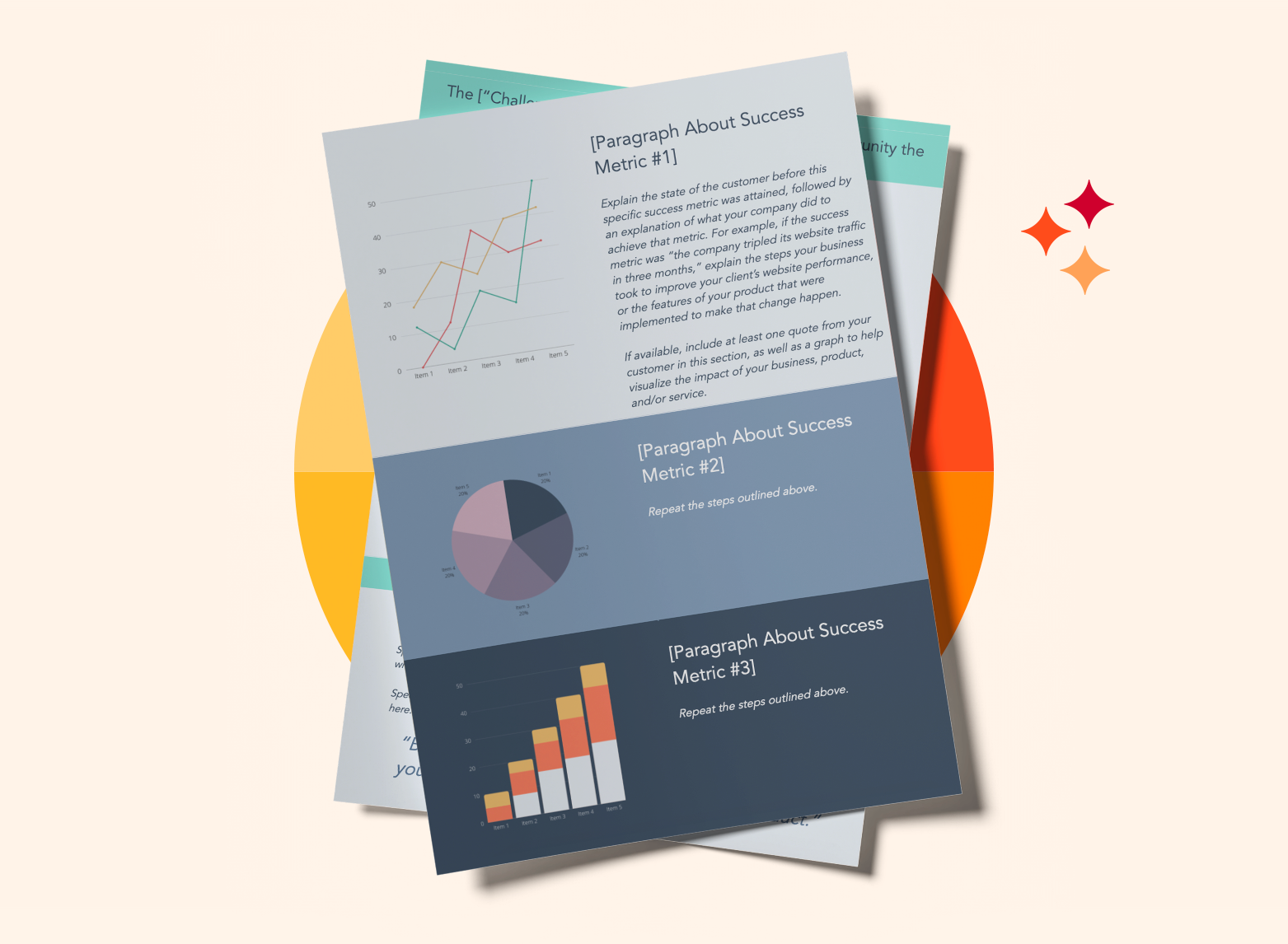
Free Case Study Templates
Showcase your company's success using these three free case study templates.
- Data-Driven Case Study Template
- Product-Specific Case Study Template
- General Case Study Template
- And more!
Download Free
All fields are required.
What is a case study?
A case study is a detailed story of something your company did. It includes a beginning — often discussing a challenge, an explanation of what happened next, and a resolution that explains how the company solved or improved on something.
A case study proves how your product has helped other companies by demonstrating real-life results. Not only that, but marketing case studies with solutions typically contain quotes from the customer.
This means that they’re not just ads where you praise your own product. Rather, other companies are praising your company — and there’s no stronger marketing material than a verbal recommendation or testimonial.
A great case study also has research and stats to back up points made about a project's results.
There are several ways to use case studies in your marketing strategy.
From featuring them on your website to including them in a sales presentation, a case study is a strong, persuasive tool that shows customers why they should work with you — straight from another customer.
Writing one from scratch is hard, though, which is why we’ve created a collection of case study templates for you to get started.
There’s no better way to generate more leads than by writing case studies. However, without case study examples from which to draw inspiration, it can be difficult to write impactful studies that convince visitors to submit a form.
Marketing Case Study Examples
To help you create an attractive and high-converting case study, I’ve put together a list of some of our favorites. This list includes famous case studies in marketing, technology, and business.
These studies can show you how to frame your company's offers in a way that is useful to your audience. Take a look, and let these examples inspire your next brilliant case study design.
These marketing case studies with solutions show the value proposition of each product. They also show how each company benefited in both the short and long term using quantitative data.
In other words, you don’t get just nice statements like “This company helped us a lot.” You see actual change within the firm through numbers and figures.
You can put your learnings into action with HubSpot's Free Case Study Templates. Available as custom designs and text-based documents, you can upload these templates to your CMS or send them to prospects as you see fit.
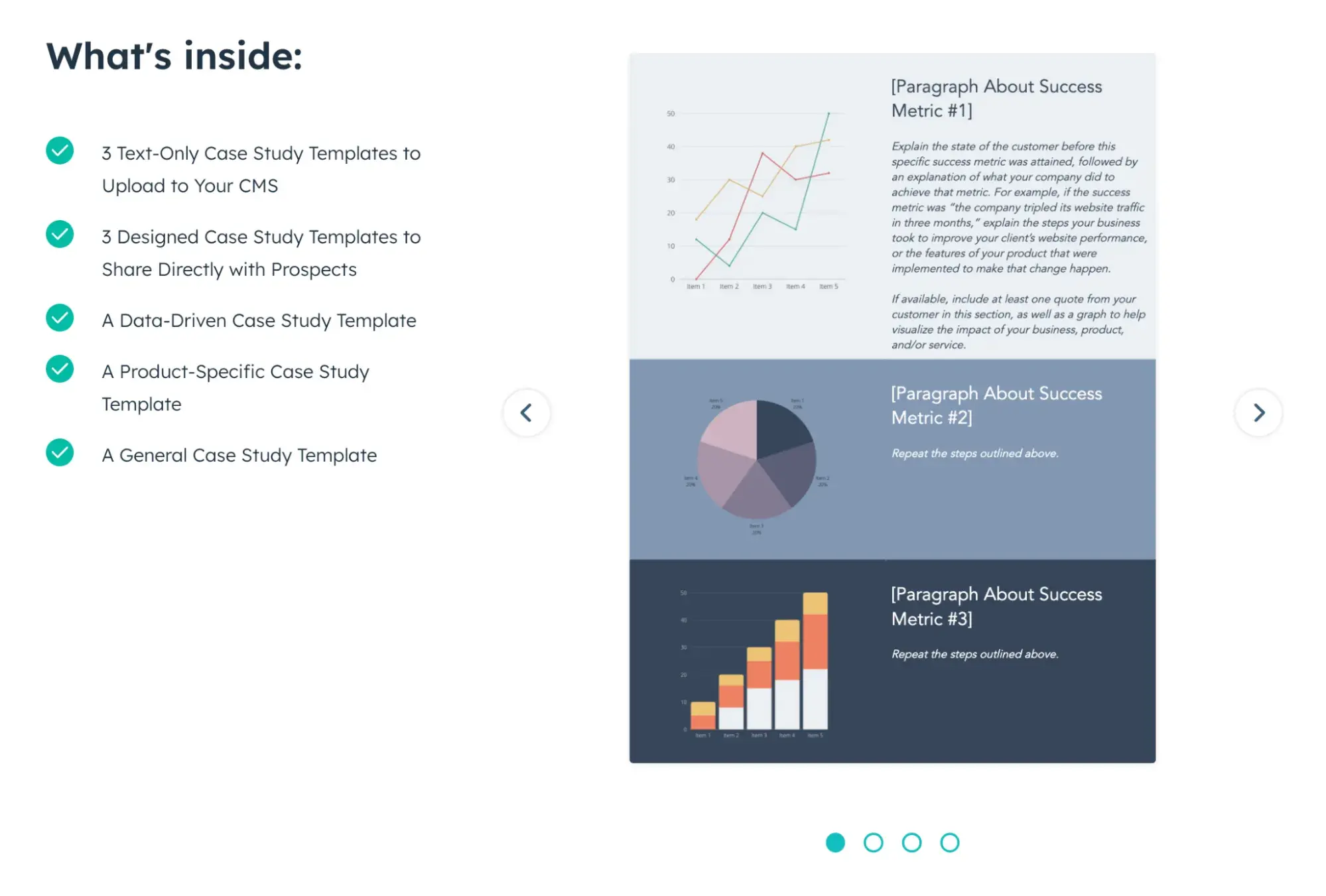
Download These Free Case Study Templates
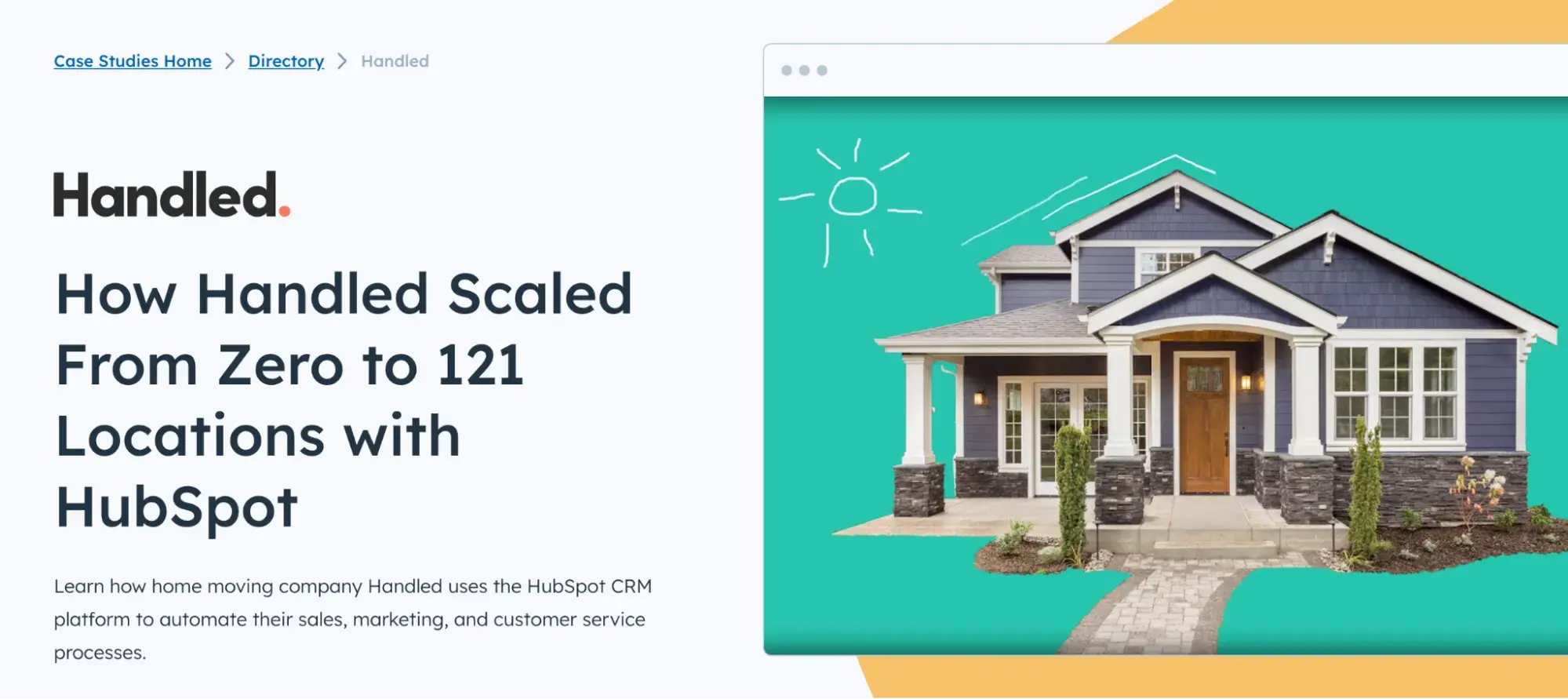
1. "How Handled Scaled from Zero to 121 Locations with the Help of HubSpot," by HubSpot
The last two times I moved houses, I organized the whole process of packing up boxes, ordering vehicles, carrying things up the stairs to the new apartment, and rearranging stuff myself. If you’ve done this before, you know how stressful it is, especially when you have other commitments like work or school.
Handled, a home services concierge, aims to relieve that stress by taking complete control over the moving process. However, unlike traditional moving companies, Handled developed a new way of moving that uses technology and high-level service reps to deliver personalized concierge services to customers.
To implement this model effectively, the company needed a CRM platform with automation capabilities to streamline the hundreds of workflows.
After trying a few popular CRMs, the company’s President and CEO, Seth Waite, chose HubSpot as their CRM of choice. After learning how to use HubSpot to its fullest potential, Seth and his team were able to automate convoluted processes and put sales, marketing, and customer service initiatives into a unified system of record.
This gave every team member 360-degree visibility into their customers and freed up time for them to deliver concierge-level services and answer customers’ questions.
With HubSpot’s help, Seth and his team were able to scale Handled from zero to 121 locations (in the US) in 37 states in just 18 months.
Takeaway
This case study meticulously described, in detail, the challenges Handled was facing, their process in finding a solution (HubSpot), and how that solution helped the company scale. You can use this format when you really want to show prospective customers how well your product works for their needs.
2. "Rozum Robotics intensifies its PR game with Awario," by Awario
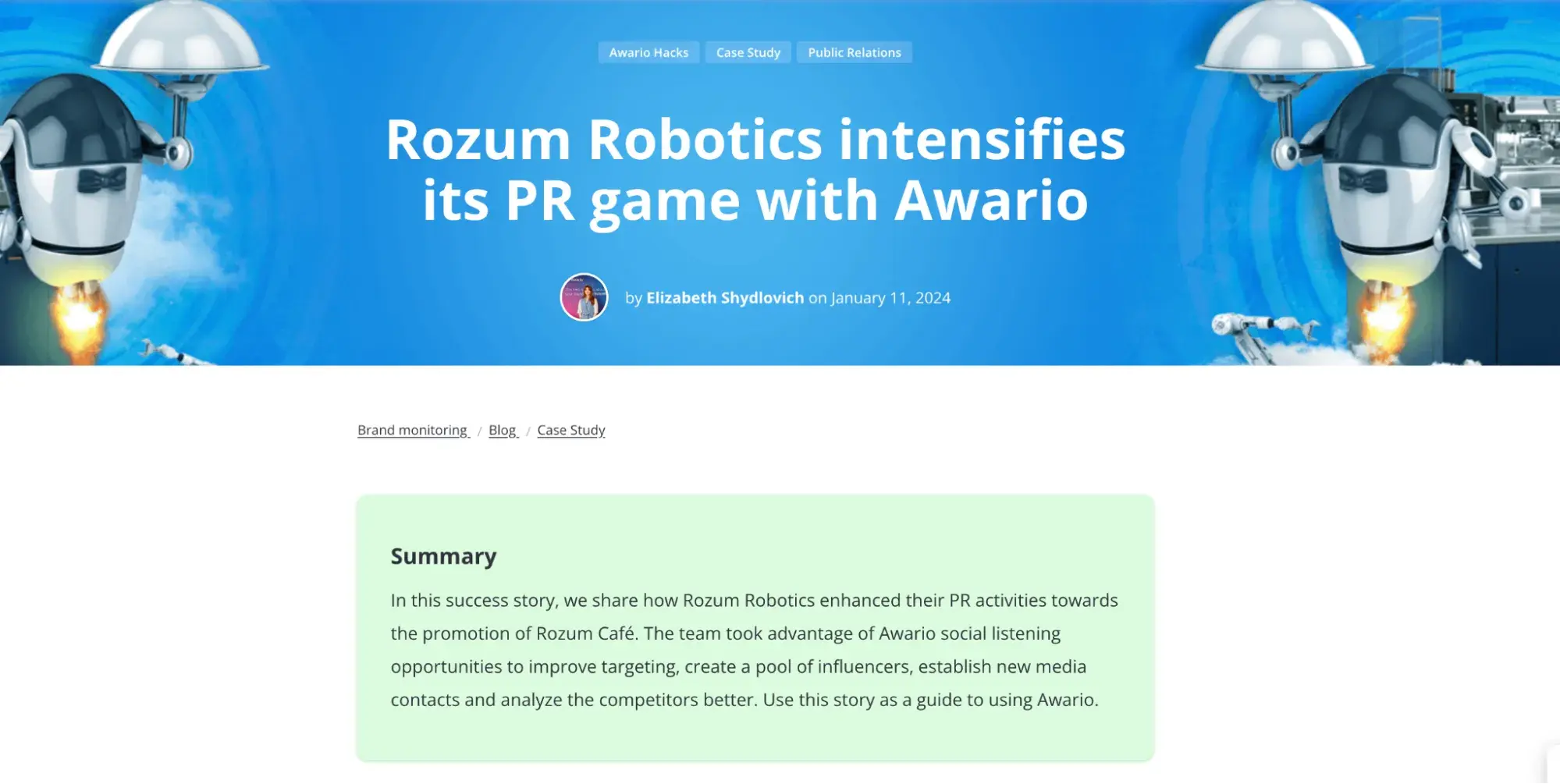
Rozum Robotics is a company that builds stand-out robotic solutions like high-precision servo motors, frameless motors, and robotic tool changers. The company also created an advanced robotic coffee house called Rozum Cafe.
However, it had trouble increasing brand awareness and generating leads for the coffee house. After trying a few tools, the marketing team at Rozum Robotics chose Awario, a brand monitoring tool, to help them step up the company’s PR and lead gen game.
With Awario, the team was able to reduce the time it spends finding and tracking relevant media sources and influencers for promoting the coffee house by 70%. It was also able to define two new target audiences for the cafe, spot viral content, react to mentions of the cafe online, analyze competitors’ social media posts, and compare the sentiment of Rozum Cafe with similar automated coffee spots.
As a result, Rozum Robotics was able to save time, find and target new audiences, nurture newly formed media relations, and improve the quality of leads generated.
Takeaway
From the jump, this case study gives an overview of Rozum Robotics, including what the company does, its pain points, challenges, and then the solution. At the end, there’s a short bullet list of the results and improvements that Awario helped generate for their client.
Dividing your case study into these sections makes it easier for prospective customers to skim through and understand.
3. “How Meagan and Alex of Agents of Change 10X-ed Their Income With Thinkific,” by Thinkific
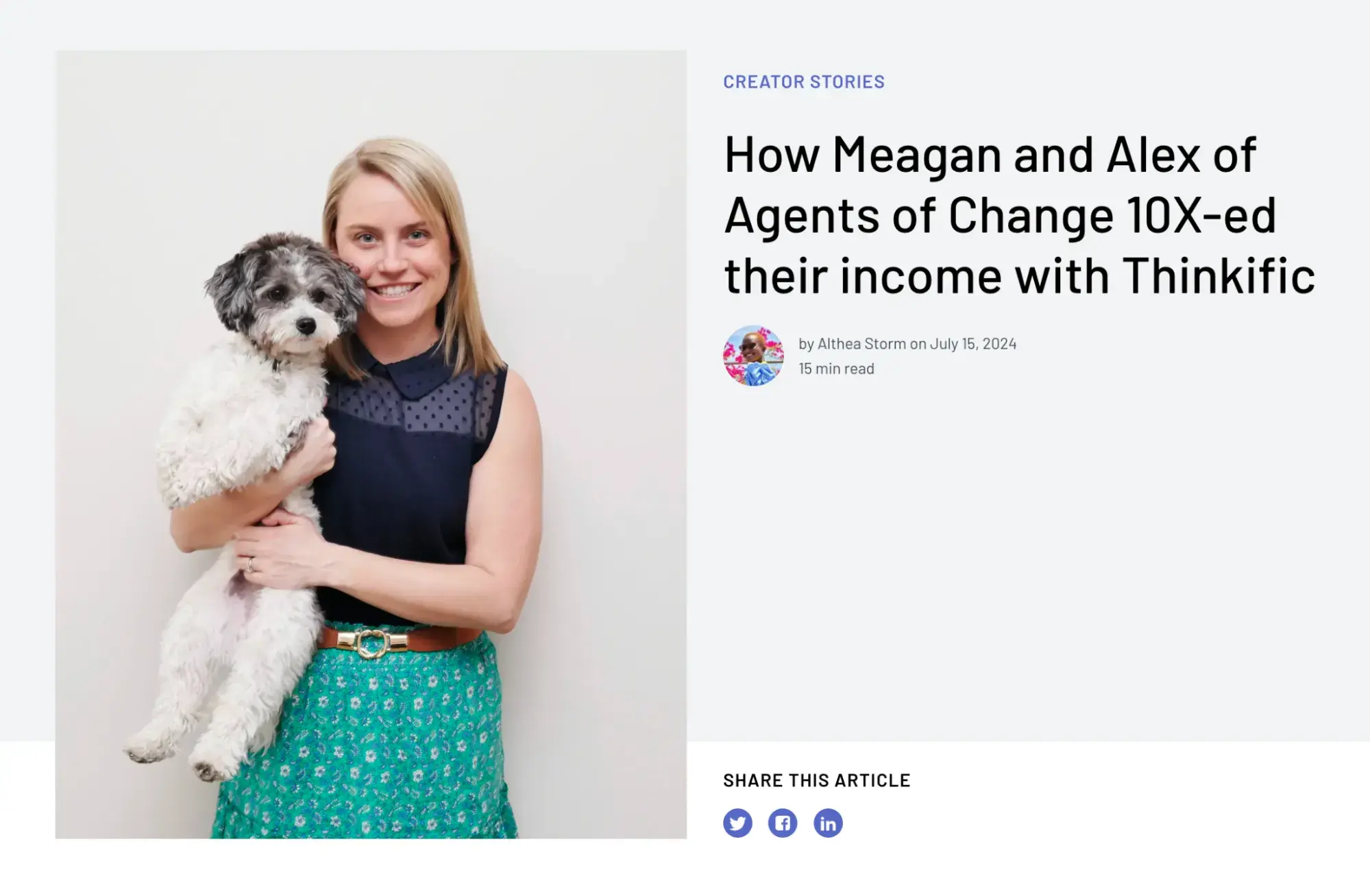
When Meagan Mitchell, one-half of Agents of Change, took the ASWB exam to become a licensed clinical worker, she only needed to get a book with which to prepare. There were other learning materials, but they were either limited or expensive. Not to mention outdated, too.
Noticing these inefficiencies, Meagan and her husband, Alex, decided to create updated materials and adapt the way people studied for their licensing exams to include more technology. That’s how Agents of Change was created in 2020.
At the time, Meagan was doing individual and group tutoring for people about to take their exams, but Alex advised her to upload her tutoring content on a course platform so people can learn at their own pace. They started with Gumroad, but a year later, they outgrew the platform and started looking for a more robust one. That’s how they found Thinkific.
With Thinkific, Meagan and Alex have been able to build an all-encompassing licensing exam prep course, build strong communities across several social media platforms, and assess their customers’ needs and iterate accordingly. They’ve also been able to create a branded mobile app for learners on the go, which has really boosted their business.
As a result, they’ve been able to 10X their annual revenue (from when they were using Gumroad) and transform Agents of Change into a thriving business.
Takeaway
This case study not only explains Meagan and Alex’s reasoning behind creating an online business that focuses on social workers, but it also lists some other lessons readers can learn from the couple on building and scaling an online business.
With this approach, you not only show people the value of your product, but you also deliver value by letting them learn from clients who might be in the same position as them.
4. "Embracing first-party data: 3 success stories from HubSpot," by Think with Google
In this case study, Christen Luciano, director of strategic alliances at HubSpot, explores how three small to mid-sized businesses (SMBs) used first-party data (data collected directly from your audience, whether customers, website visitors, or social media followers) to improve their marketing effectiveness.
The first company is Zoe Financial, a New York-based wealth-planning platform. This company’s first-party data, stored in the HubSpot CRM platform, provided insights into what makes an ideal client.
They used the data to optimize their Google Ads campaigns, which resulted in its most valuable client segment making up 60% of sales, the highest ever since the company was founded in 2018.
The second company is Cluey Learning, an online tutoring startup that helps parents find personalized school support for their kids across Australia and New Zealand. The Cluey team used the first-party data they stored with HubSpot and Google’s shared solution to reach qualified potential customers with relevant campaigns. With this strategy, Cluey’s ads increased in effectiveness by 190%, and the cost of conversions decreased by 17%.
The third company is France-based startup Agicap, which struggled to stand out in an online space saturated with ads from its competitors. By feeding its first-party CRM data from HubSpot into Google Ads and leveraging Google’s Customer Match feature, Agicap was able to reengage its qualified leads with relevant ads. This resulted in a 10% increase in conversions and a 15% increase in revenue growth.
Takeaway
If you have a few clients who use the same tool in similar ways to get specific results, you can group them together in one case study instead of creating separate case studies for each of them. This way, prospective customers who would benefit from using your tool in the same way can see themselves in each company you discussed in the case study.
Free Case Study Templates
Showcase your company's success using these three free case study templates.
- Data-Driven Case Study Template
- Product-Specific Case Study Template
- General Case Study Template
- And more!
Download Free
All fields are required.
5. "A Healthcare System Plans for Resilience," by Herman Miller
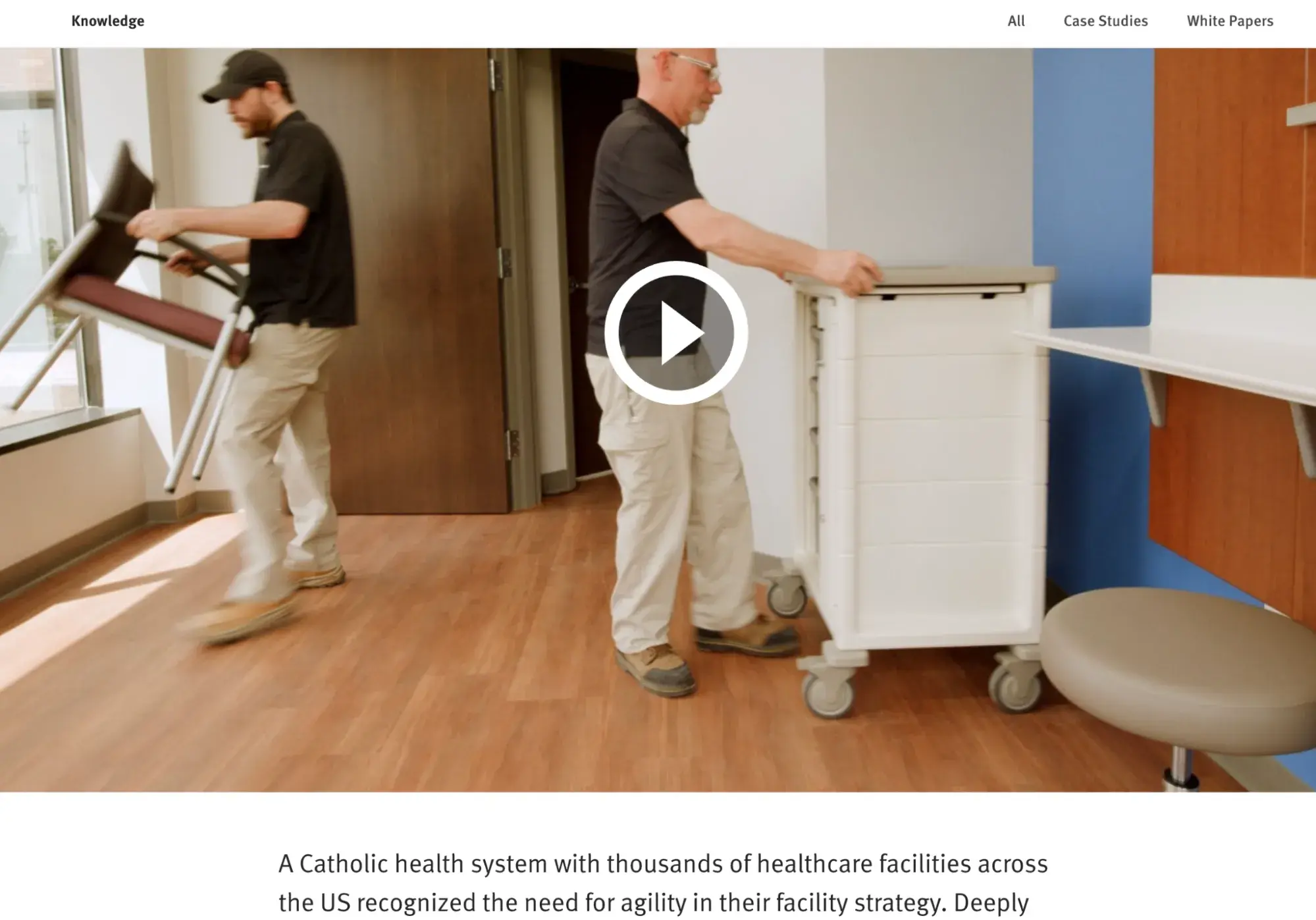
Herman Miller sells sleek, utilitarian furniture with no frills and extreme functionality, and this case study details its partnership with a Catholic health system that includes thousands of healthcare facilities across the U.S.
This organization, which is deeply committed to the environment and financial stewardship, wanted to make its growing portfolio of facilities more efficient, effective, and agile.
To do that, its Planning, Design, and Construction (PDC) team started making plans for facilities that can respond to situations and accommodate changes of all magnitudes. However, the organization wanted to reduce fragmentation and ensure consistency across locations, so it partnered with Herman Miller (and its network of dealer partners, e.g., OfficeWorks).
Herman Miller worked with this organization to develop processes for planning, designing, and executing these projects while meeting stringent guidelines. They were also able to repurpose the existing casework and furnishings for the new clinics, which saved the organization over 50% of what it would’ve cost to order things brand new.
No material from the project ended up in landfills, which is a win for both the environment and the organization.
There were also other benefits of working with Herman Miller, which included saving time via streamlined processes/solutions, getting reliable day-to-day service from OfficeWorks (which is fully integrated into the organization’s team), stress-free disassembly and reinstallation, and continuity with updates.
Takeaway
Similar to the Handled case study by HubSpot, this one by Herman Miller takes an expository approach, which is effective if the client you’re discussing in the case study used your product/service for a large project with different moving parts.
An expository approach allows you to describe those moving parts and then connect them neatly at the end as you describe the eventual results you helped the client achieve.
6. “Sephora at Kohl’s to Expand Shop-in-Shop Concept to All Kohl’s Locations,” by Retail Touchpoints
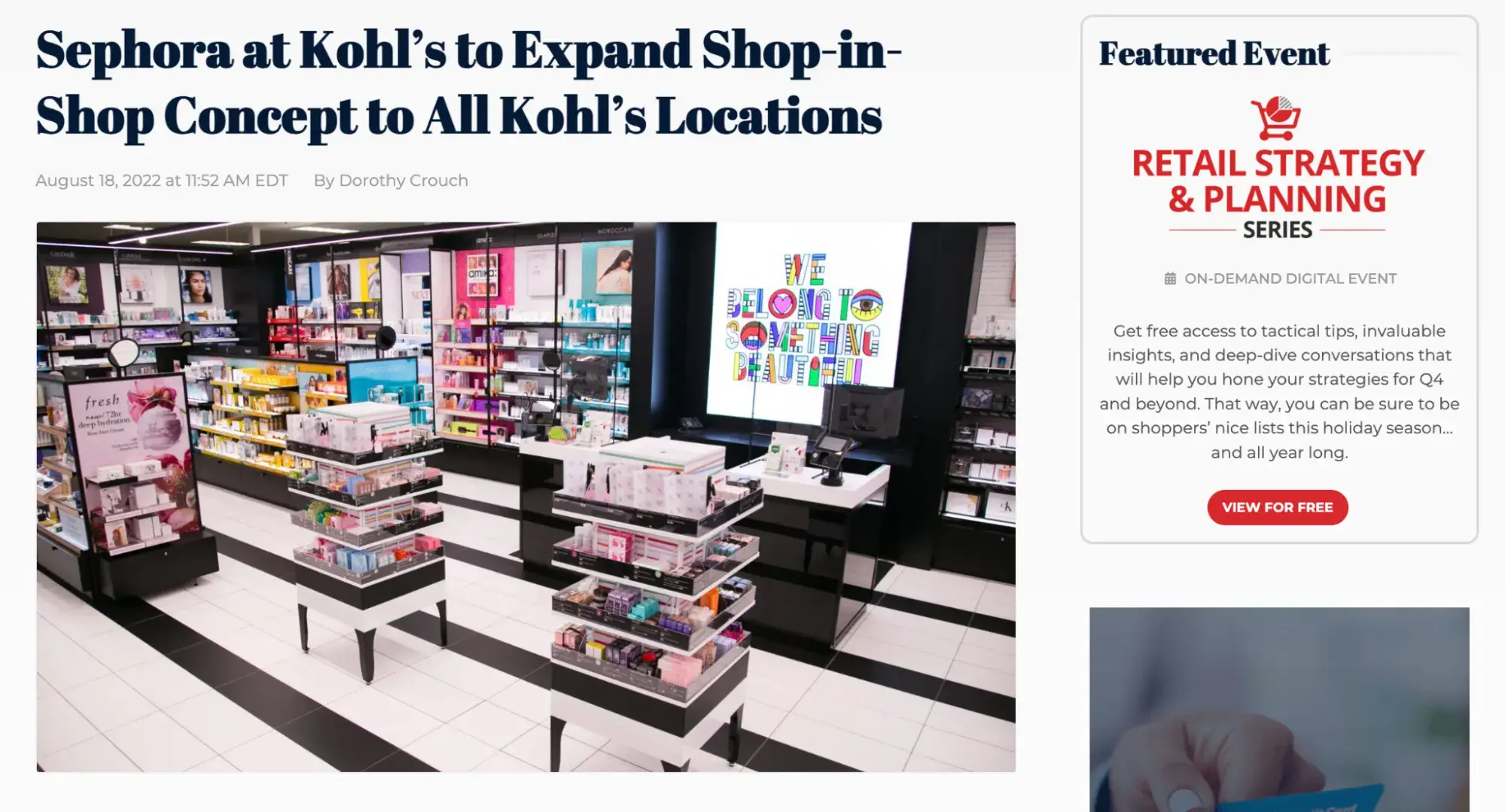
Sephora first partnered with Kohl’s in 2021, the department store retailer, to replace Kohl’s beauty offerings with Sephora counters.
At the time, both companies planned about 200 store launches, but the partnership was so successful that the partnership grew to include nearly 400 stores in 2022. With the same growth rates reported that year, Kohl’s anticipated that, by 2023, it will have opened 800 Sephora at Kohl’s locations.
Since the launch of the partnership in August 2021, Kohl’s has seen over 1 million new customers, noting that the collaboration is attracting younger and more diverse audiences. The partnership is now projected to reach $2 billion in annual sales by 2025.
Takeaway
Before describing the success of the initial partnership between Sephora and Kohl’s, this case study noted that the collaboration is set to expand.
If you have a client who’s renewing their partnership with your business, you could take this approach by first making it known that they’re continuing their collaboration with you and then explaining why (the initial collaboration was massively successful).
7. "HackReactor teaches the world to code #withAsana," by Asana
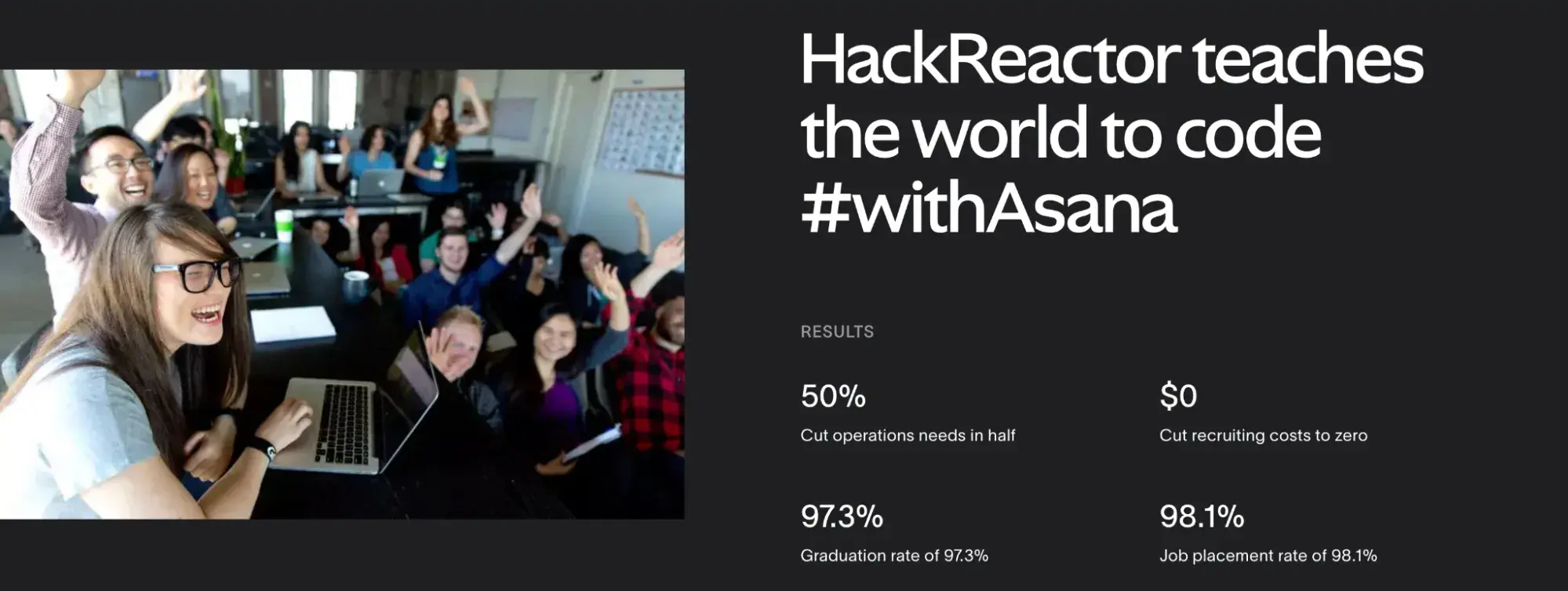
Hack Reactor is a software engineering coding boot camp program that aims to provide a world-class education to its students. When the company was just starting out, its CEO, Tony Williams, could easily keep track of all the moving pieces. But as it got more students, hired more staff, and opened more locations, being so meticulous became a challenge.
Tony started looking for a tool his growing team could use to store information centrally, so they could use it. After using Asana personally and being satisfied with it, he rolled it out to the entire team.
The first thing they did was upload their detailed documentation on important processes like course development or facilities and made it available to everyone in the company. They also used Asana’s API to streamline their processes and make them more efficient.
Not too long after, the Hack Reactor team, which comprises over 200 people, started using Asana for many different workflows, including their management processes, performance reviews, standard operating procedures, HR policies, and team-building events.
The efficiency this brought has caused Hack Reactor to cut its operation costs by 50% and recruiting costs down to $0. Hack Reactor’s graduation rate is now 97.3%, and the job placement rate is 98.1%.
Takeaway
In the same vein as the case study by Omniscient Digital, this one by Asana puts the metrics (and accompanying figures) right at the beginning to pique the curiosity of readers. Then it goes on to explain how exactly Asana helped Hack Reactor achieve these results, featuring statements from the CEO himself.
8. "Rips Sewed, Brand Love Reaped," by Amp Agency
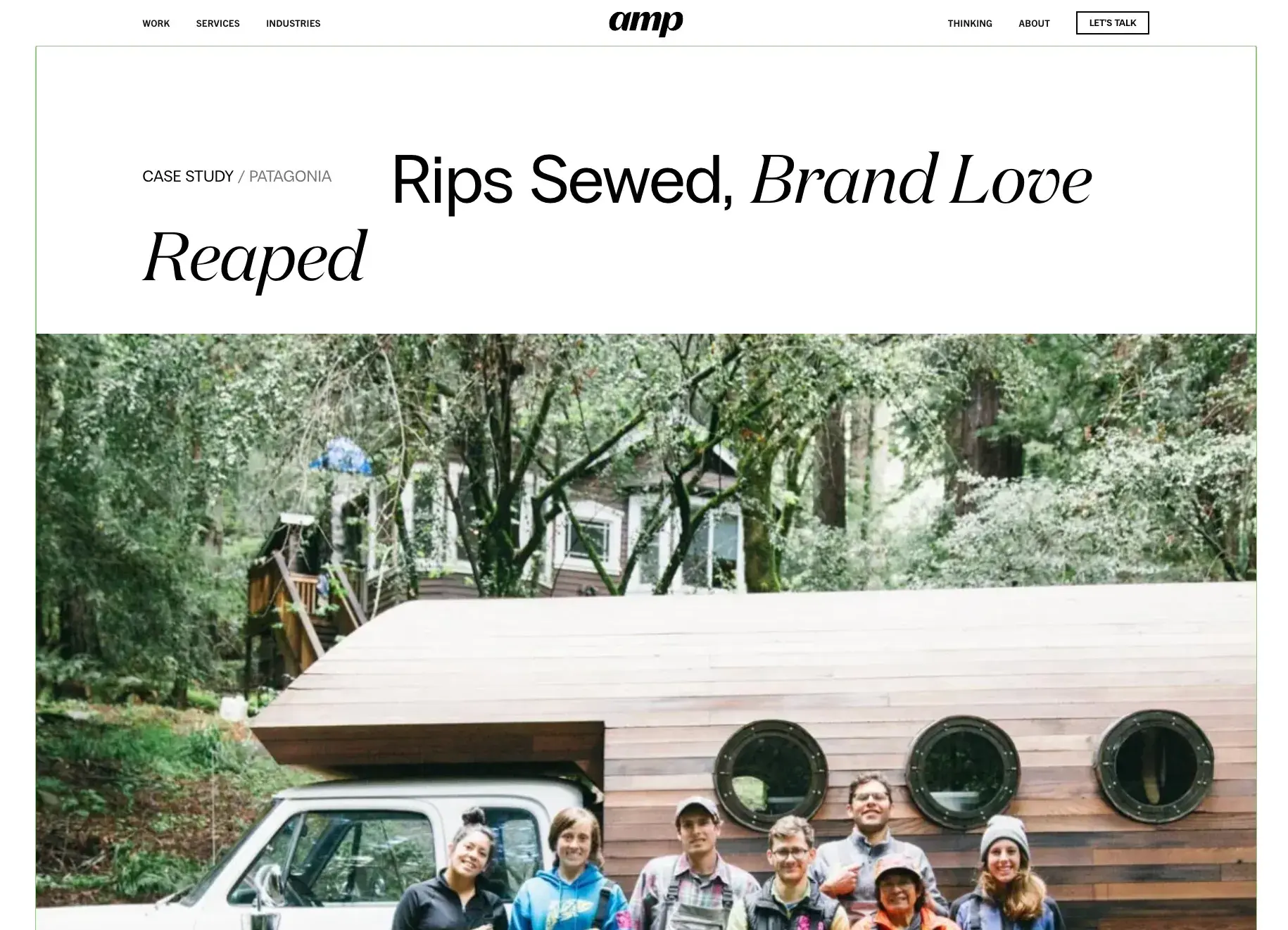
Patagonia, the American outdoor clothing and gear brand, appealed to its core audience with high-quality products, environmental activism, and sustainable business practices. However, it sought to connect with a younger demographic and change the relationships people have with the things they buy.
So, they hired Amp Agency to help them.
Upon learning what Patagonia wanted to achieve, the agency and its client worked together to come up with the Worn Wear program, which encourages people to repair and reuse existing items. To execute the program, the agency got a custom-designed biodiesel-converted Dodge truck named Delia, and embarked on a 7-week road trip to share this message with people directly.
This epic tour started in the California Bay Area and headed east, where they stopped at major Patagonia markets, smaller markets, college campuses, transit stations, local businesses, and outdoor community boards.
At each stop, Worn Wear tour team members mended and repaired used garments, shared valuable tips with DIYers, and sold used Worn Wear merchandise through Delia’s pop-up shop.
The agency documented the entire trip on social media and bolstered that with PR and guerilla marketing tactics, so Delia arrived at each stop to excited crowds. At the end of the 5,000-mile journey, they realized that they had over 11,000 tour attendees, an 88% merchandise sell-through rate during the tour, and nearly 700,000 page views on the Worn Wear landing page.
Takeaway
Taking the expository approach (but without quotes), Amp Agency succinctly describes the measures it took to reach young people with Patagonia’s message. However, at the end, it boldly lists the results it got for Patagonia, which ties up the exposition nicely.
9. “WorkDay Puts Evisort’s Connected Contract Intelligence to Work—and It Delivered,” by Evisort
The legal operations team at WorkDay, a leader in enterprise cloud applications for finance, HR, and planning, realized that the company could save hundreds of thousands of hours by automating contract data processes. The team posited that by streamlining their contracting processes using AI, the group could connect the contract data to locate information quickly.
When the team proposed this to the business, they were immediately on board and started looking for tools that can perform this function. They eventually found Evisort. Using the Evisort platform, Workday’s legal team were able to get time back. They used the platform for large-scale/global projects with multiple search parameters, and connected that data to other platforms, including Salesforce.
The Workday legal operations team also implemented multiple Evisort user levels — ranging from users who don’t frequently use the platform to those who use it every day.
By partnering with Evisort, Workday was able to optimize its legal operations, achieving a whopping 3,500% return on investment.
Takeaway
Right underneath the title, Evisort provides a short blurb that summarizes the entire case study. This helps readers who are unable to read the whole thing at that moment have an idea of what Workday is and how Evisort helped the company achieve an ROI that high.
This blurb increases the chances of readers returning to read the case study or downloading it for perusal later.
10. "Flexible Data Processing for Land Usage," by Cloudflight
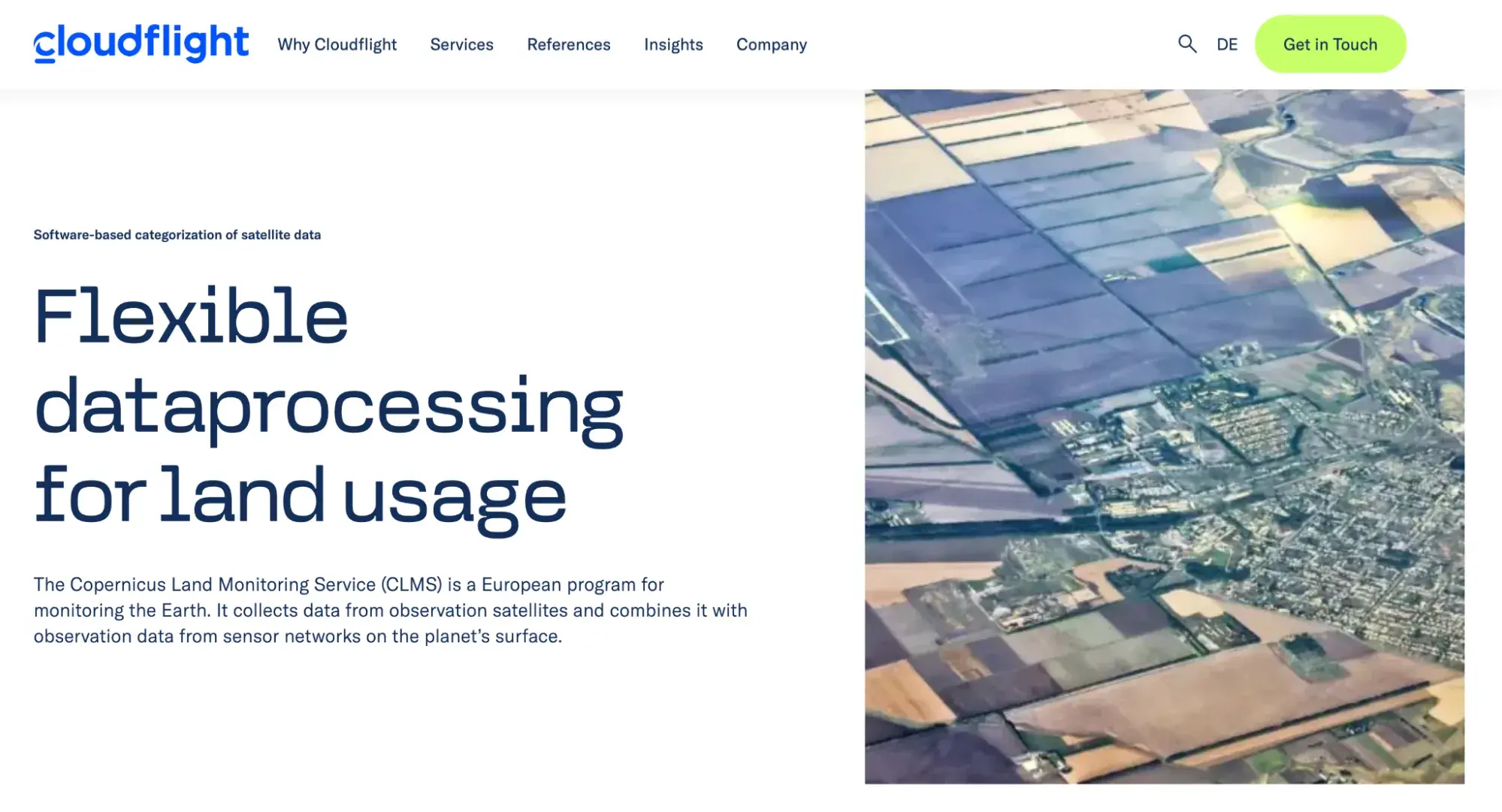
This case study describes the Copernicus Land Monitoring Service (CLMS), a European program for monitoring the Earth. Cloudflight explains that the CLMS has three parts, the second of which Cloudflight is currently developing (the CLC+ Core).
The case study goes on to describe the challenge of developing a system that covers the entirety of the EEA-38 + UK States and takes in tons of data, while remaining user-friendly and intuitive. It then describes the solution: The Cloudflight team created a blueprint that shows the opportunities to seize and best practices to adopt to make the system suitable for end-users while processing huge quantities of data.
Takeaway
This case study is highly specialized, and I don’t fully understand what the CLMS does and its significance. But, that’s the point. If your industry is deeply technical, don’t shy away from using jargon to describe what you do. It’s a great way to show prospects that you’re passionate about the industry and are not just trying to get their business.
11. “Twinkle Twinkle Little One Grows Revenue by 80% with Shopify POS,” by Shopify
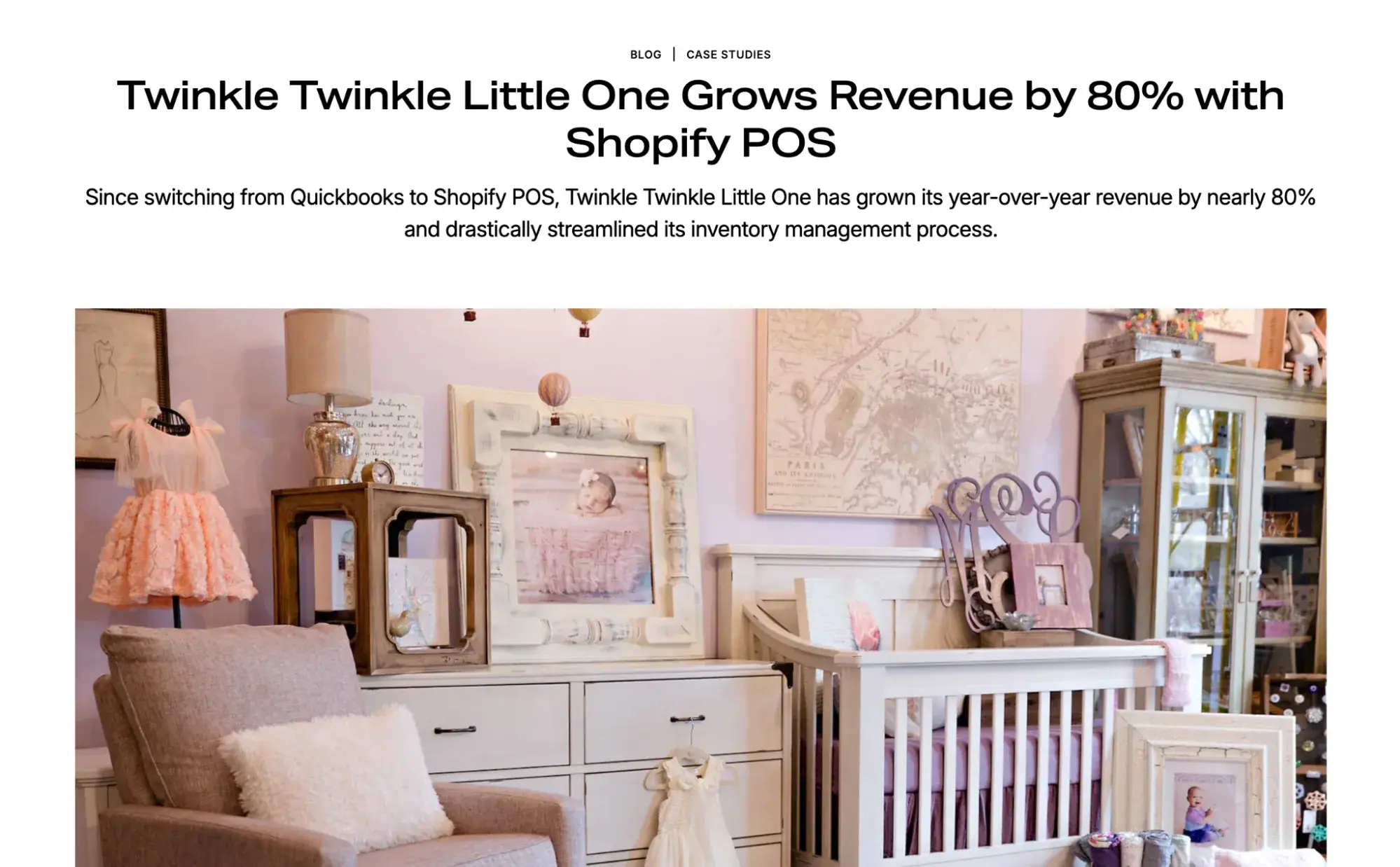
Twinkle Twinkle Little One, founded by Rachel and Corey Glasson, is a Chicago-based premiere baby and child boutique that sells things parents need to care for their babies, like cribs, dressers, car seats, clothing, etc.
The challenge this company faced is that the POS they used didn’t integrate well with the brand’s e-commerce tool. As a result, staff had to manually cross-reference inventory quantities on both systems to maintain accuracy. Not only was this time-consuming and stressful, but it was also imperfect and they sometimes received orders for items that were actually not in stock.
To unify the sales channels and streamline the business’ operations, the Glassons decided to migrate to Shopify POS, which integrated seamlessly with the brand’s QuickBooks Desktop Accounting Software.
Since this migration, Twinkle Twinkle Little One has grown its revenue by nearly 80% year-over-year (YoY), reduced back-office tasks, and streamlined its sales, inventory, and financial reporting.
Takeaway
Right underneath the title is a blurb that makes it clear that the Glassons were using other tools before Shopify. Since prospective customers who read case studies are likely trying to make a decision on which tool to go for, this is a great way to show the value your product provides (compared to your competitors).
Free Case Study Templates
Showcase your company's success using these three free case study templates.
- Data-Driven Case Study Template
- Product-Specific Case Study Template
- General Case Study Template
- And more!
Download Free
All fields are required.
12. “How BlueBridge One Uses Happeo for Knowledge Management,” by Happeo
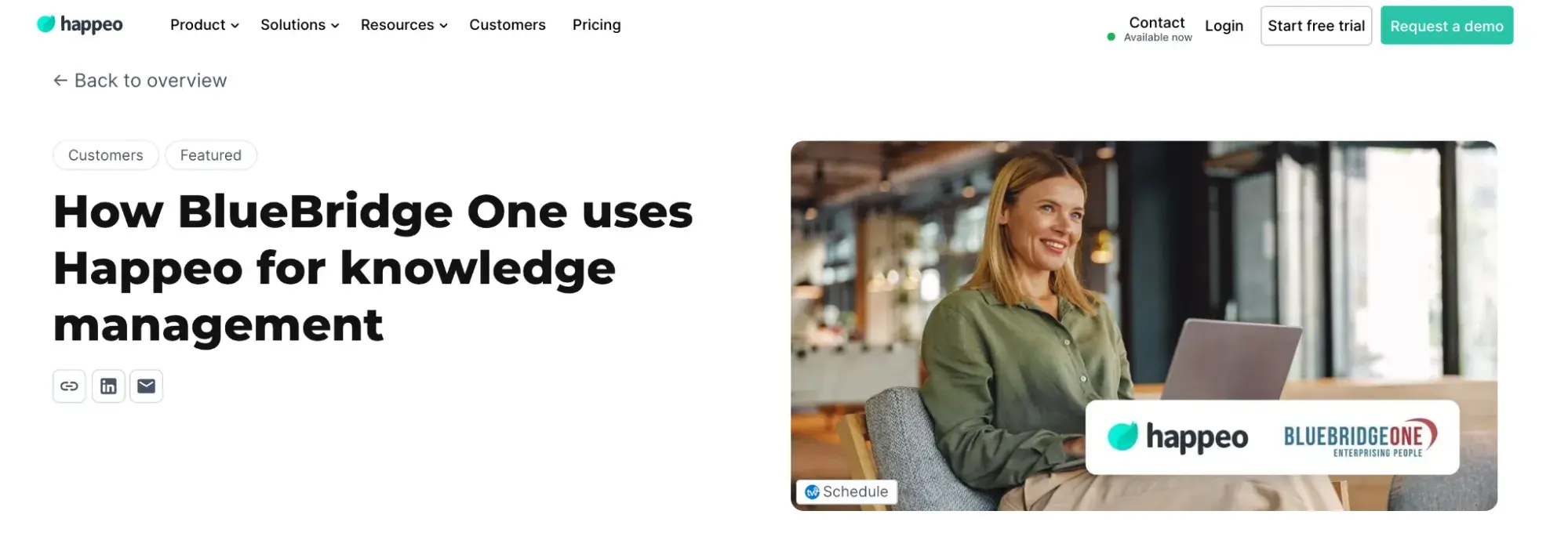
BlueBridge One is a leading Oracle NetSuite solution provider with offices in Johannesburg, Cape Town, the UK, and Romania. The company has over 80 employees who are all well-versed with the product and are experts in their field.
They had one problem, though: an overload of information. Also, with offices in different geographic locations and most employees working remotely, it was difficult to collaborate and share information.
So, the BlueBridge One team set out to find a tool that can serve as a universal source of truth. And they found Happeo, which proved to be more than just an intranet. It was also a social platform that bridged the gap between BlueBridge One’s offices and deepened the bond between colleagues.
Takeaway
The entire case study is almost exclusively composed of direct quotes from Lameshnee Chetty, BlueBridge One’s Knowledge Manager. In fact, the case study begins by introducing Lameshnee, rather than the company itself. This is a great way to humanize your client and give readers someone they can relate to in the case study.
13. "Red Sox Season Campaign," by CTP Boston
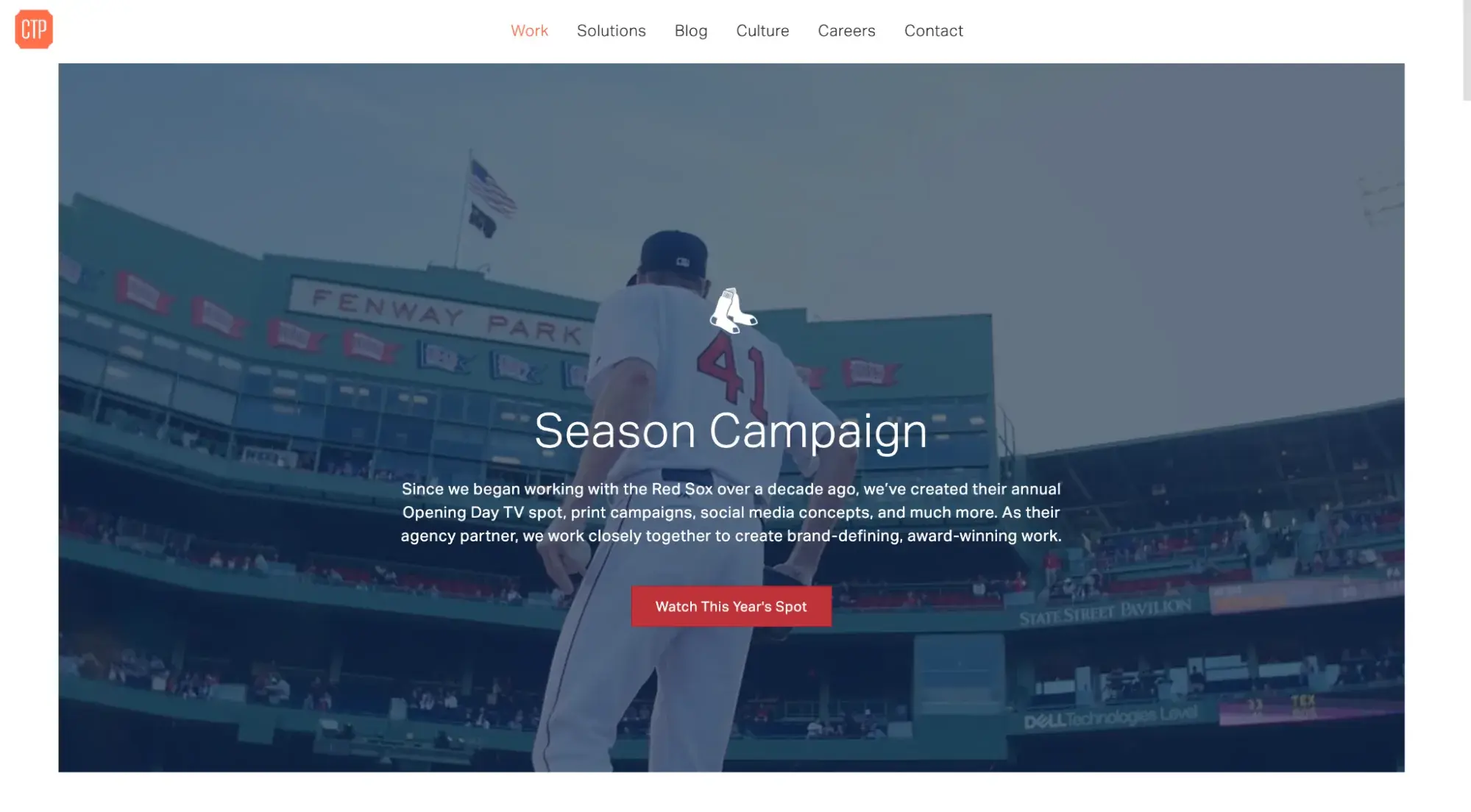
Unlike most case studies, which read like blog posts, this one by CTP Boston is structured in a landing page style. It details how CTP Boston created the annual Opening Day TV Spot for the Boston Red Sox, which it has been doing for over a decade as the team’s agency partner.
Below the hero video, the page shows the awards that CTP Boston’s work has garnered, including an Emmy and a Hatch award. This lends credibility to the work that the agency does and speaks to their expertise. After this, it briefly explains the challenge CTP Boston faced with that year’s campaign and the idea with which they approached the execution.
Then, the page showed a core metric: The Opening Day Spot earned over 1 million impressions within the first two weeks of airing, which is impressive.
Takeaway
This landing page-style case study takes the “show, don’t tell” approach seriously. The page opens with a video of the Red Sox team on the field, which sets the mood for the other videos of player spotlights on the page. There are also visuals from the print campaign and social media executions, as well as campaigns from previous years.
This is a great way to show the work that you can create for your clients as well as your range and adaptability.
14. "Reimagining the B2B Web Experience for a Challenger Digital Experience Platform," by Genuine
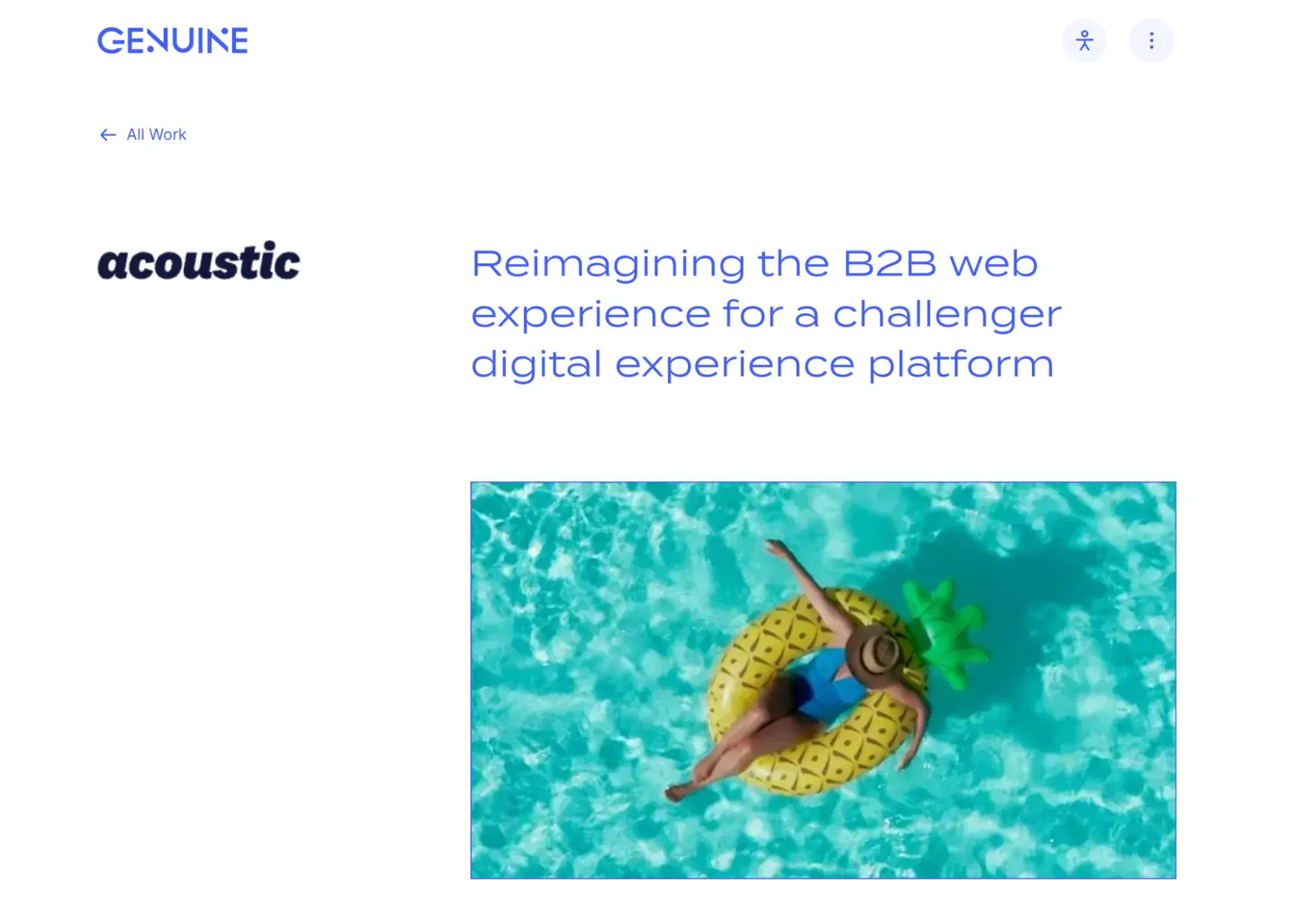
This case study covers Genuine’s partnership with Acoustic, an independent cloud marketing platform that helps marketers “unleash their brilliance.” Acoustic was building a new brand in a crowded marketing technology space and hired Genuine, a digital experience agency, to create a website that’ll help them stand out from the crowd.
And that’s what Genuine did! The company created a stunning website that put the needs of marketers and IT professionals at the center, helping site visitors identify the solutions they needed. So, instead of talking about what Acoustic does, the website focused on what Acoustic’s target audience needed.
This approach helped Acoustic get a 49% increase in form submissions, 212% increase in mobile form submissions, and a 72% increase in marketing qualified lead submissions.
Takeaway
In short, punchy sentences, Genuine described at the beginning what it did for Acoustic and the results the work brought. In similarly punchy paragraphs (with lots of white space), it gave an overview of Acoustic and what it needed, a testimonial from Acoustic’s CMO, and three takeaways from Genuine’s approach to Acoustic needs.
Having takeaways in your case study (or blog post, as in my case) is a great way to show your process and how you approach client work.
15. "Using Apptio Targetprocess Automated Rules in Wargaming," by Apptio
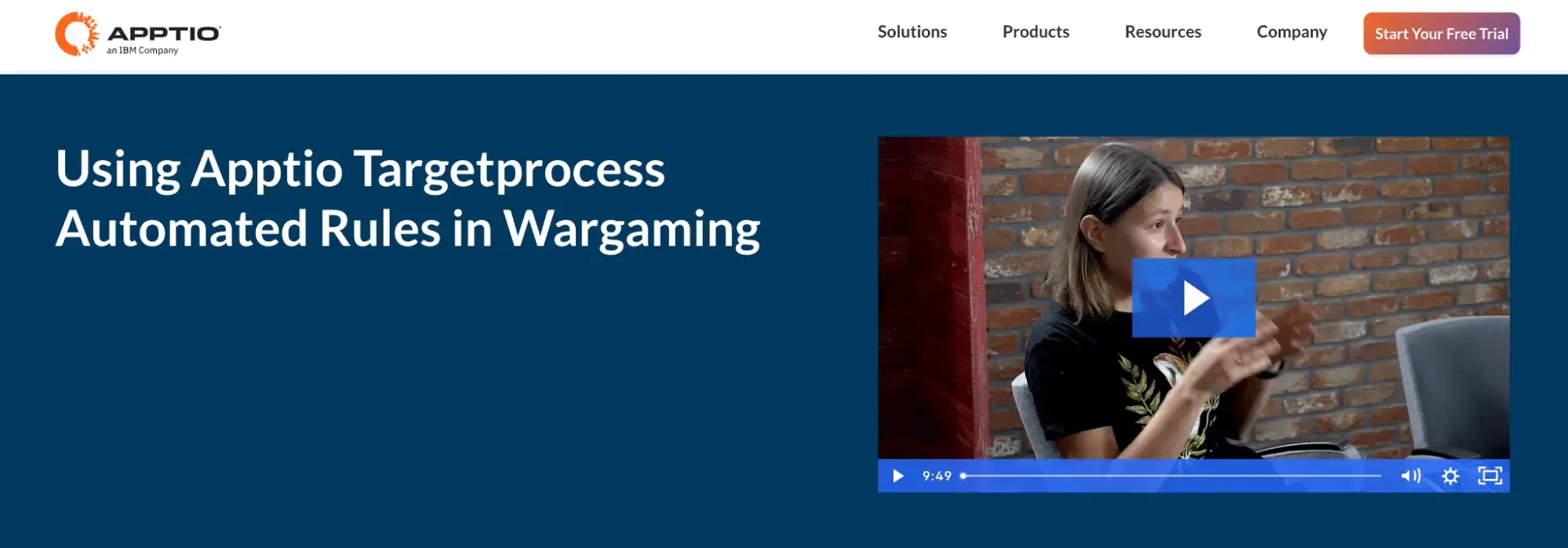
Apptio’s case study for Wargaming summarizes three key pieces of information: the goals, the obstacles, and the results. It uses bullet points and short sentences to convey the message, so instead of reading through long blocks of text, you’re able to get the message immediately.
Now, if you feel that there’s context missing or you don’t quite understand how Apptio helped Wargaming, there’s a 10-minute video in the header where Yulia Ivantsova and Diana Paliychuk (Project Manager, EPMO) at Wargaming answer questions and give more context into how Wargaming leveraged Apptio for its processes.
Takeaway
If you’re able to film an interview with a leader from the company that hired you or used your product, that’s a great way to humanize both your brand and your client’s brand, and get their unfiltered thoughts as to how they decided to partner with you and the results you’ve brought them.
When you do this, you don’t have to write a whole blog post explaining the entire process. You could just take Apptio’s route and write a 14-line summary broken down into sections.
16. "Coca-Cola Wins With First-to-Market Playable Ads,” by Uber
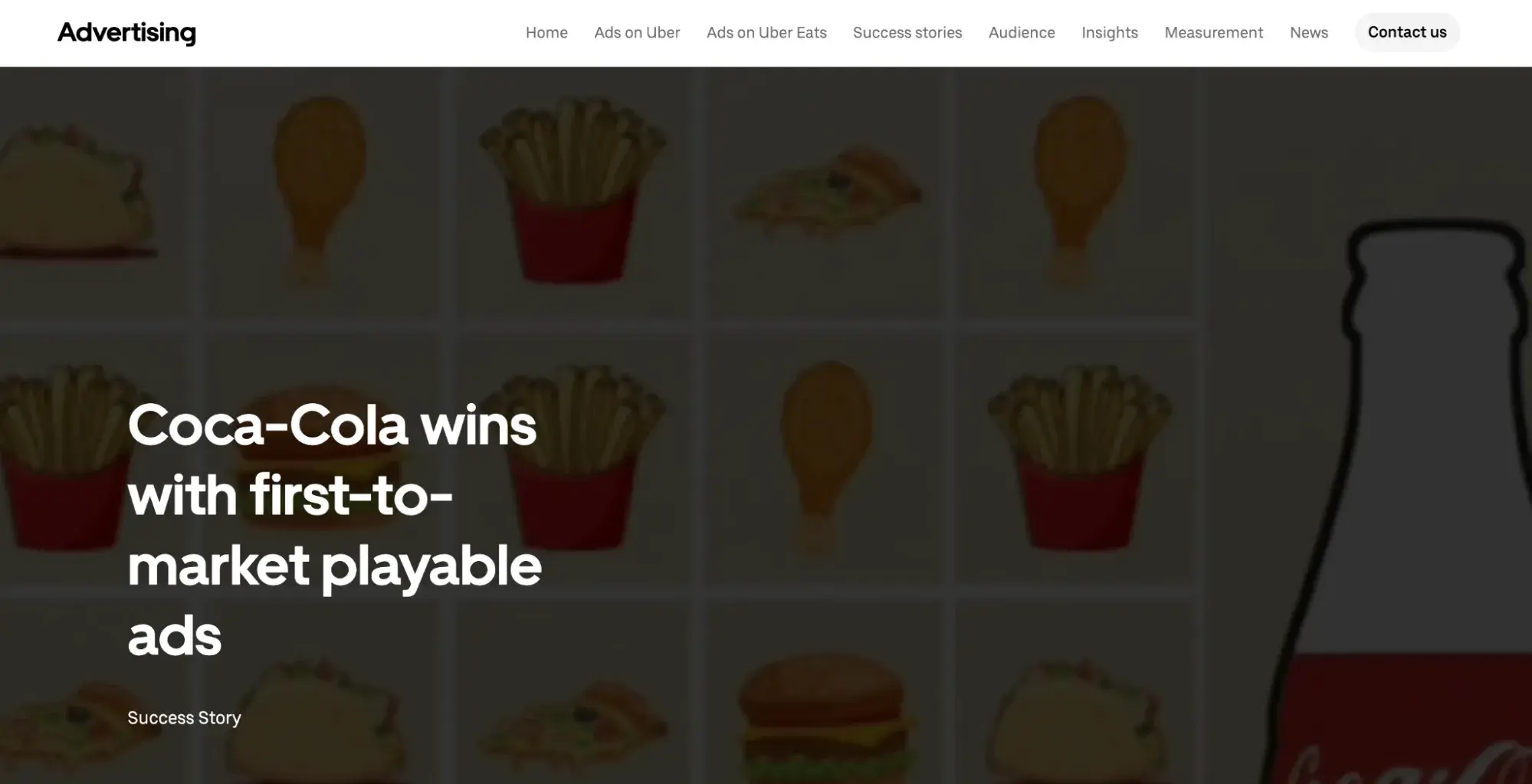
Uber isn’t just a rideshare company; it’s also an advertising company, as its collection of case studies proves. One of those case studies is this one that concisely describes how Coca-Cola partnered with Uber to engage customers during the 2023 FIFA Women’s World Cup in Australia and New Zealand.
With the first-to-market Playable Ad, the iconic brand targeted sports fans, tourists attending the event, and Uber Eats grocery shoppers. Users could play a branded game within a Post-Checkout Ad to unlock a special Coke discount.
The strategy for Coca-Cola got 21%+ new customer redemptions, 40+ secs average playing time, and 90%+ game completion rate across both Australia and New Zealand.
Takeaway
The blurb and the results from Coca-Cola’s campaign take up over half of the entire page. This speaks to how effective it is to put the results front and center and then build the rest of the narrative from there.
17. "Discovering Cost Savings With Efficient Decision Making," by Gartner
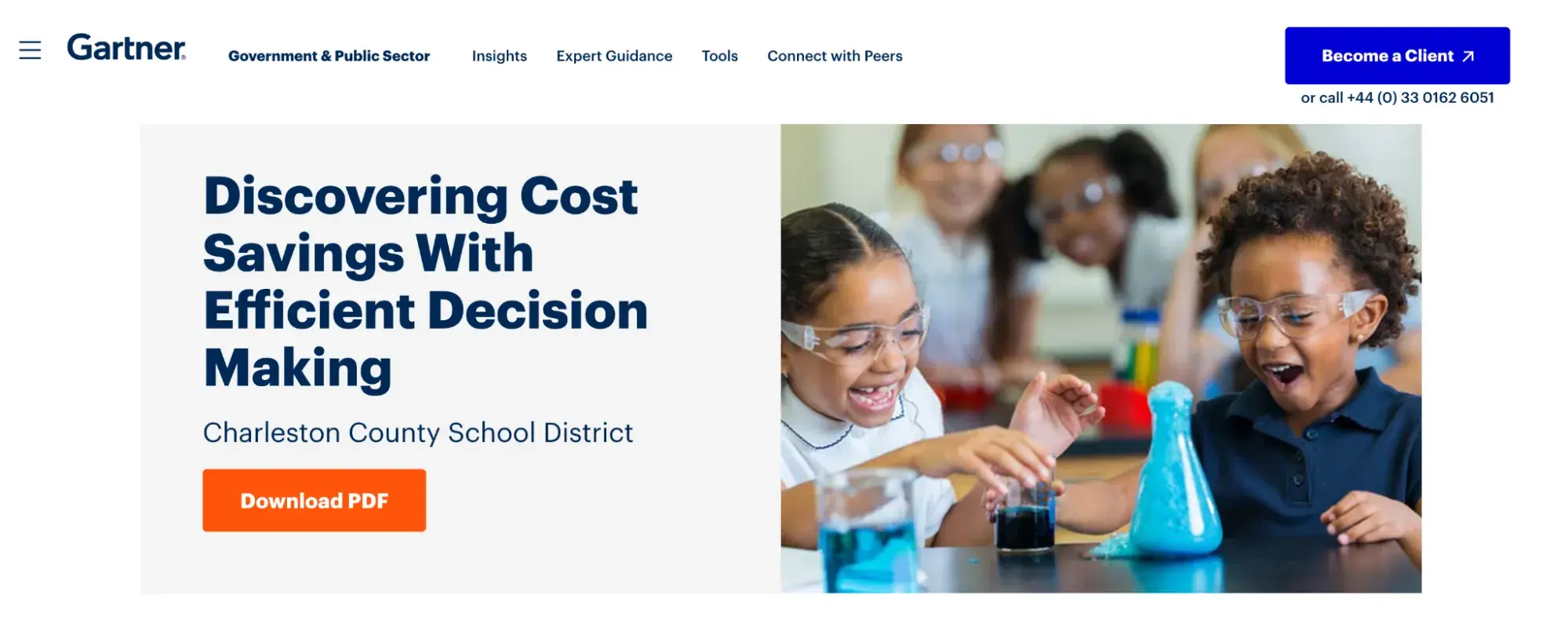
Gartner collaborated with Charleston County School District, the second largest district in South Carolina, to provide insights on how Charleston IT leaders can streamline the decision-making process and determine the optimal IT security framework for the business.
With Gartner’s help, the IT leaders were able to save time on discovering long-term cost savings initiatives. They were also able to talk about existing IP addresses and their potential to bring more budget to the district worth north of $1 million.
Takeaway
You don't always need a ton of text or a video to convey your message — sometimes, you just need a few paragraphs and bullet points, like in Gartner’s case study. Gartner does a fantastic job of quickly providing the fundamental statistics a potential customer would need to know, without boggling down their readers with dense paragraphs.
18. "Bringing an Operator to the Game," by Redapt
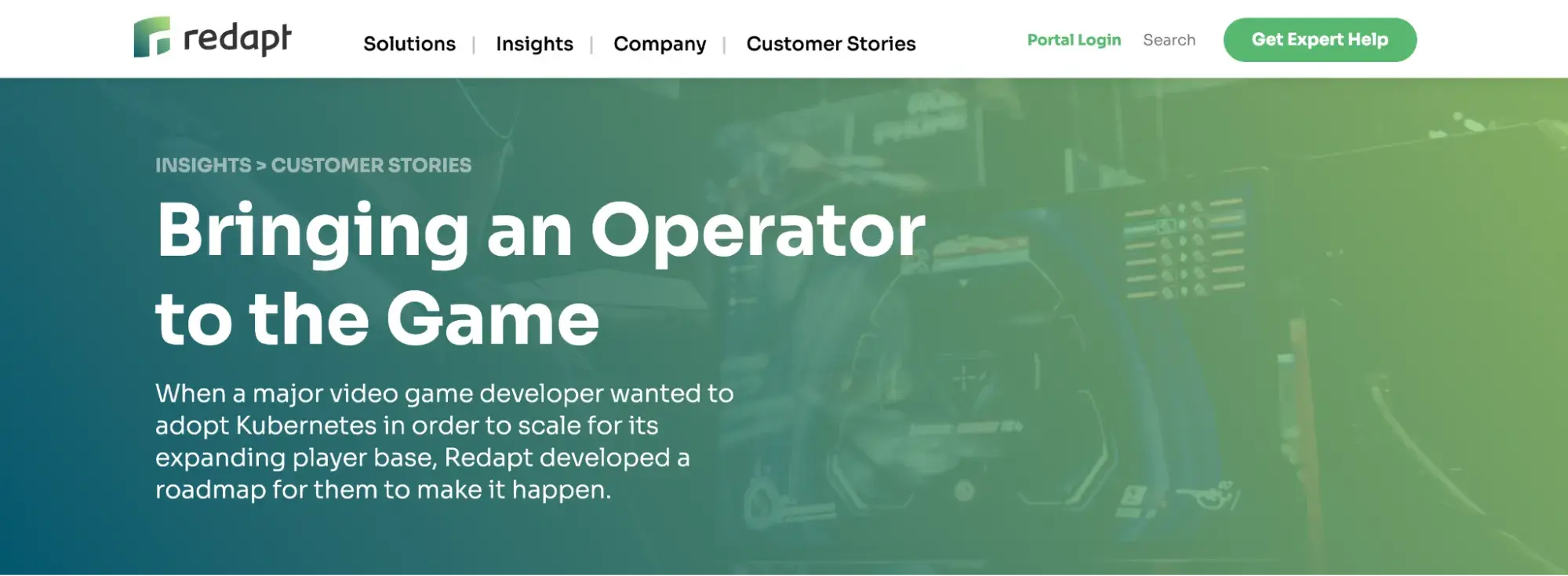
This case study example by Redapt is another great demonstration of the power of summarizing your case study’s takeaways right at the start of the study. The blurb describes in one sentence the kind of company that needed Redapt’s services, what they aimed to achieve, and how Redapt helped them achieve it.
The case study goes on to include three easy-to-scan columns: “The problem,” “The solution,” and “The outcome.” In these sections, Redapt explains that the company had online players from around the world and was trying to transition from running its apps on VMs to using a modern development environment centered around containers.
They hired Redapt, which helped them move to DevOps, containers, and Kubernetes. Because of this, the company was able to accelerate its game development process and cut costs, while reducing the need for always-available personnel.
Takeaway
Like Redapt, you can break your case study down into easily digestible sections. Also, use colored sections, like the “moment of clarity” and “end result” sections in this case study. With this addition, you can highlight the “turning points” for both you and your client when you were working toward a solution.
19. "The Soundtrack to Growth: A Spotify Marketing Case Study," by NoGood
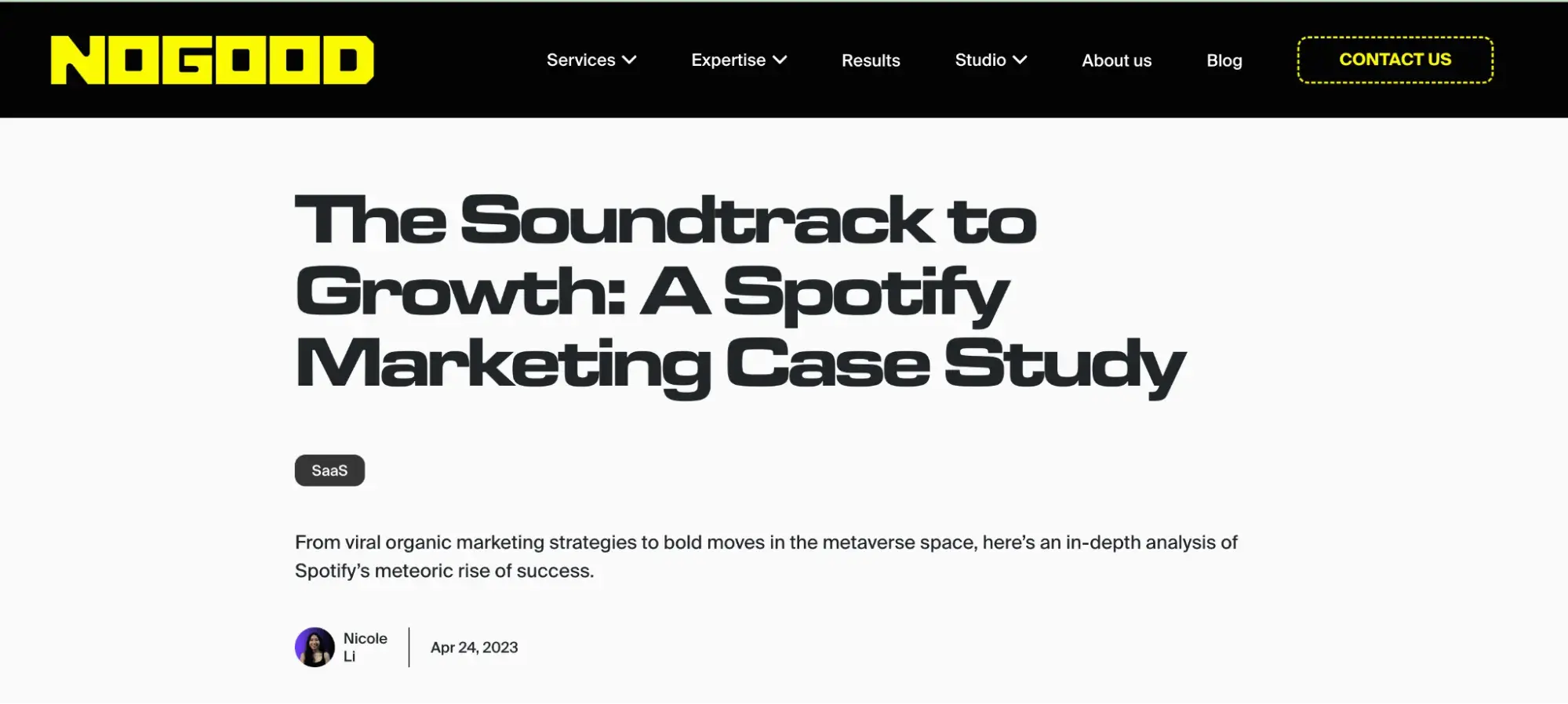
Rather than exploring how it helped a client, this case study by NoGood, a growth marketing agency, explores the marketing strategies that Spotify employed to become the global phenomenon that it is today.
This deep dive covers the three pillars of Spotify’s strategy — Personalization, Emotion, and Data — and does a good job explaining Spotify’s target audience and the company’s approach to the 4 Ps: Product, Price, Promotion, and Place.
The case study explains how Spotify uses machine learning to identify each user’s listening habits and historical behaviors. It then uses that data to predict what they might want to listen to in the future, even going as far as getting an AI DJ to curate a playlist just for them.
The case study also talks about how the company uses the data it collects from its 640 million users to run relatable and humor-filled campaigns, including the popular Spotify Wrapped, which leverages users’ emotions (memory and nostalgia, mostly) and makes them feel like part of a community.
Takeaway
Your case studies don’t always have to be about your clients, especially if you’re a service-based business. It can be about other successful businesses that fit your ideal client profile.
Doing deep dives into these businesses tells prospective clients that you’re an expert in your field. You’ll show prospects that they can trust you to come up with strategies that will work for them.
Free Case Study Templates
Showcase your company's success using these three free case study templates.
- Data-Driven Case Study Template
- Product-Specific Case Study Template
- General Case Study Template
- And more!
Download Free
All fields are required.
Digital Marketing Case Study Examples
20. “Smartling Generates $3.7M of Pipeline With Product-Led Content,” by Omniscient Digital
Omniscient Digital is a premium content marketing agency that helps software companies grow using SEO and content. In 2021, Smartling, a language translation platform, partnered with the agency to increase brand awareness and conversions.
Before that, they’d been struggling with garnering organic traffic and conversions, which was bad for business, seeing as they relied on content to reach new customers. When they lost their in-house writer and subject matter expert (SMEs), they knew they had to seek external help. After trying a few agencies with little to no results, they found Omniscient Digital.
After the initial meeting, the Omniscient team was able to pinpoint Smartling’s challenges and goals. Then, Omniscient got to work researching and interviewing SMEs to learn more about the translation management industry and Smartling’s target audience. The team also audited Smartling’s existing content using Google Analytics, Google Search Console, Ahrefs, etc.
The data they discovered helped the team build a product-led SEO strategy and content roadmap that involved creating new content, optimizing existing content, and building high-value backlinks. The intention was to capture searchers with high-conversion intent who matched Smartling’s target audience.
And it worked!
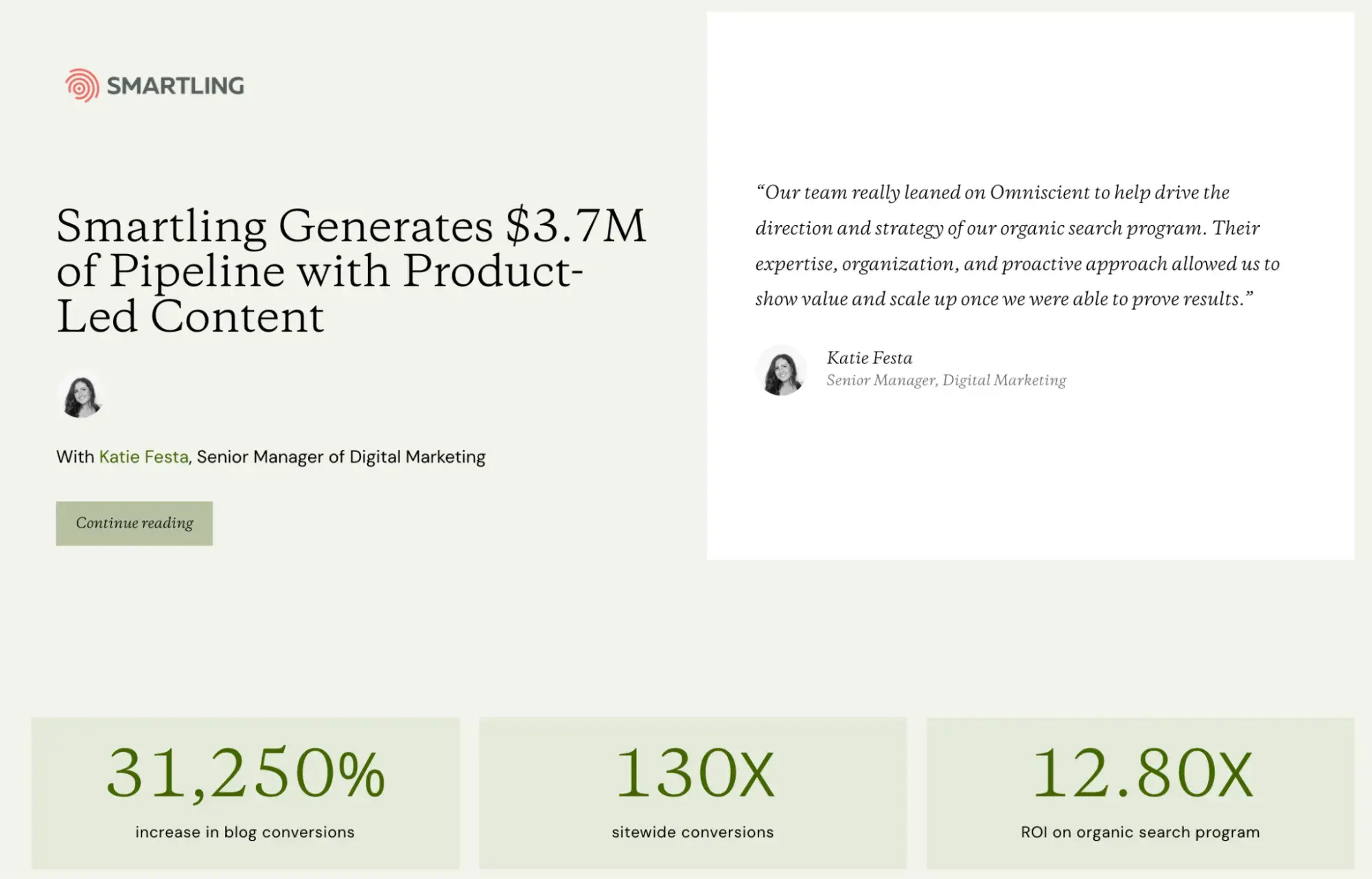
From 2022 to 2024, the Smartling blog had a 118% boost in organic blog traffic and a 31,250% increase in blog conversions. All of this amounted to $3.7 million in pipeline.
Takeaway
The title of the case study is gripping, what with the mention of $3.7 million in pipeline. Immediately, Omniscient Digital bolsters this claim by showing three metrics (increase in blog conversions, sitewide conversions, and ROI on organic search program).
This approach piques readers’ interest further, encouraging them to read on and find out just how those numbers were achieved.
21. "How Fractl Earned Links from 931 Unique Domains for Porch.com in a Single Year," by Fractl
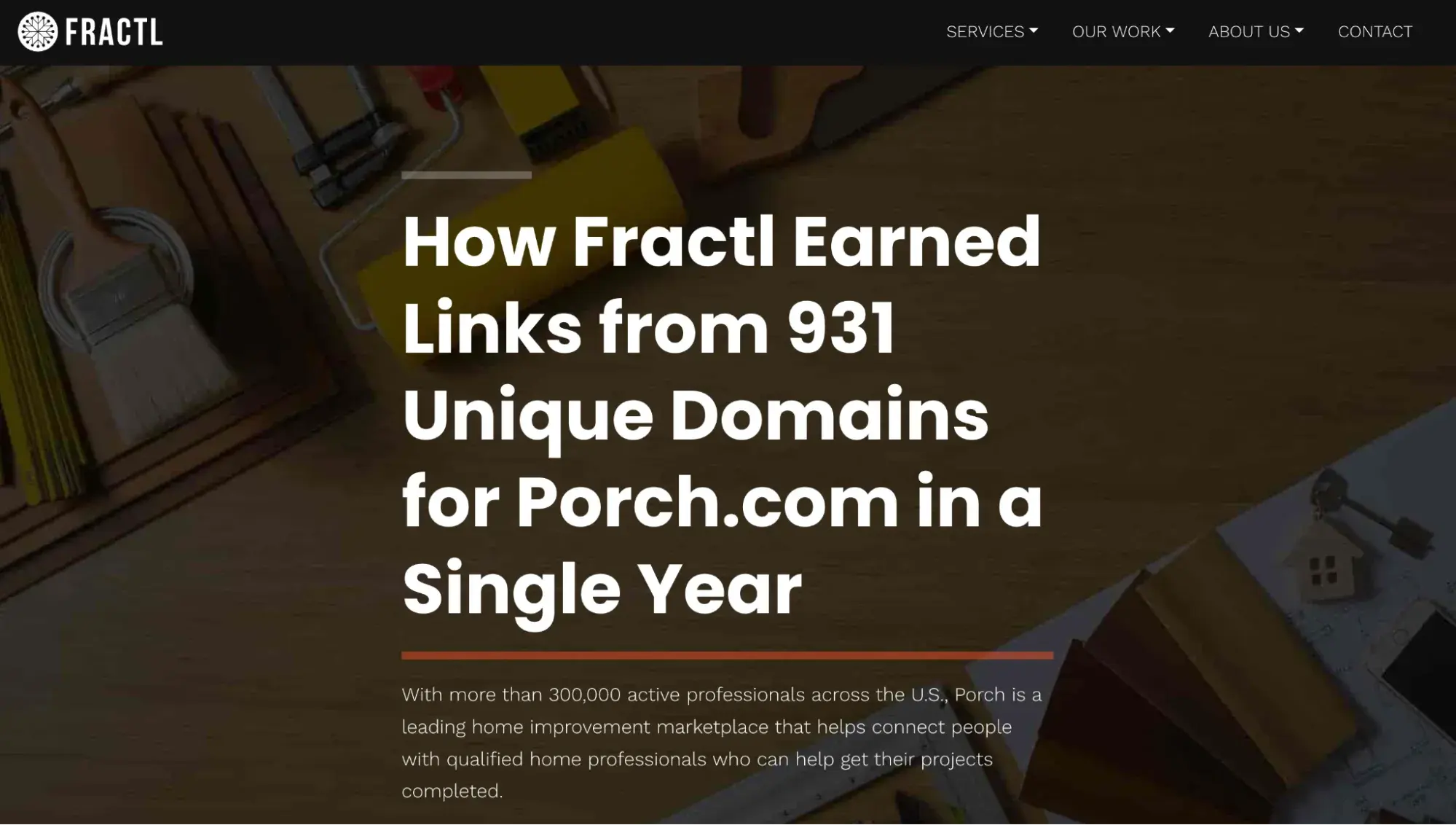
Taking the same web page approach as CTP Boston, Fractl, a digital marketing agency, showed how it helped Porch, a home improvement marketplace, earn links from 931 unique domains in one year. But that’s not all Fractl helped Porch achieve.
Just below the hero section is a rundown of metrics showing the full results of the campaign Fractl ran for Porch, including 23K+ monthly visitors added, 3,500+ press mentions, and TV coverage by Whoopi Goldberg on The View, among other feats.
Before delving into the explanation of how it achieved that, Fractl employs images to give readers a visual idea of Porch’s results, including screenshots of the analytics, logos of some companies and publications that mentioned Porch, and a map of the states that mentioned Porch.
Then, the case study explains the engagement highlights in more detail to give readers more context into these achievements, including positive responses and feedback from publishers they reached out to on Porch’s behalf.
Takeaway
Start your case study by stating the key results, like Fractl does, instead of putting the results all the way at the bottom. Let pictures speak for you by incorporating graphs, logos, and icons all throughout the case study. Also, include first-person accounts, if applicable, so readers can imagine the results they’ll get if they hire you to help them.
22. "In-Depth Performance Marketing Case Study," by Switch
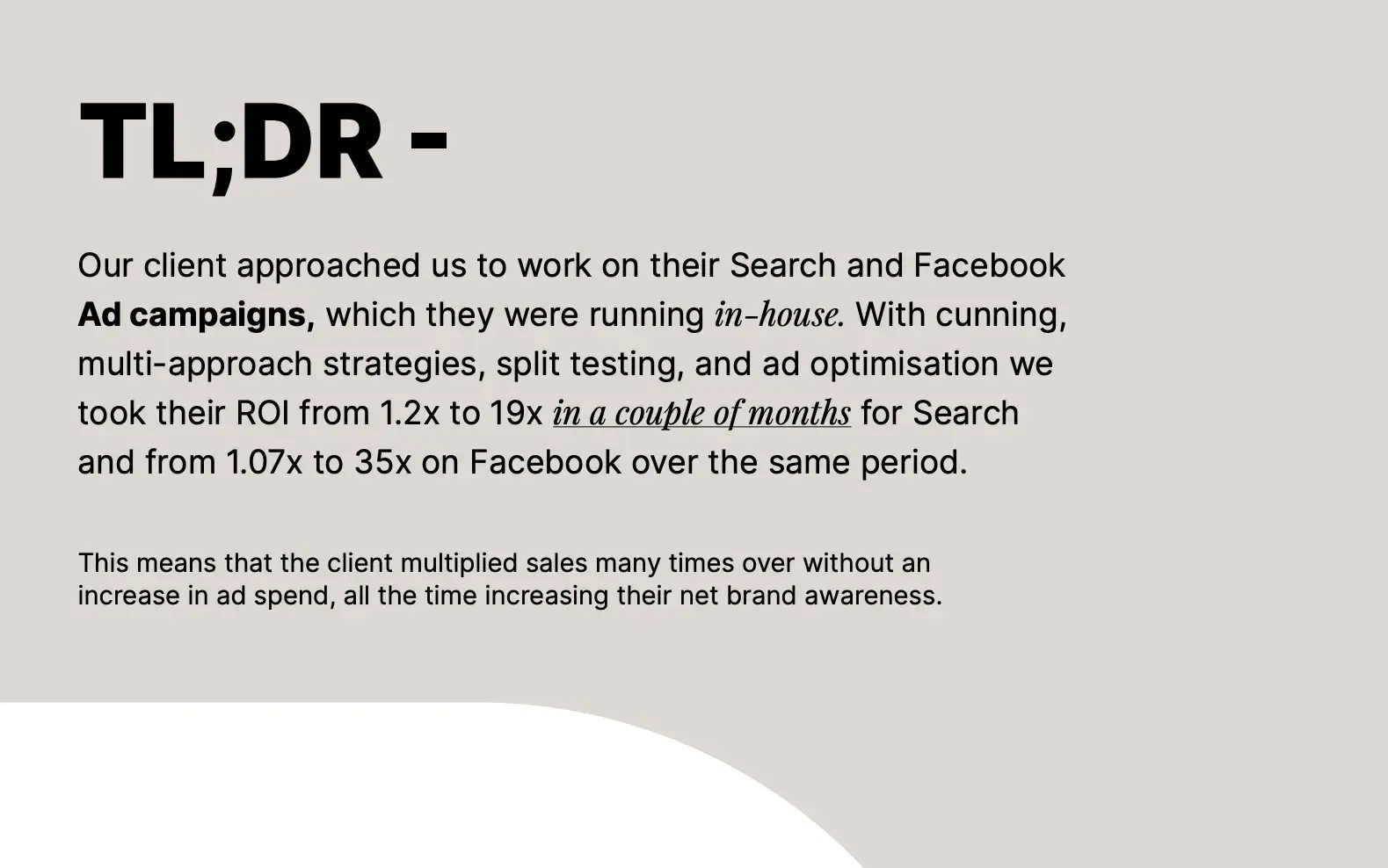
Switch is an international marketing agency based in Malta that knocks it out of the park with a case study unlike any I’ve seen. In 13 pages, Switch dives deep into how it helped its client (whose name it didn’t reveal) with their Search and Facebook Ad campaigns, which they were running in-house.
On the cover page, Switch noted that it helped this client increase ROI by 2,000% in just six weeks, positioning the case study as a “performance marketing” case study.
With clever multi-approach strategies, split testing, and ad optimization, Switch was able to raise the client’s Search ROI from 1.2x to 19x in a few months and the Facebook ROI from 1.07x to 35x in the same period.
Takeaway
Instead of the regular 1-page case study, do a deep into the results you’ve achieved for your clients. Specify the results you helped them achieve from the jump, and then explain, step by step, the approach(es) you took to help them achieve these results.
To showcase just how effective your strategies were, include industry benchmarks within your case study, like Switch does. Then, end with a call to action on how readers can get in touch with you if they need your services.
23. "Money Keywords Digital Marketing Case Study," by Cognism
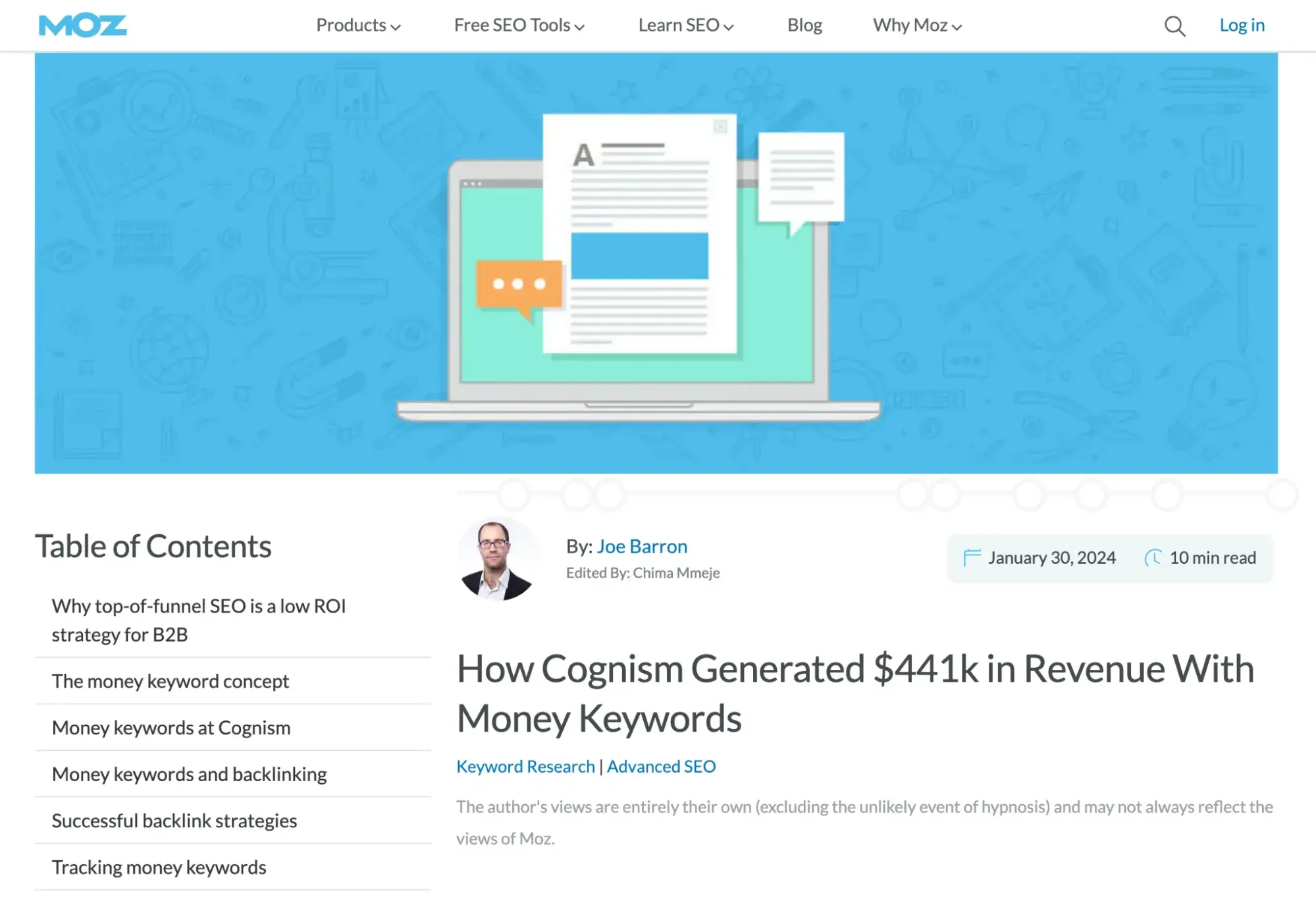
Like Switch, Cognism’s approach with this case study is in-depth. Instead of talking about a client, the writer explores Cognism itself and how its marketers use keywords such as money to help it grow.
The case study identified key issues with Cognism’s SEO that caused them to lose SERP rankings and see a decline in seasonal traffic. It introduces their unique idea of solving SEO challenges with money keywords.
These are high-intent keywords that attract ready-to-buy visitors. By introducing such ideas and spreading them, Cognism tried to improve brand awareness among its audience.
Cognism also talked about its backlink strategy, detailing how it targeted high-authority websites and tracked their progress each quarter. They used guest blogging, leveraged outreach, and created linkable content to improve SERP rankings and boost domain authority.
They also gave examples of tools like HockeyStack, which helped with data visualization and used metrics like demo requests, generated deals, and revenue as outcomes.
Takeaway
If you just implemented a successful strategy for your own website/social media/email list, make a case study about it. Talk about your process in detail and the tools you used for execution to promote your ideas in your niche and gain authority.
24. “How Persona-Focused SEO Brings Preply 25K New Visitors Every Month,” by Animalz
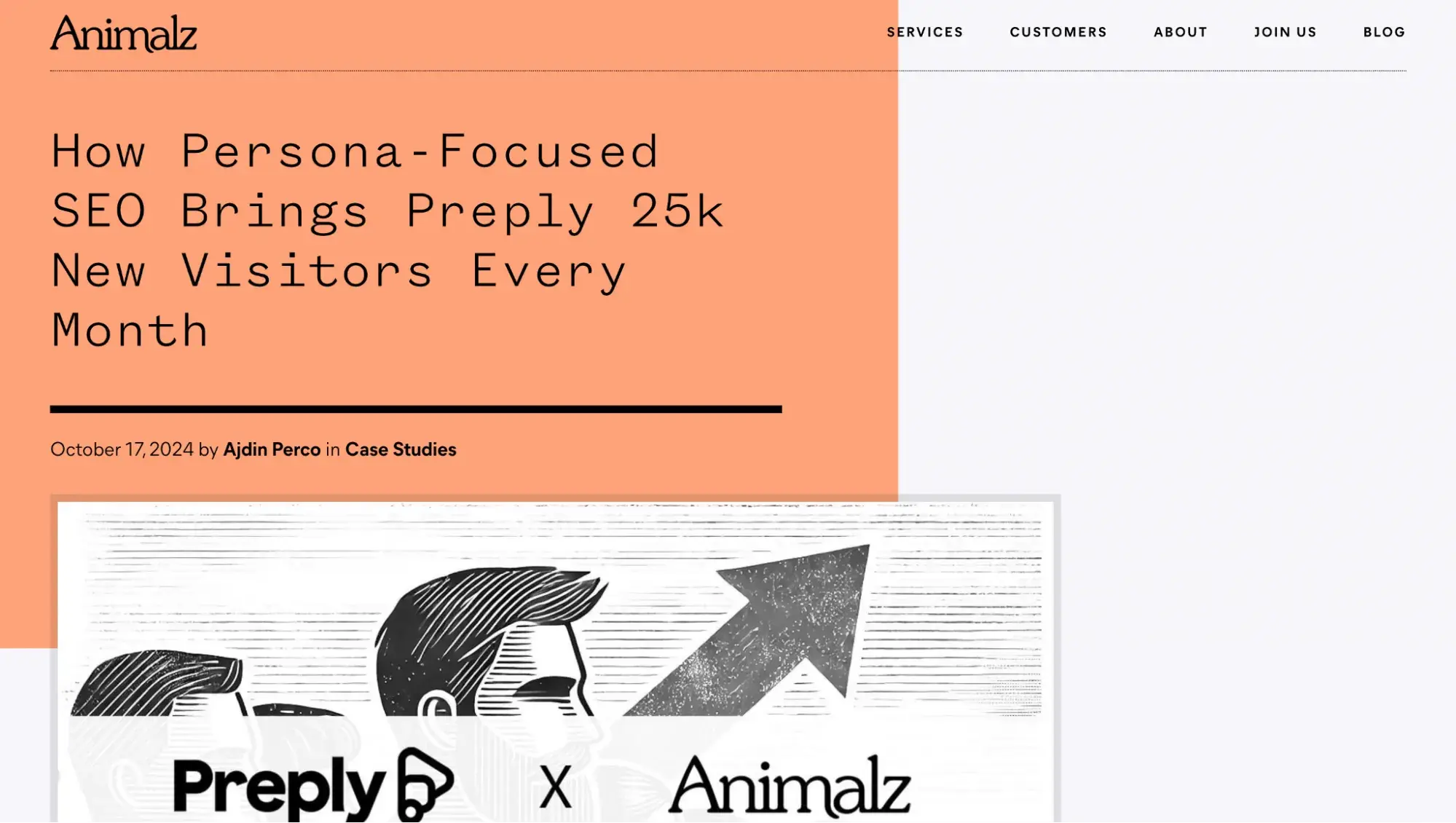
Animalz is one of the leading content marketing agencies for B2B SaaS companies, and it uses a wide range of content strategies to deal with its clients’ unique challenges. One of those clients is Preply, an online language-learning marketplace.
With over 1,000 search-optimized pages (many of which are bottom of the funnel (BOFU) content), Preply relies heavily on SEO to attract new customers.
However, after its $70 million it received in funding, the company wanted to invest in better SEO to identify more potential customers higher up the funnel. It also wanted to increase its organic traffic, which had plateaued for much of the first half of 2023.
This case study meticulously explains what Preply wanted to achieve, where they were at the moment they partnered with Animalz, the steps that the Animalz team took to build and execute a winning strategy for the company, and the results of that strategy.
Takeaway
It’s one thing to list the challenges your client was facing prior to partnering with you; it’s quite another to describe, in detail, the stage they were at the time of partnership.
In your case study, showing readers what your client was experiencing before they hired you sets the foundation for explaining the progress they made after you executed the strategy. It puts the results into perspective.
25. “Online Revenue Increased by 27% and Offline Revenue by 44%,” by The Social Shepherd
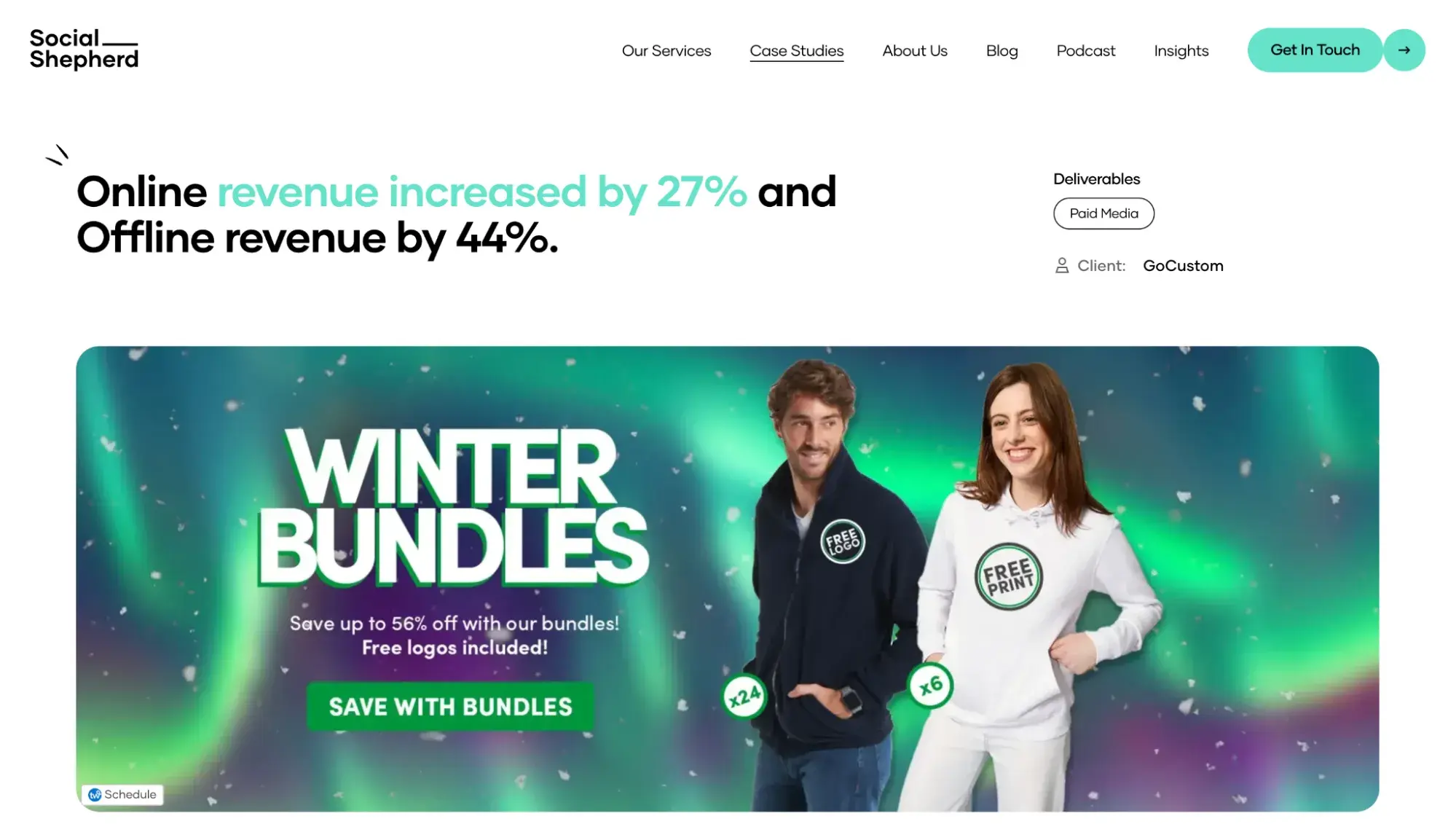
The Social Shepherd is an award-winning social first agency, and the client they discussed in this case study is GoCustom Clothing, a personalized clothing company. In this case study, The Social Shepherd gave a quick overview of what the client company does, and its goal: to grow sales through paid digital advertising, while achieving a blended target ROAS of 460%.
The next section details what The Social Shepherd did to help the client, which included analyzing past performance and then using this information to update the account’s structures.
It also strategized around both online and offline revenue generation and created an extensive range of secondary conversions to understand how the offline revenue was being generated. This helped the agency plan the investment to support the conversions and get the expected returns for GoCustom Clothing.
This approach yielded impressive results for the client: it increased both online and offline revenue by 27% and 44% respectively and achieved a blended ROAS of 474% (which was above their target of 460%). At the end, The Social Shepherd noted that GoCustom Clothing plans to increase their budget for 2024, and is working with the agency to launch a paid media campaign on LinkedIn.
Takeaway
In your case study, outline your client’s goals to present clear objectives for readers. Then, explain how you help them achieve these goals, the results, and how the client plans to further their partnership with you (if applicable).
26. “LinkedIn Advertising Case Study for Healthcare Communication Company,” by Directive Consulting
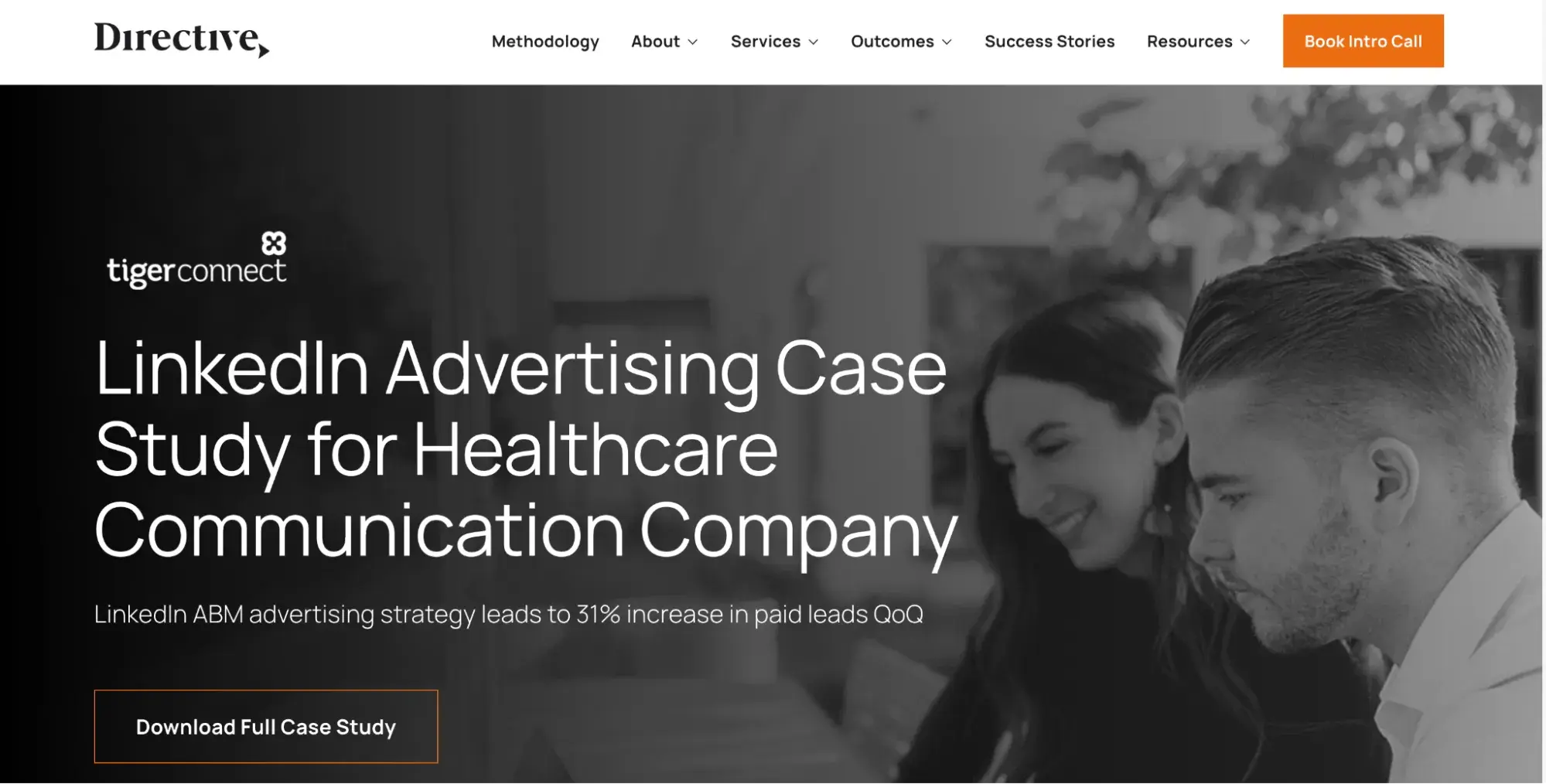
Directive Consulting’s case study for TigerConnect’s ad campaign provides a clear narrative of the latter’s challenge, strategy, and results. The case study begins with a brief overview of what TigerConnect does and how it helps doctors, nurses, patients, and care teams communicate with one another.
Then, it boldly shows the results it got for the company: 31% increase in paid leads QoQ, 111% increase in overall visits from LinkedIn QoQ, and 71% decrease in cost-per-acquisition QoQ. Directive Consulting achieved these results by helping TigerConnect nail its targeting for paid adverts.
Since TigerConnect serves a very specific vertical of healthcare professionals, the targeting pool for paid ads is really narrow, and sometimes, they don’t target the right keywords, which causes them to lose money.
So, they enlisted Directive Consulting’s help, and the agency decided to use LinkedIn to target prospective clients at the top of the funnel and guide them down the funnel toward conversion.
This strategy was very successful, as it helped TigerConnect solidify a top-of-funnel paid strategy and hit their quarterly goals.
Takeaway
Give relevant context in the client overview section, so readers have essential background information on the client. Then, offer a step-by-step breakdown of your strategy, including initial actions and subsequent adjustments. This helps readers understand the reasoning behind each decision.
27. “Siege Media’s Digital PR Helped Vena Solutions Win 300+ High-Authority Links,” By Siege Media
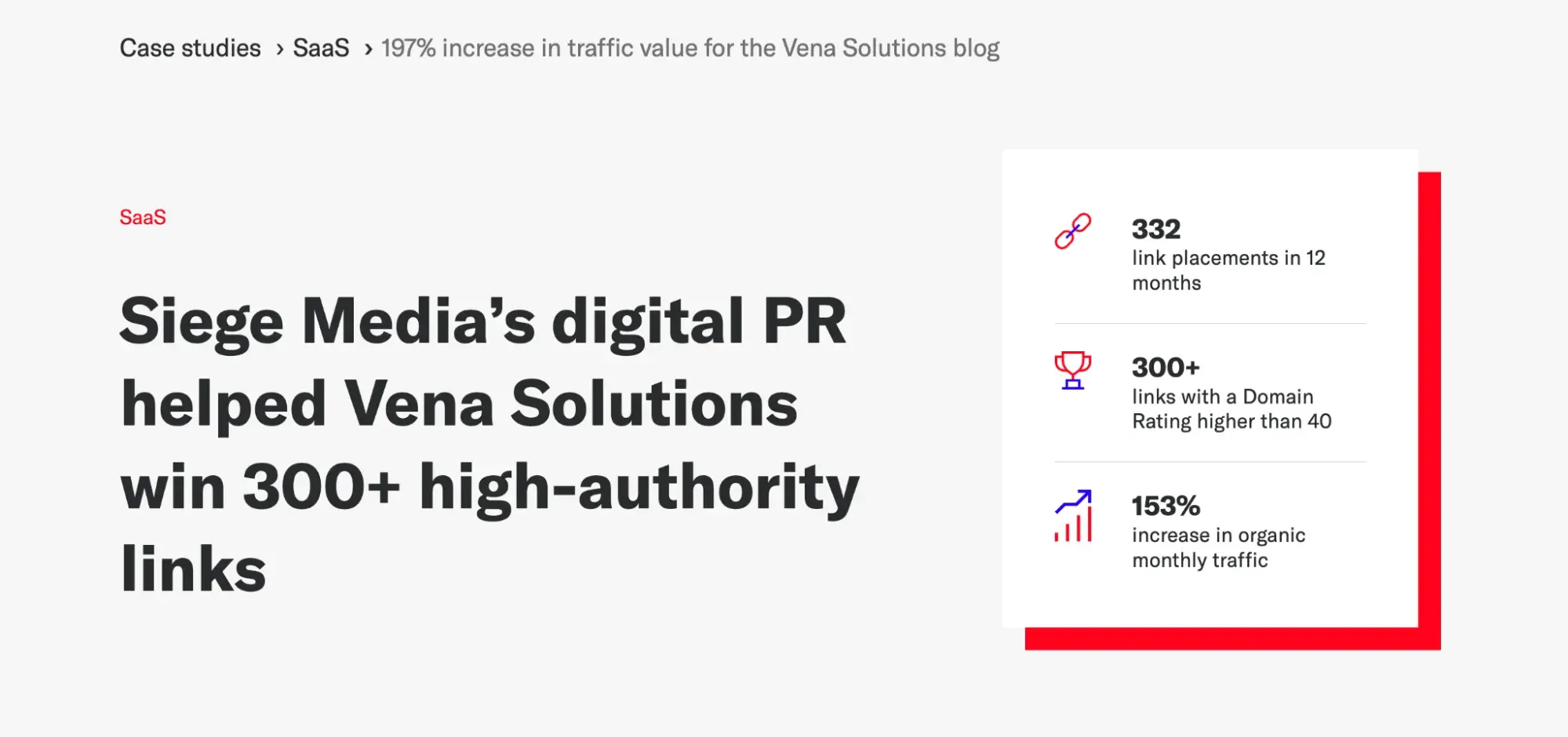
Siege Media’s case study for Vena Solutions illustrates how the former helped the latter get over 300 high-quality backlinks.
At the time, Vena Solutions, a platform that helps financial planning and analysis (FP&A) teams use Microsoft Excel to its fullest potential, needed a content marketing agency to create blog posts that would rank and bring in high-authority links from reputable news sources.
So, they hired Siege Media, a top marketing agency, that got to work creating shareable top-of-the-funnel (TOFU) content, including statistic-centric posts that encouraged others to link back to Vena as an authority in the FP&A industry. In about a year, the Vena Solutions blog saw a 197% increase in organic traffic value and 216% more links across multiple blog posts.
Takeaway
Let the visuals speak by including examples of the actual work you did for your client and graphs showing the results. This is especially useful if you’re a branding and/or marketing agency.
Start Creating Your Case Study Today
After researching and writing this piece, I realized there are countless ways to structure a case study — everything from a quick-read blog post or a traditional web page format, to long-form PDF reports and even a compilation of graphs showing results and news logos showcasing media mentions.
Sometimes, it’s most effective to write from your company’s perspective, but other times, telling the story from the client’s viewpoint brings a more personal touch. I learned that you can even mix things up with a few bullet points supported by a video interview featuring leaders from the client company.
I think you should pick whatever format helps you best highlight the results you achieved for your client. But if you’re not sure which structure to choose, feel free to download these free case study templates and start experimenting!
Editor's note: This post was originally published in August 2018 and has been updated for comprehensiveness.
Free Case Study Templates
Showcase your company's success using these three free case study templates.
- Data-Driven Case Study Template
- Product-Specific Case Study Template
- General Case Study Template
- And more!
Download Free
All fields are required.
Marketing Case Studies



![How to Turn a Case Study into a Customer Success Story [+ Tips from HubSpot Marketers]](https://53.fs1.hubspotusercontent-na1.net/hubfs/53/customer-success-story.jpg)