
This is the first of three articles that share findings from The State of Inbound Lead Generation , a new HubSpot report based on statistical analysis of 1,400 customers' inbound marketing activities. The study identifies lead generation best practices based on results from these companies. The report and this article were written by Sophie L. Schmitt.
Increasing Google Indexed Pages by 50-100 Causes Double-Digit Lead Growth
Our analysis of over 1,400 firms shows a clear positive relationship between pages indexed by Google and the leads a company generates; companies with more indexed pages tend to generate more leads.
To represent the relationship between Google indexed pages and leads, we divided customers evenly into five categories based on number of Google indexed pages. For each of these categories, we graphed the median number of monthly leads. We used median instead of average to lessen the impact of outliers.
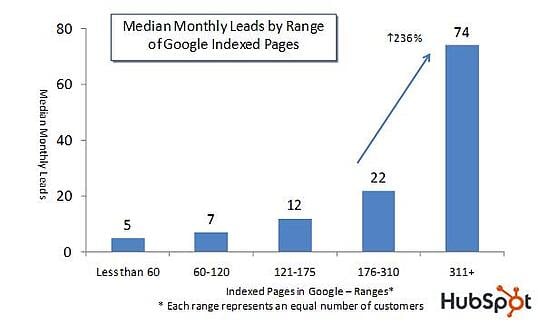
The graph above shows the strong positive correlation between the number of Google indexed pages and median leads. More specifically, it reveals that an incremental 50 to 100 indexed pages can cause double-digit lead growth up until customers reach several hundred Google indexed pages. Customers with more than a few hundred indexed pages appear to be in a league of their own as median leads are more than 2x that of the prior category.
Is Company Size a Factor for Growing Indexed Pages?
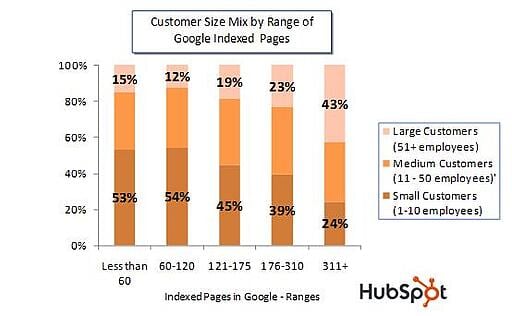
It might be reasonable to think that only larger firms have sufficient resources to create hundreds of pages that make it into Google's database. To test this, we calculated customer size mix for each category of indexed pages. Our proxy for customer size is number of employees.
What we found is that size is not a critical factor for achieving significant volumes of Google indexed pages. Size and number of pages are mildly positively correlated, mostly in the extreme categories of Google indexed pages. While HubSpot's large customers formed the biggest group with 311+ indexed pages in Google, small and medium-sized customers together outnumbered large ones in this category. In addition, small customers formed the largest group with 176 to 310 Google indexed pages.
Marketing Takeaways
Marketers are likely to ask: What are techniques for growing the number of Google indexed pages on my site?
- Build page volume: consider starting a blog to quickly increase number of pages
- Improve each page's optimization as per Google's methodology to maximize chances of having all of your web pages included in the index:
- On-Page Search Engine Optimization: placing keywords in the right places on web pages such that Google and other search engines know what each page of your web site is about, and what keywords to rank you for
- Off-Page Search Engine Optimization: building inbound links from reputable sites, thus demonstrating your popularity to search engines
It is interesting to note that the number of inbound links did not have a meaningful relationship with leads. Inbound links did correlate well, however, with unique visitors. This implies that for those interested in generating leads, quality of sites vs. quantity is more important when building inbound links.
Want to read more? Download the full State of Inbound Lead Generation report .
Live Webinar: The State of Inbound Marketing Lead Generation
|

|
Learn how companies are using inbound marketing techniques to generate higher volume and lower cost leads and customers. Date and time: Wednesday, April 7, 2010 at 1:00pm EDT |
Measuring SEO