
Twitter, on the other hand, is used to share ideas, real-time information, and trending news. While people may also use Twitter to connect with friends and family, they largely use it for a bigger purpose — to connect to the wider world and discover what's happening (in 140 characters or less).
Instagram is used to share photos and videos. People mainly use this app to post their "highlight reel" and follow friends as well as influencers. This is how users become a part of a social media community.
Of course, this still begs the question — where does your business fit into all this? To explore the pros and cons of Twitter, Facebook, and Instagram, we've created a comprehensive breakdown of the three platforms.
Keep reading to figure out which platform is a better business investment for your company.

Twitter vs. Facebook
Twitter is primarily meant for sharing informational and succicnt snippets while Facebook is meant for connecting with members of your personal network and sharing more in-depth content..
And what about Instagram?
Twitter vs. Instagram
While Twitter is used for sharing ideas and catching up with news and trends around the world, Instagram is meant for sharing your best photos and videos with your followers, as well as interacting and engaging with influencers.
Twitter vs. Facebook vs. Instagram Users
Let's start by taking a look at Twitter versus Facebook versus Instagram users.
Twitter vs. Facebook vs. Instagram Demographics
To start, let's consider the potential demographic your business could reach on each platform.
Here are some quick and informative facts:
Twitter Demographic Facts:
- 24% of U.S. adults are on Twitter.
- 40% of Twitter users are between the ages of 18-29.
- Less than 20% of people ages 50 and up use Twitter.
Facebook Demographic Facts:
- 70% of U.S. adults are on Facebook.
- 80% of Facebook users are between the ages of 18-29.
- 65% of people ages 50 and up use Facebook.
Instagram Demographic Facts:
- 37% of U.S. adults are on Instagram .
- 75% of Instagram users are 18-24.
Twitter vs. Facebook vs. Instagram Engagement
It's equally critical you determine quality over quantity — how long does each site's audience stay on the platform? Or, alternatively, how many minutes per day do they spend on each?
Twitter Engagement Facts:
- As of Q1 2019, Twitter averaged 330 million monthly active users.
- About 71% of Twitter users say they use the platform to get news.
- You have no choice but to engage users with quickly digestible content since the platform has a 140-character limit.
Facebook Engagement Facts:
- Facebook is the biggest social network worldwide.
- As of Q1 of 2021, Facebook reported nearly 1.88 billion daily active users.
- In the U.S., Facebook accounts for over 60% of monthly social media visits.
Instagram Engagement Facts:
- 59% of Instagram users visit the app daily.
- Accounts with 1,000-5,000 followers typically have a 5.6% engagement rate. On the other hand, accounts with over 1 million followers, average a 1.97% engagement rate.
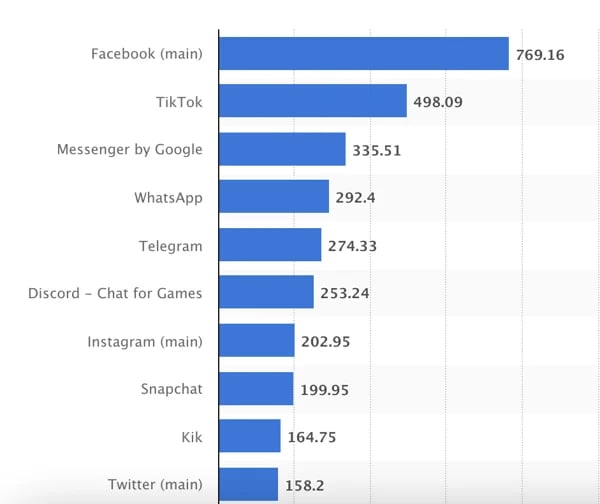
With all of the above stats in mind, no matter how many followers you have, if you can appeal to your audience with the right content, you'll likely have the best engagement rates on Facebook. Here's some research by Statista to prove it. This is a look at the most popular mobile social networking apps in the U.S., as of September 2019, by user engagement (in minutes/ month). Facebook wins by a substantial amount.
Twitter vs. Facebook vs. Instagram Usage
Here are some points to consider while choosing the right platform for your business to use:
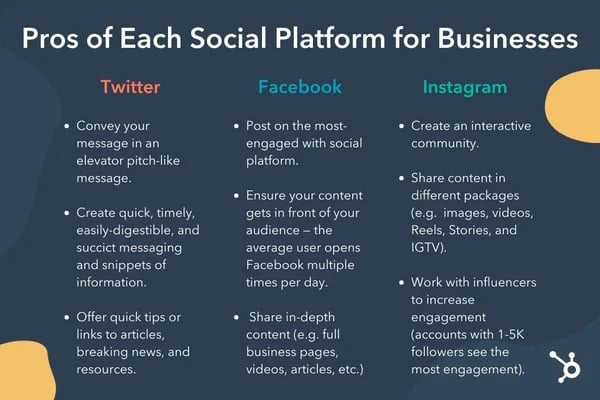
- With less than 140 characters to convey your brand's message, you might think of Twitter as your business' "elevator pitch". What do you want to get across to your audience quickly and succinctly?
- Facebook is your opportunity to engage more in-depth with an audience. You can create full business pages, share videos, and images, and further incentivize prospects to engage with your brand (by offering 10% off if they "like" your business page, for instance).
- With Instagram, you can create an interactive community. This is the platform where users are more likely to engage. People go to Instagram and expect to see influencers and follow brands they like.
Twitter Ads vs Facebook vs Instagram Ads
In general, advertising on Facebook and Instagram allows you to reach a larger audience. Since Instagram is owned by Facebook, they offer similar ad tools. Additionally, Facebook ads come with some impressive targeting tools, so you're able to narrow down salary, purchase behavior, hobbies, Facebook communities, and more.
Facebook advertising's interface is relatively easy and intuitive for the user. Facebook ads can be relatively cheap, as well — in fact, Facebook points out that, "Some people spend more on coffee each day than they do on their ad campaigns". While it depends on the campaign you're running, you can often set a budget as little as $2 to $3 per day.
Twitter also offers targeting capabilities, including purchase behavior, language, interest, and followers. However, Twitter advertising is typically more expensive than Facebook.
It may be worth the extra money, though — engagement rates for Twitter ads can be as high as 1-3%, much higher than Facebook’s average CTR of 0.119%.
Twitter vs. Facebook vs. Instagram for Business
Ultimately, it's likely best to try Twitter, Facebook, and Instagram for a while if you're unsure which one works better for your brand. Over time, you'll gain valuable insights into how well your posts perform on these sites, enabling you to dedicate more time to one over the other. Since they're free to use, there's no harm in initially trying all three.
Editor's note: This post was originally published in February 2019 and has been updated for comprehensiveness.

Social Media Strategy
![The most effective types of content on social media in 2025 [new data]](https://53.fs1.hubspotusercontent-na1.net/hubfs/53/Copy%20of%20Featured%20Image%20Template%20Backgrounds%20(16).png)


-1.jpg)
.png)
![How to Create a Great Social Media Strategy in 2025 [+ New Data]](https://53.fs1.hubspotusercontent-na1.net/hubfs/53/social-media-strategy.webp)