Inbound Internet Marketing Blog

SEO, Blogging, Social Media, Landing Pages, Lead Generation and Analytics

SUBSCRIBE

The HubSpot Inbound Internet Marketing blog covers all of inbound marketing - SEO, blogging, social media, lead generation, email marketing, lead nurturing & management, and analytics. Join 57,702 others and subscribe now!

Subscribe to RSS feed Add us on Facebook! Follow us on Twitter

Get Free Marketing Info!

Get the world's best marketing resources right to your inbox! Join more than 817,000 inbound marketers!

Subscribe by email

Your email:

HubSpot's Inbound Internet Marketing Blog

Current Articles | RSS Feed RSS Feed

3 Strategies to Run an Effective Google AdWords Campaign


.

Paid search is a complement to organic search, not a replacement.

At HubSpot, we always stress the importance of creating valuable content to strengthen presence on search engines and generate high-quality website traffic. The importance of organic search, however, does not imply that paid search is entirely valueless. Paid search may target audiences different from those drawn from organic search and thus maximize your reach to potential customers. In addition, paid search can serve as testing stone for keywords to optimize for organic search. If your website is new to search engine optimization and you don’t know which keywords will draw higher conversion rates, you can quickly test the popularity of different keyword phrases using Google AdWords campaign and later specialize in more popular ones for organic search.

Google AdWords

Paid search can be expensive, but with careful design, you can maximize the effectiveness of your Google AdWords campaign. Integrating expert insights from the Service Marketplace providers, here are 3 strategies to increase conversion rates from your paid search advertisements:

1. Consistent keyword focus both lowers cost and increases quality site traffic.

When the keywords you stress in a Google AdWords closely match the content on the subsequent landing page, Google will view your site as providing quality search result and assign your website a higher Quality Score. As a website that makes money from optimizing high-quality, relevant content, Google is incentivized to award quality search results, which it does by charging you less money. Another major advantage of focusing on the same sets of keywords on Ad copy and a landing page is that it tends to generate quality website traffic—for the same reason. Prospects interested in the keywords you bid for will likely stay engaged if they find similar content on the landing page and have a higher likelihood to convert to leads.
PPC

2. Change default settings because what Google perceives as a successful ad does not necessarily match your business objectives.

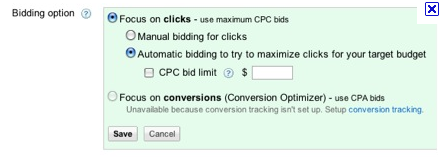
For your convenience, Google sets default for many fields. Default settings, however, don’t necessarily work best for your business objectives. For example, geographical area is set to United States and Canada, automatic bidding is on, ad rotation (which allows you to alter the frequency of showing different ad campaigns) is set to “show better performing ad more often.” If you target only customers from specific geographic areas, covering the entire United States is a waste of money. Even if you intend to attract customers from all over the world, it is still a good idea to test in which states your ad generates the higher lead conversion rate and thus performs most cost-effectively.

The latter two—automatic bidding and ad rotation—are how Google makes extra money to your detriment. Automatic bidding saves you some work, but the price of convenience is your loss of knowledge of how your bidding price changes. The algorithm Google uses is behind the screen, and you can be spending more money than you need to achieve the same results. Another thing to keep in mind is that Google’s definition of a successful ad can be different from yours. Better performance means more clicks to Google, while your standard might be higher conversion rate.  If you set ad automation to “show better performing ad more often,” it’s possible that you eliminate a campaign that generates 5 clicks with a 100% conversion rate in exchange for one that generates 100 clicks that generate only 2 leads. Know your objectives and stay in control. The screenshot below shows what NOT to do.
Automatic Bidding resized 600

3. Test your ad from multiple dimensions to find the combination that maximizes its effectiveness.

As mentioned, paid search can become a heavy ongoing expense. Maximizing the return of each dollar you spend is therefore a smart way to reduce marketing cost. One of the strengths of Google Ads Dashboard is that you can create multiple ad campaigns in a matter of seconds. Using different campaigns, you can test the exact same keyword phrases targeted at different locations to determine which areas are your products or services “hotter”; alternatively, you can try different keyword phrases in the same regions.

Time of the day and day of the week may also matter to your ad’s success. Some people set a time range on when the ad can be displayed, but that invariably leaves the rest of the day or the week out of your experiment, and you will never get to know if your ad might achieve better results with these untested time ranges. As a result, we encourage you to let your ad run uninterrupted during the experimental stage and then target criteria that yield high lead conversion rate or other business goals.

What other suggestions do you have for kick-starting your Google Adwords campaign?

Photo: The Budget Fashionista

Video: How to Get Off the Google AdWords PPC Crack

Learn how to break your Google AdWords addiction!

Download the free video to learn how to use inbound marketing to generate leads and break your dependence on programs with recurring expenses.

Posted by Lily Zhu on Tue, Jul 27, 2010 @ 07:00 AM

COMMENTS

Great tips, Lily. 
 
In talking about strategy #1, I'd also add: (a) whenever possible, have a dedicated landing page for each paid search campaign, and (b) never underestimate the importance of building extensive lists of negative keywords

posted on Tuesday, July 27, 2010 at 7:54 AM by Geno Prussakov


When I was researching keywords and keyword phrases for my new website, I was shocked to learn my niche didn't really exist. It probably set me back a year as I kept thinking I was missing something. James Chartrand from Men with Pens finally just told me to start the blog and not worry about the keywords. I finally just decided to start my own niche and now I am excited about it. 
 
It is exhausting to keep up with trying to out-think Google. I've decided to just write and am hoping my keywords will rise to the top--sort of the rationale for "Grounded Theory" in qualitative research. Just write quality content and track what pulls your audience, the keywords will emerge. Not sure if it will work, but at least it broke my keyword paralysis.

posted on Tuesday, July 27, 2010 at 8:07 AM by Mary E. Ulrich


@Geno: great additional tips. I definitely agree with (a); what do you mean by negative keywords? 
 
Thanks,Lily

posted on Tuesday, July 27, 2010 at 9:05 AM by Lily Zhu


@Mary: generating quality content definitely helps with keyword optimization and your website's search ranking for those keyword phrases. I'm not sure how using Google AdWords exacerbates or contributes to your keyword paralysis. It is true that we don't know what algorithm Google uses to rank our sites, but if identify a few phrases as keywords and use them extensively (in useful context) our site rankings will likely rise. Google AdWords may, in fact, serve as a temporary remedy to keyword paralysis - because we are not found on organic search for the words we want to be identified with, we buy those keywords and "force rank" ourselves on the 1st page of Google search (where most ads are). It may also serve as reality check for your keyword niche - whether the keywords you think are important carry the same value in prospects' eyes (in terms of their engaging with you by clicking on those keywords). 
 
Hope that helps,Lily

posted on Tuesday, July 27, 2010 at 9:11 AM by Lily Zhu


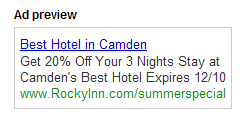
In the text ad above, the ad would generate even better click through rates if the website had been named besthotelincamden.com, losing the www in front. For some reason, repeating the message 3 times gets a higher click through rate.  
Another idea is if you're not ranking for your desired keywords, add a few more words to make it more focused. For example, if you're trying to rank for email marketing, there are 235M results, which will take you forever to rank for. But if you narrow your search down to email marketing for small business phoenix, it narrows down the search results to 338K, MUCH easier to rank for!

posted on Tuesday, July 27, 2010 at 9:30 AM by Joseph


@Joseph:Thanks for sharing your knowledge. The first tip I've not heard of - you may be right. I totally agree with your second suggestion - we at HubSpot call specific keyword phrases "long-tail keywords," which target a smaller niche market instead of highly competitive keywords.  


Thanks,Lily

posted on Tuesday, July 27, 2010 at 9:47 AM by Lily Zhu


Another aspect worth noting is position preference. Just like organic search results, the closer your ad is to the top the more likely it will be seen and clicked on. If you're in a highly competitive market it is generally worth more in the short term to bid higher for the top spots so that your CTR doesn't suffer. You'll be rewarded for it later in reduced pricing and positioning with a higher Quality Score. 
 
It's great that you pointed out that paid search can be used to target different audiences that organic doesn't.  
 
Great post!

posted on Tuesday, July 27, 2010 at 1:43 PM by Billy MacDonald


@Billy: thanks for your suggestion! While I agree that the closer to the top an ad campaign is the more clicks it gets, the ad that ranks no.1 might be several times as costly as no.3 or no.4, which might not necessarily receive less impressions because ads are considerably shorter than organic search display and people can skim through several ads at one time.  
 
Thanks for your encouragement,Lily

posted on Tuesday, July 27, 2010 at 1:47 PM by Lily Zhu


Lily,  
 
Great info - I particularly like your assessment of more clicks not synonymous with success — it truly has to do with the sales.  
 
Your tip on the default settings is also good info.  
 
The only tip I might add is that any PPC campaign has to be monitored on an ongoing basis regardless of what the settings are.  
 
I look forward to more of your articles! 
 
Jody

posted on Tuesday, July 27, 2010 at 3:32 PM by Jody Raines


@Jody: thanks, Jody! I agree with you--we at HubSpot preach perseverance and consistency in every aspect of inbound marketing implementation. 
 
Best,Lily

posted on Tuesday, July 27, 2010 at 3:37 PM by Lily Zhu


We must think of quality keywords we will be using and make sure that those words are related to the content we have. Being reliable and trustworthy is one great way to build and promote a business on the internet.

posted on Wednesday, July 28, 2010 at 12:43 AM by Web Self Service


@Web Self Service: wholeheartedly agreed. 
Thanks for your contribution, Lily 

posted on Wednesday, July 28, 2010 at 6:38 AM by Lily Zhu


My doubt is we can do anything with SEO instead of SEM Marketing? But i read one article that dude is saying that internet marketer can do anything... see the article link below.. 
 
http://www.goarticles.com/cgi-bin/showa.cgi?C=3138182

posted on Wednesday, July 28, 2010 at 8:58 AM by Venkatesh


@Venkatesh: how does SEO differ from SEM Marketing (which I take to mean search engine marketing)? Regarding your observation, I would say that search engine optimization is only one piece (albeit an important one) of online marketing success. Content creation (through blogging) and promotion (on social media sites) are equally important. Inbound marketing, in turn, is one of the many methods of marketing. We at HubSpot are not denying that traditional marketing channels such as TV advertisement have absolutely no merits. We are saying that inbound marketing is one of the most cost-effective method (in the context of an information age coupled by the boom of the Internet), which empowers small- to medium-sized businesses to compete with the big guys. 
 
Hope that helps,Lily

posted on Wednesday, July 28, 2010 at 9:04 AM by Lily Zhu


Venkatesh, I want to give you an example of what can be done with free SEO. I have been studying SEO for a while now and one thing that appeals to me is that I can rank for desired keywords just by using proper wording in my title, description and article. For example, I was trying to rank for "video email marketing for real estate". I learned and applied the rules that I knew would help me get high rankings, and what do you know? I ended up on the first page of Google results! In my area, I actually had the top 3 spots! Not bad when you consider that I paid zero in advertising costs. Studying SEO is worth it, my friend.

posted on Wednesday, July 28, 2010 at 9:26 AM by Joseph


@Joseph & Venkatesh: I agree that long-tail keyword phrases are good for boosting organic search ranking. Organic search should definitely be the focus of SEO marketing, and this article mainly focuses on how you can best leverage paid search (not on praising paid search as a long-term strategy. It should not be). 
 
You can always check out HubSpot resources on SEO. 
 
Hope that helps,Lily

posted on Wednesday, July 28, 2010 at 9:29 AM by Lily Zhu


Comments have been closed for this article.