

Whether you’re crafting a new content campaign, launching a YouTube series, or revamping your social strategy, leadership will inevitably ask: “How will this impact our company’s bottom line?”
Answering this question isn’t always straightforward. That’s why I always make sure to identify my key performance indicators (KPIs) before seeking executive buy-in. KPIs not only help me measure success but also provide the concrete evidence needed to gain leadership’s support and turn ideas into reality.

And you likely know how quickly the marketing landscape is changing — 56% of marketing leaders agree it has changed more in the past three years than in the past fifty. So, it’s clear to me that the bar for securing buy-in has risen.
Leadership wants concrete evidence of impact, often backed by AI-powered insights, customer understanding, and proven ROI.
To get a clearer picture, I spoke with marketing leaders to gather their top tips for receiving buy-in and to uncover which KPIs matter most to them in 2025.
Table of Contents
The Marketing Leader's Field Guide
This comprehensive guide reveals how to leverage AI, personalization, and emerging trends to drive measurable results in 2025 and beyond.
- AI Adoption in Marketing Success
- Personalization in Marketing
- Navigating Privacy-First Data Collection
- Expert Insights for Future Growth
Download Free
All fields are required.
What is executive buy-in?
Executive buy-in is more than just getting a nod of approval from leadership — it’s about earning their active support for your idea or campaign. When leaders buy into your plan, they become champions for it, help secure necessary resources, and remove organizational obstacles that might impede success.
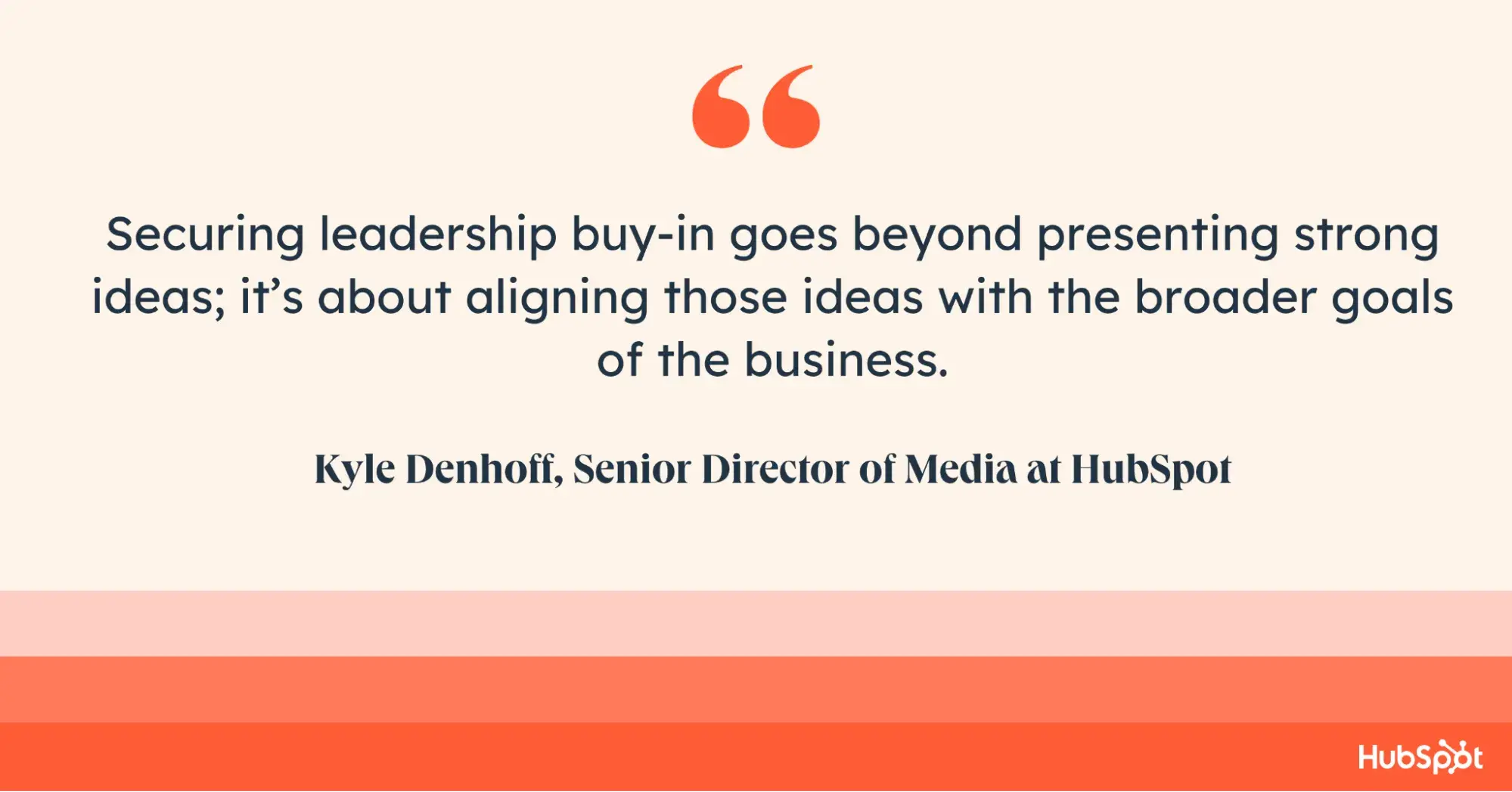
As Kyle Denhoff, senior director of media at HubSpot, explains, “Securing leadership buy-in goes beyond presenting strong ideas; it’s about aligning those ideas with the broader goals of the business. At HubSpot Media, we center our investments around two core business objectives: build brand awareness and drive demand.”
Denhoff emphasizes the importance of efficiency and alignment here: “When presenting to executives, the key is to tie your initiatives to metrics they care about while being efficient (lean team, low costs).”
By directly connecting your initiatives to the KPIs that matter most to leadership, you make a compelling case that resonates with their priorities.
How to Get Buy-In From Top Marketing Leaders
If you’re aiming to secure meaningful executive buy-in, here are some key steps I suggest you follow.
1. Lead with business impact.
Don’t start with tactics — start with outcomes. Frame your initiative in terms of business objectives and the KPIs that matter most to executives, such as Return on Marketing Investment (ROMI) or Customer Lifetime Value (CLV).
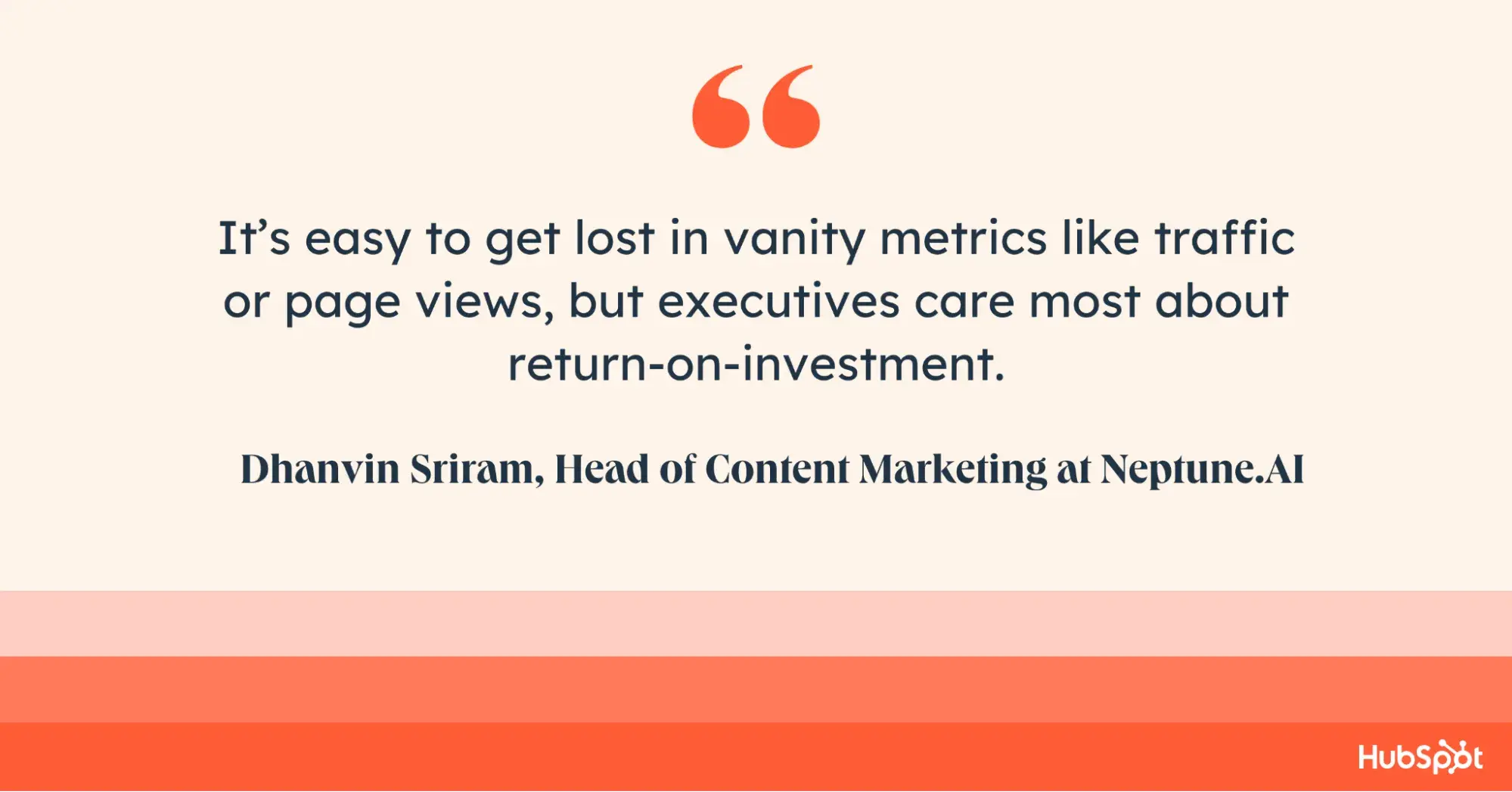
“It’s easy to get lost in vanity metrics like traffic or page views, but executives care most about return-on-investment,” says Dhanvin Sriram, head of content marketing at Neptune.AI, adding that showing tangible results is key to getting executives on board.
“For instance, we use content engagement metrics such as time spent on page, click-through rates, and bounce rates to assess the effectiveness of our content.
If engagement is high, it’s often a sign of strong content that resonates with our target audience. Once we demonstrated that increased engagement was leading to a higher conversion rate, executives understood the connection and were more supportive of our content initiatives.”
Consider how your proposal will contribute to the company’s bottom line. For example, if you’re suggesting a new social media campaign, explain how it will generate qualified leads that can convert into sales, thereby increasing revenue.
Our data backs this up, too. According to the Marketing Leader's Field Guide, 20% of leaders prioritize increasing revenue and sales, so tying your campaign to financial outcomes is critical.
2. Back it up with data.
Numbers build trust. I like to include industry benchmarks, competitor insights, and internal data to create a data-driven case for my initiative. I’ve learned this is so much more powerful than coming to leadership with a moonshot idea you want to try — you need to have the numbers to back it up.
As an example, let’s say you’re proposing a campaign targeting dormant email subscribers. You can use historical conversion data to estimate the incremental revenue this audience could generate. As a bonus, I like including visuals like charts or case studies to make the case easier to digest.
Luca O’Neil, head of growth marketing at Access Partnership, shares a unique strategy: showing the data from a pilot test. For example, he piloted a LinkedIn ad campaign targeting a niche B2B segment.
“With a 35% increase in qualified leads and a lower-than-average CPL, the success provided the confidence needed to scale the initiative globally,” he said.
“Creating executive-friendly dashboards with relevant metrics helps sustain buy-in. I use platforms like HubSpot to offer concise overviews of pipeline impact, CLV, and engagement trends, ensuring executives have instant access to data that supports decision-making,” he added.
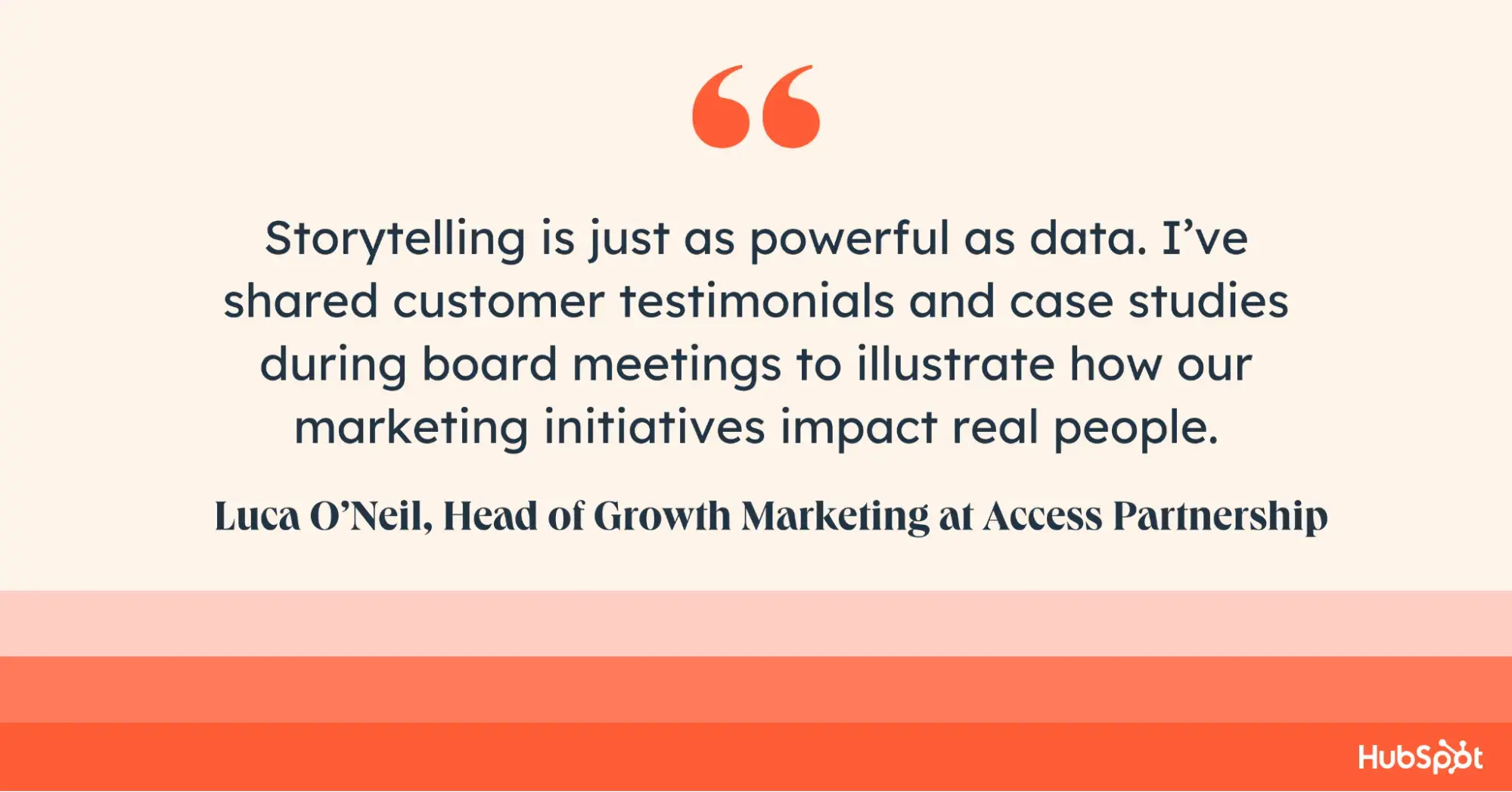
And, of course, you can’t forget tying the data back to a larger story. “Storytelling is just as powerful as data. I’ve shared customer testimonials and case studies during board meetings to illustrate how our marketing initiatives impact real people,” he said. “This approach makes marketing feel more tangible and aligned with the company’s mission.”
3. Present clear milestones.
Break your initiative into manageable phases with specific, measurable goals for each stage. Define what success looks like and establish regular check-in points.
I like to show how small, initial investments can lead to quick wins and outline how these successes can be scaled. This helps build confidence in the larger strategy and helps build a path to scaling further.
Going back to the campaign for dormant email subscribers, this could look like:
|
Phase |
Action |
Goal |
Quick Win |
|
Phase 1 |
Send re-engagement emails |
Achieve a 20% open rate |
Reactivate 200 subscribers |
|
Phase 2 |
Offer exclusive incentive |
Convert 10% into leads or sales |
Generate immediate revenue |
|
Phase 3 |
Nurture with targeted content |
Increase engagement by 15% |
Secure meetings with qualified leads |
|
Phase 4 |
Analyze results and scale |
Demonstrate clear ROI |
Present results to executives |
By aligning your milestones with KPIs that executives care about, you provide a roadmap that illustrates how your initiative will contribute to the company’s objectives.
The Marketing Leader's Field Guide
This comprehensive guide reveals how to leverage AI, personalization, and emerging trends to drive measurable results in 2025 and beyond.
- AI Adoption in Marketing Success
- Personalization in Marketing
- Navigating Privacy-First Data Collection
- Expert Insights for Future Growth
Download Free
All fields are required.
What Goals Matter Most to Marketing Leaders in 2025 [+ KPIs to Track]
What do leaders want? That’s the question you should ask yourself if you’re looking to get executive buy-in. According to HubSpot’s 2025 State of Marketing Trends Report and our Marketing Leader's Field Guide, marketing leaders are primarily focused on three goals:
- Increasing revenue and sales (20%).
- Getting a better understanding of your customers and their needs (16%).
- Increasing brand awareness and reaching new audiences (15%).
For each of these goals, let’s explore why they matter, the key KPIs to track, and tips to secure executive buy-in.
1. Increase revenue and sales.
In 2025, marketing leaders face mounting pressure to prove their department’s direct impact on the company’s bottom line. Marketing is no longer viewed as a cost center — it’s expected to be a revenue driver.
If you work backward from your company’s primary goal of increasing revenue, it makes sense that reaching new audiences and converting them into qualified leads would be top priorities.
As Jordan DiPietro, former HubSpot vice president of marketing, says, “As a marketing leader, it’s important to choose a KPI that is most aligned with your company’s overarching business objectives — it could be a revenue metric, it could be a reach metric, or in the case of HubSpot Media, it could be both!
The important thing is that your KPIs and the action plans associated with those KPIs are ones that can be directly connected to the KPIs of the business.”
DiPietro’s team focuses on two main KPIs: overall reach (visits, opens, listeners, and views) and leads (net new contacts driven by media content).
He elaborates, “Our reach KPI is indicative of the fact that HubSpot wants to grow top-of-the-funnel awareness for the business. Our media team does this by increasing the reach of our blog content, newsletters, podcast network, and YouTube network.
“Our revenue KPI is indicative of the fact that HubSpot is a SaaS business — so we want to generate leads that can be shared with the sales team in order to turn those leads into qualified leads and then into satisfied customers,” he adds.
What KPIs matter most?
- Return on Marketing Investment (ROMI). This metric quantifies how much revenue is generated for every dollar spent on marketing. It’s a favorite among CMOs who want to speak the CFO’s language.
- Revenue Growth Rate. Track overall growth and segment-specific growth (e.g., new customers vs. existing customers).
- Customer Acquisition Cost (CAC). This metric has become increasingly crucial as digital advertising costs rise. Smart teams track CAC trends across channels, segments, and campaigns, using this data to continuously refine their acquisition strategy.
- Pipeline Velocity. This composite metric shows how quickly your marketing efforts convert to revenue.
Securing Executive Buy-In
To secure buy-in for a campaign tied to this goal, you need to frame it in terms of financial impact. Executives respond well to ROI-focused proposals.
- Speak their language. Instead of explaining ad spend in terms of clicks, present it as a $1,000 investment that could generate $10,000 in revenue.
- Leverage predictive analytics. For example, show how a new campaign targeting dormant email subscribers could generate $500K in incremental revenue based on historical conversion rates.
By directly connecting your KPIs to revenue outcomes, you make it easier for executives to see the value of your proposal.
2. Get a better understanding of your customers and their needs.
With AI and advanced analytics at the forefront, understanding customer needs is both easier and more vital than ever. Customers expect personalized, seamless experiences. Without deep insights, brands risk falling behind.
Carey Thiels is a demand generation strategist and marketing consultant. She helps tech startups plan and execute a marketing strategy that will get them to exponential growth.
“Product adoption will tell you how well your customers are using your product. And, of course, renewal and/or churn rate will tell you if customers want to stay or move on to another alternative,” she says.
All of these factors are key to understanding your customers and their needs better.
What KPIs matter most?
- Customer Lifetime Value (CLV). Understanding CLV by segment helps marketing leaders make smarter acquisition and retention investments
- Net Promoter Score (NPS). A straightforward metric for gauging customer satisfaction and loyalty.
- Customer Satisfaction Score (CSAT). Measures how satisfied customers are with your product or service.
- Customer Retention Rate. Higher retention signals your efforts to understand and meet customer needs are working.
Securing Executive Buy-In
Executives care deeply about customer satisfaction, but they’re more likely to be persuaded by numbers and tangible outcomes.
- Present customer stories. Use survey data, testimonials, or case studies to demonstrate how meeting customer needs has led to measurable success.
- Link to market share. Highlight how better customer insights can lead to a competitive advantage, whether it’s winning new audiences or reducing churn.
Jason Marshall, CMO at Huntress, also emphasizes this approach: “Tracking KPIs can help marketing leaders build a compelling case to get the support they need. By projecting the revenue a customer generates over their lifetime with the business, marketing leaders can explore strategies to improve customer retention while avoiding attrition.”
3. Increase brand awareness and reach new audiences.
In 2025, standing out is no small feat. The digital landscape is more crowded than ever, with brands competing fiercely for the same attention.
While revenue remains the top priority, there’s a strong focus on deepening customer understanding and expanding reach. This suggests a balanced approach between short-term sales goals and long-term brand building.
Brand awareness is the foundation for future growth. It ensures your company remains relevant in the eyes of your audience and top-of-mind when they’re ready to make a purchasing decision. Reaching new audiences is particularly crucial as market dynamics shift and existing customer bases evolve.
Denhoff shared with me how he thinks about this goal at HubSpot. “The HubSpot Blog receives over 10M visits per month, each an impression for our brand. HubSpot Media is goaled on Leads first, Reach second. We’re focused on filling the lead pipeline for the sales team.”
He highlights how brand awareness efforts align directly with revenue generation, a crucial connection for earning executive buy-in. By growing HubSpot’s audience through owned media like blogs, podcasts, newsletters, and YouTube channels, HubSpot Media reports on total audience reach monthly, providing a tangible signal of increased brand visibility among key audience segments.
For example, Denhoff explains how a video on growing your LinkedIn company page might include a call-to-action to download a premium guide. By converting viewers into leads via gated content, HubSpot Media not only boosts reach but also drives meaningful pipeline growth — ultimately supporting the company’s broader revenue goals.
What KPIs matter most?
- Share of Voice (SOV). This metric helps marketing leaders understand their brand’s presence relative to competitors.
- Engagement-to-Reach Ratio. Rather than just tracking followers or reach, smart marketers measure meaningful engagement.
Securing Executive Buy-In
Brand-building initiatives often face skepticism from leaders focused on short-term results. The key is connecting brand metrics to revenue outcomes.
- Use strong examples. Demonstrate how a 20% increase in brand awareness on LinkedIn led to a 10% boost in sales within a key market segment.
- Leverage benchmarks. Use industry data to show how competitors are investing in brand-building and the risks of falling behind.
Huang Xiong’s experience backs this up.
“As for 2025 KPIs, the game’s evolving. Sure, we’re still tracking CAC, LTV, and ROAS — those are the backbone — but now we’re looking deeper into engagement and community,” says Xiong, an email data marketing consultant.
“Two KPIs I’m loving right now are customer engagement score (how often people interact with our content) and community growth rate (growth of our social presence and user-generated content). These aren’t just numbers; they show if we’re building real connections with our audience.
“Marketing is less about one-off sales and more about creating loyal customers who actually care about your brand. Bottom line: Focus on the numbers that tell the full story, not just the sale.”
Use KPIs to contribute to your company’s success.
I’m all for innovative ideas and moonshot plans, and I think it’s an important quality of a great marketer. However, I’ve learned that in order to turn these ideas into reality, you need critical components like KPIs to measure success and meaningful executive buy-in.
If you can’t see a strong connection between your KPIs and the business’s KPIs, it might be time to reassess your focus. Shifting your strategy to better impact the bottom line will not only enhance your contributions but also help achieve buy-in from leadership.
By starting with business impact, backing up your proposals with data, and presenting clear milestones aligned with the KPIs that matter most to executives, you’ll increase your chances of securing the executive buy-in you need to succeed.
Editor's note: This post was originally published in October 2022 and has been updated for comprehensiveness.
The Marketing Leader's Field Guide
This comprehensive guide reveals how to leverage AI, personalization, and emerging trends to drive measurable results in 2025 and beyond.
- AI Adoption in Marketing Success
- Personalization in Marketing
- Navigating Privacy-First Data Collection
- Expert Insights for Future Growth
Download Free
All fields are required.
Leadership

![The Most Common Leadership Styles & How I Found Mine [Expert Insights]](https://53.fs1.hubspotusercontent-na1.net/hubfs/53/leadership-styles-4.jpg)
![The Top Goals of Marketing Managers & Leaders in 2025 [New Data + Expert Tips]](https://53.fs1.hubspotusercontent-na1.net/hubfs/53/marketing-career-goals.webp)



![The Best Ways to Get Visibility from Your CMO and Other Marketing Execs Who Can Move You Forward [Data]](https://53.fs1.hubspotusercontent-na1.net/hubfs/53/marketing%20manager%20trying%20to%20increase%20marketing%20executive%20visibility%20in%20their%20role.jpg)
![15+ Organizational Skills Every Leader Needs [+ Ways to Develop Them]](https://53.fs1.hubspotusercontent-na1.net/hubfs/53/organizational-skills.webp)

![What Is Transformational Leadership? [+ How It Drives Innovation]](https://53.fs1.hubspotusercontent-na1.net/hubfs/53/transformational-leadership-fi%20(1).jpg)