.png?width=112&height=112&name=Image%20Hackathon%20%E2%80%93%20Horizontal%20(24).png)

When asking how long a survey should be, consider how much time you'd be willing to spend. It's a tricky question because the survey length can ultimately make or break your results.
If your survey is too long, participants may not start or complete it. If it's too short, your team will miss opportunities to gain insights into your customer base.
→ Free Download: 5 Customer Survey Templates [Access Now]
To find the answer, we decided to take this topic to consumers to better understand what their survey preferences are.
Keep reading to learn about our findings or jump ahead:
Our Approach: What We Wanted to Know
Using Glimpse and its audience of professional survey takers, we asked 100 consumers across the United States about their preferences on survey length.
Specifically, we wanted to learn which factors impact survey completion the most. This includes how much time participants are willing to spend taking a survey and how many questions they're inclined to answer.
Our survey consisted of the following questions:
- How much time are you willing to spend taking a survey?
- How many questions are you willing to answer as part of a survey?
- Of the factors below, which is most likely to make you abandon (not complete) a survey?
We also asked a couple of HubSpot market research pros to weigh in based on their survey expertise.
Let's discuss the results.
How long should a survey be?
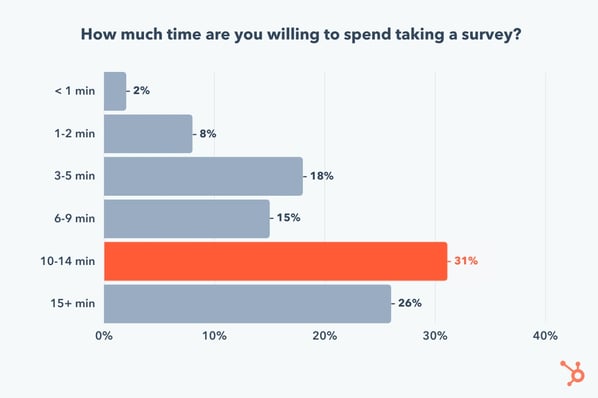
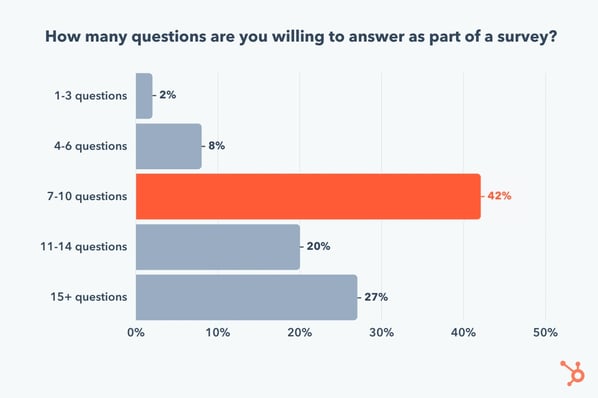
According to a recent HubSpot survey, the ideal survey length is 10-14 minutes, and consumers are willing to answer between 7-10 survey questions. This research also shows that people are more likely to abandon a survey if they feel like it's taking too long for them to complete it.
The Results: What We Learned
The results below highlight consumer preferences for ideal survey time and length along with insights into the factors that affect survey completion.
Ideal Survey Time
31% consumers said that they're willing to spend 10-14 minutes taking a survey.
The full results are highlighted in the image below.
It's worth noting that the length of your survey may vary based on the type of information you're looking for. For example, an NPS survey consists of one question and takes less than a minute to complete.
Here are some more insights on survey timing from Amy Maret who leads the Research and Thought Leadership team at HubSpot:
"The shorter the survey, the better. We're always looking to be more selective about the questions we ask.
[We do this] by hyper-focusing on questions that are directly related to the objectives of the research and being really clear about what those objectives are.
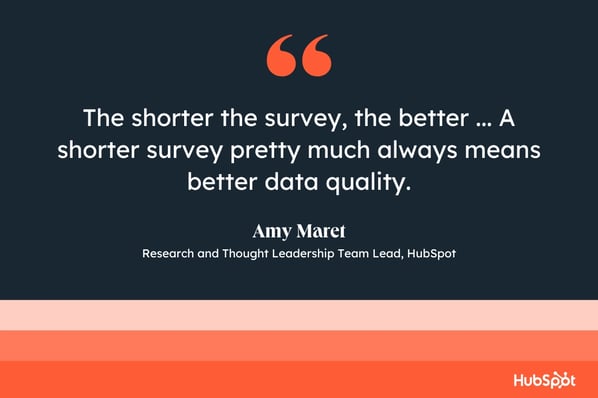
A shorter survey pretty much always means better data quality. Fifteen minutes is about the maximum I would want for a market survey.
[And] if you're surveying your own customers, you'd want to go even shorter to make the best use of the time they're willing to give you."
What This Means
People will take the time to complete your survey, but it's best to keep it under 15 minutes.
Remember to keep it focused on your survey goals, and only include questions that specifically align with what you're trying to accomplish.
Also, make sure you're upfront with customers about how long the survey will take. You should include the approximate survey time when you send out the link to your survey.
Plus, many survey tools have the capability to display the amount of time remaining as participants make their way through the questionnaire.
Pro tip: As an added bonus, it's also a good idea to provide participants with an incentive or reward for their time.
Ideal Survey Length
42% consumers said they're willing to answer 7-10 questions as part of a survey.
The full results are highlighted in the image below.
We also asked Maxwell Iskiev, a market research analyst for the HubSpot blog, what his thoughts are on survey length:
"The ideal length of a survey depends on the purpose behind it. For example, my surveys on broad topics like Marketing Trends will be longer, covering many aspects of the industry.
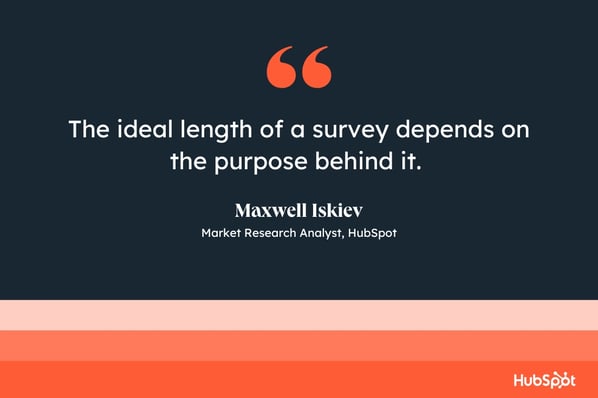
From there, I might notice interesting themes to follow up on, like data privacy, or the impact of the recession on marketers. I'll then write shorter, more focused surveys around 5-10 questions diving deeper into a specific topic of interest."
Maret seconds the idea of shorter, deep-dive surveys:
"[Keeping surveys short] might mean breaking up what could be a longer survey into multiple, smaller, sequential surveys with the same audience.
An added benefit to this approach is that it allows you to tailor your follow-up surveys based on what you learn from the previous ones, and pivot more quickly if priorities change — which they often do."
What This Means
The number of survey questions goes hand in hand with how long the survey will take. And your question count should take into account the purpose of your survey and the types of questions you're asking.
If your topic is straightforward and specific, keep it simple. More comprehensive subjects will likely require slightly longer surveys or a sequence of questionnaires.
Similarly, if your survey is heavy on open-ended questions, less is more. If there are majority multiple choice or rating scale questions, you can probably get away with some extras.
Pro tip: Take the survey yourself to get a better idea of the level of effort and the difficulty of the questions. You can also track the survey completion rate and make adjustments if it's on the lower side.
Factors That Impact Survey Completion
47% of consumers say they're most likely to abandon a survey if it's taking them too long to complete it.
The full results are highlighted in the image below.
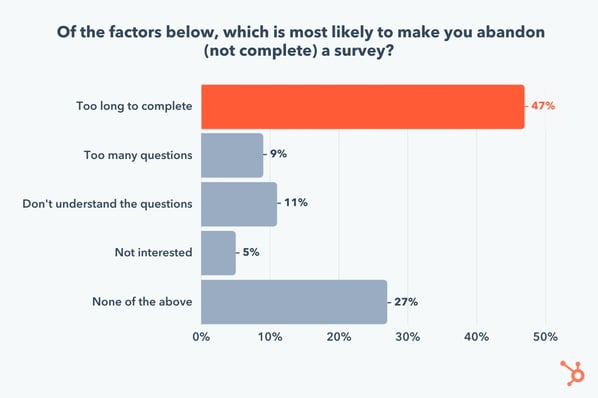
A few participants also cited repetitive questions, technical issues, and privacy concerns (e.g., too much personal information being requested) as reasons they wouldn't complete a survey.
What This Means
The data shows that survey length matters, and you'll need to take this into consideration In order to maximize your results.
As a general rule of thumb, your survey should not exceed 10 questions, and it should take no more than 14 minutes to complete.
Keep in mind that even if your surveys are the right length, sending too many surveys can also cause survey fatigue.
Pro tip: Make sure you create a reasonable cadence for feedback, and don't forget to align with other departments if they're sending out customer surveys too.
The Bottom Line
Survey length matters, but there's no one-size-fits-all rule for how long a survey should be. The length of your survey will ultimately depend on survey type, question format, and survey frequency.
When in doubt, put yourself in your customers' shoes. If you wouldn't spend the time to take your own survey, chances are they won't either.
Editor's note: This post was originally published in August 2019 and has been updated for comprehensiveness.



![What Is a Likert Scale? [Examples & Templates]](https://knowledge.hubspot.com/hubfs/likert-scale-1-20241031-1487623.webp)
![How to Conduct Survey Analysis Like a Data Pro [All My Tips + Secrets]](https://knowledge.hubspot.com/hubfs/survey-results-1-20241031-6355381.webp)



![How Automated Phone Surveys Work [+Tips and Examples]](https://www.hubspot.com/hubfs/phone-survey.webp)