However, not all of them use it the same. While some marketers use AI to produce stunning films like this Halloween-themed ad by Nike, most struggle to produce blog posts that don’t read like AI slop.
In this article, you’ll learn the skills you need to work with AI, the skills AI can’t replace, and how to boost your critical thinking skills to adapt to the AI era.
Table of Contents
- Top Skills Marketers Need to Work Effectively With AI
- Skills AI Can’t Replace
- How to Boost Critical Thinking Skills
Top Skills Marketers Need to Work Effectively With AI
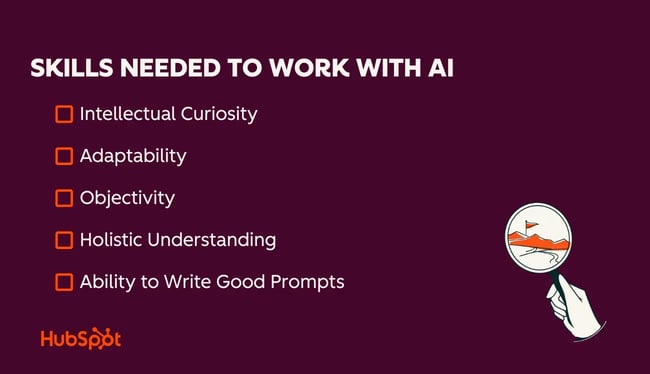
1. Intellectual Curiosity
Most people think AI rewards speed. I’ve learned it actually rewards curiosity. It helps you iterate quickly and really nail down why something works. That mindset turns every new trend or tool into an opportunity to learn, connect dots, and improve outcomes.
Take a social media manager using an AI tool to create a content strategy for their company. They might start with a generic plan for their industry. But instead of applying it as is, curiosity pushes them to ask: Why does this format work? How can we tailor it to our audience or product?
By breaking down each element (platform choice, content type, posting cadence), they uncover insights that make the strategy more relevant and effective.
Pro tip: Once a week, explore something completely unrelated to your role — a podcast, book, or tool outside your niche. Curiosity compounds when you draw connections others don’t see.
The State of Artificial Intelligence in 2025
New research into how marketers are using AI and key insights into the future of marketing.
- Marketing AI Tools
- Practical Tips
- Trends and Statistics
- And More!
Download Free
All fields are required.
Form not available
2. Adaptability
The last few years have taught me that adaptability isn’t optional anymore, especially with the speed of development in the AI industry. New tools roll out every month, automation platforms update their rules, and you’ve to learn everything all over again.
In marketing, the most effective professionals are the ones who experiment early and adjust quickly. For instance, when Canva launched Magic Studio or when ChatGPT introduced campaign idea generator, teams that tested these features first learned how to use them strategically instead of reactively.
Pro tip: Each month, test one new tool or workflow in your process. You don’t have to adopt it long-term, just see what it changes in how you work.
3. Objectivity
In marketing, we often assume data speaks for itself. My experience with AI tools has shown the opposite: Numbers only tell the story we design them to tell. The more I’ve worked with AI tools, the clearer it becomes that every dataset reflects human choices: what we include, what we ignore, and what we define as “correct.”
Google’s chief decision scientist, Cassie Kozyrkov, uses the Cat vs. Not-Cat example to illustrate this pitfall.

Say an AI expert creates a machine-learning model that determines which animals in these six pictures are cats and which ones aren’t.
From image 1 to image 5, it’s pretty obvious which animals are cats (versus not cats). However, the way the ML model will categorize the sixth image depends on whether the AI expert considers a tiger to be a cat or not.
We all know the tiger belongs to the cat family, but is it actually a cat compared to the animals in images 1, 3, and 4? Is it a different type of cat? And if it is, will it be right to put it in the same category as domestic cats?
The answer depends on the subjective truth the AI expert believes in.
In her piece, “Why AI and decision-making are two sides of the same coin,” Kozyrkov writes, “AI cannot set the objective for you — that’s the human’s job and machine learning’s ‘right’ answers are usually in the eye of the beholder, so a system that is designed for one purpose may not work for a different purpose.”
If, in the example above, the AI expert programs the model to determine that the animal in image 6 isn’t a cat, they’d be right in a sense. But if you, who uses the model, think the animal is a cat, you’d be right, too.
“From the experiments our team has performed, AI works best when the result can be subjective (art, writing, idea generation, etc.) or when some error is tolerable (data classification),” says Blake Burch, the co-founder at Shipyard.
“When you need something to be 100% right, you can only rely on the AI output if you have other ways to verify the accuracy, like code execution or undergoing human-in-the-loop review.”
There’s never a “right” way for AI to define categories that everyone would agree with. It’s up to you to choose what to believe and replicate.
4. Holistic Understanding
Holistic understanding is about seeing how every part of a project connects: content, design, data, and customer experience. The best marketers understand how their work scope fits into the larger system.
As Brian Rhea from JobLens.ai puts it, “Humans are remarkably good at Holistic Understanding: Our ability to connect seemingly unrelated information and experiences in order to draw a meaningful, creative insight.
“All those ‘What I Learned about Marketing from Game of Thrones’ posts resonate for a reason. We are much better than AI at drawing lessons from recurring — but unrelated — patterns in life.”
That’s what makes this skill powerful. When you zoom out to see how design influences conversions or how product updates affect storytelling, you start making decisions that serve the bigger goal, not just your deliverable.
Pro tip: Before finalizing a project, map how your work connects to at least two other functions. It builds context and prevents blind spots.
5. Ability to Write Good Prompts
Prompt writing looks easy until you realize how much clarity it demands. A vague request gives you generic results, but a specific one (complete with audience, context, and tone) can get you exactly what you need.
Research confirms this: A recent survey found that structured, context-rich prompts greatly improve large-language-model performance and reduce misinterpretation.
Good prompting is about structured thinking, knowing what you want before you ask for it. Over time, I’ve found that this habit sharpens how you brief teammates, plan content, and even communicate with clients.
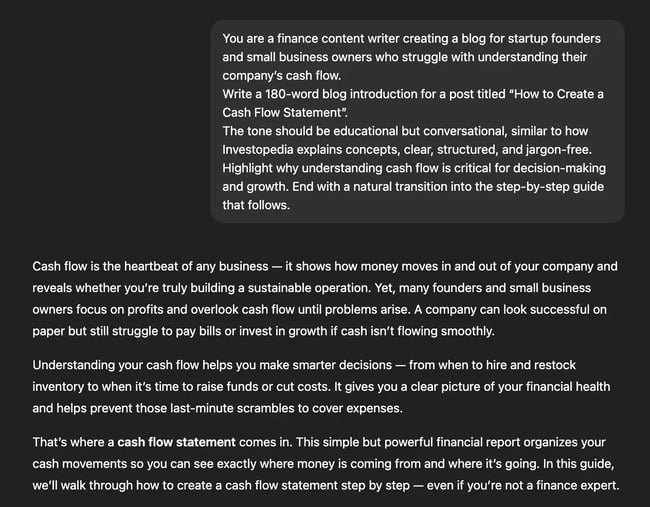
Example: Instead of prompting with “Write a blog intro about how to create a cash flow statement.”
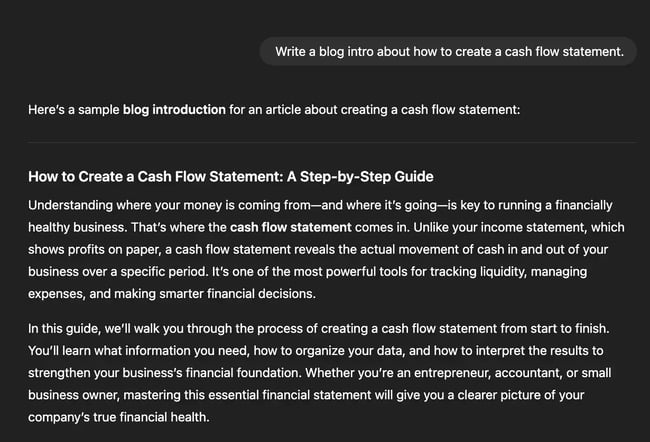
Try: “You are a finance content writer creating a blog for startup founders and small business owners who struggle with understanding their company’s cash flow.
“Write a 180-word blog introduction for a post titled ‘How to Create a Cash Flow Statement.’
“The tone should be educational but conversational, similar to how Investopedia explains concepts — clear, structured, and jargon-free.
“Highlight why understanding cash flow is critical for decision-making and growth. End with a natural transition into the step-by-step guide that follows.”
Skills AI Can’t Replace
As tools get smarter, what stands out is how human you stay. These are the skills that technology can support, but never fully replicate.
1. Critical Thinking
Critical thinking is what keeps me grounded when data looks too good to be true. It’s easy to mistake correlation for success, especially when dashboards glow green.
LinkedIn’s 2024 Future of Work Report lists critical thinking among the top five most in-demand human skills worldwide. It’s not about doubting data but digging into what it really means. Whenever I see an unexpected result, I pause and ask: What else could explain this?
Tools can give you results, but reflection helps you understand them. That’s what turns information into insight.
2. Empathy
Empathy is what keeps communication human. It’s the difference between talking to people and connecting with them.
One of the best examples I’ve seen is Dove’s Real Beauty campaign. Instead of selling products, the brand told real stories about confidence and self-perception. The videos went viral, not because they were perfectly produced, but because they made people feel seen.
Empathy makes metrics meaningful. If you understand how your audience feels, you’ll know exactly what to say and what not to.
The State of Artificial Intelligence in 2025
New research into how marketers are using AI and key insights into the future of marketing.
- Marketing AI Tools
- Practical Tips
- Trends and Statistics
- And More!
Download Free
All fields are required.
Form not available
3. Emotional Intelligence
Emotional intelligence shows up when things don’t go as planned. I’ve had campaigns delayed, budgets cut, and feedback that stung. In cases like this, marketers need to stay calm and listen.
When Microsoft’s CEO, Satya Nadella, took over, he reshaped the company’s culture around empathy and listening. Under his leadership, Microsoft’s market value tripled. His approach proved that emotional intelligence scales even in large organizations.
On being emotionally aware and sensitive, Dominik Maka, the head of SEO at LVBET, delineates, “AI’s cool, but can it understand that sigh of relief from a client when you solve a problem they’ve been stressing over? Or that excitement in a team member’s voice when they have a breakthrough idea? That’s the magic of empathy and emotional intelligence.
“It’s something that’s been invaluable in my journey, especially when navigating the diverse cultures and markets. While I’m all for AI and its wonders, there’s a warmth that we humans bring to the table. It’s like comparing an AI-generated song to one where you can feel the artist’s soul.”
I try to bring that mindset into my day-to-day life. When a project underperforms, I ask my team what they think went wrong instead of jumping to conclusions. Those conversations often reveal what the metrics can’t.
You can’t automate awareness. The ability to pause, understand, and respond thoughtfully will always be a human advantage.
4. People Management
Managing people taught me more about clarity than any leadership course could.
I once led a small content team where I edited everything myself. It felt efficient but left no room for others to grow. Eventually, I started sharing ownership, full control over posts, decisions, and results. Within a month, quality improved because people cared more about what they created. Plus, I didn’t need to rush through every deliverable.
People management is about trust. The clearer you are about the “why,” the easier it becomes for others to own the “how.”
5. Creativity
Creativity is a system. It shows up when you look at an old problem through a new lens.
When Spotify created its Wrapped campaign, it wasn’t a big-budget idea. It was a simple insight: People love seeing themselves in data. That creative leap turned year-end stats into a cultural event, driving millions of shares and organic reach.
I think of creativity the same way, not as inspiration but iteration. When a campaign underperforms, I test new formats, switch tone, or try storytelling instead of visuals. Often, the smallest tweak is what makes something click.
This sentiment is echoed by Andrew Boyd, the co-founder of Forte Analytica.
While Boyd recognizes that AI can beat humans at writing content at a large scale, he recognizes that it cannot “give a personal take on a product or service that is authoritative and grounded in real-world experience.
“You can tell it to write from the perspective of someone who has done or used something, but even then, it is still skin deep and tends to make sweeping generalizations. It lacks the nuance of a human since it cannot experience life as a human.”
Creative work rewards curiosity. Keep exploring long enough, and you’ll always find a better version of your first idea.
6. Strategic Thinking
Strategic thinking connects what you’re doing today to where you want to go tomorrow.
For example, you can tell an AI-powered scheduling tool to send a Tweet (or is it Xeet?) for you at a specific time of day from Monday to Friday. However, the automation of those tweets is likely a small part of a larger strategy to distribute content, drive traffic, and generate qualified leads for the company.
Once you start mapping each effort to a specific outcome (brand recall, lead generation, or retention), you begin spotting patterns that drive real growth. That’s when work starts feeling purposeful.
How to Boost Critical Thinking Skills
Critical thinking is one of the most in-demand soft skills across industries. But it’s also a skill you refine over time.
When I take a moment to ask one more question or look at the same data from a new angle, my decisions get better. A Harvard Business Review study found that teams who paused to reflect between project phases performed 25% better than those who didn’t.
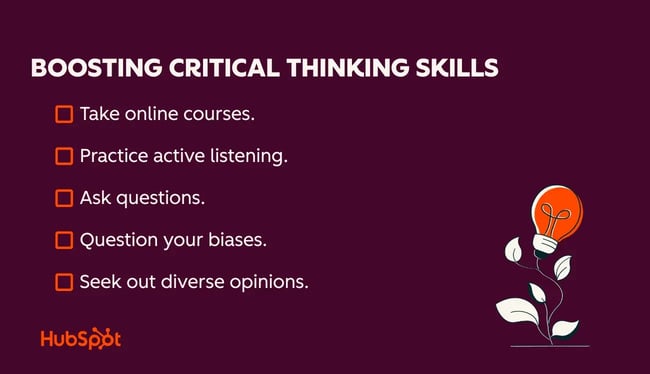
Here are a few ways I practice it daily.
1. Take online courses.
Whether you’re job hunting or upskilling in your current role, structured learning can help you strengthen this ability. Online programs encourage you to approach problems differently and analyze information objectively.
Short programs on Coursera or HubSpot Academy often help me rethink how I plan and measure work. You can start with HubSpot Academy’s Critical Thinking Course. It covers thinking dispositions, learning styles, and cognitive biases, and teaches you how to ask better questions, cultivate curiosity, brainstorm effectively, and make stronger decisions.
2. Practice active listening.
Research from the University of Minnesota suggests that we remember only 25% of what we hear. How can we analyze information effectively if we’re retaining just a quarter of it? That’s where active listening comes in.
As a foundational part of critical thinking, active listening compels you to listen carefully, not just hear what others are saying.
“When we are involved in really active conversations, there is a positive exchange of energy between speakers,” says Crystal King, instructor of HubSpot’s Critical Thinking Course. “The speaker feels heard, and the listener learns and understands.”
Empathy plays a big role here. It helps you put yourself in the other person’s shoes and fully understand their perspective. Ask thoughtful questions that show you’re engaged, keep your body language open, and avoid forming judgments while the other person is speaking.
Active listening not only improves communication but also deepens understanding — a core part of thinking critically.
3. Ask questions.
Critical thinking starts with curiosity. When you’re presented with new information, don’t accept it at face value. Ask questions to understand the context and accuracy behind it.
Start with what you already know and verify that the information is complete and correct. If something feels unclear, ask for clarification or have key points repeated to ensure nothing is missed.
Channel your curiosity and explore the details: What? When? Where? Who? Why? How?
Then, consider the source:
- Is it credible?
- Why was this information shared?
- What outcome might it be trying to influence?
- Is there more context that’s not being presented?
Asking thoughtful questions helps you avoid assumptions, uncover bias, and make better decisions based on evidence rather than opinions.
4. Question your biases.
When I agree too fast, it’s usually because I want to. Catching that helps me stay objective.
To make a conclusion without bias, you need to take a step back and challenge the assumptions you might be making. Ask yourself:
- Am I making assumptions about this information?
- Are there any perspectives or viewpoints I’m missing?
- Are there any variables/components I haven’t factored in yet?
- Have I analyzed this information from every angle?
If you realize that your cognitive biases are involved in your decision-making, you’ll need to put them aside and evaluate the information with a fresh eye (and mind).
5. Seek out diverse opinions.
People naturally gravitate toward others who think like them. Online, that tendency grows stronger as algorithms surface content that aligns with our existing beliefs. This creates an echo chamber that limits perspective and makes it harder to challenge assumptions.
I’ve learned the most from people who don’t see things the way I do. It’s uncomfortable, but it always widens perspective.
When you ask for input from people with different cultural backgrounds, ages, belief systems, or experiences, you gain a broader view of any problem. It helps you see patterns, question blind spots, and avoid groupthink.
If you’re unsure where to start, build relationships outside your usual circle. Talk to colleagues in other teams, join cross-functional discussions, or spend time with people at different career stages. Diverse viewpoints expand your understanding and make your decisions stronger.
Develop the right skills, and you won’t be replaced by AI.
The more I work with AI, the clearer it becomes that tools don’t define growth: Skills do. What matters isn’t how many platforms I can use, but how I think, learn, and adapt when things change.
Every AI skill on this list has shaped the way I work. Some came naturally, others took time and a few mistakes to build. Start your journey to learn these skills today, and you’ll be thankful you did.
Editor's note: This post was originally published in November 2023 and has been updated for comprehensiveness.
The State of Artificial Intelligence in 2025
New research into how marketers are using AI and key insights into the future of marketing.
- Marketing AI Tools
- Practical Tips
- Trends and Statistics
- And More!
Download Free
All fields are required.
Form not available