.png?width=112&height=112&name=Content%20Hub%20AI%20Image%20Generation%20(1).png)
Now I can spin up on-brand banner variations in just a few clicks, give more detailed briefs to my team, and deliver higher-quality designs in half the time. And if you're building or refreshing a website alongside your design work, HubSpot's AI Website Generator can generate a full custom site — layout, copy, and CTAs — from a few simple prompts, so your web presence keeps pace with your content.
But which AI graphic design tools actually give you usable results and the best ROI?
I tested the top 8 to find out. Here are my prompts, results, and recommendations.
Table of Contents
- Why use AI for graphic design?
- How I Tested the Best AI Graphic Design Tools
- Best AI Tools for Graphic Design
.png?)
HubSpot's AI Image Generator
Transform text into AI-customized images that perfectly match your content.
- Go to your preferred content tool
- Find the image generator feature
- Enter a text prompt or content input
- Generate and insert your image
Why use AI for graphic design?
Marketing teams are under more pressure than ever to produce more visual content, across more channels, in less time without sacrificing quality or brand consistency.
Design backlogs are common, turnaround times are shrinking, and the demand for personalized, campaign-specific assets keeps growing. For many teams, the bottleneck is production capacity rather than creativity.
That's where AI for graphic design comes in. According to HubSpot's State of AI survey, over 40% of marketers already use AI image and design generators, and the most common reason is speed.
An AI graphic design generator removes the slowest parts of the creative process: the blank canvas, the repetitive resizing, and the back-and-forth on first drafts.
Streamlining Your AI Design Workflow
Sure, AI speeds up individual tasks, but it also changes how design work gets done from start to finish. Common use cases I'm seeing across marketing teams include:
- Quick edits. Resizing, cropping, background removal, and color adjustments that used to take 20–30 minutes can now be done in seconds.
- Social media content. 38% of marketers use AI to create image-based and video content for social media, print, and more. Tools like ChatGPT, Canva, and Veo-3 can render scenes and generate assets in a fraction of the time.
- Trend-based content. Need to hop on a visual trend quickly? An AI graphic design generator can produce on-brand versions in minutes, not days.
For teams managing a website alongside their visual content, the workflow benefits extend even further.
HubSpot's AI Website Generator, part of Content Hub, lets you generate a fully designed, CRM-connected website from a short prompt — meaning the graphics you create with AI design tools can go straight into a web environment that was built the same way: fast, on-brand, and ready to convert.
Maintaining Brand Consistency at Scale
One of the harder problems in design is creating a plethora of great assets that all look like they came from the same brand.
AI tools help here by letting you build from brand kits, locked templates, and style references, so every output stays on-brand even when volume is high. This is especially valuable for teams running A/B tests or producing assets across multiple markets or seasonal campaigns.
Removing Creative Blocks
Beyond production, AI is a strong strategic partner earlier in the process. If I'm stuck on a campaign direction, I can prompt an AI graphic design generator to produce five different visual concepts in under a minute.
I can generate creative briefs, explore color palettes I'd never have considered, and use AI-generated mockups to align stakeholders before any real design work begins. Some of my best-performing graphics started as AI-generated concepts that a designer refined.
How I Tested the Best AI Graphic Design Tools
To make this as useful as possible, I moved beyond gut reactions and built a consistent testing framework I could apply equally across all eight tools. Every tool was tested with the same two prompts, evaluated against the same five criteria, and scored without factoring in brand reputation or prior experience with the tool.
The Two Test Prompts
I used two "mega prompts" designed to cover the most common marketing design use cases. Basic prompts weren't revealing enough, so I needed detailed instructions to see how well each tool could follow direction and produce something publish-ready.
Prompt #1 — Blog Banner/Featured Image
"Design a clean, modern blog banner for an article titled 'The Rise of AI in Graphic Design' using a minimalist layout (1200x628px) optimized for web and social sharing. Prioritize a bold, high-contrast headline in a contemporary, tech-inspired font. Use a subtle background texture or gradient that enhances, but doesn't compete with, text legibility. Incorporate understated AI-themed motifs like neural nodes, abstract chips, or creative lightbulb icons. Maintain visual harmony with generous white space and balanced composition. Enhance the title's visual impact through font weight, spacing, or soft shadowing, and ensure strong text-to-background contrast for clarity. Export as a high-res PNG or JPG."
Prompt #2 — Social Media Post
"Design a high-impact Instagram post (1080x1080px) to announce a new AI-powered design tool, featuring the bold tagline 'Design Smarter. Not Harder.' in large, modern sans-serif typography with layered effects, dimensional shadows, or motion-inspired blurs for depth. Use a vibrant, futuristic background with gradients (blue, purple, teal, pink), abstract shapes, and subtle tech motifs like HUD overlays or network nodes. Include the product logo or name subtly in the bottom corner, with an optional CTA like 'Try It Free Today.' Ensure clean balance, mobile readability, and visual clarity on both light and dark interfaces. Export as a high-res PNG or JPG under 1MB."
Evaluation Criteria
Each tool was assessed across five criteria:
1. Ease of Use: How quickly could a non-designer get a usable result? I looked at onboarding friction, interface clarity, and whether the tool required technical knowledge or prompt engineering skills to get decent output.
2. Output Quality: How closely did the result match the prompt? I evaluated layout, typography, color choices, visual hierarchy, and whether the output was publish-ready or needed significant rework.
3. Editing Capabilities: Could I refine the output without leaving the tool? I looked at whether inline editing, layer control, or iterative prompting were available, and how intuitive they were to use.
4. Brand Integration: Did the tool support brand kits, custom fonts, color palettes, or style references? For marketing teams, the ability to generate on-brand assets without manual correction is a major factor in real-world usability.
5. Pricing & Value: I considered the cost of each plan relative to the output quality and feature set, with particular attention to what's available on free or entry-level tiers — since that's where most people start their AI design workflow.
Comparison Table
Here's how all eight tools stack up at a glance before we get into the individual results:
| Tool | Ease of Use | Output Quality | Inline Editing | Brand Integration | Free Tier | Starting Price |
|---|---|---|---|---|---|---|
| Canva AI | ⭐⭐⭐⭐⭐ | ⭐⭐⭐⭐ | ✅ Yes | ✅ Yes | ✅ Yes | $5.81/mo |
| ChatGPT | ⭐⭐⭐⭐ | ⭐⭐⭐ | ⚠️ Limited | ❌ No | ✅ Limited | $20/mo |
| Ideogram | ⭐⭐⭐⭐ | ⭐⭐⭐⭐⭐ | ❌ No | ❌ No | ✅ Yes | $7/mo |
| Autodraw | ⭐⭐⭐⭐⭐ | ⭐⭐ | ❌ No | ❌ No | ✅ Yes | Free |
| Gemini | ⭐⭐⭐⭐ | ⭐⭐⭐ | ❌ No | ❌ No | ✅ Yes | $22.26/mo |
| Kittl | ⭐⭐⭐ | ⭐⭐⭐ | ✅ Yes | ⚠️ Limited | ✅ Yes | $11.42/mo |
| Adobe Express | ⭐⭐⭐ | ⭐⭐ | ✅ Yes | ⚠️ Limited | ✅ Yes | $4.55/mo |
| Designs.ai | ⭐⭐ | ⭐⭐ | ⚠️ Limited | ❌ No | ❌ No | $29/mo |
Ratings reflect performance on the two standardized test prompts above. Your results may vary depending on use case and prompting style.
Best AI Tools for Graphic Design
Not every AI graphic design generator is built for the same job. The right tool depends on what you're making, who's making it, and what constraints you're working within. Before diving into the full reviews, here's a quick guide to help you find your best starting point:
Best AI Design Tool by Use Case
Best for Social Media Graphics — Canva AI
If your primary output is social content — Instagram posts, LinkedIn banners, story templates — Canva AI is the most practical choice. Its template library, brand kit support, and direct integrations with platforms like HubSpot make it the easiest tool to plug into an existing social media workflow.
Best for Brand Design — Kittl
Kittl is the strongest option for teams focused on visual brand consistency. Its multi-model AI engine, vector editing capabilities, and extensive template library make it well-suited for logos, merchandise, print assets, and anything that needs to look polished and on-brand at scale.
Best for Content Marketing — Ideogram
Content marketers who need text-heavy graphics — blog banners, featured images, call-to-action buttons, and ad creatives — will get the most mileage out of Ideogram. Its text rendering accuracy is significantly better than most other AI graphic design generators on this list, which matters when your graphic needs to carry a headline or tagline.
Best for Beginners — Canva AI
For anyone new to design or AI tools, Canva AI has the lowest barrier to entry. The interface is familiar, the presets remove the pressure of writing perfect prompts, and the ability to edit outputs directly inside the canvas means you're never stuck with a result you can't improve.
Best for Budget — Autodraw or Adobe Express
If cost is the primary constraint, Autodraw is completely free and requires no account. For slightly more capability on a tight budget, Adobe Express offers a functional free tier and paid plans starting at $4.99/month — making it the most affordable option for teams that need basic editing alongside generation.
Best for Ideation & Concepting — ChatGPT
ChatGPT isn't the strongest standalone design tool, but it's the best on this list for early-stage creative work. Use it to generate concept directions, draft design briefs, or produce rough mockups to align your team before moving into a more design-focused tool.
Best for Video & Multimedia Campaigns — Gemini or Designs.ai
If your campaigns span video, audio, and static graphics, both Gemini (with its Veo-3 video integration) and Designs.ai (with its voiceover and videomaker tools) cover more of the multimedia production stack than the other tools on this list.
Now let's get into the full reviews, including the exact prompts I used, the outputs I got, and my honest take on each tool.
1. Canva AI
I think Canva is a more accessible, intuitive version of the Adobe suite. Most freelancers rely heavily on Canva for client projects, and I can see why.
Canva has stepped up its design game in the last year. I’m seeing a huge shift towards AI-assisted design workflows through its Visual Suite 2.0. I love how I can create interactive dashboards just through sheets, generate cool new backgrounds, and so much more with the new Canva.
Moreover, Canva is now integrated into HubSpot, which means I can seamlessly use it inside my blogging workflow.
Free resource: Learn how to use Canva in HubSpot in this Academy course.
Now, let’s get to testing.
Test Results
I used the web app for this test. But you can achieve the same results with Canva AI on mobile or tablets (iOS and Android), as well as the desktop app (macOS and Windows).
Find Canva AI, click on it, and you’ll get a prompt field where you can describe what you want. Here’s what I got for Prompt #1:
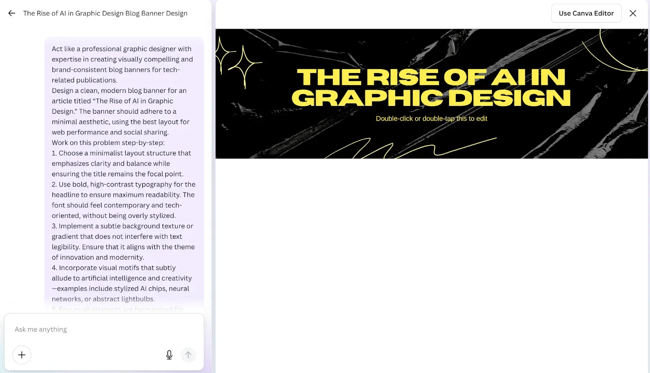
As you can see, the layout and typography are decent. The background? Not so much.
The fact that Canva embeds its own instructions in the image (“Double-click or double-tap this”) is a bit annoying, honestly. But being able to edit the output through the Canva editor is a plus in my book.
Here’s what I got for the second prompt:
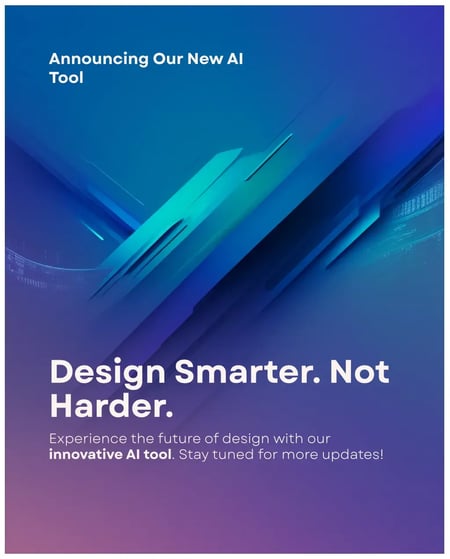
I feel that Canva is best for use cases related to social media. You can even get carousel posts with Canva AI.
I would, of course, make some minor tweaks to the above image like removing “announcing our new AI tool’, switching out the copy, etc. However, Canva gives me a good base to start from.
Bonus: Don’t want to write custom prompts? Canva AI has presets for you to use. I tested one of them to show you how they work.
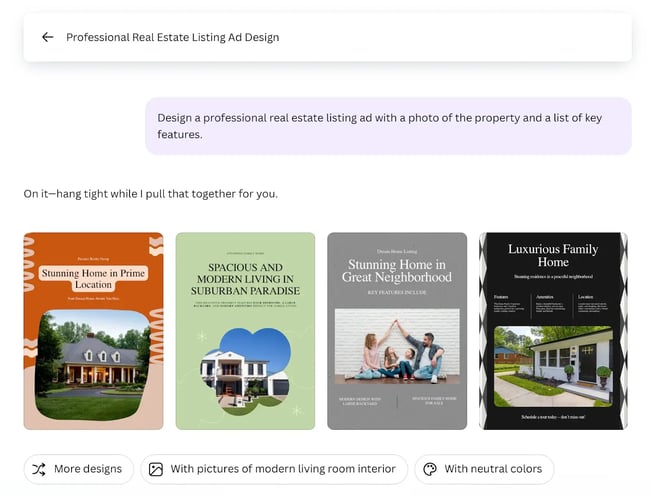
It took almost 10+ minutes to generate these mockups. However, I thought the results were pretty great and can be shipped with some tweaks. You can definitely use Canva AI for social media graphics.
What I like:
- Simple and intuitive interface.
- Ability to edit images within the tool.
- Offers a wide range of premium templates.
- Integration with Canva’s design suite and other platforms like HubSpot.
What can be improved:
- Better adherence to my prompts.
- Generate mockups faster.
Pricing: Free access with limited credits. Paid plans from $5.81/month and $46.49/year.
Best for: Social media graphics and reusable visual assets.
2. ChatGPT
ChatGPT is my go-to AI chatbot for brainstorming content ideas, creating outlines or first drafts, and even analyzing Excel spreadsheets. It’s a great creative partner, and that’s why I also use it for creating design and image mockups to pass on to my designers.
When using ChatGPT for graphic design, I provide the model with existing graphics to serve as a reference for style, layout, and so on. Here’s an example of a typical prompt I use.
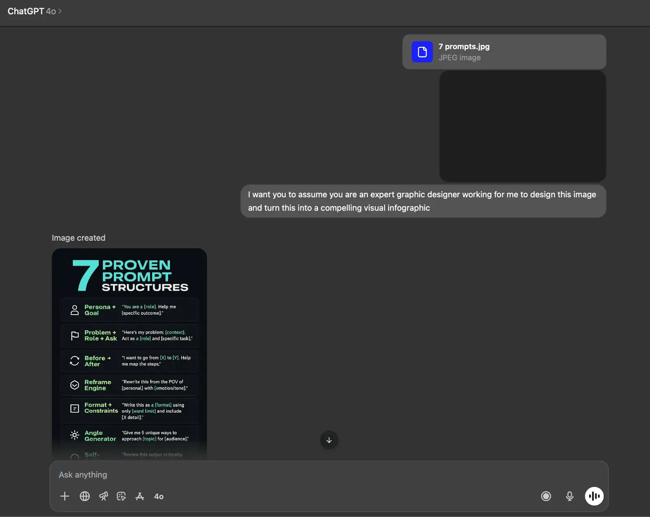
As you can see, it comes up with decent designs when it has reference images. For this test, however, I used a fresh chat to ensure fairness and consistency in the results.
Test Results
When I first entered Prompt #1, ChatGPT started breaking it down and explaining it to me. That’s a weird quirk on this platform, probably because it’s trained to be a conversational model.
Anyway, after asking it again to create the banner, here’s what I got.
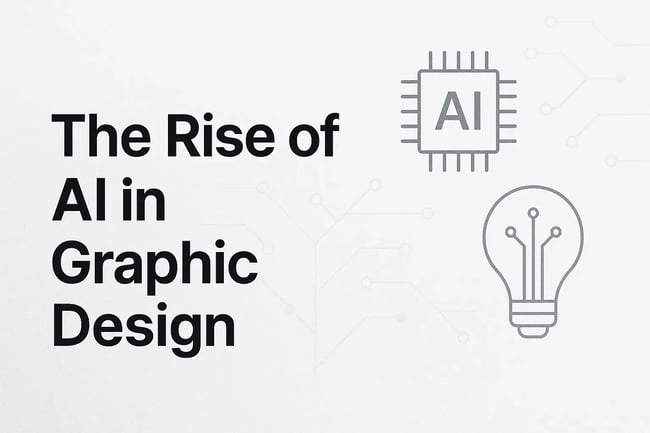
While this looks alright from a minimalist design perspective, I’m not a huge fan of how the text is positioned. There’s a lot of whitespace, and I’m not too sure about the lightbulb.
I could probably fix this with a reference image, but let’s skip that for now. Instead, let’s see how ChatGPT does with the social media prompt.
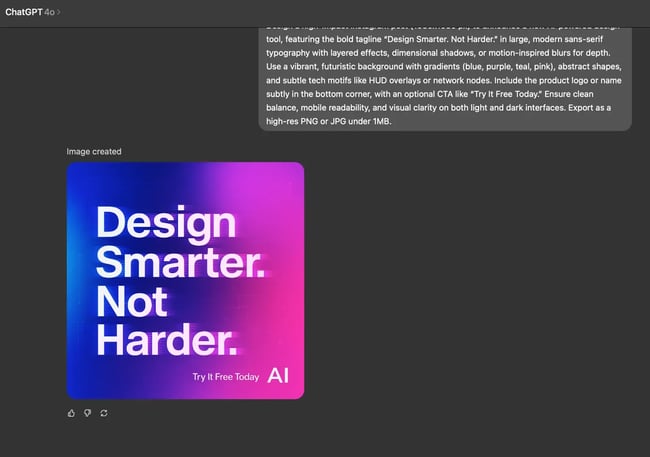
As you can see, this graphic isn’t very professional. So I gave ChatGPT another shot, this time putting Canva’s design as a reference. The model mimicked the image and didn’t come up with anything original. Bummer. More often than not, though, providing examples and pushing for iterative fixes with follow-up prompts will give you better results with ChatGPT.
What I like:
- Fits right into my broader AI workflow since I already use ChatGPT.
- Does a decent job when given the right references.
- Images get generated fairly quickly.
What can be improved:
- Design quality; custom training datasets would help here.
- Ability to edit created images inside the context window without changing the whole image.
Pricing: $20/month for ChatGPT Plus and $200/month for the Pro tier. Limited access for free users.
Best for: Brands that already use ChatGPT in their workflow.
3. Ideogram
As a content marketer, I usually need text-heavy graphics. Think blog banners, call-to-action buttons, and infographics. Since my goal is to drive engagement and conversations, visual elements and text in the graphics are helpful for capturing user attention.
However, getting AI tools to render legible text designs was harder than I thought it would be. I heard a lot of good things about Ideogram, though, so I decided to try it out for graphic design.
Test Results
I used the web version of Ideogram for this test. You can also use the newly-launched mobile app if you like. Here’s the output of the first part.
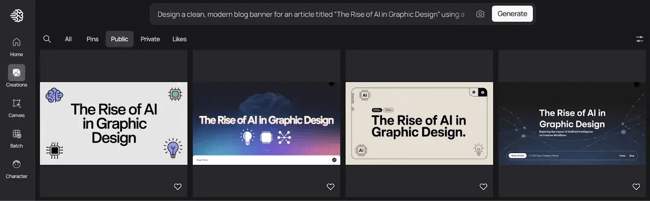
Honest opinion? I thought the layout was sub-par. The generated banner also had unnecessary elements (like “1200 px”), but I can’t complain about the quality and style of the text.
Next, I entered my social media prompt, and here’s what I got.
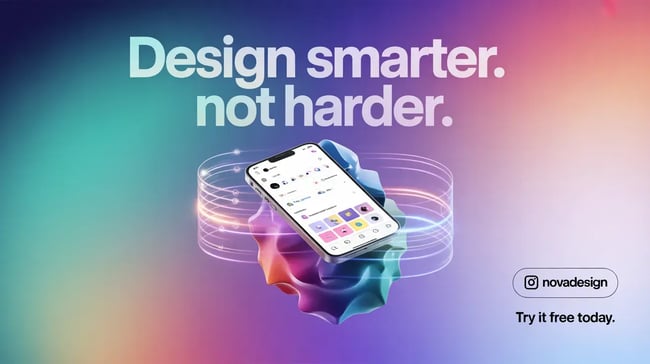
This is by far the best social media post (design-wise) on this list so far. Minimal, modern, and clean — just like I asked. It even came up with a name for the brand, which none of the other tools did. The ‘N’ should have been uppercase, but that is a quick fix. All in all, Ideogram generated a graphic I’d actually use.
What I like:
- High-quality text rendering with good font choices.
- Vibrant color palette and scheme that stops the scroll.
- Original elements like brand name suggestions, etc.
What can be improved:
- More control over design layers.
- Ability to edit text and other components inline.
Pricing: Free access with limited ‘slow’ credits. Paid plans cost $7–$42/month.
Best for: Simple, text-heavy banners, social media posts, billboards, etc.
Pro tip for content marketers: Once you've generated your blog banners and featured images, publishing them is even smoother if your CMS is AI-native too.
HubSpot's AI Website Generator builds your site from a prompt and integrates natively with Content Hub — so the visuals you create in Ideogram or Canva can be uploaded directly into a web environment that's already optimized for SEO, lead gen, and performance tracking.
4. Autodraw
AutoDraw is an AI tool that combines machine learning and drawings from artists. You can doodle in the tool, and it’ll suggest the closest shape to your drawing. I must say I loved the premise of Autodraw. While I am decent at digital design (thanks, templates!), I can’t draw a straight line without a ruler. Having an AI tool improve my art sounded super cool.
A warning: I don’t have a graphics tablet. So everything you’re about to witness, hilarious though it may be, was done with just a mouse. I’m guessing the tool’s capabilities are far greater with a tablet or a stylus at hand.
However, without giving too much away, it proves that you can input a terrible drawing into AutoDraw and get something better back.
Test Results
I started with something basic — a good old smiley face. As you can see, the suggestions were pretty good, but I wanted the smile to be just a tad bit wider.
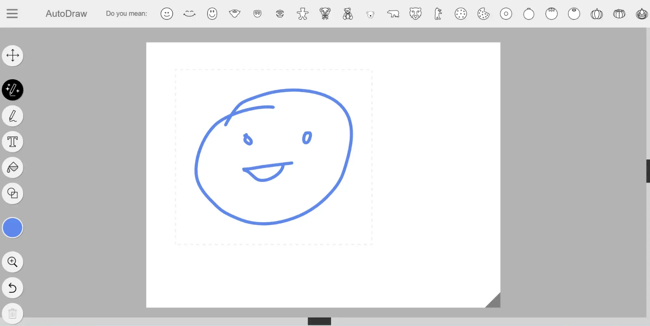
So, after selecting the right smiley, I tried to make the mouth wider. Sadly, Autodraw doesn’t take the whole drawing into account while suggesting shapes. The suggestions were way off — I definitely wasn’t trying to draw shorts.
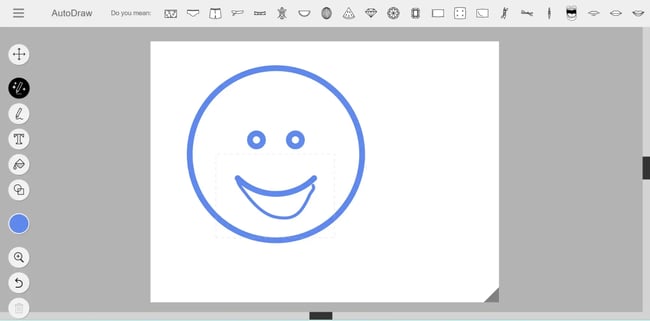
So, I went back to the drawing board (literally) and tried to get what I wanted with a single drawing. This time, I wanted to draw a girl.
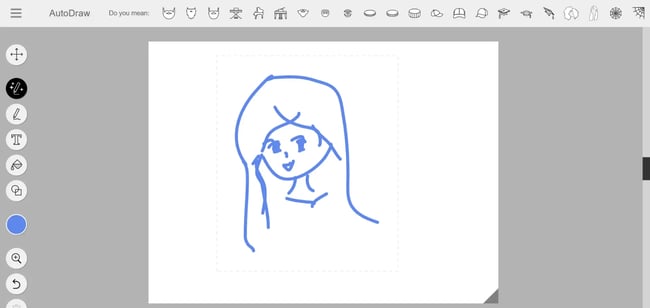
I knew my drawing skills were questionable, but I didn’t think it would suggest a beard when I was aiming for a girl. I guess the suggestion feature can only help with simple preset shapes, which is a bummer.
What I like:
- Simple to use, free, and very fun!
- A large range of icons as suggestions.
What can be improved:
- Complex artwork needs you to be a good artist (which I’m not).
- Doesn’t consider the whole artwork while generating suggestions.
- No option to upload custom images
Pricing: Get started for free.
Best for: Speeding up the design process.
HubSpot's AI Image Generator
Transform text into AI-customized images that perfectly match your content.
- Go to your preferred content tool
- Find the image generator feature
- Enter a text prompt or content input
- Generate and insert your image
5. Gemini
I first came across Gemini through AI-generated overviews in Google Search. Then, I saw it integrated natively with most of the products I use daily (Google Workspace, Pixel phone). So, whenever I want a convenient yet powerful AI tool option, I turn to Gemini.
Gemini is pretty good at deep research. It also has one of the best models for video generation with native audio (hello, Veo-3!). So, I was excited to test out Gemini for graphic design.
Test Results
Gemini’s UI is pretty similar to ChatGPT. I sent it the first prompt, and this is what I got.
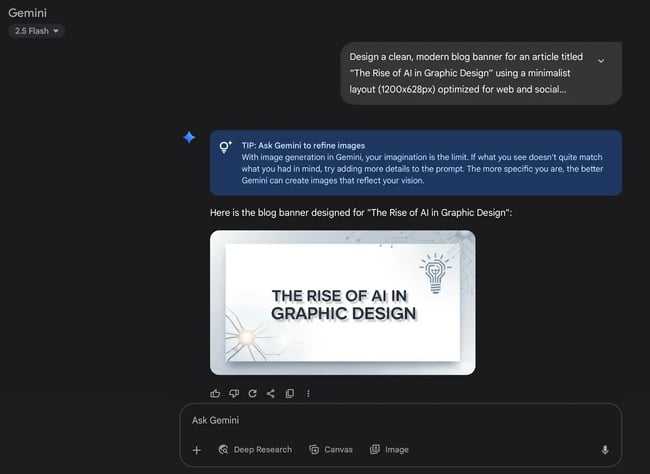
Decent text rendering, but I felt the image was too simplistic. The I tested it for the social media use-case. Here’s what I got.
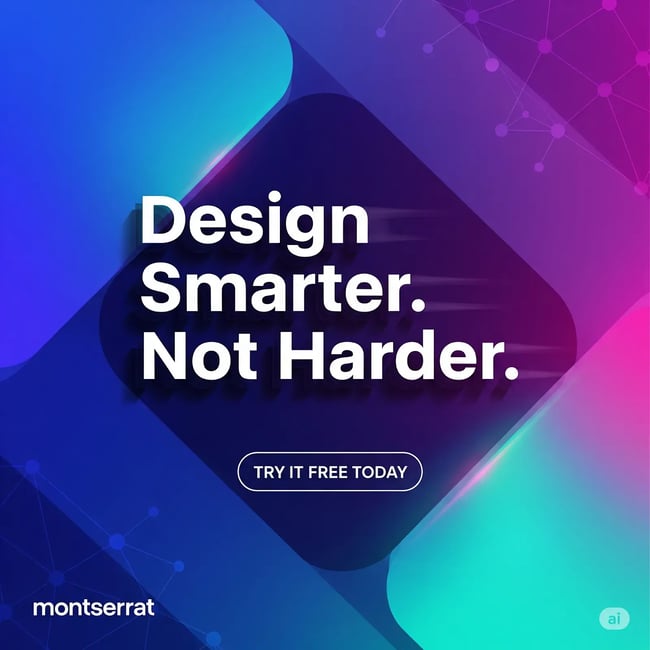
Much better, although not as good as what we got from the other tools like Ideogram. I’d rate it 6/10.
What I like:
- Intuitive user experience with decent design generation capabilities.
- Free to use with limited credits.
What can be improved:
- Free trials for video graphics.
- Native video editing features.
Pricing: Gemini is free for all Google users. Pro models available with paid plans, starting from $22.26/month with higher AI limits and video generation.
Best for: Brands looking to generate images and video in one tool.
6. Kittl
Honest confession? I wanted to try out this tool because of its name. Kittl! Isn’t that cute? Jokes aside, I didn’t know about this tool until I stumbled upon it during my research for this piece. But I’m so glad I did, because this is actually a very powerful yet free tool. Much like Canva.
The image quality isn’t one of the best ones on this list, but Kittl is great at customization. It lets you choose between multiple image generation models, even as a free user, which is rare from what I have seen so far (and I’ve seen many of these).
Test Results
You need to sign up with an email or Google to access Kittl. But thankfully, you don’t need to give any card details. Also, Kittl does not have a mobile app as of August 2025, so you need to use the web app like I did for this test.
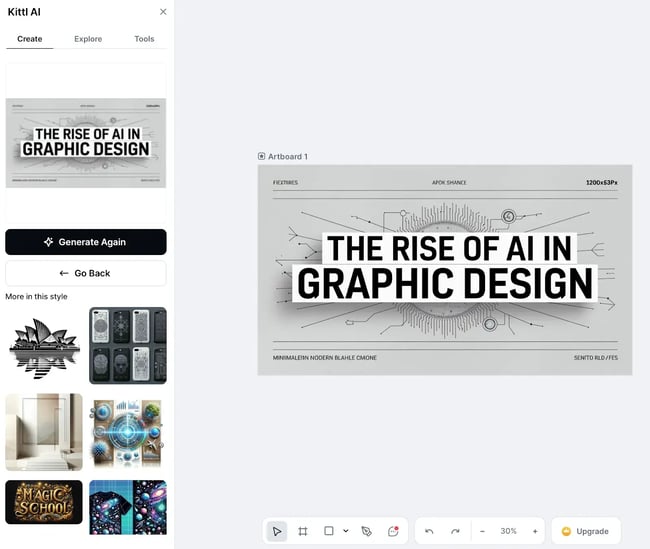
As you can see, Kittl’s UI/UX combines elements from Canva, Adobe Illustrator, and other top graphic design tools. While its AI certainly needs to evolve, let’s see how it fares with the social media use case.
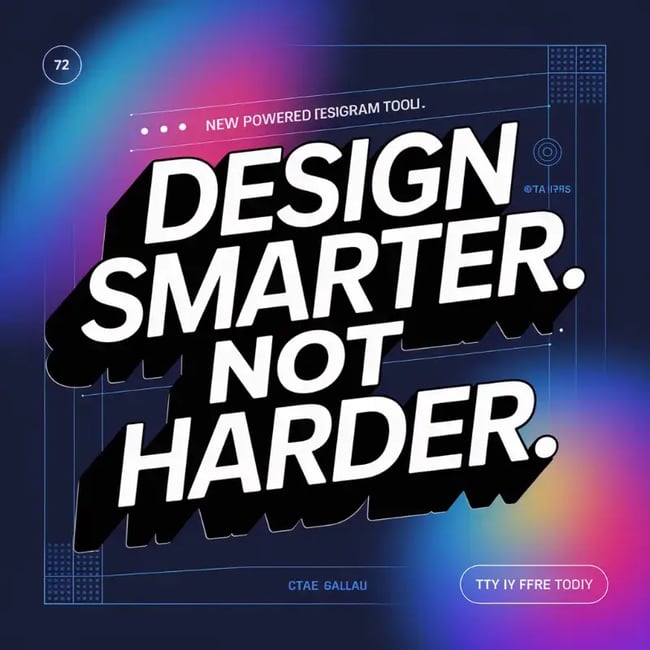
While this one’s much better from a design standpoint, the text was all over the place, so I checked if there’s an option to edit this. There wasn’t, but I stumbled upon the “Design Generator (Beta)” tool and decided to try it out. It returned this editable design.
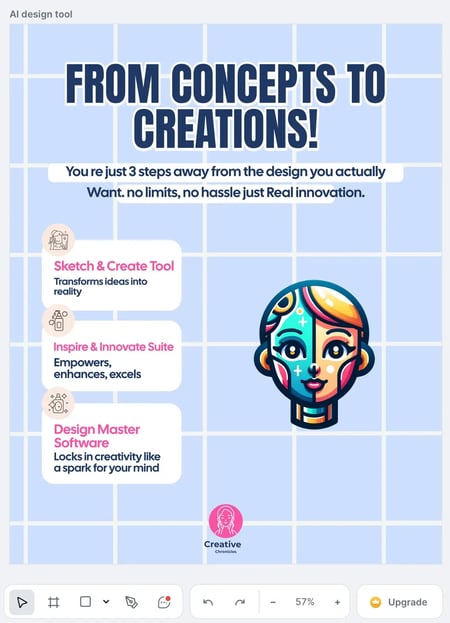
The design looks pretty clean, and I can work with it to make it better. The problem, however, is that you can only put 50-character prompts in Design Generator (Beta). Because of this, the output wasn’t aligned with my needs, and I had to edit most of the text to make it usable. That’s a lot of work for an “AI designer.”
What I like:
- Access to multiple AI models.
- Extensive customizability.
- Multiple AI tools clubbed into one.
What can be improved:
- Text rendering.
- Simpler UI for amateurs.
Pricing: Free access with limited credits. Paid plans start from $11.42/month.
Best for: Brands looking for a freemium alternative to Canva.
7. Adobe Express
Although I started my design journey Adobe tools as I mentioned earlier, I've been using them less and less over the last couple of years. I get most things done with ChatGPT and Canva now. However, I decided to give the web version of Adobe AI a shot after reading up on its AI features.
I first tried Adobe Express with simple logos, but the results were mostly subpar. Then I pushed through and tested more extensively for this article.
Test Results
In Adobe Express, you can create both templates and images using AI. Image creation uses Firefly 3, Adobe’s proprietary model. I tested the tool with this and got the following result for Prompt #1.
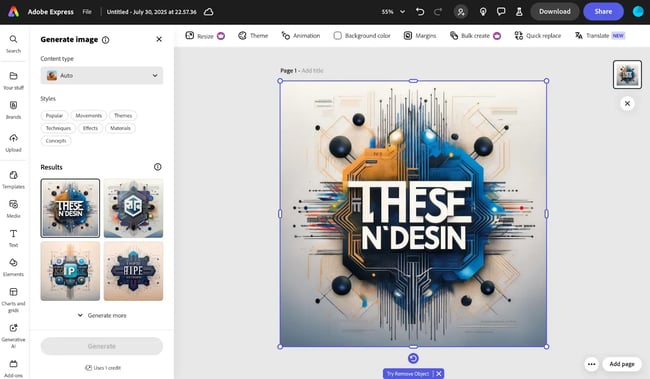
While the background had a lot going on, Adobe completely went astray with the text and layout, despite the detailed prompt. Thankfully, you can edit the text or add to it without leaving the window.
Then, I provided the social media prompt, hoping for better results. But…
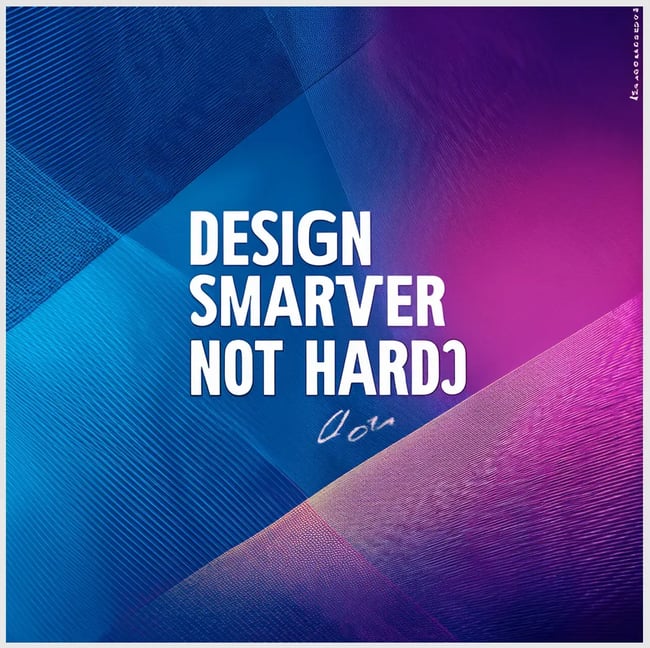
I don’t think I need to say much about the design or the text. Adobe is lagging significantly in the AI race, which is why it’s losing out on non-designers like me. It would be interesting to see how this impacts its market share and dominance over the next 2-5 years.
What I like:
- Integrated with the Adobe suite so that you can edit inline.
- Wide variety of professionally designed templates.
What can be improved:
- Prompt adherence.
- Text rendering.
- Overall image quality.
Pricing: Free to use with limited features. Paid plans start from $4.55/month.
Best for: Brands and marketers who have deeply integrated the Adobe suite into their workflows.
8. Designs.ai
I first heard of Designs.ai as an “Agency-as-a-Service” solution and got instantly curious about the idea. Although I haven’t used it extensively (mainly due to the hefty costs) I think the idea is intriguing.
You can do everything from logo design to text-to-speech for AI voiceovers using Designs.ai. For this article, I only tested the design part.
Test Results
You need to provide your card details to start the trial, which was quite annoying. Anyway, I went ahead with it for this article to see if it’s worth it. Here’s the output of Prompt #1.
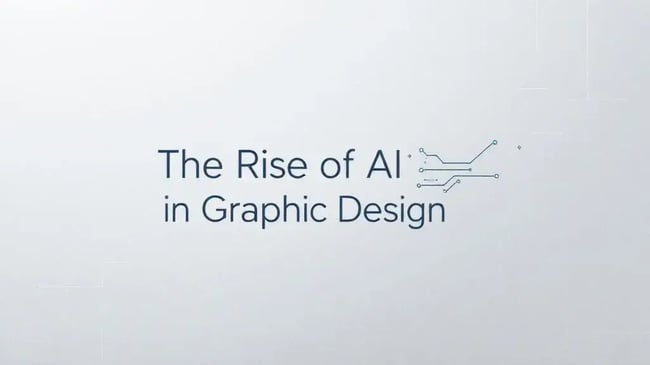
Well, at least design agencies don’t need to worry about Design.AI taking their job. At least not with banners or featured images for blogs. Let’s see if it does a better job creating graphics for social media.
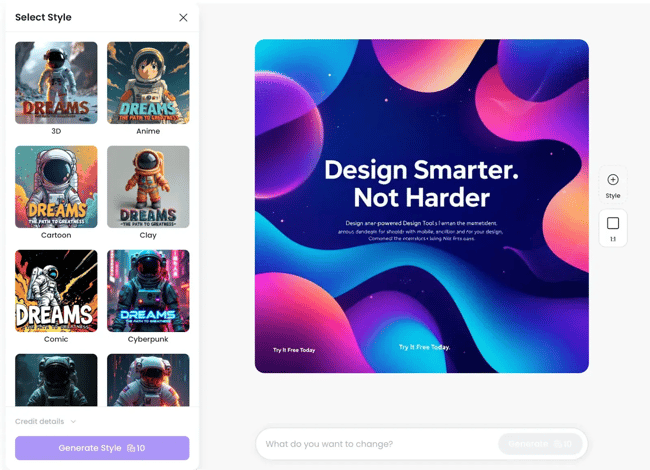
Except for the tagline, most of the other text is either smudged or gibberish. The layout isn’t very appealing either.
As you can see, there’s an option to select the style. But every time you select a style, change the aspect ratio, or make any edits whatsoever, you need to spend 10 credits. This way, you’ll exhaust the 1000 free credits in no time, which doesn’t make this tool worth it, in my opinion.
What I like:
- Interesting packaging and offer idea (although poor execution).
- Extensive product suite.
What can be improved:
- Free trial without card info.
- Relaxed rates limits or higher credit availability.
Pricing: 7-day free trial, followed by Basic plan starting from $29/month or $228/year ($19/month on yearly plan).
Best for: Brands working on multimedia campaigns that need an integrated tool with features for video creation, such as voice-overs.
How to Get Started With AI Graphic Design
The biggest mistake most people make when adopting an AI design workflow is trying to replace their entire process at once. The smarter approach is to start narrow, build confidence, and expand from there. Here's a practical framework for integrating AI graphic design tools into your work without disrupting what's already working.
Step 1: Start Small With One Use Case
Pick a single, repeatable design task and use AI for that one thing first. Good starting points include:
- Blog featured images — low stakes, high volume, easy to evaluate quality
- Social media graphics — fast feedback loop via engagement metrics
- Ad creative variations — natural fit for A/B testing with AI-generated alternatives
Resist the urge to overhaul your whole workflow on day one. The goal at this stage is to get comfortable with prompting, understand a tool's strengths and limitations, and build trust in the output quality before expanding usage.
Step 2: Build a Prompt Library
One of the most underrated productivity moves in any AI design workflow is maintaining a living library of prompts that work. Every time you get an output you're happy with, save the prompt that produced it — along with notes on what made it effective.
A basic prompt library entry might look like this:
- Use case: Blog banner, tech topic
- Tool: Ideogram
- Prompt: [full prompt text]
- What worked: Strong text rendering, clean layout, minimal background
- What to tweak next time: Increase contrast on headline
Over time, this library becomes a reusable asset for your whole team, reducing the trial-and-error cycle and making your AI graphic design generator produce consistent results faster.
Step 3: Create a Feedback Loop Between AI and Your Designer
AI output rarely goes straight to publish — and it shouldn't. The most effective teams use AI to accelerate the early stages of design, while human judgment refines and finalizes. Build a simple feedback loop that looks something like this:
- Generate — Use an AI graphic design generator to produce 3–5 concept directions
- Select — Choose the strongest direction based on brand fit and brief alignment
- Brief — Pass the selected concept to a designer with specific notes on what to keep, change, and polish
- Refine — Designer refines the AI concept into a publish-ready asset
- Document — Note what worked so your prompt library improves with each cycle
This approach keeps designers focused on high-value creative judgment rather than production tasks, while AI handles the volume and speed demands.
Step 4: Combine AI With Traditional Design Tools
AI graphic design generators work best when they're part of a broader toolkit, not a replacement for it. Here's how to think about the division of labor:
Task Best Approach
Generating initial concepts AI graphic design generator
Typography refinement Traditional tool (Canva, Illustrator)
Brand kit application Traditional tool with AI assist
Background removal/resizing AI tool
Final polish and export Traditional tool
A/B test variations AI graphic design generator
One often-overlooked step in the AI design workflow is where your finished assets actually live. If your team is publishing to a website, the handoff from design tool to CMS matters as much as the design itself.
HubSpot's AI Website Generator bridges that gap — you can build and publish a fully custom, AI-generated website through Content Hub, then drop in the graphics, banners, and visuals you've created with the tools in this list.
Everything lives in one place, connected to your CRM, without the usual back-and-forth between your design stack and your web team.
Step 5: Measure and Iterate
Once AI is part of your workflow, track its impact with the same rigor you'd apply to any other process change. Useful metrics to monitor include:
- Time to first draft — Has it decreased since introducing AI?
- Design revision rounds — Are AI-generated concepts requiring fewer or more rounds of feedback?
- Content output volume — Are you producing more assets in the same timeframe?
- Engagement performance — Are AI-assisted graphics performing on par with or better than fully manual designs?
Use these data points to refine which tools you use, when you use them, and how you prompt them. The teams getting the most out of AI design workflows aren't just using better tools — they're continuously improving how they use them.
FAQs About AI for Graphic Design
Is There an AI for Graphic Design?
Yes — and there are quite a few of them.
AI graphic design generators range from all-in-one platforms like Canva AI and Kittl, which combine template-based design with AI generation, to specialized tools like Ideogram, which focuses specifically on text-heavy graphics, and Midjourney, which is best known for producing high-quality artistic imagery.
The right tool depends on your use case, budget, and the design experience you bring to the table. The full breakdown of the best AI tools for graphic design is covered in detail above.
Beyond standalone design tools, if you're looking to bring your AI-generated visuals into a website, HubSpot's AI Website Generator is worth exploring.
It generates a full custom website — including layout, copy, and CTAs — from simple prompts, and integrates directly with HubSpot's Content Hub so your design and web presence stay aligned.
Can ChatGPT Do Graphic Design?
Yes, but with limitations. ChatGPT can generate images directly through its built-in image generation capabilities, and it performs reasonably well when given detailed prompts and visual references.
Where it really shines in a graphic design context, however, is earlier in the process — generating concept directions, writing design briefs, suggesting color palettes, and producing rough mockups to align stakeholders.
For final, publish-ready graphic design output, a dedicated AI graphic design generator like Canva AI or Ideogram will generally give you stronger, more consistent results. That said, if you already use ChatGPT heavily in your workflow, it's worth testing for design tasks before adding a new tool to your stack.
Is Graphic Design Still Worth It With AI?
Yes — and arguably more so than before. AI hasn't replaced the need for good design judgment; it's made that judgment more valuable. Anyone can now generate a passable graphic in minutes, which means the bar for what counts as a great design has risen.
What AI can't replicate is a designer's ability to understand brand nuance, make strategic creative decisions, interpret a brief beyond its literal instructions, and produce work that genuinely connects with a specific audience.
What AI does exceptionally well is handle volume, speed, and iteration — the production side of design that used to consume a disproportionate amount of a designer's time. The most effective setup in 2026 isn't AI instead of designers. It's designers using AI to do more of the work that actually requires human creativity.
What Is the Cost of AI Tools for Graphic Design?
AI graphic design tools are available across a wide range of price points, and most offer a free tier to get started. Here's a general breakdown based on the tools tested in this article:
| Tool | Free Tier | Starting Paid Price |
|---|---|---|
| Canva AI | ✅ Yes | $5.81/mo |
| ChatGPT | ✅ Limited | $20/mo |
| Ideogram | ✅ Yes | $7/mo |
| Autodraw | ✅ Yes | Free |
| Gemini | ✅ Yes | $22.26/mo |
| Kittl | ✅ Yes | $11.42/mo |
| Adobe Express | ✅ Yes | $4.55/mo |
| Designs.ai | ❌ No | $29/mo |
For most individuals and small teams, a budget of $10–$20/month is enough to access meaningful AI design capabilities. Larger teams or those with higher volume needs should look at mid-tier plans, which typically unlock more generation credits, brand kit features, and collaboration tools. If you're just starting out, the free tiers on Canva AI, Ideogram, and Kittl are genuinely useful starting points before committing to a paid plan.
Should you use AI tools for graphic design?
The results of my experiment proved one thing: AI hasn’t replaced the need for good graphic designers. If anything, AI has made it more important to understand how to differentiate a good design from a bad one.
My favorite AI tools in this list are ChatGPT (ideation), Canva (social media), and Ideogram (text-heavy stuff). While the concept of Autodraw was cool, I don’t think I can draw well enough to make the tool work for me.
However, editing with these tools is a bit of a pain. I can tell a human designer to edit or modify an image or design, pixel by pixel, in any direction. However, when I try to work with AI, it sometimes messes up, gives me the wrong text, or generates a different image altogether.
Bottom line? I’d recommend using AI tools for graphic design to quickly generate mockups, ideation, or base designs. While AI does speed up the design process by a lot, you still need a professional designer to polish it and make it publish-ready.
Editor's note: This article was originally published May 2024 and has since been updated for comprehensiveness.
HubSpot's AI Image Generator
Transform text into AI-customized images that perfectly match your content.
- Go to your preferred content tool
- Find the image generator feature
- Enter a text prompt or content input
- Generate and insert your image
Artificial Intelligence