
I also thought it was the perfect time to reach out, and I was right, because they were in the consideration stage. The editor said they already knew they’d need help from a partner like me — they just haven’t started searching for one yet.
As you can see from my example, understanding the different stages of the buying cycle can give you the confidence and knowledge you need to reach your ideal customers.
Table of Contents
What is the buying cycle?
The buying cycle, also known as a sales cycle, is a process consumers go through before they make a purchase. The buying cycle is used to help businesses market and sell to consumers by knowing what to market to consumers when. The buying cycle helps with creating content and closing sales for new and recurring consumers.
.webp)
Free Customer Journey Template
Outline your company's customer journey and experience with these 7 free templates.
- Buyer's Journey Template
- Future State Template
- Day-in-the-Life Template
- And more!
Download Free
All fields are required.
Online Buying Cycle
The online buying cycle is very similar to the traditional buying cycle, but the key difference is that it occurs online. Because it is online, many ecommerce sites and brands will leverage social media platforms and email marketing as tools to help market and sell to consumers and generate leads back to their ecommerce site. The buying cycle and online buying cycle go through the same five stages of closing a sale.
Why is the buying cycle important?
It helps improve conversion.
You know what they say — timing is everything, and the longer I am in marketing the more I can relate to this saying. The buying cycle allows you to understand where your leads are in the buying journey. For example, if someone googles “reasons for a high bounce rate,” you can tell they’re probably in the problem recognition stage.
Before choosing a solution, they need to identify the root cause of the problem — in this case, the high bounce rate. That’s a valuable insight. To attract leads at this stage, you could create educational content like blog posts or videos explaining why visitors might leave a site quickly. By serving the right content at the right moment, you increase your chances of turning prospects into paying customers.
It lets you identify bottlenecks.
When you have a buying cycle — and analyze what happens when leads move from one stage to the next — it’s easier for you to spot where most drop-offs take place. The same can be said about leads who eventually become customers, but who have spent too much time lingering in a specific stage of the buying cycle.
Say that you’re a SaaS, and plenty of leads make it to the demo stage, but very few convert to customers. This could mean any of the following:
- A problem with the demo itself, i.e., it isn’t convincing enough.
- The wrong people are being qualified.
- Salespeople need help handling objections better.
As you can see, without tracking the buying cycle, you wouldn’t know which stage to look at with a magnifying glass to find and resolve issues.
It lets you understand where to reach and appeal to your customers.
This taps more into the strategic planning side of customer sales (and even spans beyond it, as it can inform how and where to attract prospects in the first place).
For example, I once worked at a company that sold to B2B clients through both cold calls and cold emails. Over time, we saw a clear shift — emails began to significantly outperform phone calls.
It turned out that many of the people we were calling were constantly on the move, attending trade shows or jumping between meetings, and often working across different time zones. They rarely had the time to engage in a call or respond to follow-ups.
Email, on the other hand, allowed them to respond when it suited them — which led to more meaningful interactions and, in many cases, long-term business relationships. This kind of insight is exactly what tracking the buyer’s journey can reveal.
It helps build stronger relationships with customers.
One of the biggest benefits I’ve seen from using the buying cycle is building stronger relationships with customers. When you provide value at every stage of the customer journey, without pushing for a sale too early, you show that you actually understand and care about their needs. That builds trust.
Years ago, when I worked at a SaaS company, I noticed a lead downloading a guide about improving website conversion rates. Instead of jumping in with a sales pitch, I followed up with a friendly email sharing a case study from a similar business.
Later, when they moved into the decision stage, they reached out to me, unprompted, saying they felt like I understood their challenges. That relationship started with value, not pressure, and it turned into a long-term client.
When people see you as a helpful resource, they’re far more likely to stick around.
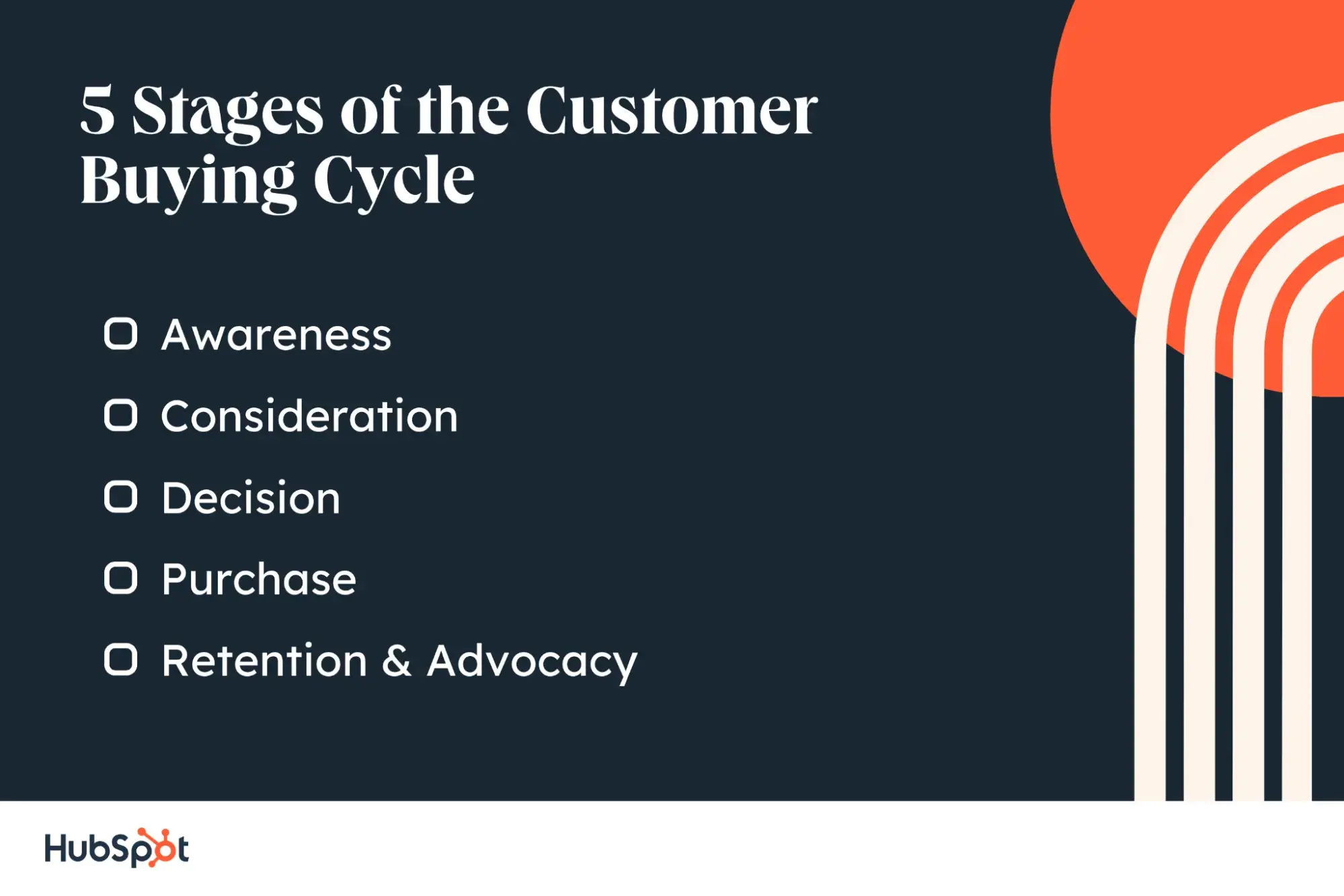
5 Stages of the Customer Buying Cycle
You can look at a customer's buying cycle as a customer’s purchasing cycle. Many customers go through stages during their purchasing process to educate themselves before they make a purchase. There are five buying cycle stages that you have to consider:
1. Awareness
Awareness is the first stage in a customer’s buying cycle when customers realize that they have a problem that needs a solution. They don’t yet know what options are out there, but they begin searching.
Companies try to reach their target customers in this stage by showing up in the places prospects are searching and providing answers to their questions.
For example, a customer is trying to lower plastic waste from water bottle usage. When she does a Google search, she finds an informational article on your blog for your company that sells water filters about the harms of plastic water bottles and why water filters are a more sustainable, healthier solution.
At the awareness stage, I recommend creating the following type of content to present your brand as a possible solution to the problem your leads are facing. Remember that the aim here is not to sell, but to create interest:
- Blog articles. SEO-friendly posts that answer common questions or explain problems (e.g., “Why Your Blog Isn’t Driving Traffic”).
- Social media content. Bite-sized tips, infographics, or thought-provoking posts that spark curiosity or discussion.
- Checklists or templates. Useful tools that solve small but nagging issues (e.g., Content Calendar Template).
- Educational videos or explainer animations. Short and engaging ways to introduce a topic or challenge.
- Podcasts or guest appearances. Great for thought leadership and tapping into new audiences.
The best content here is educational, helpful, and easy to discover.
Free Customer Journey Template
Outline your company's customer journey and experience with these 7 free templates.
- Buyer's Journey Template
- Future State Template
- Day-in-the-Life Template
- And more!
Download Free
All fields are required.
2. Consideration
This stage is where the prospect is considering their options. They have found a number of companies that offer various products or services that could solve their pain point. They tend to be in comparison mode, looking at features, prices, and quality of the different offerings they have come across.
In this stage, you can provide detailed information to explain how your product will help solve their problem. To go back to our example, after the customer has done some initial research into your company and competitor offerings, you push ads so your company stays top of mind.
Interested in the water filter, she clicks your ad and arrives on a landing page where you list the benefits of the water filter, such as cleaner water, more cost effective than buying bottled water, and gives a good boost in health. Once the customer understands that this product is what she needs to solve her problem, she will move onto the next stage.
Here’s the type of content I find that works well:
- Case studies. Show how you’ve helped clients overcome similar challenges, with real results.
- How-to guides. Go deeper into solving specific problems (e.g., “How to Build a Content Strategy for a SaaS Product”).
- Comparison content. Articles or videos comparing different approaches (e.g., In-House vs. Outsourced Content: What’s Right for You?).
- Webinars or workshops. Live or recorded sessions where you walk through a process and position your expertise.
- Email sequences. Nurture leads with curated content that speaks to their specific pain points and goals.
At this stage, you’re helping prospects evaluate their options and gently showing why your product/service might be the right choice.
3. Decision
In this stage, a salesperson aims to earn the trust of potential customers so that they choose to purchase from their company. Whether you tap them emotionally or logically, this is the time when a salesperson convinces the potential buyer that their product is the best solution for their needs.
For the water filter example, you could accomplish this through reviews from existing customers, highlighting the benefits of the product, prior customer satisfaction, and long-term cost savings.
Once the customer is convinced and has seen proof that the product works, they are ready to purchase.
Here are the types of content and actions you can take at this stage:
- Personalized product recommendations. Tailor suggestions based on the customer’s specific use case or needs.
- Customer testimonials and reviews. Share stories from real people sharing their experiences and results to build credibility.
- Product-centered content. Focused content that highlights specific advantages of key features.
- Comparison content. Side-by-side breakdowns of your product versus competitors or alternatives.
- Interactive demos or product tours. Allow prospects to explore how the product works in a self-paced but guided format.
- Limited-time offers or exclusive plans. Introduce urgency without pressure, encouraging decision-making.
4. Purchase
At this point, your customer is ready to purchase the solution for their needs. While your customer is in this stage, you need to ensure that your pricing is reasonable and you make the buying process as simple as possible.
At the purchase stage, your content and actions should focus on reassurance, support, and relationship-building. The customer has already decided — they just need confidence that they’re making the right choice and will be well taken care of.
For the water filter, you could offer your customer a free year-long warranty and next day shipping. Also, it would be key to provide helpful documentation on how to set up the water filter and a way to contact you if she needs help.
Here are the types of content/actions that are appropriate at this stage:
- Welcome emails. Set expectations, introduce team members, and share helpful links.
- Onboarding materials. A guide, video walkthrough, or FAQ page to show what happens next.
- Client portal or dashboard walkthrough. If relevant, a video or document that helps them navigate your tools or process.
- Customer success stories. Reassure them with examples of satisfied clients who saw great results.
- Introductory strategy session. Offer a 1:1 call to align on goals and make them feel supported.
- Behind-the-scenes content. A “meet the team” video or blog can humanize your agency and build trust early.
Remember, the purchase is just the start of a relationship with a customer, not the end. If you build a strong relationship with them, you will keep them in the buying cycle.
5. Retention & Advocacy
When the customer purchases, that is not the last step in the customer buying cycle. The final stage of the buying cycle is repurchasing your product or service and/or telling their friends about your brand. This is where you manage your relationship with the customers.
You don’t want the customer to be a one-time buyer. You will need to manage the customer’s relationship with your site to make them a returning customer. Maintain contact with the customer on their problem solving journey to make sure that the product works properly and that they are satisfied.
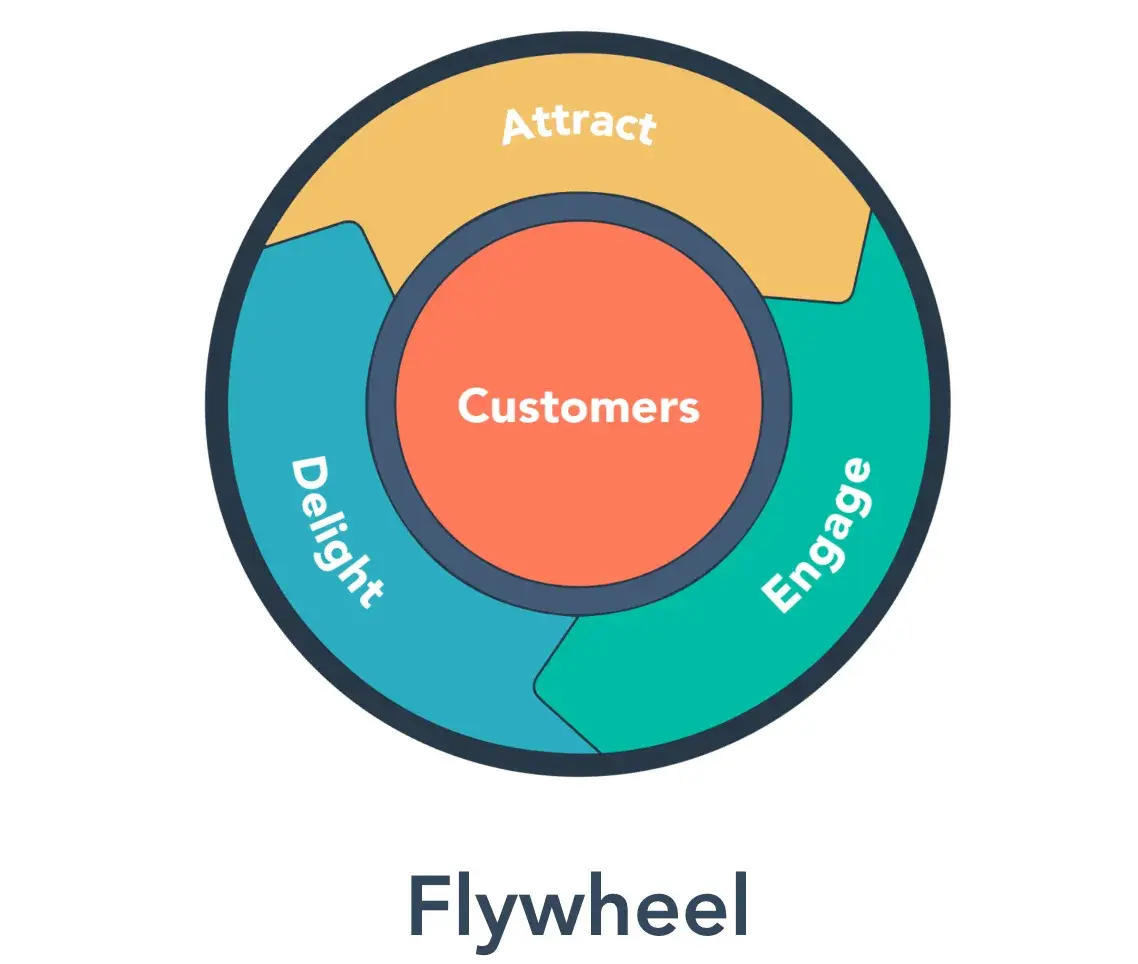
To get to repurchase, it’s imperative that the customer is happy and satisfied. In addition, in this stage, you can ask a customer for a review or a testimonial on how this product or service helped them with their needs.
I think some of the most effective actions to take at this stage include:
- Proactive check-ins with value updates. Regularly touch base to show how the product or service is delivering results, and highlight any new features or improvements they might not be using yet.
- Exclusive offers or upgrades. Offer special pricing, bonus features, or early access to incentivize renewal or upsell opportunities.
- Personalized renewal reminders. This will appeal particularly to subscription-based businesses. Send tailored messages that reflect the client’s usage, outcomes, and potential next steps, rather than generic renewal notices.
- Referral or advocacy programs. I was very surprised when I first learned about this, but “referral contagion,” as HBR calls it, is a real thing. Existing customers typically bring in between 30-57% of new customers through referral programs. I recommend inviting satisfied clients to share their success stories with their community. This will turn them into champions and strengthen their long-term connection to your brand.
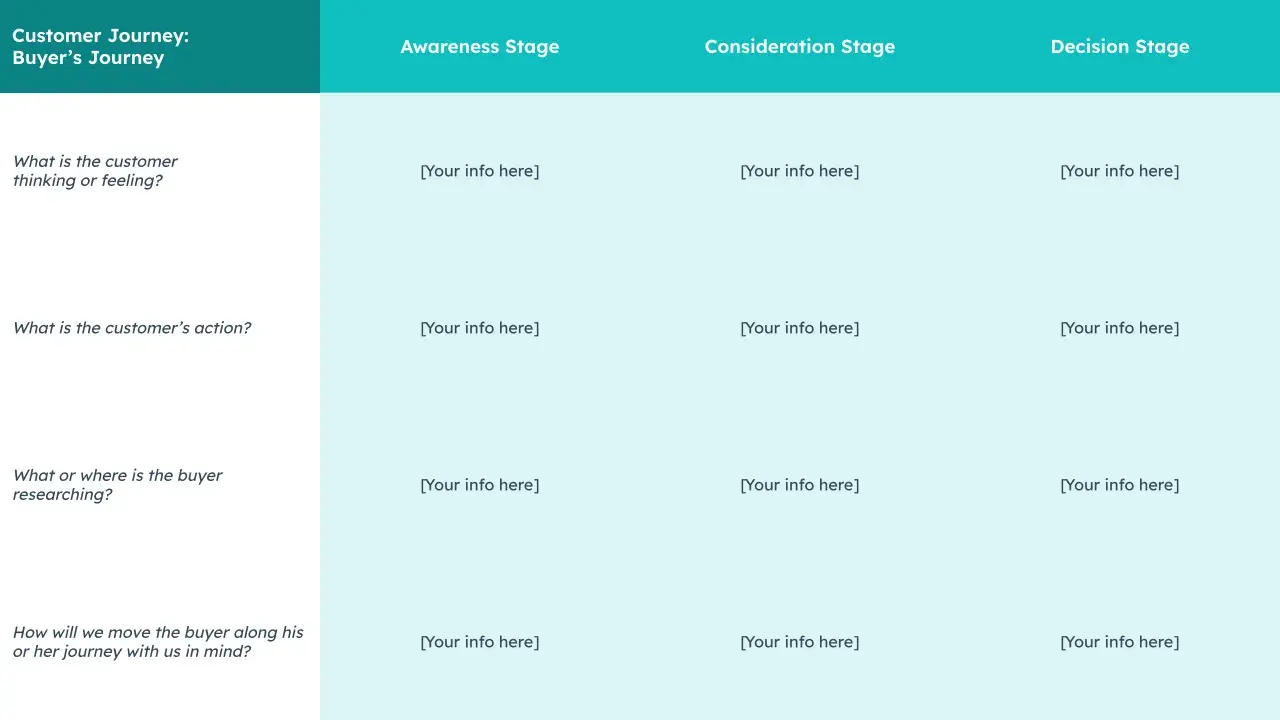
If you’ve never mapped out the buyer’s journey before, then you might find our Free Customer Journey Map Template very helpful. It will help you understand your customers’ goals and needs at each stage, and decide on how you can best meet them to secure higher conversions.
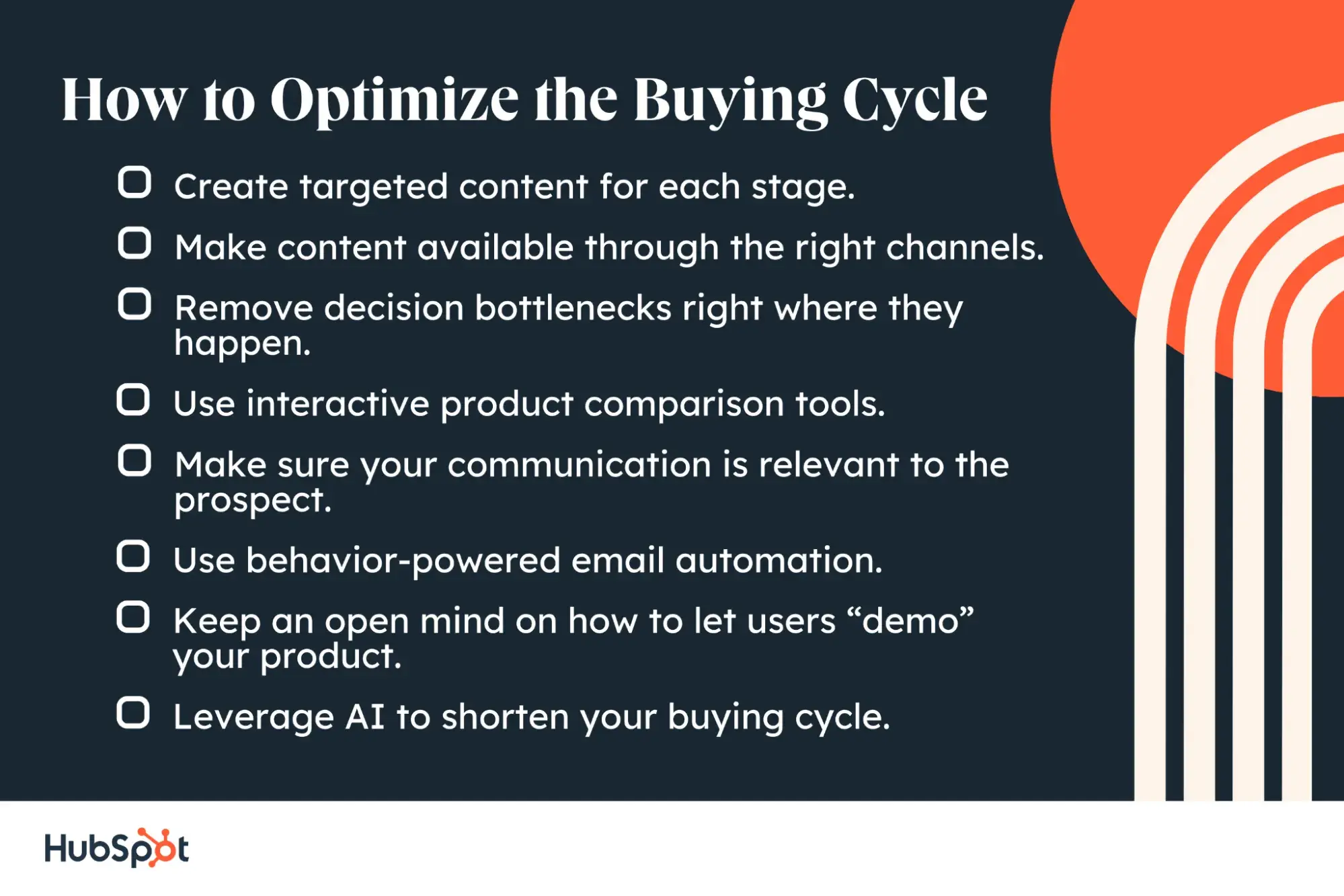
How to Optimize the Buying Cycle
Create targeted content for each stage.
As I highlighted above, providing the right content for each stage of the buying cycle is key to engaging prospective customers. To get started with “targeted content,” you need to answer the questions which are related to specific buying cycle stages.
But how do you know what your customers are searching for so you can provide relevant information? The answer lies in search queries. Look at this example:
If someone searches for “flat screen tv,” I know that customer is in the awareness stage because it is a generic term seeking general answers. However, if they search for “Compare flat screen tvs,” I read the desire to compare products as someone further along, such as the consideration or decision stage.
Finally, if someone searches for “Sony 42 in lcd,” they are definitely in the decision or purchase state since it is a very specific product query. They are likely evaluating prices from various vendors.
After you’ve identified the queries customers use for each stage, the next step is to create content that moves customers closer to purchase. For example, look for keywords that are related to the awareness and consideration stages. Using the previous example, I could provide a guide to selecting the perfect flat screen TV.
For the decision stage, leveraging customer testimonials, providing specification sheets, and telling your brand story will help push prospects closer to the purchase stage, which is the perfect time to use a PPC ad with text that entices them to buy. To lead them towards retention, you can send monthly newsletters with helpful tips and tricks that will keep your brand top-of-mind.
Free Customer Journey Template
Outline your company's customer journey and experience with these 7 free templates.
- Buyer's Journey Template
- Future State Template
- Day-in-the-Life Template
- And more!
Download Free
All fields are required.
Make content available through the right channels.
Once you make relevant content for each stage of the buying cycle, you need to put it in places where prospects are most likely to find it. And “the right place” depends on the stage they are in.
Of course, the content you share is fully dependent on the product you offer and the profile of your customers, but I’ve found there are basic commonalities on how to market in each buying cycle stage:
- Awareness. For the majority of ecommerce sites, this is all about being found via search engine marketing, particularly PPC and SEO.
- Consideration. Once customers find you in search engines, keyword-tailored landing pages are essential. You can also use comparison charts that highlight the key selling points to help you stand out from the competition.
- Decision. Your website should do the talking here, especially your product descriptions and overall branding. This is a critical stage in capturing contact information.
- Purchase. Get your coupons and discounts out there, whether it’s through your PPC ad text, a pre-sales email, or social media.
- Retention & Advocacy. Keep in contact with your customers via scheduled emails, social media, and personal outreach. Your customers are your best growth opportunity.
Remove decision bottlenecks right where they happen.
I dare to say that most companies’ dream is to shorten their buying cycle. And the best tactic to do so is by eliminating friction at different stages of the purchasing decision. This is the kind of approach that Rick Slot, chief editor at Slotozilla, follows.
“We sped up the buying cycle by removing decision bottlenecks right where they happen, just before the click. Instead of asking users to “learn more” or jump between pages, we gave them everything they needed in one view: feature comparisons, pros and cons, and key metrics. That shift alone boosted demo engagement by 38%,” said Slot.
The tactic applies anywhere, buyers stall when they’re forced to guess or chase info. The more confident they feel on the page, the faster they move. Confidence shortens the cycle. Every time.
Use interactive product comparison tools.
Luca Dal Zotto, co-founder of Rent a Mac, told me that the team has entirely transformed their buying cycle by using interactive product comparison tools. This enables prospects to view side-by-side specifications of various Mac models and rental price options.
The shift eliminated their most significant friction point within their sales process — customers’ lack of knowledge about which Mac model suited their particular needs.
“After we rolled out this feature, our conversion rate grew 37%, and the average sales cycle went from 6 days to a mere 2.5 days. Customer surveys showed that 83% of the buyers found the comp tool to be ‘extremely helpful’ in their decision to lease, and sales teams experienced a 41% decrease in the time it took to answer questions regarding specifications,” he added.
This straightforward, data-driven solution turned a significant pain point into a competitive advantage.
Make sure your communication is relevant to the prospect.
I love good content, but when I receive something pushy or irrelevant, I get mad (and I’m sure many others do too). Effective marketing is about timing, understanding your clients, and showing empathy — no one likes being sold to!
That’s something Kevin Moore, CEO of WalterWrites.ai, fully understands. He told me that he is in charge of making sure buyers don’t feel like they’re being sold to — they should feel like they’re making the choice. That mindset shift shaped how they redid their entire sales enablement.
“We rewrote every email to speak directly to one pain point. Each message shared one practical tactic the prospect could use, even if they never bought from us. No mention of features unless it solved the specific problem,” said Moore.
For instance, if they were targeting educational institutions, they said, “Here’s how to help faculty save time checking student outputs” instead of “WalterWrites helps you humanize text.” For marketing professionals, they said, “Most AI tools make your content sound the same — here’s how to avoid that,” instead of listing automation features.
“That simple switch led to a 27% spike in qualified replies. Prospects felt seen, not targeted. And when they booked, they already understood how we could help. We didn’t increase volume, we increased relevance. That made the buying process feel like a consultation, not a chase,” he added.
Use behavior-powered email automation.
If email is one of your main lead generation or sales channels, then it’s worth using an email platform that will automatically adjust your email content based on users’ behavior on your other owned channels.
That’s what Joy Ramos, operations manager at The Trade Table, says their company did to boost conversions.
“We used to send the same emails to everyone, but it didn’t work well. So we started sending emails based on what people did on our site — like viewing a product multiple times or leaving something in their cart,” Ramos said.
If a customer checked a product multiple times, the new email platform would trigger a follow-up email with content like reviews or a side-by-side comparison that would help the person decide which direction they’d like to proceed.
Ramos said that implementing the new email tool led to a 37% increase in email conversion rates. It also helps accelerate customer purchases. “The biggest lesson I learned? When your emails match what people actually prioritize at the moment, they’re more likely to take the next step.”
Keep an open mind on how to let users “demo” your product.
I’ve already mentioned how, as a digital product or service like a SaaS, running a free online demo can be a great way to convince leads in the final stages of your buying cycle. That said, this doesn’t mean that you can’t use a similar tactic if you sell online, but offer a physical product.
Barbara Stern, owner and sales manager at Ottoman Textiles, told me that offering what she calls a “fabric swatch sampling system” was a game-changing tactic for her ecommerce store.
“Thus far, many customers were resistant to buying online since they could not feel the fabric with their hands or judge its real-life color in their space,” Stern said.
After seeing that this was the stage during which most leads dropped out, the company introduced an additional step. Shoppers were now able to order five free samples, only covering the shipping fees. If they did decide to buy any of the tested fabrics, these fees were also reimbursed against their order.
“Results came in fast and tangible. Our abandonment rate decreased by almost 25% in the first two months, and our sample-to-sale conversion rates achieved around 42%,” Stern said.
Adding a free sample stage to the buying process also reduced back-and-forth conversations between the company’s sales reps and customers. The average sales process was now cut down from an average of 10 to 14 days to 3 to 5 days. Trust was built, and the company’s online window shoppers became confident buyers.
Leverage AI to shorten your buying cycle.
Finally, I think AI can be a great ally when it comes to optimizing your sales cycle. Businesses have seen it increase their ROI by 10-20%. Although the right AI tool will depend on your individual buying cycle and where you most need to optimize, here are a few key ways I think AI can enhance your customers’ buying experience:
- AI can streamline your sales cycle by using predictive analytics to qualify leads so your sales team can engage only with leads who are more likely to buy.
- It can provide personalized recommendations for customers in the awareness and consideration stages, so they have to do less work to discover your offerings.
- Automatic nurture campaigns keep your prospects engaged while saving your sales reps' time. Automated email sequences have led to a 66% increase in positive responses.
- AI can create dynamic pricing to keep your offering competitive, or it can automatically tailor deals for individual customers.
- In the decision and post-purchase stages, an AI chatbot can respond to customer queries 24/7 so they feel supported whenever they need it.
Create a meaningful customer buying cycle.
Over the years, I’ve learned that constantly chasing the next sale isn’t a sustainable strategy. Customers aren’t all standing at the same gate — some are just discovering a brand, others are considering their options, and a few are ready to buy.
It’s up to companies to meet them where they are and guide them forward with the right message at the right time.
When I approach marketing this way — with empathy and strategy — I see stronger relationships, better results, and a more dependable customer pipeline. It’s not just about selling anymore; it’s about building trust and creating a journey that makes sense for everyone involved.
Editor's note: This post was originally published in July 2011 and has been updated for comprehensiveness.
Free Customer Journey Template
Outline your company's customer journey and experience with these 7 free templates.
- Buyer's Journey Template
- Future State Template
- Day-in-the-Life Template
- And more!
Download Free
All fields are required.
Buyer's Journey