
Your agency is doing great work. Your clients love you. You’ve got a team of smart, talented creatives, strategists, and digital marketers.

But you’re not getting the attention you want -- even deserve.
Gaining attention from the press and getting published in industry publications is one way to build your agency’s brand, increase your visible expertise, improve your credibility, and win more new business.
But it’s not easy getting the attention of editors and writers. You’re not the only one vying for attention. According to U.S. Department of Labor, editorial voices are outnumbered by public relations professionals by almost 5:1. At some top-tier publications, journalists see 26,000 press release pitches per year – out of a total of 38,000 emails.
Download Now: Free Press Release Template
To deal with this daily volley of both targeted and irrelevant pitches, editors and journalists becomes experts at triaging their email to delete distractions. And if you emulate the bad -- even if you have something valuable to say -- your PR pitch will be sent to the trash bin.
According to Fractl, 70% of publishers are open to getting pitched ideas that fit their beat. While the PR-journalist relationship sometimes seemed strained, most editors truly value the relationships they have with people who can point them to interesting stories, can provide insightful quotes and commentary on recent news, and can send them in the right direction when they need more information on a trend or subject.
How to Email Your Press Release Pitch to a Newspaper Editor
What journalists don't need are more emails that start with lines such as these (and the following are real examples):
- Can you post my blog?
- I would really appreciate if you could intimate me with your decision.
- I know you’re busy and all, but could you RESPOND?
If you can get an editor’s attention for the right reasons -- because you approach the relationship correctly and understand what that person needs -- you can build a relationship of trust, which will ultimately lead to you to getting more attention, more press, and hopefully, more referrals and clients.
This can help your agency stand out and compete in a crowded market.
But first, you need to know how editors work and what they want to see in a press release pitch. Otherwise, you might find your PR efforts relegated to the archive bucket.
10 Tips for Formating a Press Release Pitch that will Grab PR Attention For Agencies
- Provide Context to the Editor
- Provide a Perspective
- Don’t Treat Them Like Your Customers
- Follow Their Lead
- Be Helpful
- Write Clear, Compelling, Simple Email Subject Lines
- Treat Them Differently Than Content Distributors
- Make the Pitch Easy to Read
- Build Relationships
- Maintain Traditional Business Communications
1) Provide Context to the Editor
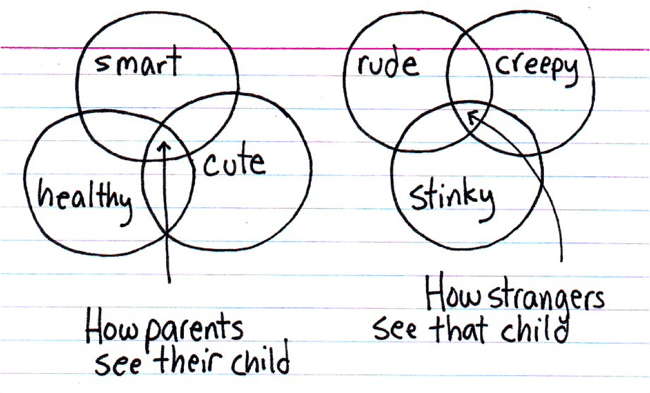
We all want to think we are special, unique unicorns. But this is not how editors will see you -- unless you give them a reason.
Source: Indexed
Public relations is about building and maintaining relationships. So you have to explicitly tell the editor why she should want to pay attention to you, your agency, and what you have to say.
This is not the way to get an editor's attention:

Because most people provide zero context for why they are crowding up an editor’s inbox, you’ll stand out by stating a few simple facts:
- Your name and title
- Company (hyperlinked)
- Two sentence or less description of what your company does and how it fits into the competitive market
- Credibility markers such as recently published guest posts in other publications, links to in-depth, high quality content published on your blog, LinkedIn, Medium, etc., and recent awards won or recognition by authoritative sources
2) Provide a Perspective
For editors to tell good stories, they need great characters. They need characters with personalities, opinions, their own great stories to tell, and a perspective.
When pitching an editor, make sure you emphasize your agency’s point of view or the point of view of the executive you are putting forth as an expert source. What have you taken a stand on? How is your opinion different from that of your competitors?
Your agency needs to be bigger than its outputs. This is what makes a source or a company memorable.
Consider these examples: SoulCycle doesn’t just promote its studios as places to find good spin classes. Its studios are where people go to both sweat and find inner peace and inspiration. It’s brand and messaging are about empowerment, intention, and community; not stationary bikes and calorie counting. Or how about Lego? Does it focus on the fact that it makes toy bricks? Or does the brand promote its ability to foster play and encourage imagination in people of all ages?
These two points of view connect these brands with concepts beyond their products and services.
Consider what the biggest problems facing your industry are. How do you believe things should change? What are possible solutions? When editors know that you have a specific perspective -- or they can perform a Google search and stumble upon your opinion -- they will reach out to you for commentary and opinions on a new research report or a news-worthy item. You have to go beyond the five tips and four ways to do x, y, or z to get the attention of reporters.
3) Don’t Treat Them Like Your Customers
This is a problem I run into quite a bit when working with guest authors.
They pitch article ideas and stories that appeal to their prospects and customers, not the readers of the publication. This means most of the article ideas are for “beginners” or those trying to educate themselves about an industry, while the readers of a publication have most likely already read content on those introductory concepts because the publication has already covered it.
An example of this would be:
- Pitch based on customer persona: How to Conversion Optimize a Blog Post
- Pitch based on readership:7 Little Call-to-Action Tweaks That Could Give Your Conversion Rates a Big Bump
A marketing-focused publication has most likely already outlined best practices for conversion optimization, but it might not have discussed conversion optimization of CTAs.
Here's an example based on the HR industry:
- Pitch based on customer persona: Why Recruiting Is Important to Your Business
- Pitch based on readership: How to Recruit the Best Candidates Without Ever Meeting Face-to-Face
In this instance, an HR company might want to write about the benefits of recruiting to educate small businesses, but an industry editor -- who reads content on HR every day -- has written about this subject numerous times, read about it hundreds of times, and been pitched on the subject multiple times.
You can cover similar topics, but you need to find a unique angle or a new approach.
4) Follow Their Lead
Journalists are conditioned to be allergic to sales and self-promotion. They’ve been trained to be able to separate what matters from the nonsense.
Now, we’re not all pitching the New York Times or Wall Street Journal on a regular basis, but that doesn’t mean you get to just make up -- or worse -- ignore the rules.
Adhere to best practices, including:
- Cite information using credible sources.
- Double check the spellings of brand names, products, and people.
- Provide helpful links to outside resources and data.
- Don’t make assumptions.
In addition, disclose conflicts of interest. This can be as simple as saying, “Our client experienced this when she … .” There’s nothing more frustrating for an editor than reading an article only to find out every example and brand is a somehow connected financially to the guest contributor.
Finally, approach writing the pitch or the guest post with the intention of telling a story. While brands may have co-opted the term storytelling for advertising purpose, this idea is the basis of what all writers and editors do -- it’s their job. Pull in unique examples, highlight trends, and give insider advice. This last item is especially important.
5) Be Helpful
Many guest posts that are sent my way start in the same way:
“At X company, we believe that … .”
The mention of the company name and the bright blue hyperlink basically says, “Hi valued reader that knows nothing about me or my company, don’t read this article even though that is why you are here. Just click this link to LEARN MORE and BUY NOW!”
This is exactly what editors want to protect their readers from.
And while leads and sales might be the benefit from a proactive PR and content marketing strategy, these should not be the goals associated with the outreach. Your goals should be more aligned with increasing the visibility and credibility of an internal expert and your agency and gaining backlinks from high authority websites.
Now, this doesn’t mean your content won’t lead to ROI. According to Skyword, editorial content that offers in-depth insights is the most influential content type during the purchase process.
Editorial content personalizes your company, and people want to buy from companies whose values and ideas align with their own. Guest posting is a great way for your target audience to learn more about what your agency does, to get to know your leadership, and to trust you.
6) Write Clear, Compelling, Simple Email Subject Lines
The below reveals what an editor might typically see in her inbox.
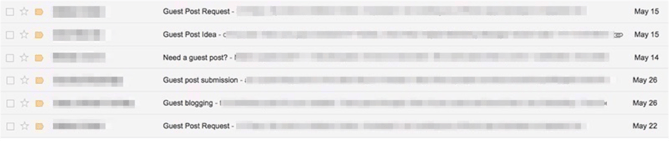
Riveting, right?
According to the Fractl study, 85% of writers surveyed said that they open an email based on its subject line. And you’re probably familiar with this commonly cited stat: 8 out of 10 people will read headline copy, but only 2 out of 10 will read the rest.
Yet, people spend hours writing up email pitches and quality articles and neglect considering the impact of a subject line before dashing off the email.
If the subject line isn’t interesting, why would an editor conclude that your pitch is worth her time?
Subject lines should be simple, clear, and compelling.
Here are a few examples to copy from:
- Ad blocking leads to higher customer engagement. HubSpot’s CEO explains the data. [Guest Post]
- How meetings are going extinct at one agency. [Interview Opp]
- 85% of publishers are not ready for mobilegeddon. [New Research]
7) Treat Them Differently Than Content Distributors
Here are a few common requests I receive:
- Do you have any ideas?
- Can I write for you?
- What topics are you interested in?
All these questions lead to time-consuming and confusing communication between the editor and the PR rep.
Do your research. Most sites that accept guest posts publish guidelines for submitting articles, best practices, FAQs, and examples of well-written articles.
Try Googling one of these options:
- Write for X site
- Guest post X site
- Industry keyword (such as marketing, sales, human resources, etc.) submit guest post
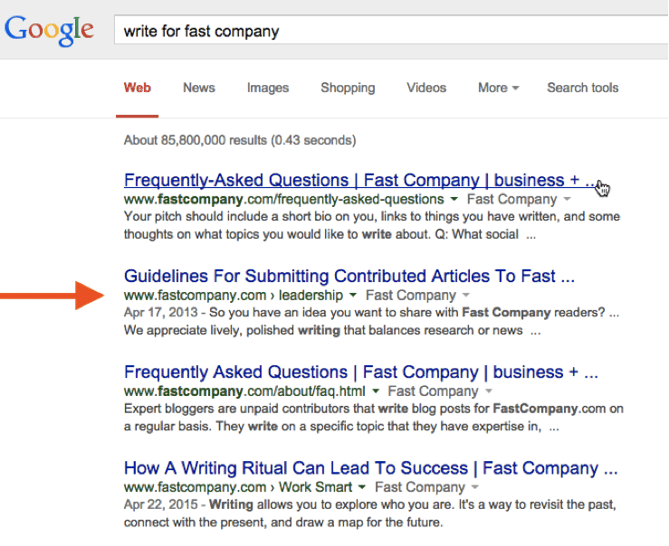
You can find the main topics and categories a site covers by reviewing articles and the site’s tagging structure. Agency Post has a dedicated topic page that lists how we categorize our posts.
It’s also more efficient and appreciated by the editor if you send over a completed article stating that you are willing to make changes to get it publication ready or an in-depth outline of an article. Emails with questions such as, "Can I write for you?" or "Can I send you an article on X topic?" won't help the editor to determine if the article is a good fit. Most likely, that email will just be ignored as it’s an unnecessary step.
8) Make the Pitch Easy to Read
Too often, PR pitches are way, way too long. I receive many that are longer than 1,000 words; one even I even clocked in at over 2,500.
According to the Fractl study, 45% of writers want pitches to be less than 100 words, and 43% want them to be less than 200 words.
When writing pitch emails, follow the best practices of writing for online audiences:
- Use bullet points
- Bold important pieces of information
- Link to more information: videos, images, product tour, demos
- Keep paragraphs short
- Put the most important information at the top
- Try including a short and longer version --TL;DR
- Attach press releases or include them at the end of the email
- Avoid jargon: game-changing, revolutionary, disruptive, paradigm, holistic
9) Build Relationships
While it can be tempting to draft a generic pitch email and mass BCC a huge list of contacts, it’s not a great way to build a relationship with editors and reporters.
It might take more time to write more personalized emails, but it will lead to better media placements and more real connections with journalists.
In your email, mention how you were introduced to the writer or the publication. Mention previous articles you’ve read that led you to believe that your pitch would be relevant to their readers. A little flattery never hurt, especially for journalists. If you’ve ever spent time perusing the comments section of some publications, you know that it is not a place where you gain self respect.
10) Maintain Traditional Business Communications
I know it’s frustrating. You spend all that time crafting the perfect pitch only to hear … nothing. It’s not ideal for either party, but as we stated earlier, there are so many more people pitching and a lot of these people are pitching irrelevant information, which drains an editor’s time.
You should assume that the journalist read the pitch, but you should also follow up at least once -- and no more than three times. Use an email tracking system or one of these PR monitoring and tracking tools to see if and when the journalist opened your email. If you don’t hear anything back, you can assume that it either wasn’t a good fit or isn’t a good fit now. Editors have capacity issues, schedules to adhere to, goals, etc., so while she might not have time to do an interview with your agency on a recent report you published, she could publish a guest post or an infographic. So ask if the reporter wants the content in a different format. This can be a great way to begin a relationship. Once the editor trusts the content you create, she will feel more comfortable reaching out to your team for a quote or commentary on a subject.
And don’t be intrusive. If you don’t hear back, don’t start blasting the reporter with pitches through LinkedIn, Twitter, and Facebook -- unless the reporter specifically says that she accepts pitches this way. Otherwise, keep to traditional business communication channels.
Plus a Bonus: 2 PR Email Pitch Templates
Finally, I want to make it easy on you to reach out the editors in the right way. Customize these two agency pitch templates to make it easy to do more proactive outreach and get a better response from your PR efforts.
Guest Post Pitch Email Template
Hi [First Name],
My name is [Full Name], CEO of recruiting software firm [Company Name]. We believe companies need to remove explicit and implicit bias from their recruiting process so they can hire the best, most qualified candidate for positions.
In the past, I’ve written about running face-to-face interviews for Entrepreneur [include link], and I recently published a piece on best practices for hiring based on skills-based tests [include link] for Fast Company.
We’ve read your submission guidelines and would like to submit for your review a guest post: How to Run an Anonymous Recruiting Program
In it, your readers will learn [list 2-3 key elements of the article]:
- How bias plays into the hiring process -- specifically the science behind our “biased brains”
- How to reduce its influence on candidate selection with anonymous recruiting
- A model for running an anonymous recruiting with step-by-step instructions
Here’s a key point from the article:
“[Insert quote from the article]…”
I’ve attached the article and a short bio. You can grab a headshot here [link to image]. Please let me know if you have any questions.
I appreciate you taking the time to review.
Thanks,

New Coverage Pitch Email
Hi [First Name],
I’m reaching out to share a look at a new study on bias in the recruiting process from [Company Name]. We’re a recruiting software company that believes that more of the hiring process needs to be done online and anonymously to remove implicit and explicit bias in the hiring process. This is so companies can find the best candidates for the job that needs to be done.
This interesting report [title] reveals:
This is relevant due to the recent news about [detail relevant industry trend].
If you’re interested in covering, let me know. I would be happy to put you in touch with our CEO, [name + link]. He can speak on why we did the study, which findings were most surprising, and the action items for recruiters.
Here’s a link to the study: [include tracking URL + don’t put behind a form]
Thanks,

Public Relations