
However, content marketing is constantly changing. And it definitely doesn’t look the same as it did 10 years ago.
To fully understand the evolution of marketing, we need to understand both where it’s been and where it’s going. In this post, we’re going to take a look at how content marketing has evolved in the past decade and how it’s going to evolve in the next one, according to expert predictions.
Table of Contents
The State of Marketing in 2025
HubSpot's Annual Inbound Marketing Trends Report
- Top Marketing Channels
- AI in Marketing
- Managing Privacy
- The Future of Marketing
Download Free
All fields are required.
How Content Marketing Evolved in the Past Decade
Google changed the game.
In 2011, Google conducted its landmark Zero Moment of Truth (ZMOT) study.
It found that 88% of shoppers use what’s known as a Zero Moment of Truth — a discovery and awareness stage in a buying cycle where a consumer researches a product before buying it.
Google’s research also indicated that word of mouth was a definitive factor in swaying that moment.
The study provides a unique point of reference in the context of content marketing’s evolution. It captures the essence of how and why businesses needed to focus on content marketing at the beginning of the 2010s.
It was tacit evidence that companies’ stories were being told online — well beyond the control of their marketing departments — and it was in their best interest to help shape those conversations.
Search Engine Optimization (SEO)
The ZMOT study highlighted the need for sound Search Engine Optimization (SEO). Ranking for relevant keywords on search engines became all but essential to bolstering a company’s online presence and holding up during consumers’ Zero Moments of Truth.
But, that study wasn’t the only bombshell Google dropped in the early 2010s.
Around the time the study came out, Google’s search ranking algorithm changed to discourage “keyword stuffing” — the practice of repetitively loading a web page with specific keywords to try to sway search engine rankings.
Since then, Google’s search engine results have shifted to more thorough and relevant content.
Many companies and services like Captain Words have leveraged these algorithm changes to provide optimized articles with extensive research.
The change represented what is still a continuous effort by Google to provide users with positive, helpful online experiences. And it did just that. The shift set the stage for businesses to focus on producing more high-quality, meaningful content.
Social media rose.
But content marketing’s evolution wasn’t exclusively linked to search engines. Social media’s meteoric rise to prominence — one of the most disruptive trends in human history — also had a profound impact on the practice.
I still remember when Facebook became popular in high school.
Anyone and everyone was on the platform. As social media platforms like Facebook, Instagram, and X developed into mainstays of everyday life, they presented new challenges for content marketers.
Pointed vs. Passive Consumption
As social media evolved, it popularized a different kind of content consumption than search engines. The difference boiled down to a matter of “pointed versus passive.”
Consumers use search engines to find content more pointedly. Generally speaking, when you use a search engine, you’re looking for a specific answer or a specific subject.
Social media allows users to consume content more passively on their preferred platforms. The content you see on your Facebook feed is finding its way to you — not the other way around.
That trend incentivized the creation of more shareable, attention-grabbing content that could easily be spread across social media channels.
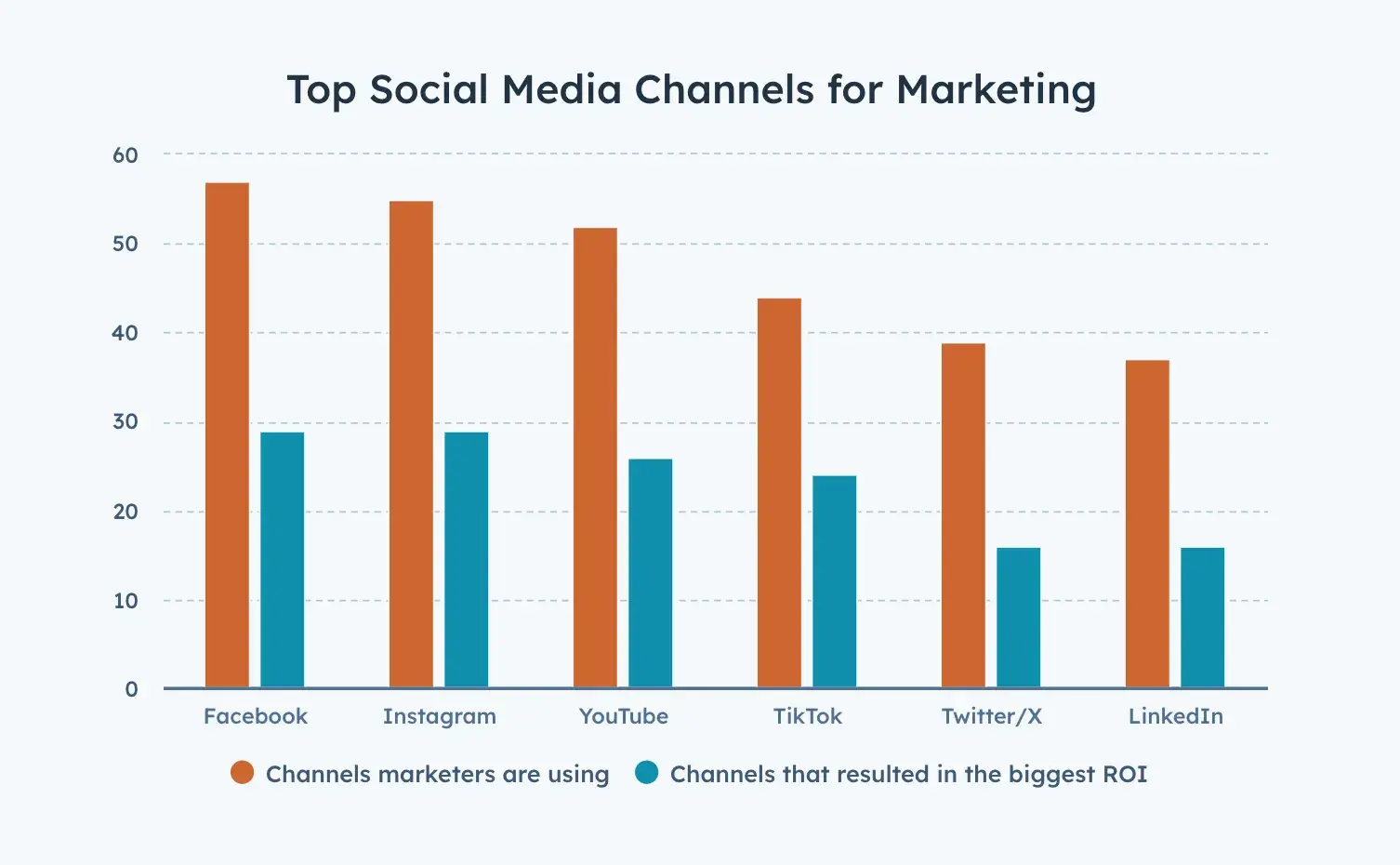
In fact, as of 2024, social media is still among the top three marketing channels with the biggest ROI. It’s the first place many Gen Z and Millennials head to when looking for new products, and 31% of consumers use it to find answers to their questions.
Video made a push.
Video also emerged as one of the prevailing content marketing mediums as the decade progressed, particularly among younger consumers.
As of 2024, short-form video content offers the highest ROI, and nearly 25% of marketers plan to invest more in this video format than in other content marketing strategies.
Additionally, 89% of consumers report wanting to see more videos from brands.
Video is inherently engaging. It’s generally easier to follow than blog posts, email newsletters, or ebooks. As the decade progressed, audiences took to it more and more. By the end of the 2010s, platforms like YouTube were central to the landscape of content marketing.
Obviously, content marketing underwent several shifts in the 2010s, but as I said at the beginning of this article, the practice isn’t — and will never be — static.
There are still plenty of changes to come, especially with the addition of artificial intelligence.
How AI Is Changing the Future of Content Marketing
Whether you love it or hate it, AI is here to stay, and it’s changing the future of content marketing.
In recent years, generative AI has entered marketers’ everyday workflows, promising to free up time and help create better, more personalized content.
As of 2024, 40% of companies have taken a proactive approach to AI, adding dedicated AI experts to their marketing teams.
AI can automate marketing-related tasks.
Do you remember Microsoft’s Clippy, the helpful little writing assistant? I’m old enough to remember chasing Clippy around the screen.
However, if you have no idea what Clippy was because you were born after 2007, it was Microsoft’s early version of a virtual assistant designed to help users with tasks like page layout and spelling.

Think of generative AI as the new Clippy, only better. 60% of marketers consider AI to be their new virtual assistant. Marketers use AI for certain tasks, like:
- Drafting content.
- Writing content.
- Ideation and inspiration.
- Content outlines.
Using AI, marketers say they can save up to three hours on each piece of content.
AI can help your content perform better.
In our study, 56% of marketers say their generative AI-created content performs better than content they’ve created without it.
There are a few reasons for this. Generative AI can help:
- Identify knowledge gaps within your content.
- Optimize your copy for best SEO practices.
- Tailor your content to match your brand’s tone of voice.
As AI becomes a more permanent part of marketing, it’s helpful to consider it as an intelligent tool to improve your workflows and optimize your marketing channels.
Marketers hold AI at arm's length.
Although AI is changing the way marketers approach their work, they’re still skeptical about adding AI to their workflows.
Notably, 60% of marketers who use generative AI on a regular basis are concerned it can harm their brand’s reputation due to biases, plagiarism, or misalignment with brand values.
To effectively add AI to marketing, marketers should avoid copying and pasting AI-generated content and calling it their own. It’s good practice to fact check AI content and humanize it — not just to ensure it aligns with your brand, but to ensure it gets past Google’s algorithm, too.
In March 2024, Google began cracking down on low-quality AI content.
Humanizing AI content, like re-writing it to first person or adding in quotes from subject matter experts, helps ensure you’re creating content with your audience in mind (while reaping the time-saving benefits of AI!)
The State of Marketing in 2025
HubSpot's Annual Inbound Marketing Trends Report
- Top Marketing Channels
- AI in Marketing
- Managing Privacy
- The Future of Marketing
Download Free
All fields are required.
How E-E-A-T Influences the Algorithm and Marketing Strategies
I can’t talk about the future of content marketing without mentioning E-E-A-T. EEAT — or expertise, experience, authority, and trustworthiness — is the founding principle of all of our content at HubSpot.
Google first introduced the concept of EAT in 2018, adding the second E, experience, in December 2022.
With recent changes to its algorithm, Google favors EEAT-focused content. This means value-packed content is a higher priority in search engine results when compared to low-quality content.
(Don’t forget, Google doesn’t like low-quality content anyway.)
Marketers are finding creative ways to ensure their content meets Google’s EEAT expectations. To do this, marketers are changing their strategies to include:
- Writing blog posts in first-person.
- Including subject matter expert quotes when relevant.
- Sharing optimized transcripts from videos or podcasts on their blogs.
- Citing credible sources, like studies from websites with high authority domain ranking.
- Creating relevant case studies and sharing those insights with their blog readers.
It’s helpful to remember that EEAT-focused content isn’t any more challenging to create than run-of-the-mill content. Instead, the bigger focus is ensuring your content resonates with your audience on a deeper, more personal level.
Plus, marketers can still use AI to help them create this kind of content. The key is to add the human touch. Remember, it’s human content powered by bots.
How Content Marketing Will Evolve in the Next Decade
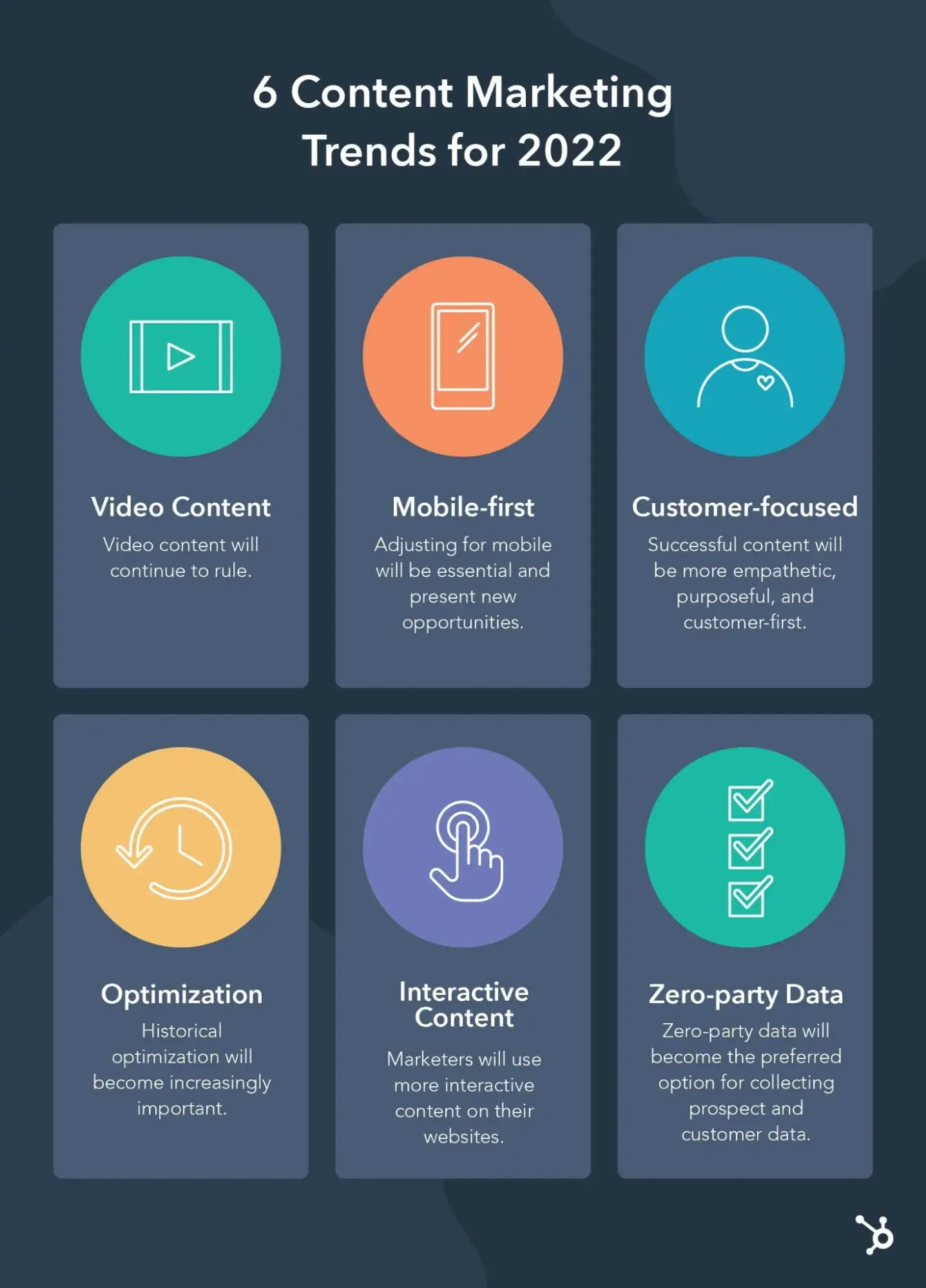
Video content will continue to rule.
As I mentioned earlier, video emerged as one of the most — if not the most — important mediums for content marketing at the end of this past decade.
There’s no indication that the trend will stop anytime soon, considering short-form video currently brings in the highest ROI.
56% of marketers who use TikTok plan to increase their investments and efforts on the platform. Plus, 14% of marketers say they plan to try live-streaming in the near future, something you can do on nearly every video-sharing platform.
Video content will become more value-packed.
And, as Canva’s B2B Head of Content Rachael Perry, points out, “Video content is positioned for massive growth now, especially as video-first social platforms like TikTok continue to rule.”
Perry says, “Almost everyone creates and absorbs visual content in today’s world, and video is a great way to bring your brand to life and build more personal connections with your audience.
“Until now, video creation has been complex, but there are new tools making it easier. If you can understand what your audience truly needs, video can help you provide that value in a memorable way.”
All told, it looks like the exploration and expansion of video as the preeminent medium for content marketing will continue. Marketers’ priority will be standing out, which is why over 30% of them who do not currently use video in their marketing efforts plan to incorporate it into their strategies in 2025.
That could mean emphasizing the quality of the content you produce, ensuring it’s:
- Engaging and timely.
- Well-crafted and produced.
- Relevant to viewers.
Video content will open new opportunities for flexible brands.
CEO & Co-Founder of Slidebean, Jose (Caya) Cayasso, told me he encourages brands to step outside the more traditional avenues of content marketing — blogging, email marketing, and SEO — to create “wider moats” around their content efforts.
He says, “[At Slidebean] we decided to bet on YouTube, and it’s become our most significant source of revenue and brand awareness. Alternatively, companies like Morning Brew and Duolingo are killing it on TikTok — but [video marketing] requires us to reinvent ourselves constantly, and to break the status quo of typical corporate content.”
Cayasso adds, “You have to be incredibly clever and adaptable to succeed in video content — even more so if you’re a brand, versus an individual.”
No matter how individual producers and companies manage to innovate when it comes to video marketing, the medium is going to be a mainstay in the evolution of content marketing going forward.
Adjusting for mobile will be essential and present new opportunities.
As people continue to rely more on their mobile devices, content marketers will have to adjust their marketing strategies, including adding new marketing channels. Before I explain new channels for you to tap into, let’s discuss a tried-and-true strategy that shows no signs of going anywhere: mobile browsing.
Mobile Browsing
According to Statista, global mobile data traffic made up nearly half of all web traffic in the last quarter of 2023.
Mobile device usage is increasing astronomically, and it’s in every content marketer’s best interest to keep pace with that trend.
In January 2024, Google dominated the global mobile search engine market, generating over 95% of mobile searches. Compared to past trends with mobile searches, Google’s dominance shows no signs of slowing down.
That said, having a website optimized for mobile devices will be central to successful SEO efforts. And a lot of the content you create will need to fit that bill as well.
11% of marketers say having a mobile-friendly website is a good use of their time and efforts. Blogs should be easily navigable on smartphones. If they’re inaccessible, you’ll see a higher bounce rate, which translates to losing your audience.
Readily accessible video content that your audience can watch on mobile devices will also be a big help. Prospects and customers will need to be able to get as much out of your mobile resources as your desktop ones.
Mobile Messaging
Smartphones aren’t just for browsing the web or watching short-form videos.
Some people actually use them for their intended purpose — calls and messaging.
As content marketing shifts to short-form content, mobile messaging will become a valuable marketing channel.
A majority of marketers already use messaging as part of their marketing strategies. In fact, 87% of marketers plan to continue or increase their investment in mobile messaging through channels like SMS, Facebook Messenger, or WhatsApp.
Of those marketers who incorporate messaging into their strategies, 10% of them say it’s one of the biggest drivers of their ROI.
So, how can you use mobile messaging to get more eyes on your content? Easy. With messaging, you can:
- Send images or short videos to engage your audience.
- Send short links directing your recipients to a new blog post on your website.
- Create a messaging campaign sequence to promote your long-form content.
Virtual and Augmented Reality
This shift towards mobile will also present new opportunities through emerging kinds of media. More novel mobile technology — like virtual and augmented reality — will have a very real place in the future of content marketing.
Virtual and augmented reality provide your audiences with a 3D, immersive experience. For example, Amazon, Wayfair, and Ikea currently use virtual and augmented reality to show users how furniture will fit into their living spaces.
You can also use virtual and augmented reality to provide a unique storytelling experience. As your audience interacts with the interactive content, they learn more about your brand and how it can benefit them.
Although virtual and augmented reality aren’t mainstream marketing strategies yet, there’s a real chance they’ll become powerful marketing strategies in the future with the help of AI.
The State of Marketing in 2025
HubSpot's Annual Inbound Marketing Trends Report
- Top Marketing Channels
- AI in Marketing
- Managing Privacy
- The Future of Marketing
Download Free
All fields are required.
Successful content will be more empathetic, purposeful, and customer-first.
Google’s ranking algorithm aims to prioritize the content that will mean the most to searchers. Ideally, by Google’s standards, the first ranking search result for any keyword is the one that best addresses whatever users are searching for. And in all likelihood, they’ll keep tinkering with their process in pursuit of that interest.
While there’s no telling exactly how the algorithm might change going forward, one fact remains — marketers need to focus on high-quality content that will register with consumers. That means understanding your audience and putting considerable effort into how to reach them best.
Create content with your audience in mind.
As HubSpot Senior Content Strategist Amanda Zantal-Wiener puts it, “Where I’m starting to see content turning a corner is in the area of empathy.
In the years to come, marketers are going to start creating more content that’s truly created in the mindset of putting themselves in the shoes of others — be it their customers, prospects, partners, or someone else within their audiences.”
She adds, “They’ll ask questions like, ‘What does my audience need from me right now? What can I create that’s truly going to help them?’ That’s going to become a requirement for marketers when they begin brainstorming content.”
Your content should be helpful, not so much a promotion.
Content marketing is trending towards audience enrichment as opposed to product promotion.
If this shifting tide holds true, content marketing will continue to become more targeted, purposeful, and customer-centric as the practice evolves.
As Katelyn Seese, Content Strategist at Blue Frog, puts it, “Content marketing has the power to make real connections with your audience and educate them of the value of your brand beyond your services, products, or offerings.
Consumers care much more today about the who and why of your brand rather than just what you do. Understanding who your audience is and why they need your brand is the key to creating meaningful content that truly resonates with your audience.”
Of course, content creation isn’t easy. Fortunately, Kim Giroux, Director of Marketing at Beautiful.ai, believes the future includes an increase in tools that should help your writers with content creation and design.
Humanize your content.
Giroux told me, “Over the next decade, content creation will be automated with tools backed by artificial intelligence and natural language processing.
Widespread adoption of such tools will give marketers the ability to create quality content in a fraction of the time. At the same time, integrations will simplify tech stacks and end-user experiences. Professionals will no longer need to understand complex tools, while workflows and team collaboration will be seamless.”
She adds, “With automation in content creation tools as the norm, designing or branding content such as presentations, infographics, blog posts, and white-papers will be effortless.
“The days of spending hours formatting and incorporating brand elements and design principles into every piece of content will be long gone. Smart technology will instantly create branded, visually appealing collateral, freeing up marketers’ brainpower to focus solely on the messaging and strategy behind a brand.”
Pro tip: AI content is good, but it’s often short of being great. To create AI-generated content that resonates with your audience, you’ll need to humanize it.
As AI grows in popularity, humanizing AI-generated content will continue to become the norm.
Personalize it.
Along with humanizing your content, personalization continues to become a major trend in content marketing. Over the last decade, we’ve seen the power of personalizing marketing efforts based on individual audiences.
In fact, marketers who aimed to provide a more personalized experience to their customers were 215% more likely to say their 2023 marketing strategy was very effective compared to marketers who skipped out on personalization.
With new AI tools that can provide real-time insights into how audiences interact with content, brands can quickly personalize it to create a more meaningful connection. AI tools can help:
- Change CTAs based on user profiles.
- Recommend related content based on user interactions.
- Enhance static web pages, making them more dynamic and interactive.
Historical optimization will become increasingly important.
According to Statista, the most challenging aspect of an SEO professional’s job is creating an effective content strategy. Your content strategy shouldn’t just consist of producing new content and calling it done.
Instead, Basha Coleman, a Historical Optimization Marketing Manager at HubSpot, believes the future of content marketing will include an increased awareness and dedication to historical optimization.
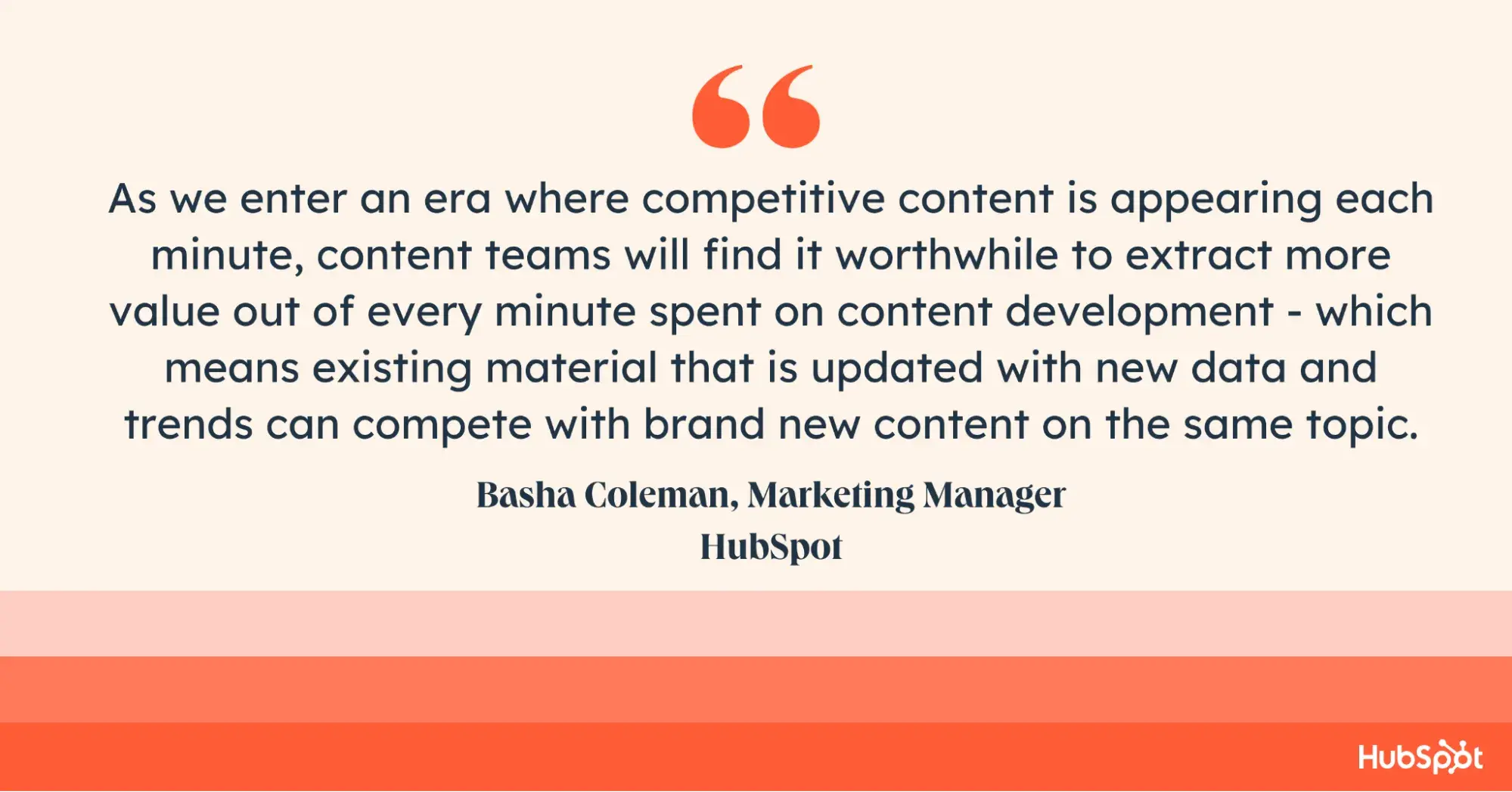
She says, “As we enter an era where competitive content is appearing each minute, content teams will find it worthwhile to extract more value out of every minute spent on content development.”
Coleman adds, “That means existing material that is updated with new data and trends can compete with brand new content on the same topic, while spending less time and resources to produce it.”
If you don’t already, consider investing in a strong optimization strategy for 2025 and beyond. This will help you create consistently relevant and high-ranking content without constantly starting from scratch and is a critical SEO tactic for maintaining authority in the SERPs.
Marketers will use more interactive content on their websites.
Nowadays, consumers are interested in easily digestible, interactive content.
Interactive content, like a quiz or a calculator, is more engaging than static media, which is why 14% of marketers plan to add it to their arsenal.
To serve your audience’s needs, consider how you might implement more interactive content, which breaks up long paragraphs of text and provides the viewer with an alternative method for consuming content.
As VP of Marketing at Trusted Health Jill Callan explains, “With average attention spans dwindling down to less than that of a goldfish, brands can no longer afford to have one-way conversations with their audience.”
Callan says, “Interactive content on your website or blog can help engage visitors and make complex information easy to digest.
“At my company, Trusted Health, we’ve used this approach to engage our nursing audience with things like our Salary Calculator, which helps nurses get detailed salary and cost of living information for every state. The best part? Creating contextual user experiences needn’t suck up precious product or engineering resources.”
If you aren’t sure how to begin, you’re in luck. Callan shared with me three tips to kick-start your interactive content journey:
- Embed an ROI calculator on your website to show potential customers how you will save them money. An interactive tool immediately shows your product’s value versus relying on text-heavy copy to explain it.
- Crowd-source product innovation. Tap into your brand advocates and loyal customers to learn more about their pain points and product wishlists. Use those insights to inform a product roadmap.
- Create a quiz. Not only are quizzes a great way to engage visitors, but they also give you a better understanding of your audience so you can create more targeted campaigns in the future.
Collecting customer data will change.
The way we use cookies and other ad-tracking tools in the next decade will change dramatically. Marketers will need to continue prioritizing the security of their prospects’ and customers’ data or risk losing their consumers’ trust.
As of 2024, 81% of marketers rely on third-party data to inform their marketing strategies. However, as more consumers move to protect their private data, marketers will need to find more creative ways to support their marketing efforts without third-party data.
There are three other ways marketers can collect data from consumers without risking security breaches. Those are:
- Zero-party data.
- First-party data.
- Targeted social media ads.
Let’s take a deeper look at these alternatives to third-party data collection.
Zero-party data.
Zero-party data is data collected voluntarily from customers in exchange for value. Zero-party data goes beyond collecting contact information. Instead, it collects:
- Personal context.
- Interests.
- Preferences.
This kind of data is insights consumers willingly share, like survey responses or feedback. In return, prospects and customers can expect a more personalized consumer experience.
As Senior Director of Marketing at Microsoft Advertising, John Cosley, told me:
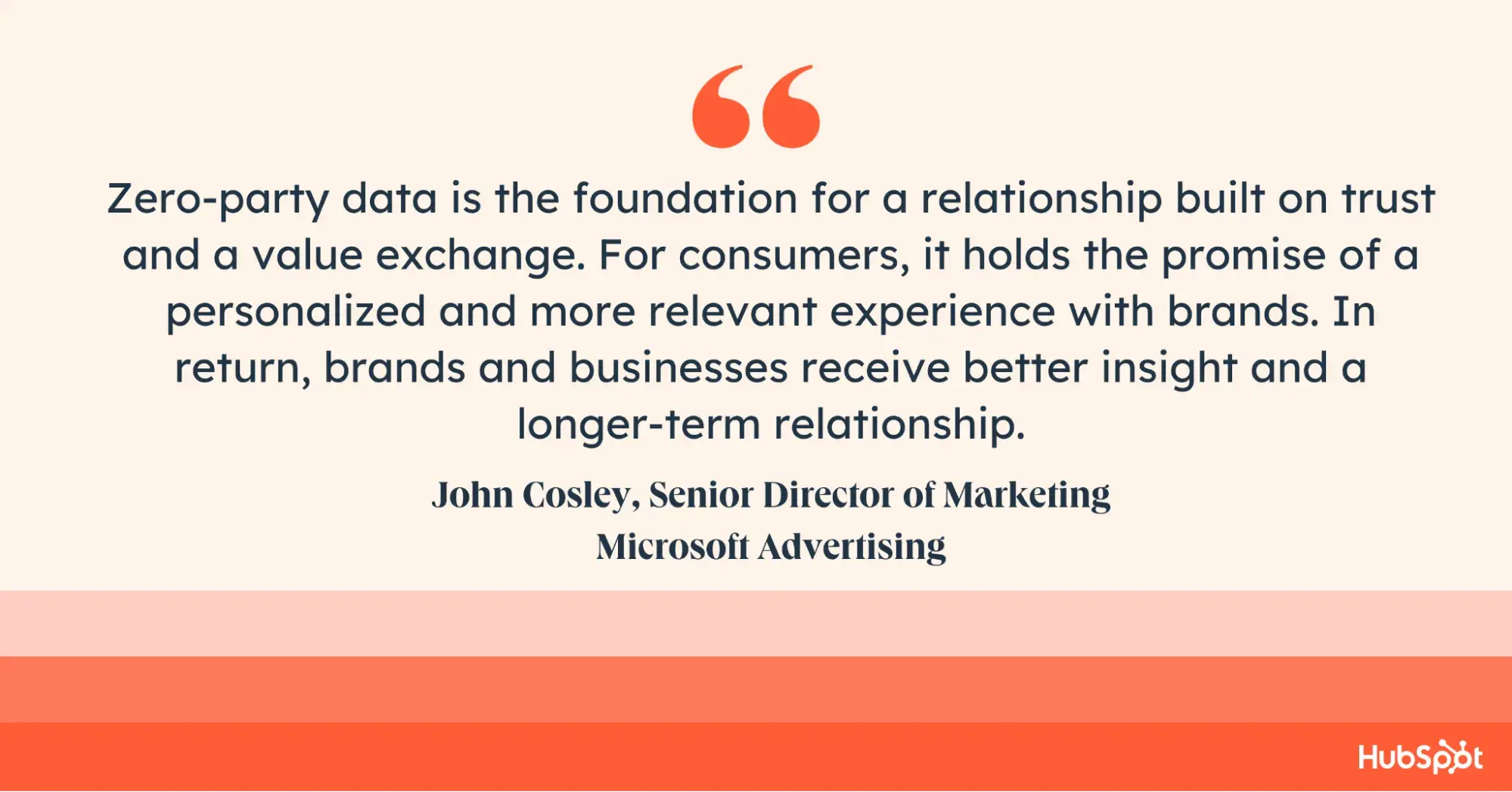
“Zero-party data is the foundation for a relationship built on trust and a value exchange. For consumers, it holds the promise of a personalized and more relevant experience with brands. In return, brands and businesses receive better insight and a longer-term relationship.”
Using zero-party data enables you to create trust between your brand and its consumers while also ensuring you’re delivering the most personalized content possible for your customers.
As other types of data collection are phased out — including third-party cookies — you’ll see marketers shift to zero-party data in the next decade.
First-party data.
While zero-party data is information a customer provides on their own, first-party data is a deeper look into how they interact with your brand and its marketing channels. First-party data includes insights relating to:
- Purchase history.
- Demographic information.
- Online chat transcripts.
- Social media interactions.
25% of marketers plan to collect first-party data from their customers, particularly from interactions customers have with their email campaigns.
Bounce rates, open rates, and click-through rates can be a good indicator of how well your recipients respond to your marketing efforts.
When you rely less on third-party data and more on your customers’ interactions, you can build better marketing campaigns and help build stronger relationships with your customers.
Targeted social media ads.
25% of marketers plan to analyze interaction with targeted social media ads to help inform their next marketing and retargeting campaigns.
Retargeting is critical for marketers who want to continue cultivating interest from users who have already shown some interest in their brands. By analyzing how they interact with ads, marketers can find better ways to customize campaigns without needing to collect sensitive personal information.
As the decade progresses and more marketers and consumers become more protective of their data, marketers will need to find new angles and creative uses of the information available to them without relying on third-party data collection.
Content Marketing Is Always Evolving
If there’s anything to take away from understanding the previous and upcoming evolutions of content marketing, it’s this — don’t get too comfortable.
New trends and challenges are always emerging, and it will always be in your best interest to stay abreast of them.
And above all else, focus on consistently creating high-quality content that your audience will always be able to get something out of.
Editor's note: This post was originally published in May 2020 and has been updated for comprehensiveness.
The State of Marketing in 2025
HubSpot's Annual Inbound Marketing Trends Report
- Top Marketing Channels
- AI in Marketing
- Managing Privacy
- The Future of Marketing
Download Free
All fields are required.
Content Marketing
-1.webp)
![How to create a content style guide [+ free guide & examples]](https://53.fs1.hubspotusercontent-na1.net/hubfs/53/image1-May-07-2024-07-15-58-1152-PM.webp)