

If consumer connection and engagement are your goals, you must stay on top of video consumption trends.
Our annual State of Video Marketing survey with Wistia shows that video plays have increased for businesses of all sizes. Small- to medium-sized businesses increased plays by 13%, and large businesses increased plays by 5%.
Here, I'll highlight seven research-backed ways video consumption habits are changing and how marketers can respond strategically.
In this article:

The Ultimate Video Marketing Starter Kit
Access everything you need to get started with video marketing.
- Video Script Templates
- Video Best Practices
- Example Videos
- And More!
Download Free
All fields are required.
Online Video Consumption Statistics Marketers Should Know
As video continues to be integral to marketing strategies, marketers should keep the following statistics in mind:
- The number of digital video viewers worldwide is more than 3.3 billion.
- In 2024, 89% of consumers confirm they want to see more videos from brands.
- People are 52% more likely to share video content than any other type of content.
- 75% of viewers watch short-form video content on their mobile devices.
- 83% of marketers suggest videos should be under 60 seconds.
Video Consumption Trends
From video length to what attracts viewers — here‘s what’s changing for video consumption in 2024.
1. Consumers increasingly rely on marketing videos from brands.
In the past, consumers would visit websites, look at online reviews, watch commercials, and maybe watch a few YouTube videos to learn about a product.
Now, with video accessible on every major social media network, they are learning to rely more heavily on this type of content in their research phase.
According to HubSpot research, 62% of consumers have watched video content (i.e., product demos, reviews, FAQs, unboxings, etc.) to learn about a brand or product.
In the latest Consumer Trends Report, HubSpot surveyed more than 700 consumers, and 37% prefer to discover products through short-form videos (such as TikTik’s or Instagram reels), 8% prefer long-form video, and 17% favor the video livestream.
The trend is clear: In 2024, consumers increasingly expect to see brand video content. Why?
Videos allow consumers to know how a product or service works, discover any flaws before purchasing the item and identify perks they might not have learned in the text-based description.
As this trend grows, brands are leaning more into platforms like Storyly that can help brands meet consumer expectations. Storyly and similar tools enable the creation of immersive shoppable video experiences with features like interactive elements that let customers explore products in-depth, clickable tags leading straight to purchase pages, and engaging functionalities that turn passive viewers into active shoppers. These tools enhance the research phase and also make the path to purchase seamless for today’s video-first consumers.
2. Conversions are made directly within the video.
Considering consumers are watching and relying on brand videos, failing to optimize your video for conversion is a missed opportunity. Conversions can be encouraged within videos using annotations, CTAs, or forms.
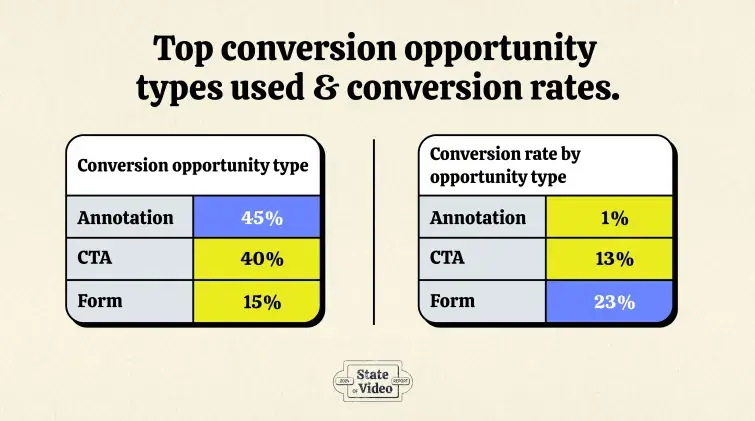
A Wistia survey, which includes HubSpot insights, found that conversions are best placed at the end of videos for shorter form videos (less than one minute to five minutes long), but longer form videos, those over five minutes, benefit from a CTA placement early in the video.
Interestingly, videos at sixty minutes or more have the highest conversion rate at 24% when the CTA is placed at the end.

Jack Brodie, managing director and video producer at Colada Creative, is finding conversion success through an innovative and interactive video format.
Brodie says, "This innovative video format is already used by brands like Nike, IKEA, Porsche, and more. We‘re using it with our clients, and we’re positive that businesses large and small shouldn't sleep on interactive video.”
Brodie expects interactive video to have as much as five times more engagement and 30% higher conversions.
“Ecommerce brands can make their products literally purchasable within the video, and this leads to a 41% increase in products added to cart. The immersive nature of interactive video means consumers spend as much as 47% more time watching and engaging with the video,” Brodie recommends.
3. Brands must create relatable and authentic content.
Authentic and relatable content is a must. Our most recent survey found that 38% of consumers found that relatable content was more memorable.
Additionally, when it comes to social media content, consumers prefer to see relatable and authentic videos (63%) over polished and high-production-value videos (37%).
Even if you‘re creating informative marketing videos, bring in your brand’s authenticity and relate to your consumer.
Tristan Harris, demand generation senior marketing manager at Thrive Digital Marketing Agency, experimented with relatable and authentic video in social media content.
Harris notes there is a significant following for reels and live videos, with the value it puts on authenticity and even immediacy. Then, there are personalized videos, which cater to the preferences of specifically identified market segments.
“Short-form videos also have their share of popularity. We tried to integrate this format for thought leadership here. The insights and feedback indicated that this is how our audience wants to learn now,” Harris says.
Harris emphasizes that the audience will remain engaged in high-quality content that is both informative and entertaining: “The storytelling and production should be given good thought as well to ensure that this meets the expectations of your target viewers.”
4. Consumers prefer shorter videos.
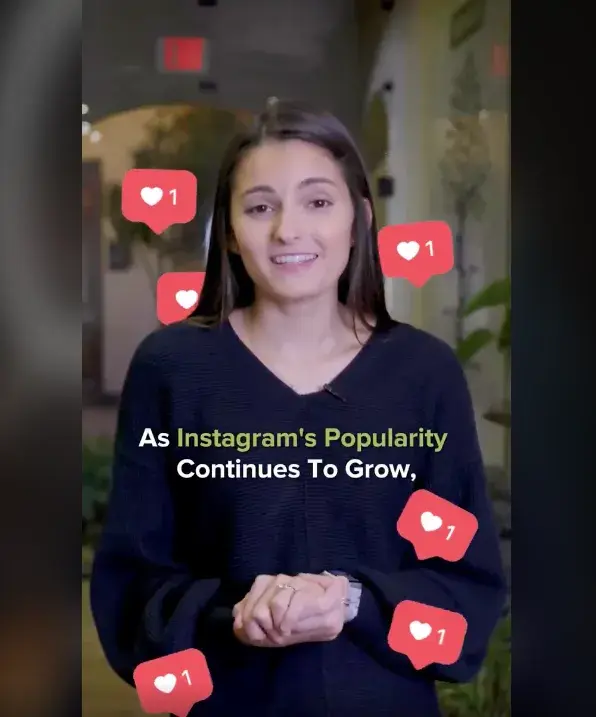
Thanks to the rise of TikTok — and the wave of short-form content that followed — consumers are seeking quick, snappy videos. Specifically, videos under three minutes fall into a sweet spot.
If you're new to video, starting with short-form videos can help you get your feet wet — and tell you what resonates with your audience.
You also need to set the right pace for your video content. Before you put a marketing video online, re-watch it from the point-of-view of a somewhat busy consumer. Then, ask yourself, “Does this video quickly pull viewers into the action and keep their attention?”
If you‘re worried that parts of your video seem dull, shorten it. But, if your team thinks it’s entertaining or informative the entire time, you can experiment with publishing your longer-form video and learning from its results.
Daniel Anderson, founder and editor at The Money Maniac, discovered that “Short-form videos can help improve your content's accessibility and reach. Once I started publishing videos that section a blog post into engaging parts, it also improved our website traffic and monthly visits by up to 70% and has been consistent ever since.”
It’s worth noting that Anderson is repurposing content by adding engaging media to blog sections. This type of repurposing can save marketers a lot of time.
The key to repurposing is a) understanding your content architecture and b) organization.
HubSpot’s Content Hub will improve your ability to repurpose using AI to help you turn existing content into various video formats.
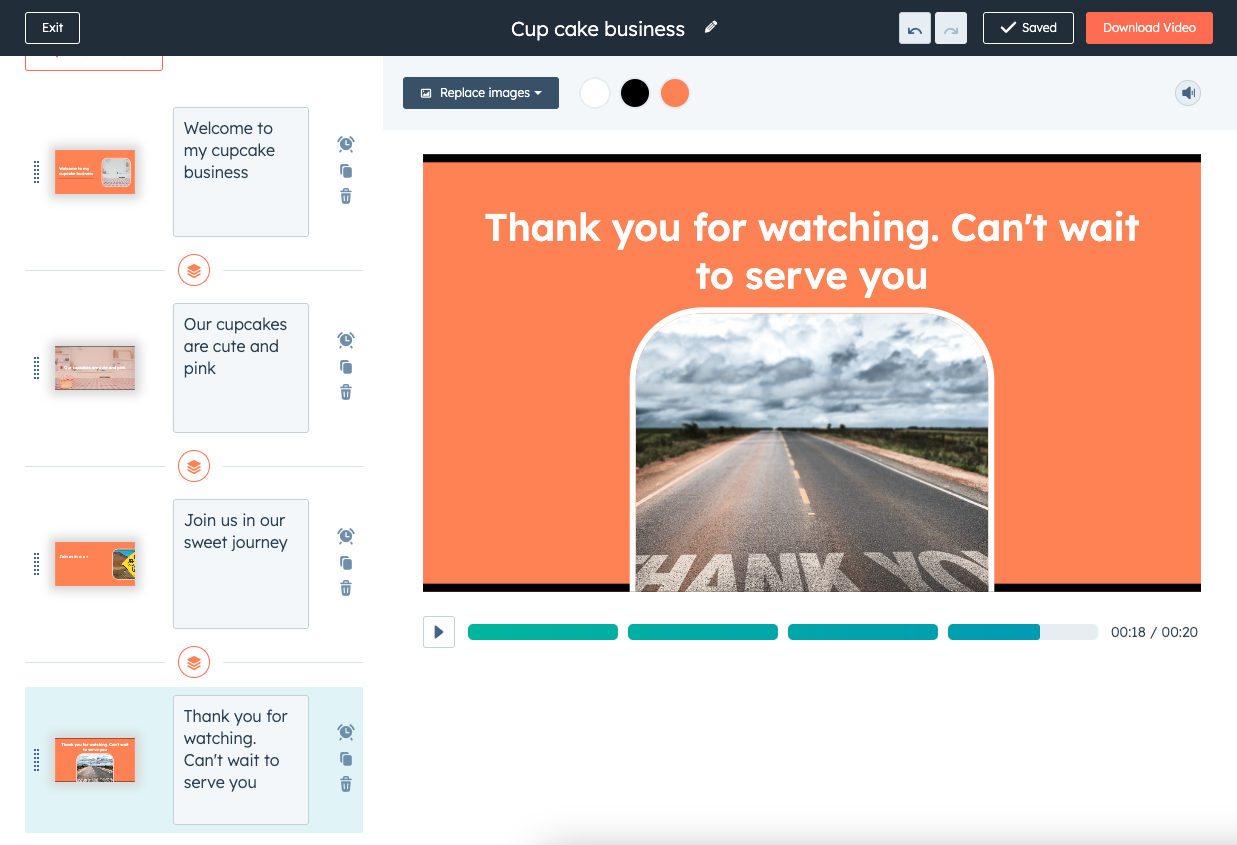
With Content Hub, you can record and embed video content on your website and across marketing channels such as emails. Plus, Content Hub’s AI will do some of the thinking and organizing for you. Combined with Clip Creator, video creation and distribution efforts are simplified with a few clicks.
The AI can generate titles and find repurposing opportunities.
Free AI Video Generator
Convert text into professional videos for your business with just a few clicks with HubSpot's Clip Creator.
- Generate in moments with AI.
- Customize to your needs.
- Use free video templates.
- Finalize and drive results.
Video Consumption Trends by Demographic
Naturally, different demographics think about and interact with video differently. This next section looks at video consumption trends by demographic.
1. Video Sharing on Social Media
Video marketing on social media is likely to increase brand visibility and encourage user engagement through sharing.
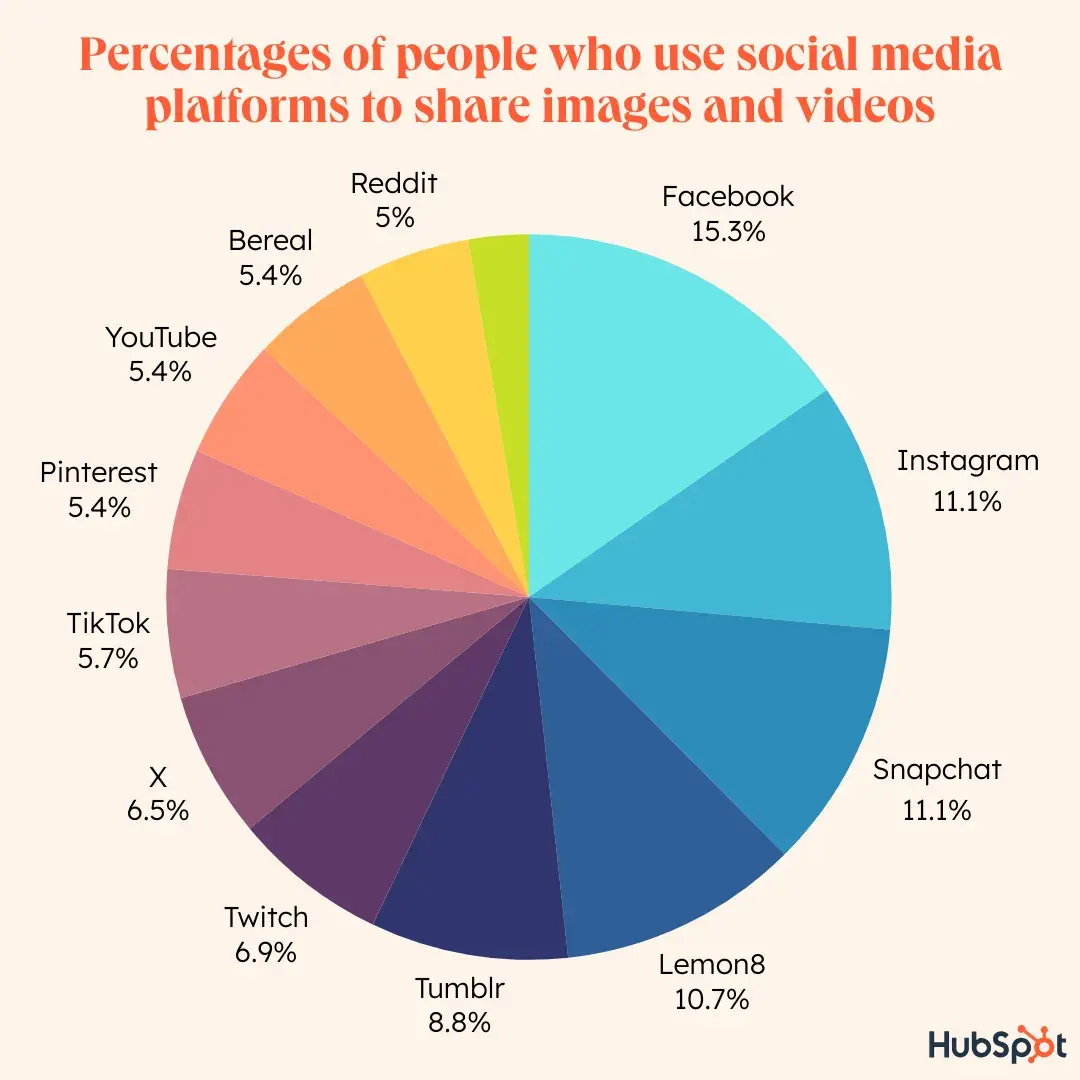
HubSpot surveyed over 700 consumers, and every social media platform was used to varying degrees for video sharing. Facebook came up top, with 40% of users prioritizing sharing videos and images on the platform.
Surprisingly, video-led platforms like YouTube, Twitch, and BeReal were used less for video sharing, but of course, these platforms are also used for video consumption.
Before posting a video to earn impressions and shares, you might want to create relatable content. Then, consider your demographic and where they will most likely share videos.
The stats from our recent survey tell us that all demographics share content on select social media channels (Snapchat, Pinterest, Instagram, Lemon8, LinkedIn, Tumblr, Twitch, Reddit, Twitter, TikTok, Facebook, and YouTube).
There are a few exceptions:
- Gen Z and Boomers do not share videos on LinkedIn at all.
- Gen X and Boomer do not share videos on Lemon8 at all.
Here are the stats by platform and demographic.
Of over 700 users surveyed, 40% use Facebook to share videos.
The data by demographic:
- Gen Z 27%
- Millennials 34%
- Gen X 40%
- Boomers 44%
YouTube
Of over 700 users surveyed, 14% use YouTube to share videos.
The data by demographic:
- Gen Z 25%
- Millennials 17%
- Gen X 14%
- Boomers 9%
Of over 700 users surveyed, 29% use Instagram to share videos.
The data by demographic:
- Gen Z 27%
- Millennials 27%
- Gen X 34%
- Boomers 21%
TikTok
Of over 700 users surveyed, 15% use TikTok to share videos.
The data by demographic:
- Gen Z 19%
- Millennials 14%
- Gen X 20%
- Boomers 2%
Of over 700 users surveyed, 17% use Twitter to share videos.
The data by demographic:
- Gen Z 32%
- Millennials 19%
- Gen X 14%
- Boomers 12%
Of over 700 users surveyed, 13% use Reddit to share videos.
The data by demographic:
- Gen Z 10%
- Millennials 19%
- Gen X 12%
- Boomers 8%
Of over 700 users surveyed, 7% use LinkedIn to share videos.
The data by demographic:
- Gen Z 0%
- Millennials 17%
- Gen X 8%
- Boomers 0%
Tumblr
Of over 700 users surveyed, 23% use Tumblr to share videos.
The data by demographic:
- Gen Z 33%
- Millennials 29%
- Gen X 13%
- Boomers 0%
Twitch
Of over 700 users surveyed, 18% use SnapChat to share videos.
The data by demographic:
- Gen Z 29%
- Millennials 23%
- Gen X 10%
- Boomers 14%
SnapChat
Of over 700 users surveyed, 29% use SnapChat to share videos.
The data by demographic:
- Gen Z 18%
- Millennials 28%
- Gen X 35%
- Boomers 33%
Of over 700 users surveyed, 14% use Pinterest to share videos.
The data by demographic:
- Gen Z 22%
- Millennials 13%
- Gen X 15%
- Boomers 10%
Lemon8
Of over 700 users surveyed, 28% use Lemon8 to share videos.
The data by demographic:
- Gen Z 25%
- Millennials 36%
- Gen X 0%
- Boomers 0%
The Ultimate Video Marketing Starter Kit
Access everything you need to get started with video marketing.
- Video Script Templates
- Video Best Practices
- Example Videos
- And More!
Download Free
All fields are required.
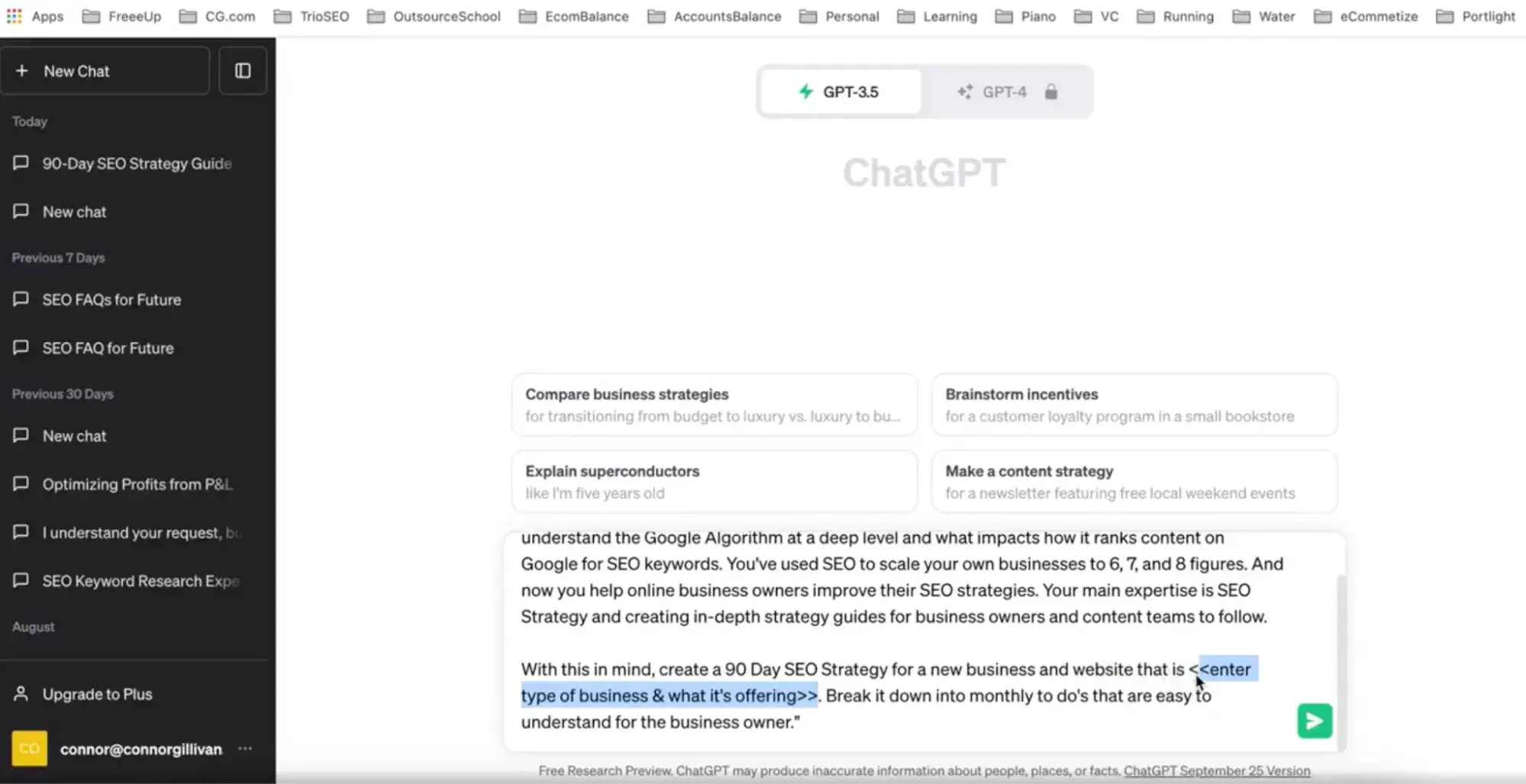
Connor Gillivan, entrepreneur, owner, and CMO at TrioSEO, values video as a shareable asset on LinkedIn and X.
He says, “Video content has been one of my best-performing in the past year on LinkedIn and X, where I‘m most active. I’ve run tests where I post content with just an image versus a short video tutorial included, and the video content gets greater impressions and engagement each time.”
For social media specifically, Gillivan hypothesized and read that channels push video content more than others because there's a high chance of keeping users on the channel for longer, as they watch the video content.
Some of Gillivan’s best videos have earned as many as 143,000, 95,000, and 82,000 impressions.
2. Discovering New Products
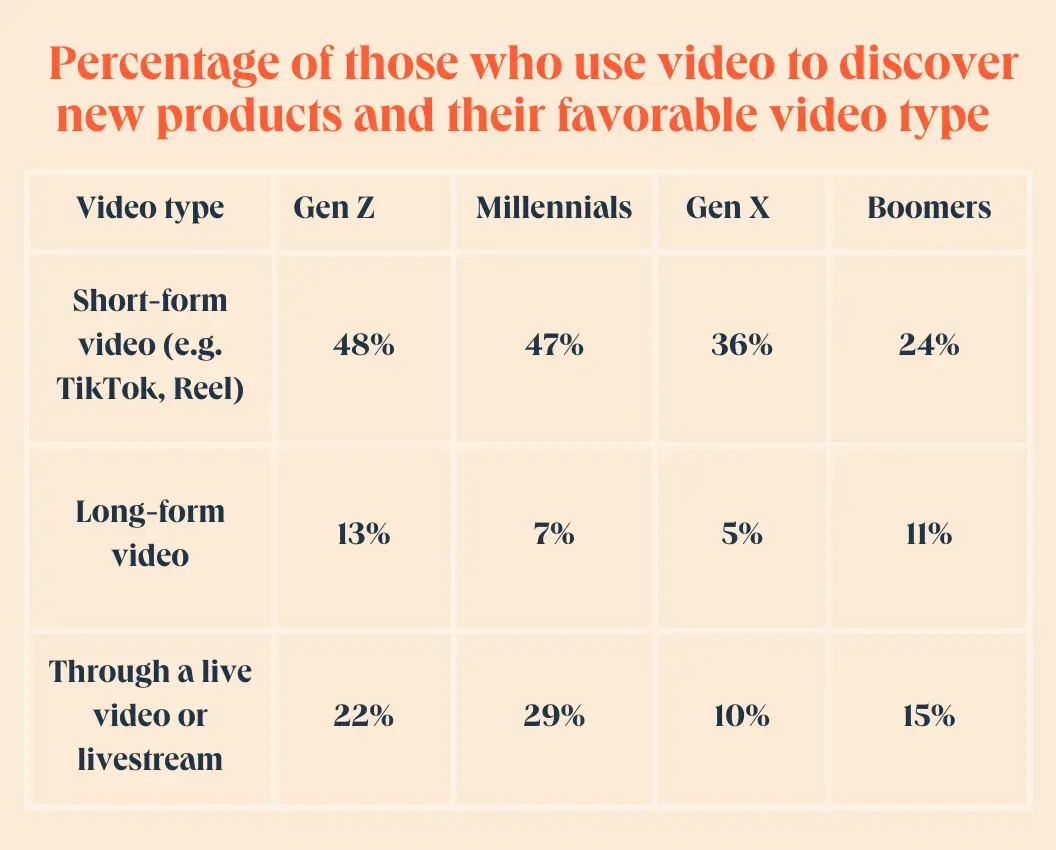
As mentioned above, video is leading consumers to discover new products, and different demographics use video in different ways.
The table below shows the percentage of those who use video to discover new products and their favorable video type.
Kevin Watts, president and founder at Raincross, has seen the conversion benefits that product video has on consumers.
He says, “Our strategy involves creating targeted, optimized content that speaks directly to viewers' needs. For example, in the e-commerce sector, product demo videos have been crucial. Videos that clearly demonstrate the use of a product, emphasizing its benefits and ease of use, have led to an average increase of 30% in conversion rates.”
3. Production Quality and Demographics
As before, production quality is generally not as important as a brand creating content that is relatable and authentic, but it is true that demographics value production quality differently.
Gen Z is the only demographic to value video production quality (52%) over relatability and authenticity (48%).
Boomers significantly value relatability and authenticity (75%) over video production quality (25%).
For Gen X and Millennials, the differences are comparatively marginal. Gen X and Millennials both value relatability and authenticity (56%) over video production quality (46%).
Paul Chow, CTO and co-founder of 3DGearZone, credits editing with engagement. He says, “We've seen tremendous engagement with video content, particularly through our 3D printer review video podcast on YouTube). We found that viewers highly value high-quality editing.”
Crisp visuals, clear audio, and engaging cuts keep them hooked and wanting more. This translates to increased views, Chow says. In fact, his team is only seven episodes into a series and has reached thousands of views on YouTube, as seen from YouTube Studio.
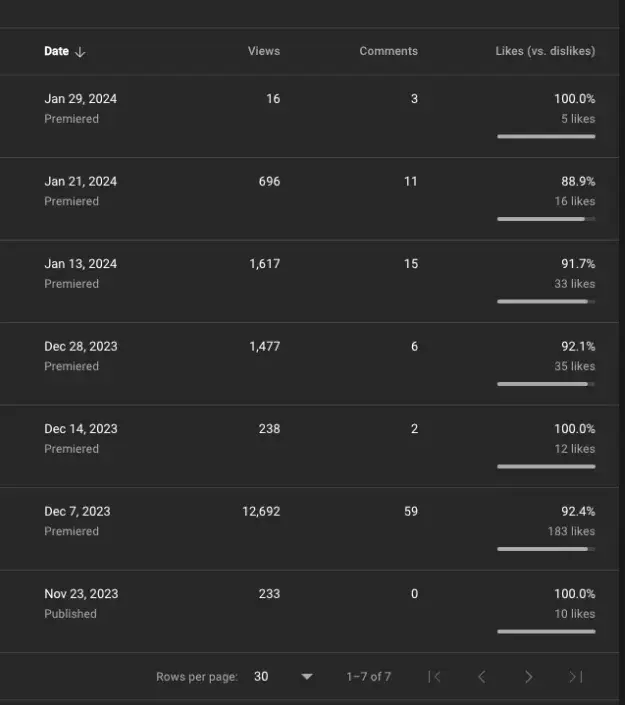
“We can see a higher number of visits to the website (we see it in our GA4 data), and ultimately, a deeper understanding of the 3D printing process for our audience,” Chow says.
Video software like Vidyard, Bonjoro, and TwentyThree makes it easy to record and send short video messages — like pitches, welcome videos, and more — to customers without needing a Hollywood budget.
Navigating Video in 2024
The video landscape is changing in favor of marketers who can adapt to new trends. Consumers prefer to learn about brands via video content and use it as a necessary tool in the information-gathering phase and even the buying phase of their buyer's journey.
Video isn't going anywhere but constantly expanding, changing, and evolving to fit new consumer needs and platforms.
As this content evolves with each new generation, marketers should continue researching video consumers' interests and behaviors.
Editor's note: This post was originally published in July 2020 and has been updated for comprehensiveness.
Video Marketing


![The best social media platforms for video content in 2025 [consumer data]](https://53.fs1.hubspotusercontent-na1.net/hubfs/53/img-1-20250516-9399498.webp)

![3 Short-Form Video Trends Marketers Should Watch in 2025 [New Data]](https://53.fs1.hubspotusercontent-na1.net/hubfs/53/ft-short-form-video-trends.webp)
![Are In-Stream Video Ads Worth the Investment? [Benefits & Best Practices for Marketers]](https://53.fs1.hubspotusercontent-na1.net/hubfs/53/in-stream-video-ads-1-20250314-6407067.webp)
![45 Video Marketing Statistics for 2025 [New Data]](https://53.fs1.hubspotusercontent-na1.net/hubfs/53/video-marketing-statistics-1-20250227-6425117.webp)
![Why You Should Leverage Interactive Videos [Data from 500+ Marketers]](https://53.fs1.hubspotusercontent-na1.net/hubfs/53/interactive-video-1-20250216-406926.webp)
![Silent But Mighty: How Soundless Videos Are Winning Social Media [+ 2025 Data]](https://53.fs1.hubspotusercontent-na1.net/hubfs/53/Soundless%20Videos%20We%20Love.png)