-2.webp)
If you're like me, you only open a small fraction of the (dozens? hundreds?) email newsletters you've subscribed to. So I set out to find what makes B2B newsletter marketing effective—what do those really good newsletters, the ones you open on the regular, have in common?
![Download Now: The Future of Newsletters [Free Report]](https://no-cache.hubspot.com/cta/default/53/58c8c1bb-6a8c-44a9-8d37-7800956eccc6.png)
Email newsletters have been floating around in the zeitgeist for some time now, especially as more writers have left online publishers to make it on their own.
I spoke with a half dozen experts in the field, including both technical and content specialists.
My goal is to highlight the differences between B2B newsletter marketing and other types of emails, guide you through best practices, and uncover some key takeaways from indie newsletters that you can apply to your own brand.
Table of Contents
The Future of Newsletters
Your Guide to Building a Profitable Media Empire
- Learn the Basics
- Understand How to Monetize
- Build Your Content Strategy
- And More!
Download Free
All fields are required.
What is B2B newsletter marketing?
B2B newsletter marketing is a strategic approach where businesses create and distribute regular, value-driven email content to other businesses. Unlike promotional emails that push for immediate sales, B2B newsletters focus on building long-term relationships through educational content, industry insights, and thought leadership.
B2B vs B2C Newsletter Marketing: Key Differences
| Factor | B2B Newsletters | B2C Newsletters |
|---|---|---|
| Decision-Making Process | Multiple stakeholders with longer evaluation periods (3-12 months); requires consensus across departments | Individual decisions with shorter purchase cycles (minutes to days); single decision-maker |
| Content Focus | Educational resources, industry trends, ROI data, case studies, and thought leadership content* | Product features, lifestyle content, promotional offers, and entertainment value |
| Relationship Building | Nurturing leads through complex sales funnels using account-based marketing approaches** | Direct conversions, repeat purchases, and transactional relationships |
| Primary Goal | Establish authority, educate prospects, and influence long-term business decisions | Drive immediate purchases and build brand affinity |
| Tone & Style | Professional, data-driven, analytical with expert insights | Conversational, emotional, visually engaging |
| Audience Segmentation | By industry, company size, job role, and buying stage | By demographics, interests, and purchase behavior |
| Success Metrics | Pipeline influence, qualified leads, engagement with decision-makers | Click-through rates, conversion rates, immediate sales |
*Thought Leadership Content: Original insights, expert analysis, and forward-thinking perspectives that position your brand as an industry authority.
In newsletters, this includes proprietary research, expert interviews, trend forecasts, and strategic commentary that help business readers make better decisions.
**Account-Based Marketing (ABM): A strategic approach that treats individual companies as markets of one, delivering personalized content to specific high-value accounts.
In a newsletter context, this means segmenting content by company characteristics and tailoring messaging to address the unique challenges of target organizations rather than broadcasting generic content.
Furthermore, B2B newsletters focus on building long-term relationships through consistent, value-driven content rather than direct promotional messages. Unlike one-off email campaigns that push specific products or offers, newsletters establish your brand as a trusted industry resource.
They prioritize education, thought leadership, and unique content over immediate conversions.
In fact, our 2025 State of Newsletters Survey found that 30% of the 435 respondents say their newsletter most often features tips, opinions, and industry hot takes.
If your inbox is even half as full as mine is, you’ve got a steady stream of emails about sales, new product alerts, and reminders to purchase that new gadget you put in an online shopping cart and promptly abandoned.
Those traditional marketing emails are important to your overall marketing strategy, but today we’re talking about an entirely different beast.
I spoke to Lia Haberman, who founded and writes the successful ICYMI newsletter and teaches social media marketing and influencer marketing at UCLA. She says that “the difference between email marketing and [B2B] newsletters is really a difference between performance marketing and content marketing.”
She explains that the primary goal of performance marketing, like email marketing, is to drive conversions. “You’re trying to generate leads, to increase sales. There’s a point to the email that extends beyond the email itself.” These emails might be tied to a particular campaign or initiative.
Newsletters, like content marketing, “focus on providing value within the email itself. The subscriber doesn’t need to click out to get the value of whatever the newsletter is promising.”
This may sound counterintuitive, but a regular newsletter cadence establishes your brand as an authority in its field.
And if you’re giving your potential customers real value that serves their purposes instead of yours, congrats, you’re well on your way to building trust.
Why Start a B2B Newsletter
The real question, as I learned researching this article, is perhaps, “Why shouldn’t you start a B2B newsletter?”
Starting a newsletter can deliver a great return on investment and build and nurture your target audience — but not if you go into it with unrealistic expectations or limited resources.
Newsletters require consistency and dedication — not just to create regular content, but to ensure deliverability, something that may require advanced technical knowledge.
The three biggest challenges of B2B newsletter marketing are maintaining subscriber engagement, creating consistent quality content, and proving business impact.
Pro tip: Combat list fatigue by segmenting your audience and personalizing content based on subscriber behavior and preferences. Build a content calendar and repurpose existing resources to maintain consistency without burning out your team.
Newsletters are a long game, so if you need immediate marketing results, look elsewhere. And if you can’t or don’t want to commit to a long-term relationship (we’ve all been there) with your audience, newsletters aren’t going to be a great fit.
Enough of the negativity. Here are six benefits to starting a newsletter:
1. Build trust with your audience.
A regular drumbeat of newsletters builds long-term relationships and creates an opted-in audience — the people who are enthusiastic to hear from you.
2. Establish thought leadership.
Take HubSpot’s Masters in Marketing newsletter as an example. Every week, we interview a marketer who is breaking new ground and innovating in the field.
It reinforces HubSpot as a source for thought leadership and high-quality marketing expertise that you can’t get anywhere else.
3. Take advantage of the monetization potential.
Contrary to popular belief, making money from your newsletter doesn’t necessarily require tens of thousands of subscribers.
Ferrari — admittedly a brand whose fans have a little more money to burn than the average bear — has just 5k subscribers to its Ferrari Market Newsletter.
The paid subscription options range from $10/month to $90/year (presumably this is chump change if you drive a Ferrari). The yearly revenue attributed to just the newsletter is reportedly between $2 and $4 million.
4. Leverage high-impact sponsorship opportunities.
If you have a dedicated niche audience that has value to other brands, you can sell space in your newsletter.
Evaluate your brand and your audience to make sure that the sponsorships reinforce the trust you’re building — if you run a cat-sitting company, sell sponsorship space to the maker of your cats’ favorite treats, not to a meal delivery service.
5. Use audience segmentation to give readers what’s most valuable to them.
Audience segmentation is arguably more valuable than adding new subscribers, Alexis Grant tells me — though she cautions that segmentation and adding subscribers aren’t mutually exclusive, and that “it’s easy for a list to get stale if you don’t add new people.”
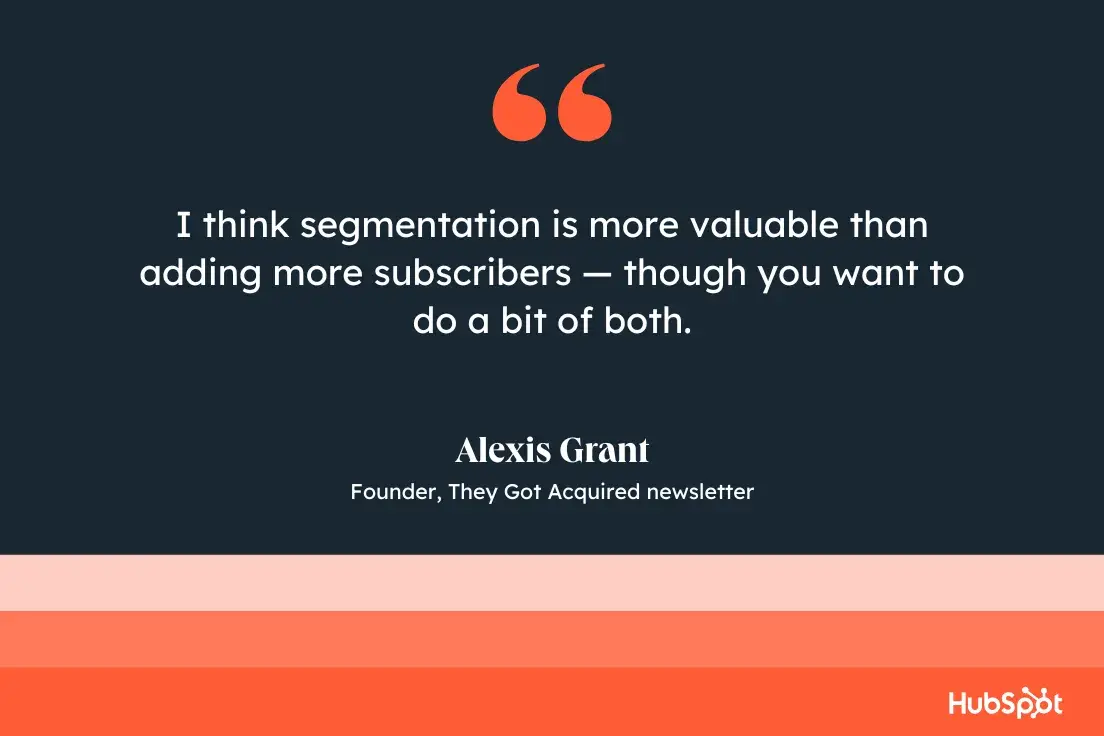
Grant runs the newsletter They Got Acquired, and she uses audience segmentation tools like RightMessage to “serve people exactly what they want.” When you sign up for They Got Acquired’s newsletter, there’s an optional survey to identify niche demographics like founders looking to sell within the year.
One of Grant’s goals is to get more users on her platform, called They Got Acquired Data, which provides data and insights that can be used to identify comps, grow buyer lists, and strengthen your negotiations.
That platform will likely be more valuable to a founder looking to sell within the year than somebody looking to sell within five years, and Grant can tailor her content accordingly.
Common B2B Newsletter Challenges
While the benefits are compelling, successful B2B newsletters require navigating several unique challenges:
Resource Intensity: Creating consistent, high-quality content demands significant time and expertise. Unlike promotional emails, which can be templated, newsletters require fresh insights and original thinking. Consider partnering with subject matter experts or hiring journalists to maintain quality without burning out your team.
Measuring ROI: B2B newsletters play the long game, making traditional metrics like immediate conversions less relevant. Track engagement metrics (open rates, click-through rates, forward rates) alongside pipeline influence and customer lifetime value to demonstrate impact.
Smaller, Specialized Audiences: B2B newsletters typically have smaller subscriber counts than B2C, but don't let that discourage you. As Al Iverson discovered with his 1,300-subscriber Spam Resource newsletter, a highly targeted audience can be more valuable than massive reach.
Technical Deliverability: Corporate email filters are notoriously strict. You'll face challenges like delayed delivery, spam filtering, and the need for allowlisting—especially when targeting .edu, .gov, or .mil domains. Building sender reputation takes time and consistent best practices.
6. Establish a direct line to decision-makers.
A niche audience can be targeted-networking gold.
Take Al Iverson’s Spam Resource newsletter, which focuses on email marketing and deliverability. Iverson told me that he only has around 1,300 subscribers — but they were the perfect 1,300 people to reach out to during a recent job search.
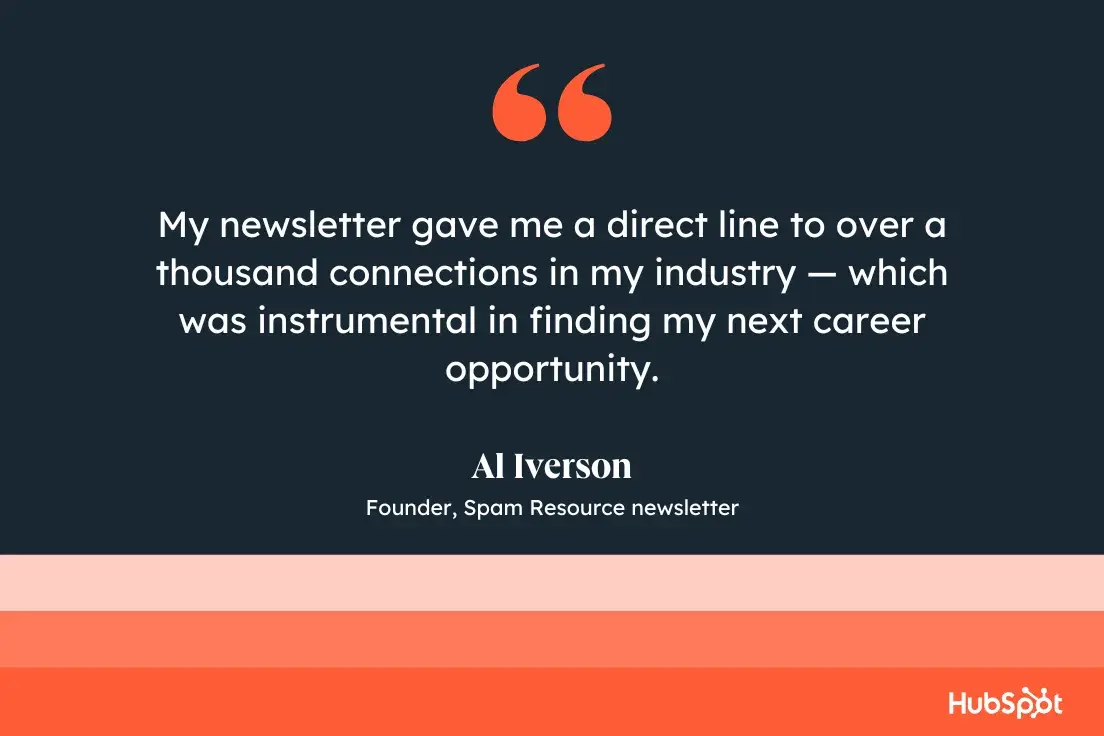
“My newsletter gave me a direct line to over a thousand connections in my industry,” he says. “It was instrumental in finding my next career opportunity.”
The Future of Newsletters
Your Guide to Building a Profitable Media Empire
- Learn the Basics
- Understand How to Monetize
- Build Your Content Strategy
- And More!
Download Free
All fields are required.
How to Create a B2B Newsletter People Want to Read
Content Strategy
I spoke with several experts and heard the same thing over and over again: Write good newsletters that serve your audience — not your brand. (If you want more examples, I compiled a list of 23 of my fav marketing newsletters.)
Focus on Educational Value
B2B audiences seek insights that help them excel at their jobs. Prioritize how-to guides, industry analysis, and actionable frameworks over product features. Aim for an 80/20 split between educational content and branded mentions.
Curate Thoughtfully
Brad Wolverton, founder of Newsletter Examples, suggests: "Think like a journalist. Your job is to share the most useful information." Mix original insights with curated industry news, always adding your unique perspective.
Write for Humans, Not Corporations
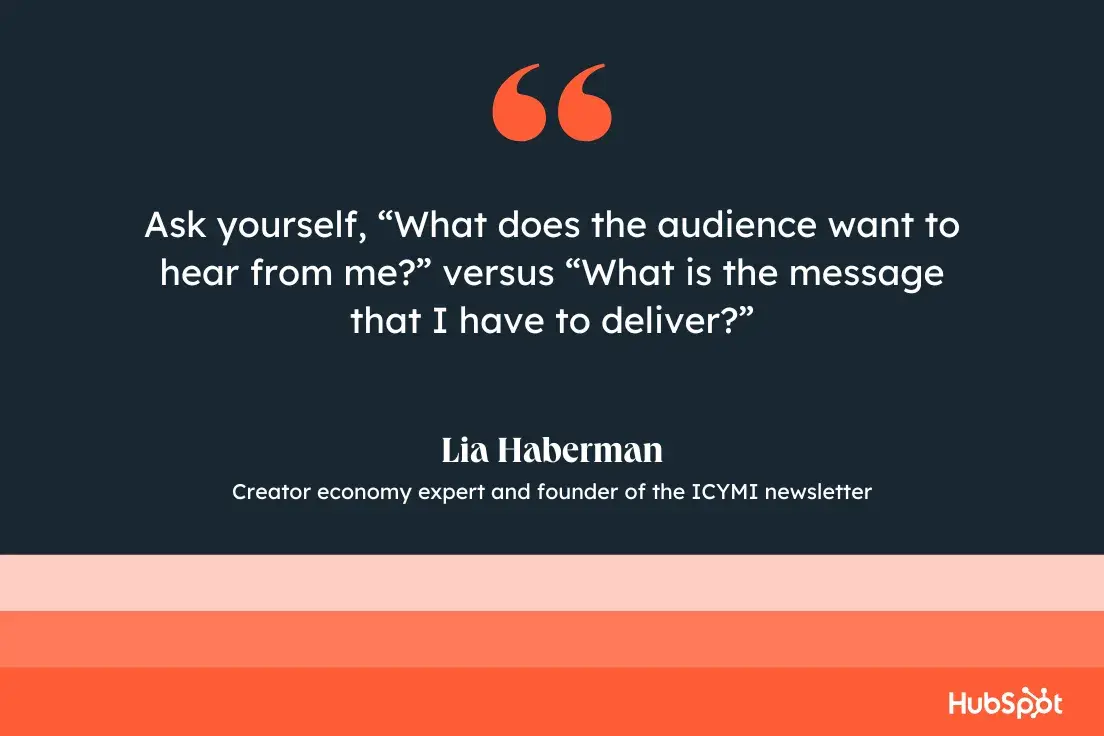
Haberman recommends hiring writers with journalistic or creative backgrounds. "Marketers can be great writers," she says, "but the mindset of a marketer and the mindset of a writer are two different things."
Technical Requirements
Most email marketing platforms include some level of technical support, but Kaylee Jenzen, a technical marketing manager at HubSpot, highlights critical considerations:
Deliverability Optimization
- Authenticate with SPF, DKIM, and DMARC to pass corporate spam filters
- Monitor sender reputation and maintain list hygiene (remove hard bounces immediately)
- Keep emails under 102KB to avoid Gmail clipping
- Test rendering across Outlook, Gmail, and other corporate email clients
IP Strategy: Choose between shared and dedicated IPs based on volume. Jenzen notes: "If you're running a small newsletter or don't send regular emails, you'll benefit from a shared IP address." However, dedicated IPs offer more control for high-volume senders.
Segmentation Architecture: Alexis Grant of They Got Acquired emphasizes: "I think segmentation is more valuable than adding more subscribers." Use progressive profiling and behavioral data to deliver increasingly personalized content.
Design and Format
Mobile-First Design Over 50% of B2B emails are read on mobile devices. Use single-column layouts, 14px minimum font size, and buttons at least 44px tall for easy tapping.
Scannable Structure
- Clear hierarchy with descriptive headers
- Short paragraphs (2-3 sentences max)
- Bullet points for key takeaways
- Bold text for important concepts
- White space to reduce cognitive load
Visual Elements: While B2B newsletters are typically text-heavy, strategic visuals enhance engagement. Include relevant charts, infographics, or screenshots that support your narrative without overwhelming the design.
Frequency and Timing
Finding Your Rhythm
Weekly newsletters work well for news and trends, while bi-weekly or monthly cadences suit in-depth analysis. Whatever you choose, consistency matters more than frequency.
Optimal Send Times
B2B newsletters perform best Tuesday through Thursday, between 10 AM and 2 PM in your audience's primary time zone. Avoid Mondays (inbox overload) and Fridays (weekend mindset).
Testing and Iteration
A/B test subject lines, send times, and content formats. Track metrics like open rates (B2B average: 15-25%), click rates (2-5%), and unsubscribe rates (under 0.5%) to optimize performance.
Lessons for Brands
- Invest in creativity. That requires more than just hiring creative people to write content — it requires giving them trust and freedom, too. That can be a hard pill for brands to swallow, but consumers don’t want an email from a well-oiled marketing department. They want voice, creativity, and a sense of the face(s) behind the newsletter.
- Resist the urge to be self-serving. It’s tempting to use newsletters to drive website engagement and nothing more. Think about what your audience wants, and find the right balance of branded and external content. It will build your credibility, trustworthiness, and authenticity.
Pro tip: Our 2025 survey found that newsletters consisting of mixed media content (text plus video or imagery) generate the highest open rate, click rate, revenue, website traffic, and conversion rate.
B2B Newsletter Marketing Best Practices
B2B newsletters, like anything else in marketing, is a growing and evolving field. Use this three-pronged list of best practices as a guide, whether you’re starting a newsletter from scratch or revamping an existing one.
I’ve also included a few examples of newsletters I think do a particularly good job with content strategy and audience engagement. (Technical optimization is a bit harder to judge, since it all takes place under the hood.)
Content Strategy
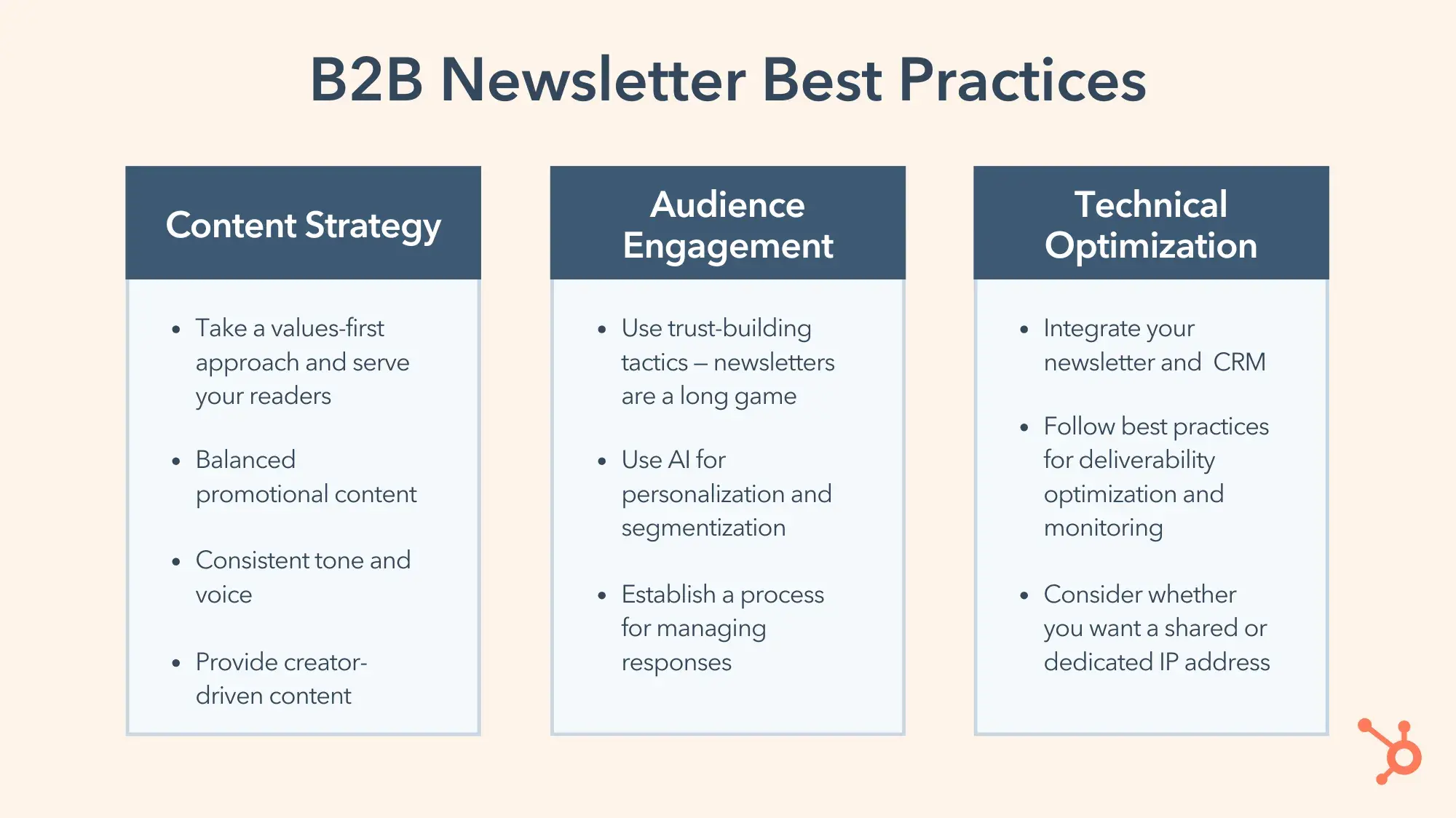
The content strategy for newsletter marketing should fit comfortably within your overall marketing strategy, but to recap a few guidelines from the experts I spoke with, prioritize:
- A values-first approach that serves your readers
- Balanced promotional content
- Consistent voice and format
- Provide creator-driven content
In original HubSpot research from September 2024, we asked 500+ newsletter operators about their most commonly used content strategies:
- Your personal opinions, tips, or hot takes on your industry or topic of interest (28%)
- Expert advice or tips (quoting someone you didn't interview other than yourself) (16%)
- News or trends (14%)
- Expert advice or tips (quoting someone you did interview other than yourself) (12%)
- Data, research, experiments, or studies that you've gathered or run (11%)
- Data, research, experiments, or studies cited from third-party or outside brands (11%)
- User-generated content with quotes, tips, comments, text, or other elements sourced from your subscribers or audiences (8%)
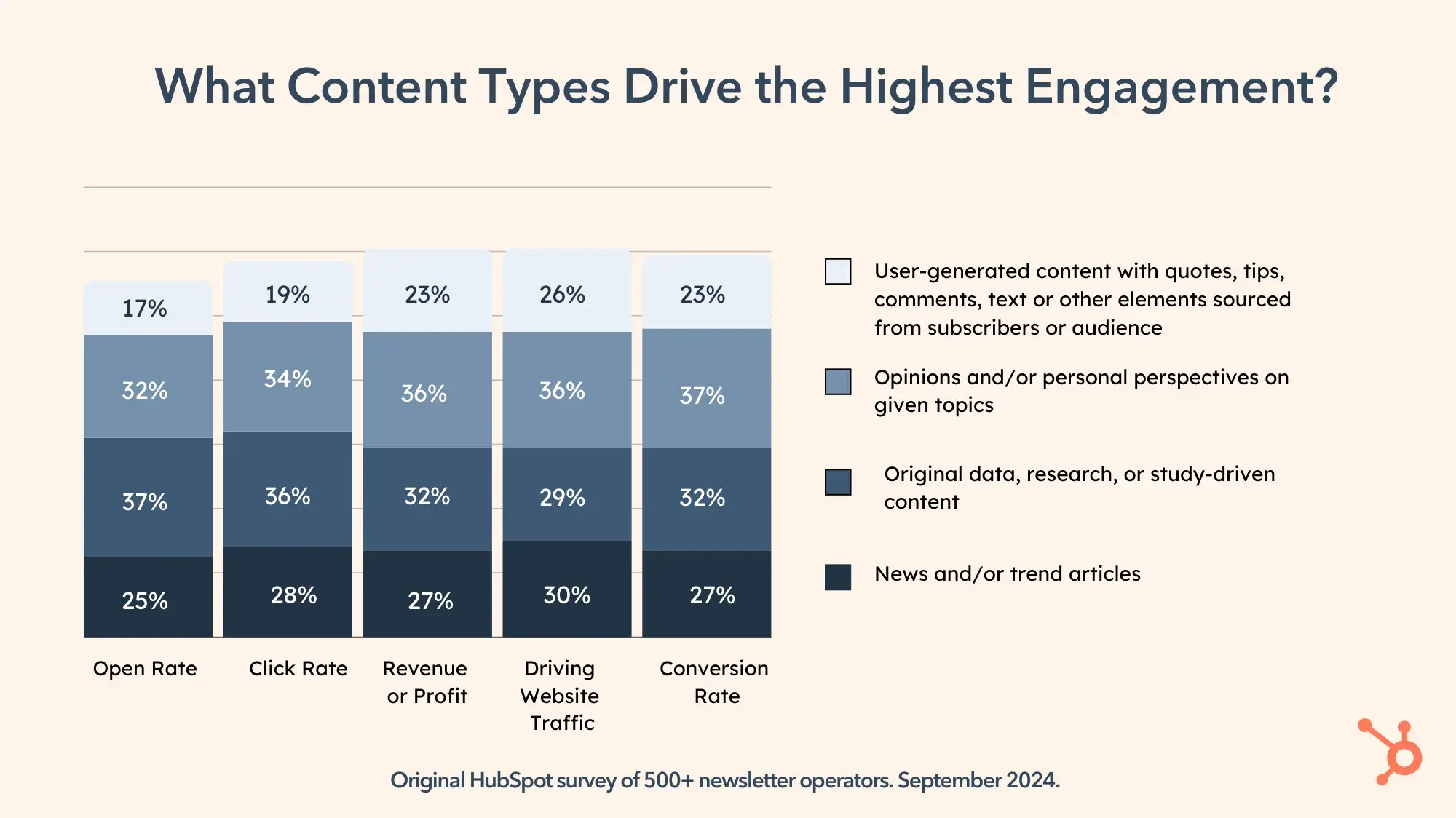
We also asked what type of content drives the most engagement.
Our findings are consistent with the expert advice in this article: Readers want emails from real people with real opinions.
By every metric, content based on your personal opinions and perspectives, along with original data and research, drives the highest engagement.
Get inspired: Check out The Publish Press, a thrice-weekly send with the latest news for creators, and WTF is SEO?, which shares advice and interviews on SEO for news and publishers.
How to: We’ve got a detailed step-by-step guide on how to create an email newsletter and tips for creating great content.
The Future of Newsletters
Your Guide to Building a Profitable Media Empire
- Learn the Basics
- Understand How to Monetize
- Build Your Content Strategy
- And More!
Download Free
All fields are required.
Audience Engagement
Audience engagement might be measured in different ways depending on your priorities (for instance, one of my colleagues wrote about how The Hustle prioritizes click-through rate over open rates).
- Trust-building tactics, like centering the readers’ wants and needs
- Personalization techniques
- Segmentation strategies
- Response management
Get inspired: Check out FINGERS, a newsletter about drinking in America, which is highly lauded for its engagement; and of course The Hustle, which I would read every day even if I didn't work here.
How to: We’ve compiled 22 of the best newsletter tools for engaging subscribers.
Pro tip: Track newsletter ROI by connecting email metrics to revenue outcomes: attribute website conversions, demo requests, and closed deals back to newsletter engagement.
FYI: Our 2025 survey found that the top 3 newsletter metrics marketers track are views (58%), clicks or click rate (35%), and engagement metrics such as replies, comments, likes, and reactions (30%).
Beyond open and click rates, measure long-term indicators like subscriber lifetime value, influenced pipeline, and content engagement trends. Set up UTM parameters and integrate your email platform with your CRM to track the full customer journey.
Technical Optimization
Technical optimization often requires deeper technical know-how.
Since it’s likely that your email marketing platform of choice will provide some technical support, I haven’t gone into detail here — but here are a few things to keep in mind and ask questions about as you get your newsletter off the ground:
- CRM integration and automation setup
- Deliverability optimization and monitoring
- IP management (shared vs. dedicated)
How to: We’ve got a free downloadable guide with email marketing best practices and a planning template.
Pro tip: Email deliverability depends on three core elements: authentication protocols (SPF, DKIM, and DMARC records), a clean sender reputation, and permission-based subscriber lists.
Always use a reputable email service provider and never purchase email lists, as this tanks your sender score. Monitor your bounce rates and spam complaints closely—high rates signal to inbox providers that your emails shouldn't be delivered.
B2B Newsletter Statistics
Key B2B Newsletter Findings
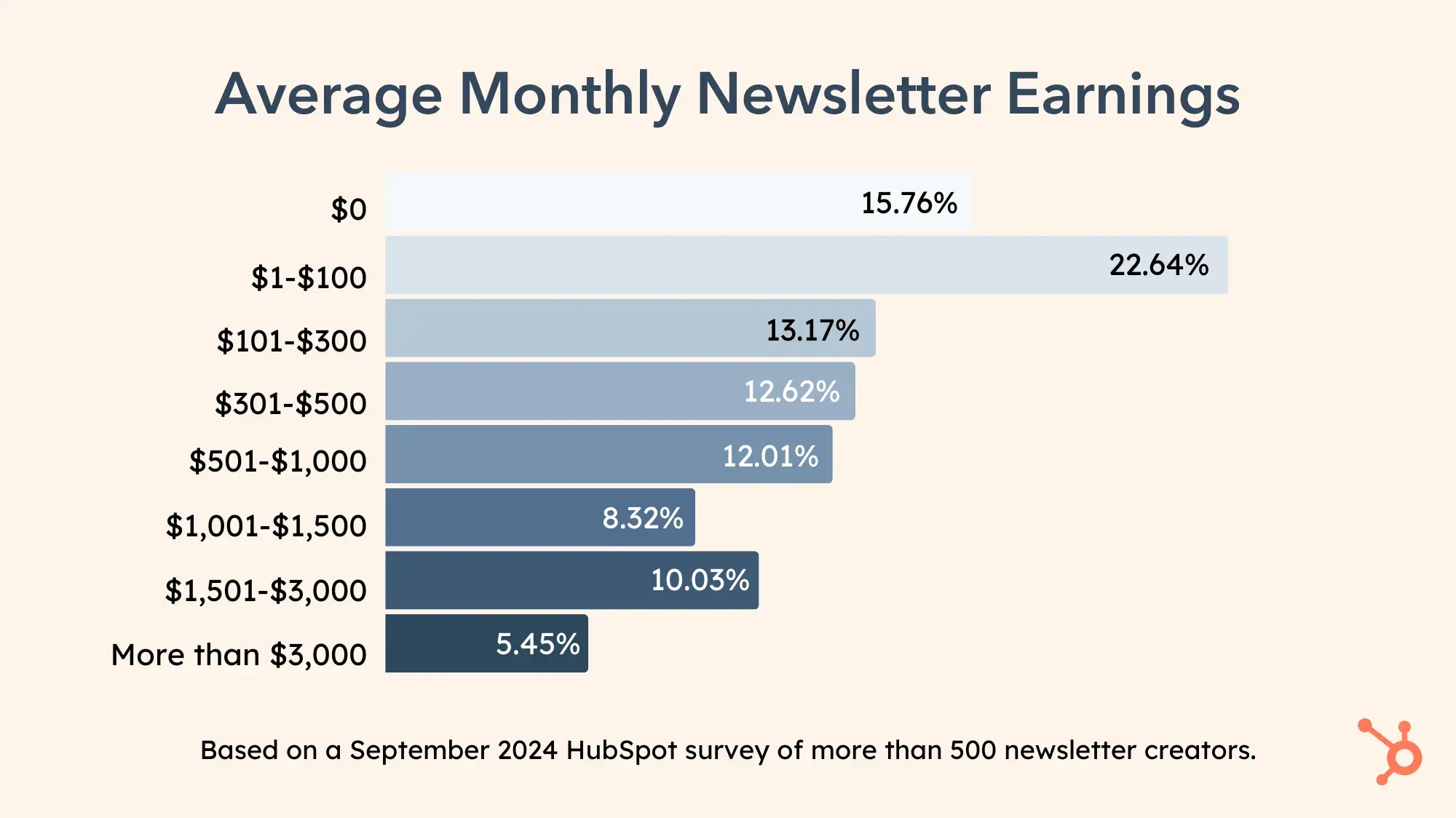
Most newsletter operators aren’t making a living out of it.
Just 5.45% of respondents earn more than $3k a month from their newsletter, and 38.4% make between $0 and $100 each month.
Running a newsletter is a lot of work.
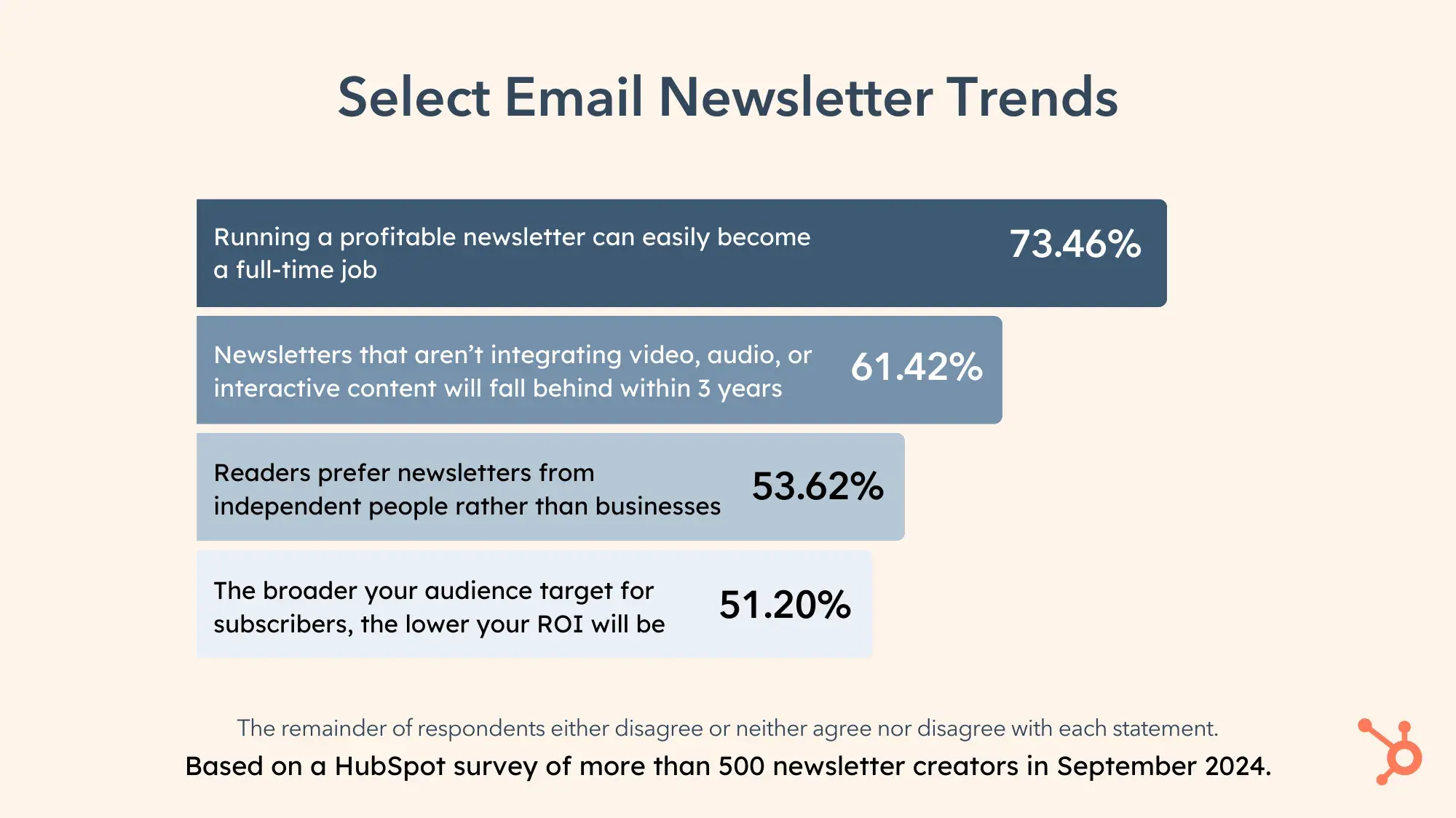
Like, a lot of work: An incredible 73.46% respondents said that running a profitable newsletter can easily become a full-time job.
Be sure you do the calculus in your marketing strategy so you don’t put more resources into a newsletter than you can reasonably get out of it.
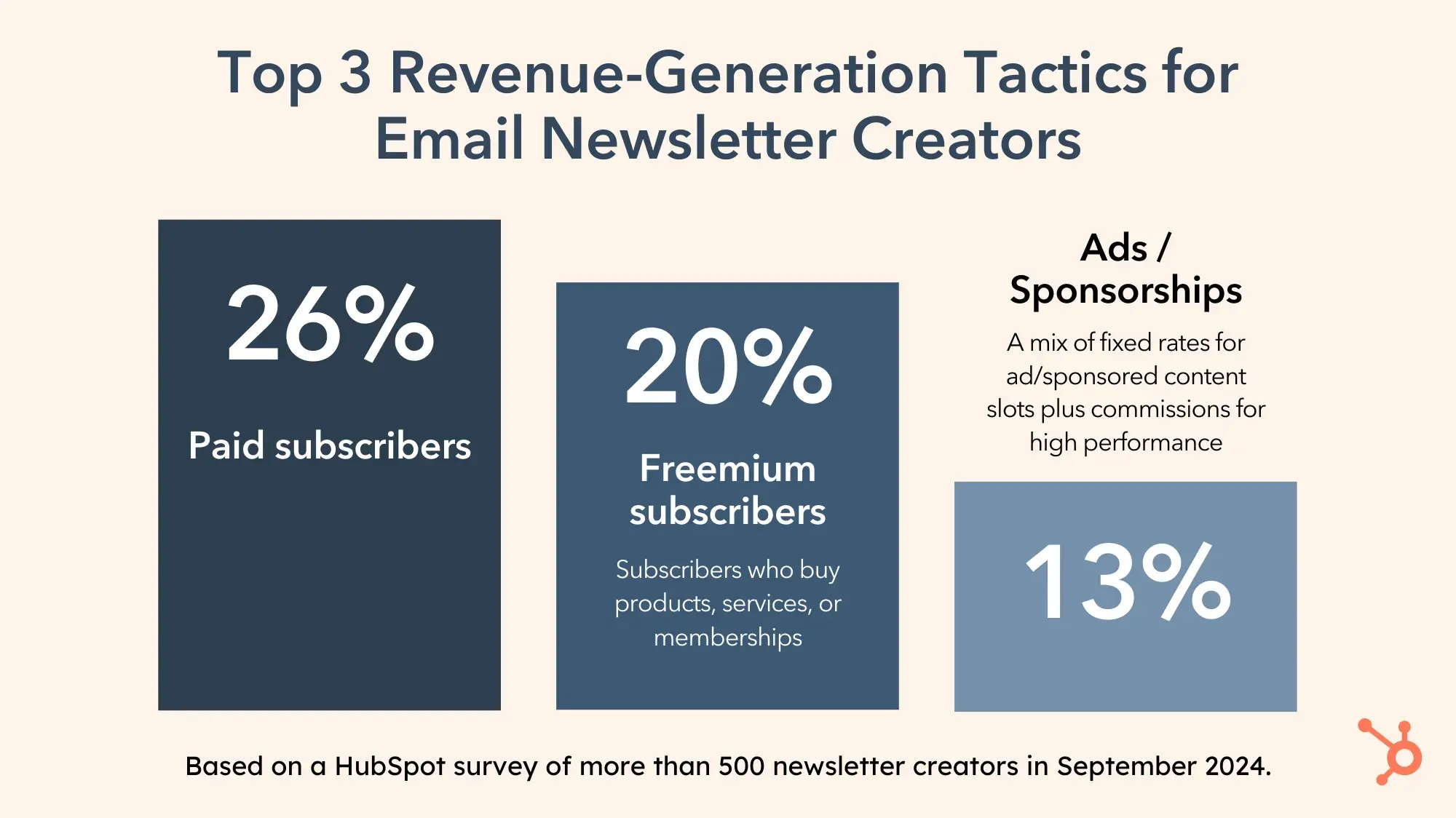
Paid subscriptions are the top source of newsletter revenue.
We asked respondents to identify the top three money-making tactics, and 26% said paid subscribers, 20% said freemium, and 13% said that ads and sponsorships were their top revenue source.
Stay on top of current trends.
Nearly 62% of respondents said that newsletters that don’t integrate video, audio, or interactive elements will fall behind in less than three years.
Readers want to hear from people — not brands. If you’re writing on behalf of a brand, keep Haberman’s advice in mind about hiring creative writers or getting into a reader-focused mindset.
Narrow your target audience.
Your newsletter can’t be all things to all people, and you’ll be better positioned if you embrace that.
Over 51% of respondents said that the broader your target audience, the lower your ROI. Look for a niche that only you can fill, and you’ll be able to get more value out of fewer subscribers.
B2B Newsletter Examples That Get Results
Let's examine successful B2B newsletters that demonstrate these principles in action:
1. Morning Brew (Business News)
What works: Daily business news delivered with personality and wit. Their conversational tone and clever subject lines achieve 40%+ open rates in a crowded category. Key takeaway: Even serious B2B content benefits from personality.
2. HubSpot's Marketing Blog Newsletter
What works: Curated marketing insights combined with original research and templates. They balance educational content with subtle product integration. Key takeaway: Provide immediate value through downloadable resources.
3. CB Insights (Tech & Startups)
What works: Data-driven insights presented through compelling visuals and snarky commentary. Their unique voice cuts through typical corporate communications. Key takeaway: Don't be afraid to take a stance and show personality.
4. Really Good Emails (Design Inspiration)
What works: Curated email design examples with expert commentary. They practice what they preach with beautiful, functional design. Key takeaway: Show, don't just tell—especially for visual industries.
5. Litmus Weekly (Email Marketing)
What works: Deep dives into email marketing trends with actionable tips. They segment content based on subscriber preferences and job roles. Key takeaway: Personalization goes beyond using someone's name.
B2B Newsletter Marketing: Frequently Asked Questions
1. How often should I send B2B newsletters?
Most B2B companies find success with monthly or bi-weekly newsletters, as this frequency keeps you top-of-mind without overwhelming busy professionals. The key is consistency—choose a schedule you can maintain reliably.
Test different frequencies with your audience and monitor engagement metrics to find your optimal cadence.
2. What's the difference between B2B and B2C newsletters?
B2B newsletters focus on professional value like industry insights, thought leadership, and solving business challenges, while B2C newsletters emphasize entertainment, promotions, and emotional connection.
B2B audiences expect longer-form, educational content and typically have longer decision-making cycles. B2B newsletters also tend to target multiple stakeholders within an organization rather than individual consumers.
3. How do I measure B2B newsletter ROI?
Track engagement metrics, including open rates, click-through rates, and time spent reading, and then connect these to business outcomes, such as leads generated, opportunities created, and revenue influenced.
Utilize UTM parameters and CRM integration to track newsletter interactions and attribute them to sales pipeline activity. Calculate ROI by comparing the revenue generated from newsletter-driven conversions against your total newsletter costs (tools, content creation, and time).
4. What tools are best for B2B newsletter marketing?
Popular B2B newsletter platforms include HubSpot, Mailchimp, and ActiveCampaign for their CRM integration and automation capabilities. For more sophisticated needs, consider Marketo, Pardot, or Eloqua, which offer advanced segmentation and lead scoring.
Many B2B companies also utilize specialized tools, such as Litmus, for testing and analytics, as well as platforms like Google Analytics for more in-depth performance tracking.
5. How do I grow my B2B newsletter subscriber list?
Offer valuable gated content, such as whitepapers, industry reports, or exclusive research, in exchange for newsletter sign-ups. Promote your newsletter through multiple channels, including your website, LinkedIn, webinars, and at the end of blog posts.
Leverage existing touchpoints, such as email signatures, sales conversations, and customer onboarding, to encourage subscriptions from qualified prospects.
6. What content works best in B2B newsletters?
Industry insights, original research, and actionable how-to content perform well because they help subscribers perform their jobs more effectively.
Case studies, customer success stories, and thought leadership pieces build credibility and demonstrate your expertise. Curated content that saves readers time by highlighting the most relevant industry news and trends also generates strong engagement.
B2B Newsletter Marketing for Brands
B2B newsletter marketing is the practice of sending regular, value-driven email updates to business audiences to build relationships, share insights, and drive long-term growth. Unlike promotional emails that focus on immediate conversions, B2B newsletters are fundamentally different—they prioritize education, thought leadership, and nurturing leads over time.
Effective B2B newsletters focus on educational and value-driven content that serves your readers first and your brand second. This approach, combined with consistent delivery, builds trust with business audiences and establishes your organization as an authority in your field.
To succeed, define your audience, deliver relevant content consistently, and ensure technical deliverability through correct setup of SPF, DKIM, and DMARC records. These authentication protocols are essential for reaching inboxes rather than spam folders.
B2B newsletter ROI is measured differently than traditional email campaigns—track engagement rates, pipeline influence, and long-term customer value rather than just open rates and immediate conversions. These metrics better reflect the relationship-building nature of newsletter marketing.
HubSpot offers AI-powered tools for B2B newsletter creation and automation, enabling the easy personalization of content at scale, intelligent audience segmentation, and adherence to technical best practices without requiring in-depth technical expertise.
Want to launch or improve your B2B newsletter? Start free and leverage proven best practices from real-world examples to accelerate your success.
Editor's note: This post was originally published in November 2024 and has been updated for comprehensiveness.
The Future of Newsletters
Your Guide to Building a Profitable Media Empire
- Learn the Basics
- Understand How to Monetize
- Build Your Content Strategy
- And More!
Download Free
All fields are required.
Email Newsletters
![HubSpot's 2025 State of Newsletters Report [data from 400+ newsletter pros]](https://53.fs1.hubspotusercontent-na1.net/hubfs/53/state-of-newsletters-1-20251030-4170182.webp)
.png)
![How to Create an Email Newsletter [+ Expert Tips & Checklist]](https://53.fs1.hubspotusercontent-na1.net/hubfs/53/how-to-create-email-newsletters-1-20250211-3097238.webp)
-Oct-10-2025-03-00-17-4988-PM.webp)

.png)