-3.webp)
In this post, I’ll be sharing the real-world takeaways I’ve learned using SPIN selling. The complete book is short and approachable, making it well worth the read, but my goal is to boil it down to the essentials so you can apply it right away. Whether you’re new to the framework or looking to modernize how you use it, this guide will get you there.
Table of Contents
- What is SPIN selling?
- SPIN Selling Book Summary
- SPIN Selling Methodology
- 50+ SPIN Selling Questions to Add to Your List
- The 4 Stages of the SPIN Selling Method
- Outcomes for Measuring Progress in SPIN Selling
- 7 Tips for Modern-day SPIN Selling
- What does SPIN training cover?
- SPIN Sales Training Vendors
What is SPIN selling?
SPIN selling is a consultative sales method developed by Neil Rackham that helps salespeople lead more effective conversations. The acronym stands for the four types of questions used to uncover customer needs: Situation, Problem, Implication, and Need-Payoff.
Unlike hard-closing tactics, SPIN is all about building trust, diagnosing real challenges, and helping the buyer come to their own conclusion — that your solution is the best fit. It’s especially useful for complex, high-ticket sales where relationships matter and decisions take time.
In my experience, the SPIN method is still the gold standard for mostly inbound sales. If leads are reaching out to you, it’s important to lead an effective discovery process that qualifies the opportunity, assesses the needs of the prospect, and moves them toward your solution in a natural and logical way.
Free Sales Plan Template
Outline your company's sales strategy in one simple, coherent sales plan.
- Target Market
- Prospecting Strategy
- Budget
- Goals
Download Free
All fields are required.
SPIN Selling Book Summary
Neil Rackham developed the SPIN selling framework to help salespeople tactfully navigate the selling process and close deals. If you haven’t read the book (you should) or it’s been a while, here’s a quick overview:
Section 1: Breaking Down What Actually Drives Sales Success
Rackham’s research, based on more than 35,000 sales calls, debunked many old-school selling myths. He found that the best reps weren’t the ones who talked the most or had the slickest pitches. They were the ones who asked smart, purposeful questions and guided buyers to uncover their own needs.
Section 2: Why Closing Techniques Don’t Work in Big Deals
In major sales, aggressive closing doesn’t just fail — it backfires. The bigger the deal, the more likely a hard close will raise red flags for the buyer. SPIN teaches sellers to earn commitment gradually by aligning with the buyer’s process. In Rackham’s take, there are four potential outcomes to every sales call: order, advance, continuation, or no-sale.
Section 3: Moving Beyond Surface-Level Needs
Inexperienced reps often jump on the first pain point they hear. But high-performing sellers dig deeper — exploring the consequences of problems and how they impact the business. That’s where SPIN’s implication and need-payoff questions shine.
Section 4: Applying SPIN as a Strategic Framework
Rather than treating each sales call like a standalone event, SPIN encourages a more strategic arc. Each conversation builds on the last, gradually shaping the buyer’s thinking and guiding them toward action. According to the book, salespeople who close at high rates tend to ask the same types of questions in the same order, and this observation definitely correlates with my own experience. When you’ve been selling for a while, the patterns start to really jump out at you.
Section 5: Framing Benefits in Terms That Matter
Customers don’t buy features, they buy outcomes. SPIN sellers frame benefits as direct responses to the buyer’s articulated needs, not generic product perks. It’s a subtle but powerful shift that makes a big difference. The book also notes that benefits are most influential when presented near the end of the sales conversation.
Section 6: Getting Ahead of Objections by Addressing Root Causes
SPIN isn’t about dodging objections — it’s about preventing them. When buyers feel heard and understood, many objections fade before they’re even raised. You’re not just selling a solution; you’re shaping a buying vision. Rackham observes that objections are usually created by the salesperson, and although it’s tough medicine to swallow, I can easily remember times I’ve talked my prospect into an objection.
Section 7: Nailing the First Impression Without Over-Talking
SPIN’s approach to opening is simple: Set a professional tone, establish relevance, and ask thoughtful questions. No need for flashy intros or over-hyped agendas. Just be clear, confident, and curious.
Section 8: Building Your Own SPIN Playbook
Every salesperson needs to tailor SPIN to their style and industry. For me, that meant creating a bank of go-to questions for each stage — and practicing them until they flowed naturally in conversation. I’ll share some of those questions later in this post.
SPIN Selling Methodology
When you read through Rackham’s book, you’ll notice that meaningful questions are at the core of SPIN selling. As I’ve experimented with the methodology, I’ve learned firsthand that every question should have a clear purpose, and asking these intentional questions in a strategic order is what ultimately creates the desired impact.
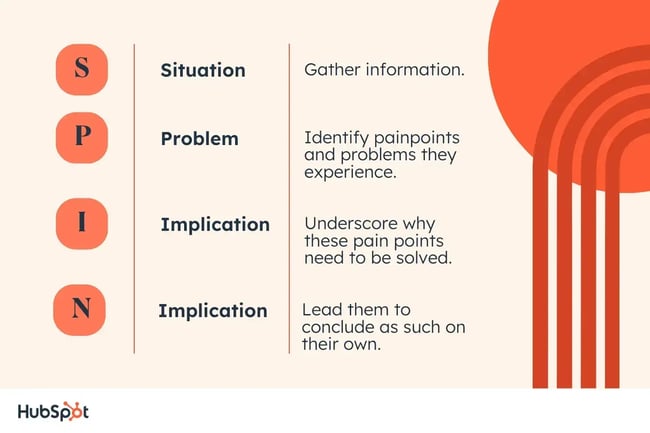
It’s worth reiterating section seven of the book that we just touched on above: random questions that arise (usually in an effort to prevent long pauses in a conversation) almost always hurt more than they help. To master the questioning sequence, let’s turn to the SPIN acronym:
Situation
These are your fact-finding questions — think of them as a way to set the scene. Ask just enough to get context without overwhelming the prospect. I usually prepare 3-4 key questions to use depending on the industry.
Examples:
“What does your current workflow for [X] look like?”
“How are you currently tracking [metric/process]?”
“Which tools are you using to handle [specific task or challenge]?”
Problem
Problem questions are where the conversation starts to pivot. Your goal is to help the buyer recognize an issue they may not have fully considered. I’ve found these questions work best when they challenge assumptions in a respectful way.
Examples:
“What’s the most frustrating part of that process right now?”
“Where are things starting to break down as your team scales?”
“What’s not working the way you’d like it to?”
“Have there been any recent complaints from internal stakeholders or customers?”
Pro tip: The best problem questions are an opportunity to earn trust by showing that you understand the space you’re selling into. Just make sure you do your research ahead of time, as a swing and a miss here can derail the sales process in a way that’s difficult to recover from.
Implication
These questions explore the ripple effects of the problem. What’s the cost of inaction? How does it impact other departments? These are powerful for creating urgency without being pushy.
Examples:
“How does that delay affect your quarterly targets or reporting?”
“What’s the cost of that inefficiency over the next 6-12 months?”
“If this keeps happening, how might that affect your team’s morale or customer satisfaction?”
“How much time is your team spending fixing this issue instead of focusing on higher-value work?”
Need Payoff
This is where the magic happens. Ask your prospect how solving the problem would improve their situation — and listen closely. When they articulate the value themselves, they’re far more likely to take action.
Examples:
“What would it mean for your team if that bottleneck were eliminated?”
“How would it change things if you could recover that eight to 10 hours a week?”
“If this were no longer a problem, how would it free you up to focus on other priorities?”
“What kind of results would justify making a switch now instead of waiting?”
Free Sales Plan Template
Outline your company's sales strategy in one simple, coherent sales plan.
- Target Market
- Prospecting Strategy
- Budget
- Goals
Download Free
All fields are required.
50+ SPIN Selling Questions to Add to Your List
In practice, SPIN questions are less like a script and more like a toolkit. You don’t need to hit every category on every call, but you do need to know when to use which type. Let’s look at some more examples of SPIN selling questions.
Situation Questions You Can Use
Use situation questions to learn where your prospects stand, from their processes and pain points to competitive plans and results. These questions will depend on your product. For example, at ALINE we’ve had a lot of success helping companies with marketing for recruitment. Everyone knows they should be trying to reach potential customers, but they often overlook the importance of selling themselves to potential new hires.
To figure out how a prospect is handling hiring, I might ask, “Where are you finding the most talent to fill your applicant pipeline?”
This question prepares the groundwork for my entire pitch because it gives me insights to build on. With a single question, I’ll find out how sophisticated the company’s hiring practices are, along with what they’re doing well, plus an easy segue into the problem section — issues they’re having and areas they could improve.
Here are some sample questions you can customize for your use:
Examples
- What tools are you currently using to manage [process]?
- How long have you been using your current system?
- Who else is involved in decisions about this area?
- What is your role at [company]?
- How do you do X?
- What’s your process for X?
- Walk me through your day.
- Do you have a strategy in place for X?
- Who’s responsible for X?
- How long have you done X this way?
- How much of your budget is assigned to X?
- Why do you do X this way?
- How important is X to your business?
- Who uses X most frequently? What are their objectives?
- Which tools do you currently use to do X?
- Who is your current vendor for X?
- Why did you choose your current vendor for X?
- Are you satisfied with X? Is there room for improvement in your current process?
You’ll notice that this list doesn’t include fact-gathering questions about company size, number of locations, products sold, and so on.
When Rackham published SPIN Selling, there wasn’t anywhere near as much information available to sellers. Now that you can discover a long list of key details about your prospect with a quick online search, situational questions are far less effective.
Instead, ask questions that show you’ve done your research. For example, I might reframe my general question about their hiring practices to ask, “How successful have you been at using Indeed to get in front of potential applicants?” By specifically calling out a method they’re using, I’m demonstrating that this call is happening for a reason.
Problem Questions That Reveal Pain
In this stage, reps identify the right opportunities to sell to a prospect. What gap isn’t being filled? Why is the prospect dissatisfied? Your prospects may be unaware they have a problem, so it’s up to you to identify areas where your solution adds value.
To continue in my recruitment marketing example, I could ask how long positions are staying open before they’re filled, or how many applicants end up failing before they find the right fit.
Examples
- How long does it take to do X?
- How expensive is X?
- How many people are required to achieve the necessary results?
- What happens if you’re not successful with X?
- Does this process ever fail?
- Are you satisfied with your current process for X? The results?
- How reliable is your equipment?
- When you have issues, is it typically easy to figure out what went wrong?
- How much effort is required to fix your tools or buy new ones?
- Are you happy with your current supplier?
- What’s your biggest frustration with the current process?
- Where are things falling through the cracks?
- Are there any recurring complaints from your team?
Implication Questions That Create Urgency
Once you’ve identified an issue, determine its severity. Implication questions reveal the depth and magnitude of your prospect’s pain point, simultaneously giving you valuable information for customizing your message and instilling urgency in the buyer.
Once you’ve arrived at this part of the conversation, your prospects should have a new appreciation for the problem. In Rackham’s research, he cited that top-performing salespeople ask four times more implication questions than their average peers.
If I find a prospect is struggling to fill roles quickly, I have a few different approaches to implication. In industries such as manufacturing where inputs and outputs are more objective, I might ask how much output is lost for each week a position is vacant. If the company is in professional services, I might ask what an unfilled role does to team morale when existing employees are forced to pick up slack.
Examples
- What’s the productivity cost of doing X that way?
- What could you accomplish with an extra [amount of time] each [week, month]?
- Would your customers be [more satisfied, engaged, loyal] if you didn’t experience [problem related to X]?
- If you didn’t experience [issue], would it be easier to achieve [primary objective]?
- Does [issue] ever prevent you from hitting your goals in [business area]?
- When was the last time X didn’t work?
- How is [issue] impacting your team members?
- Would you see a big impact on your team by solving [problems with X]?
- Would you say [issue] is a blocker in terms of your personal career growth?
- How have [problems with X] impacted your business performance?
- Would saving [amount of time] significantly affect your [team, budget, company]?
- How would you use an extra [amount of money] each [week, month, quarter, year]?
- Has a problem with X ever negatively impacted your KPIs?
- What are some downsides you’ve experienced when implementing X?
- Have you considered the cost versus benefits of replacing X?
- How much time is being lost due to this issue?
- What’s the cost of these delays over a year?
- How does this affect your team’s ability to hit goals?
Need-Payoff Questions That Seal the Deal
Need-payoff questions encourage prospects to explain your product’s benefits in their own words. Not surprisingly, this approach is far more persuasive than listening to you (essentially a complete stranger) describe those benefits.
Here, you‘re asking questions that surface your product/service’s potential to help with their core needs or problems. These questions focus on your solution’s value, importance, or utility. In this section, I’ll ask what it would be worth to the prospect to fill their open roles in half the time, or potentially find a better fit for the position twice as often.
Make sure your need-payoff questions don’t highlight issues your product can’t solve. For instance, if you help corporate recruiting teams identify potential engineering candidates, you shouldn’t ask about the impact of hiring better marketers.
Fortunately, it’s relatively simple to develop need-payoff questions — they should come directly from your implication questions.
Sample implication question: “Has a problem with X ever prevented you from meeting a goal?”
Sample need-payoff question that follows: “If you could do X in half the time, would that make it easier to meet your goals?”
Examples
- Would it help if … ?
- Would X make it simpler to achieve [positive event]?
- Would your team find value in … ?
- Do you think solving [problem] would significantly impact you in Y way?
- Is it important for your team members to see X benefit so they can take Y action?
- Do you think [solution] could improve your overall efficiency?
- Can you think about the impact of eliminating [problem] with [solution]?
- How would your business benefit from [eliminating problem] more quickly?
- Could solving [problem] move the needle for your business faster?
- Do you think eliminating [problem] would [benefit]?
- If we could reduce those delays by 50%, what would that mean for your team?
- How would a smoother process affect your workload?
- What kind of results would justify making a change?
Pro tip: If your need-payoff questions are too obvious, you might come across as condescending. Try to reframe the solution in a way the buyer hasn’t previously considered.
For example, instead of asking, “Would your company benefit from reducing costs?”, you could ask, “Would redirecting $1,000 per week from recruiting fees and putting it into Facebook advertising produce a better ROI?”
Starting to get the hang of it? Remember, you don’t need to start memorizing these questions. With some role-play and real-world practice, you’ll start to know what should come next without having to really think about the mechanics of the sales call.
The 4 Stages of the SPIN Selling Method
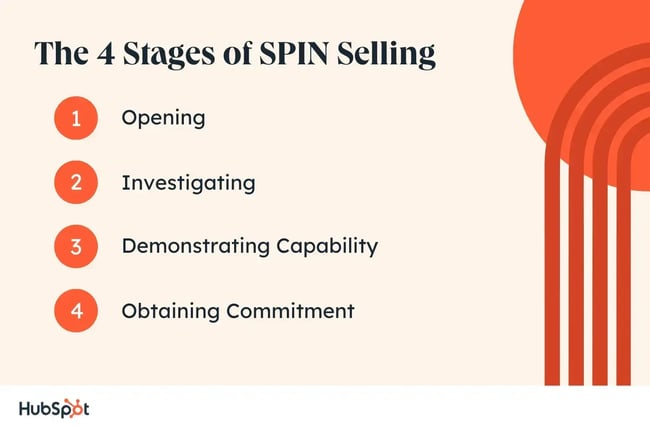
As you begin to implement SPIN questions when talking to prospects, consider the lifecycle of your conversation. Rackham says there are four basic stages of every sale.
Opening
If I could only offer one piece of advice to a salesperson, it would just be a reminder that it’s not about you. Even experienced reps can forget this tenet when they find an amazing, high-value prospect that’s the perfect fit, but immediately jumping into your product’s features and benefits will inevitably turn prospects off AND cost you the opportunity to learn valuable information.
The purpose of the connect call is to get the buyer’s attention and start to earn their trust. Lead with a compelling insight or thought-provoking question that gets you more information and shows you’ve done your homework.
Investigating
In my mind, investigation is the most critical phase of SPIN selling. It’s equivalent to the discovery call: You’re figuring out how your product can help the buyer, identifying their priorities and buying criteria, and gaining credibility by asking relevant, targeted, and strategic questions.
Critically, you’re also DISqualifying prospects that initially seemed promising but aren’t actually a good fit. According to Rackham, a strong question strategy can improve your close rate by 20%. It’s tough to get hard data on this, but I personally think it’s a conservative estimate.
Free Sales Plan Template
Outline your company's sales strategy in one simple, coherent sales plan.
- Target Market
- Prospecting Strategy
- Budget
- Goals
Download Free
All fields are required.
Demonstrating Capability
Once you yourself have connected the dots between your solution and the prospect’s needs, you need to prove to the prospect that the connection exists.
There are three basic ways to describe your product’s capabilities, Rackham says:
- Features. Features are most useful when selling low-cost, simple products. A feature of an AI inbox organization tool might be “it can pre-generate draft replies to emails requiring them.” End-users tend to find features more compelling than decision-makers who care about the bottom-line results.
- Advantages. Advantages describe how a product’s features are actually used. Like features, they’re useful for smaller purchases but less persuasive with larger ones. The advantage of the AI tool above might be that “you can increase the capacity of each individual sales rep.”
- Benefits. Benefits go one step further and show how a feature can help the prospect. They typically have a financial component and meet your customer’s need(s). The benefit in this example might be “a 20% increase in the overall revenue generated by your sales team.”
The FAB formula gives you another way to consider features, advantages, and benefits:
Because your product has [X feature], the user will be able to unlock [X advantage], which means the prospect will experience [X benefit].
This formula is useful for creating engaging sales pitches, and it encourages you to go beyond features where some untrained reps will stop. Let’s use the formula to build a pitch for a hypothetical salesperson offering employee training software.
Feature: “Our platform lets you design personalized learning paths that cater to each role or team at your company.”
Advantage: “This personalization enables your employees to access tailored training modules whether they’re onboarding or upskilling, saving them time spent on less relevant education.”
Benefit: “With tailored learning paths, your team will gain the exact skills they need, cutting time spent training by 20% while boosting employee retention by 15%.”
Obtaining Commitment
Objections are inevitable in the buying process, and if you’re not hearing any, your buyer just isn’t sharing them with you. In order to obtain commitment from the prospect, you need to discover why they haven’t already pulled the trigger on this purchase. Once you’ve identified what’s holding them back, it’s your job to help them understand why their concerns aren’t true blockers.
Of course, there could be a perfectly valid reason your product isn’t a good fit. Finding that out in the commitment stage means you didn’t qualify the prospect effectively.
Rackham talks about two types of objections in SPIN selling:
- Value. Your prospect isn’t convinced about your product’s ROI. They might say, “I like the features you offer, but the cost is too high.”
- Capability. Your prospect doubts that your product can meet their specific needs. If you’re hearing “I’m not sure it’ll be able to do X for us,” “That process seems like it would take more time than you’re estimating,” or “I think we need a more robust solution,” you’re dealing with a capability objection.
In my experience, the best way to overcome both types of objections is by showing that you’ve overcome them before. If a customer is questioning value, I’ll find them a case study or reference specific to their situation that demonstrates a clear ROI. “[Current customer] had the same doubts, but they now recommend us without hesitation.” If the prospect is uncertain of our capabilities, it’s the same playbook: “We can do it for you because we’ve done it for [current customer similar to the prospect].”
Outcomes for Measuring Progress in SPIN Selling
I often see transactional salespeople — those focused on closing the deal as quickly as possible — attempt to move through all four SPIN stages in a single sales call. If your role is dependent on a high sales volume, you might have to rush things, but I would argue that SPIN selling is built on a different approach.
I’m usually working on deals that might take as long as six or eight months to close, and the thing I love about SPIN selling is that it’s most effective when you slow down and genuinely take an interest in your prospect and their business. There will be quite a few interactions over that timeline, and the methodology outlines four possible outcomes from each one.
Advance
To help mid-market and enterprise salespeople measure their progress and keep their eyes on the (often very-far-away) prize, Rackham uses the concept of “advances.” An advance is an action the buyer commits to that brings you closer to a purchase.
The operative word here is action. It’s tempting to interpret something like a prospect’s request for more information as a buying signal, but that sort of ask puts the ball entirely in your court. In my experience, if the buyer is actually interested in your product or service, they’ll agree to do some work as well.
Continuation
A continuation is a sales conversation that ends with an undesirable outcome. In other words, when you finish the call or meeting, the buyer hasn’t agreed to any next steps that will advance the deal.
Example advances include the prospect reviewing your pricing page and sending you their questions, signing up for a free trial and exploring the tool, or introducing you to a key stakeholder.
Come up with as many valuable advances as possible. The more paths to the sale you have, the more likely you are to wind up there. When your prospect turns down one of your advances — for example, an introduction to a contact in the procurement department — you can accept the immediate rejection and then propose an alternative way to proceed.
Order
An order is the third potential outcome of a sales call. The buyer agrees to purchase your product and shows their strong desire by signing paperwork. For large deals, this is usually the last outcome in a series of progressively larger closes.
No-Sale
A no-sale is the fourth (and least desirable) outcome. Your prospect rejects your request — you can’t meet with the decision-maker, they won’t schedule another meeting, or, at the most extreme, they say there’s no possibility you’ll work together.
7 Tips for Modern-day SPIN Selling
SPIN Selling was published more than 30 years ago, so it shouldn’t be surprising to hear that the typical buying journey has evolved over the past few decades.
If you use the SPIN model, add your own spin to it. Here are some of my best practices for adjusting the SPIN selling method in the present-day sales landscape.
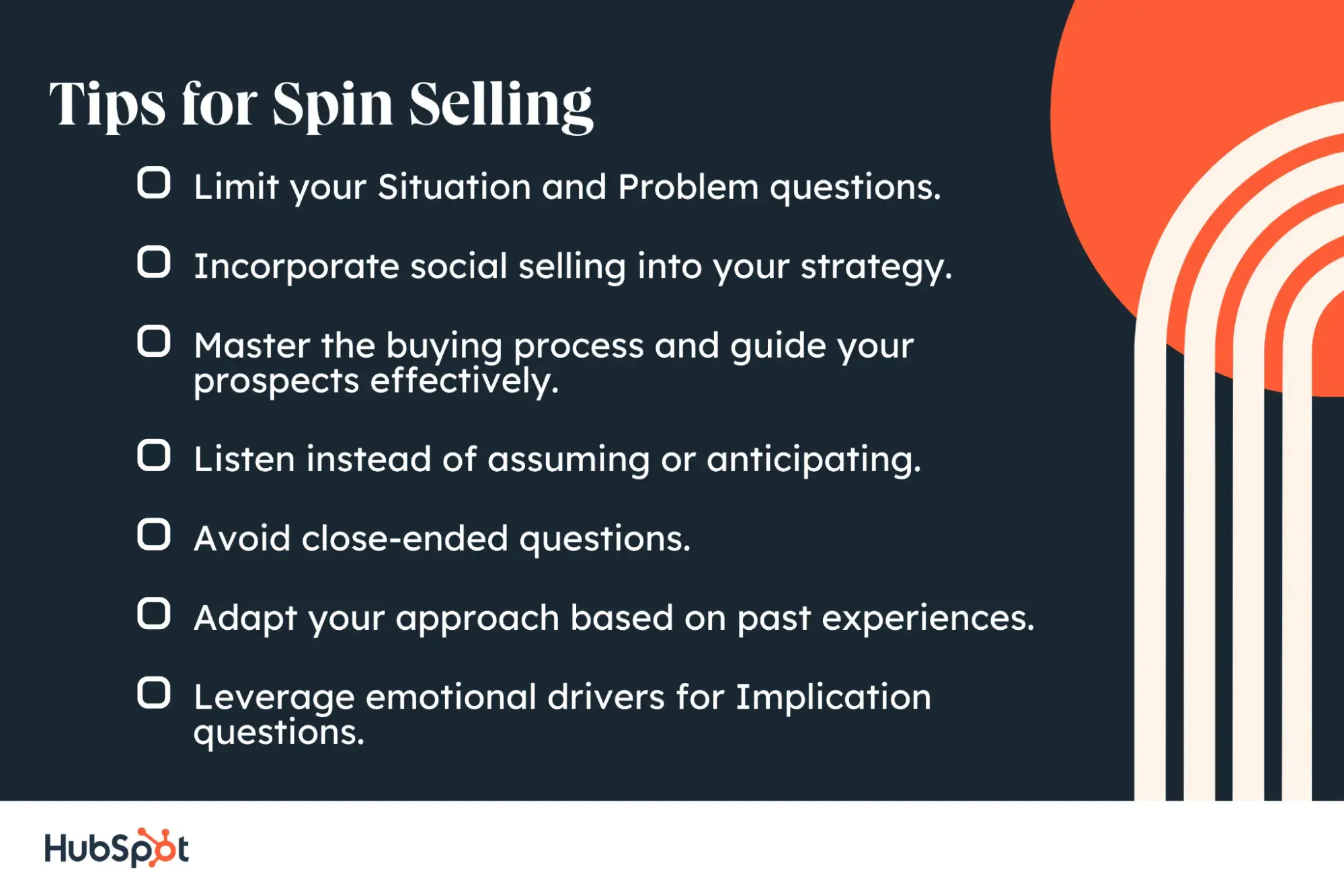
1. Limit your Situation and Problem questions.
Pro tip: Prospects don’t have the patience to help you do your homework.
Buyers aren’t interested in helping you identify the pain points they face every day. Instead, they’re more interested in hearing ways you can solve these problems.
Create value through your conversations by asking questions to:
- Help buyers realize the opportunity cost of their current challenges.
- Share the value of your solution and guide prospects to discover these benefits.
There are many questions that can help accomplish these goals, but I often rely on: “What strategies have you implemented to overcome [known challenge]?”, “Have you seen some of the recent data about [new development]?”, or “Can I offer some recommendations based on my experience supporting [similar company to prospect]?”
2. Incorporate social selling into your strategy.
When Rackham came out with SPIN Selling, LinkedIn didn't exist. Today, we have far more insight into our buyers’ perspectives, priorities, and personalities than salespeople in the late ‘80s could ever have imagined. Don’t let this valuable resource go to waste. Social selling has two components: information collection and outreach.
For the former, read your prospects’ profile(s), browse their group comments and any articles they’ve written or shared, and so on. My goal is to become as familiar as reasonably possible with a prospect before a kick-off sales call so I can engage them like it’s the fifth meeting instead of the first.
Obviously, focus first and foremost on qualification. You shouldn’t be scrolling through your prospect’s social media history unless you know without a doubt the company is a great fit for your product or service.
And second, leverage your own social media presence to reach new audiences. According to HubSpot research, 87% of sellers report that social selling is effective for their business. That’s an overwhelming majority, and it’s no coincidence.
3. Master the buying process and guide your prospects effectively.
Data from 6Sense indicates that the average buying group has ballooned to include at least 10 stakeholders. While you sell your product over and over again, prospects might only buy it once every couple of years — so come armed with the information they’ll need to navigate the buying process efficiently and effectively.
In my experience, this means knowing the job titles and ideally names of their coworkers who will need to be informed or consulted, and have at least a rough understanding of the procurement person’s typical checklist of items before approving a purchase.
Working with your contacts to anticipate and avoid roadblocks from procurement or legal will accelerate deals more than almost any other effort on your part.
4. Listen instead of assuming or anticipating.
In sales (like the rest of life), it’s easy to tune out half of what the prospect is saying because you’re too busy planning your own response. Kick this habit and you’ll reap vast benefits — a better understanding of the individual’s needs, stronger relationships, and a reputation as a trusted resource in your industry.
Active listening lets you grasp objections with much more clarity, helping you propose meaningful resolutions that assuage your prospect’s concerns and close deals.
5. Avoid close-ended questions.
Another best practice when using the SPIN selling method is to motivate prospects to share as much information as possible through open-ended questions.
A close-ended “yes” or “no” question won’t move your conversation forward, and it can feel to the prospect like you’re information gathering instead of providing value.
Strive to maintain an engaging and insightful dialogue where both parties discuss the best ways to solve buyers’ pain points. In my opinion, there’s no substitute here for genuine curiosity. Sales is an amazing career because you get to converse with and learn from business leaders every day. Remind yourself not to take it for granted, and you’ll have better, more illuminating conversations.
6. Adapt your approach based on past experiences.
SPIN selling gives you a structure, not a script. The more conversations you have, the more patterns you’ll spot — which questions resonate, which ones fall flat, and how different buyer types respond.
After every sales call, I take a moment to highlight which questions sparked the best insights. Over time, I’ve built a personal library of go-to questions that I tweak depending on the industry, buyer role, and sales stage.
Don’t be afraid to evolve your approach. It’s the same thing I’ve found with every sales methodology: The best sellers adapt SPIN to fit the moment rather than following it word-for-word.
7. Leverage emotional drivers for Implication questions.
Implication questions are where urgency gets built, and emotion plays a huge role in that. While it’s easy to stay in the realm of data or logistics, real change happens when a buyer connects a business issue to something personal: their stress, their team’s morale, their ability to lead effectively.
When I want to help a buyer fully appreciate the weight of a problem, I ask questions like, “What kind of impact is this having on your team’s bandwidth or motivation?” These questions open the door to more honest, reflective answers.
Emotion isn’t manipulation — it’s understanding deeply what your buyer cares about most.
What does SPIN sales training cover?
At its core, SPIN training equips reps with the mindset and skills to sell in a consultative way. Here are the topics that are typically addressed.
Uncovering Pain Points
Successful SPIN selling rests on a salesperson’s ability to uncover a prospect’s pain points organically and effectively. That requires knowing how to identify and express certain conversational patterns, letting reps demonstrate value, and making high-impact benefit statements. SPIN training provides the insight that can inform that kind of dialogue.
Personalizing Sales Conversations
SPIN selling requires a personal touch. If you’re going to have a one-on-one advisory conversation with a prospect, you need to be able to tailor your approach to suit them as individuals. SPIN sales training gives you the right questions to ask and tactics to leverage that will help you get there.
Moving Away From Product-Driven Sales Pitches
SPIN selling is about taking a more human approach to sales. That’s why many SPIN training programs include time dedicated to finding and understanding alternatives to product-driven sales pitches in favor of efforts driven by articulating value.
Incorporating SPIN Tactics Into Proposals and Presentations
SPIN tactics aren’t reserved solely for immediate conversations with prospects — they can also have a place in broader communications like proposals and presentations. Many SPIN training programs offer guidance about how to incorporate the overarching strategies into those kinds of efforts.
SPIN Sales Training Vendors
There are a few different outlets that provide SPIN training to salespeople, but two of the most prominent are the Miller Heiman Group and Huthwaite International.
Miller Heiman Group
Miller Heiman Group offers SPIN selling training in both virtual and on-site formats. Their programs dive deep into the core principles of the methodology — from uncovering urgency and managing buyer skepticism to increasing deal value and shortening the sales cycle. If you’ve got a team, they’ll even bring the training to you. Pricing depends on your setup, so you’ll need to reach out directly for a quote.
Huthwaite International
Huthwaite International offers both virtual and in-person training built around real-world applications of the methodology. Their course lineup covers everything from SPIN coaching to account strategy and even marketing alignment. They’ve worked with some big-name clients, and like most vendors, pricing is customized based on your needs.
Should You Pay for Training or Just Read the Book?
When to Train a Team
If you’re managing a team, formal training ensures consistency and shared language without requiring you to give your reps summer reading they might not actually follow through on. Courses can be expensive, but no other approach will provide the in-depth instruction and accountability that produces results.
When to DIY It
If you’re a solo rep or startup seller, the book can be a great resource. Pair it with role play and, most critically, practice it with your prospects over and over again. No matter the outcome of a deal, retrace your steps to understand the path you took and how to optimize it for better results in the future.
You’re ready to leverage the SPIN selling method.
I’ve tried plenty of frameworks over the years like Challenger, MEDDIC, and Sandler, and while they all have their merits, I’ve always been attracted to the simplicity and flexibility of SPIN. Ultimately, it’s about better understanding your buyer and leveraging a consultative approach that combines empathy and curiosity.
If you’re looking for a method that feels natural and customer-first, give SPIN a shot. It changed the way I sell, and it might do the same for you.
This infographic needs to be corrected. Next to the N it should say “Need Payoff” instead of “Implication.”
Editor's note: This post was originally published in May 2017 and has been updated for comprehensiveness.
Free Sales Plan Template
Outline your company's sales strategy in one simple, coherent sales plan.
- Target Market
- Prospecting Strategy
- Budget
- Goals
Download Free
All fields are required.
Sales Methodology



![I Learned How Sales Champions Drive Deals Forward — Here’s What You Should Know [+ Recent Data]](https://53.fs1.hubspotusercontent-na1.net/hubfs/53/sales-champion-1-20250110-9355712-1.webp)
![Decoding Buying Signals in Sales [+ Examples & What I Learned]](https://53.fs1.hubspotusercontent-na1.net/hubfs/53/buying-signals-1-20250501-3647992.webp)