
Yet,35% of B2B marketers struggle to optimize their content for SEO. The result? Websites that fail to rank despite publishing hundreds of blog posts. This underscores the challenge that companies face in bridging the gap between complex technical features, SEO best practices, and persuasive copywriting.
Platforms like HubSpot’s Content Hub help B2B marketers, content strategists, and growth teams transform websites into a scalable revenue driver.
This guide outlines the definitions, strategies, and tools required to create web content that rank, engages, and convert.
Table of Contents
- What is website content writing for B2B?
- How to Write Content for a B2B Website
- Tools for Website Content Writing
- Common Website Content Writing Mistakes to Avoid
- How to Measure and Improve Website Content Performance
- Frequently Asked Questions About Website Content Writing
What is website content writing for B2B?
Website content writing for B2B involves creating informative, persuasive text designed to address the needs of business buyers and buying committees. Unlike B2C writing, which often relies on emotional triggers, B2B content must prioritize:
- Logic: Constructing arguments based on reason and efficiency.
- Evidence: Supporting claims with data and case studies.
- Long-term value: Demonstrating ROI to stakeholders ranging from technical users to executive budget holders.
Growth teams rely on high-quality web content to bridge the gap between marketing and sales. In fact, 41% of marketers measure their content strategy’s success through sales.
I’ve been writing B2B content for cloud computing, artificial intelligence (AI), cybersecurity, and other industries since 2015. Over the years, I’ve seen innovative SaaS products fail to gain traction simply because their web content focused too heavily on features rather than outcomes. Brands that lack a strong SEO strategy often see their content underperform in traditional search engines and AI.
Effective website content writing engages with the target audience at their respective buying stages, with the goal of turning visitors into qualified leads. Furthermore, the rise of Answer Engine Optimization (AEO) means content must be structured to answer questions directly.
Additionally, a brand must have a strong presence across AI platforms to improve the chance of its content being cited. Tools like HubSpot’s AI Search Grader help brands identify their market position and share of voice compared to competitors on ChatGPT, Perplexity, and Gemini.
%20hubspot%20ai%20content%20writer%20editing%20email%20copy%201%20(1).webp?)
Free AI Content Writer
Ideate, create, and share content. Easily create...
- Blog articles.
- Website copy.
- Social posts.
- And more!
How to Write Content for a B2B Website
Transforming complex B2B solutions into compelling narratives requires more than just writing skills; it demands a strategic workflow. Here is a step-by-step framework to guide your website content writing process.
1. Develop a comprehensive content brief
A content brief serves as a roadmap to ensure alignment between SEO specialists, strategists, and writers. Generally, it outlines the:
- Content goal (to inform, educate, market, or sell)
- Content strategy
- Target audience
- Keywords to use
- Structure of a specific web page
Skipping the brief is the single most common cause of project delays. When writing without a brief, the tone often drifts, and the message gets lost in a scrambled narrative.
![hubspot breeze for content brief generation, website content writing]](https://53.fs1.hubspotusercontent-na1.net/hub/53/hubfs/hubspot%20breeze%20for%20content%20brief%20generation%2c%20website%20content%20writing%5D.webp?width=650&height=345&name=hubspot%20breeze%20for%20content%20brief%20generation%2c%20website%20content%20writing%5D.webp)
Pro Tip: Use HubSpot’s Content Hub to generate content briefs automatically based on topic clusters. The AI tools within the platform can suggest headers and sub-topics that align with current search trends.
2. Conduct deep competitor research
Competitor and keyword research involves analyzing high-ranking pages in a specific niche to identify content gaps and opportunities for differentiation. This way, B2B marketers understand what the target audience is searching for and how competitors currently address those queries.
Usually, I’ll start by searching for similar content on Google. The goal is to analyze the types of content ranking in search and identify gaps that will enable me to create better content. Then, I’ll dive deeper into a specific subject, which includes reading through:
- first-party research
- statistics
- expert guides
- interviews
Manual research, however, is tedious. HubSpot’s Breeze Assistant can expedite competitor research by analyzing competitor positioning, suggesting unique angles and surface keywords that writers might have missed.
3. Structure content for scanability and value
Scannable content uses short paragraphs, bullet points, and clear headings to help users quickly identify relevant information. It is a core principle of high-performance content writing for websites.
Studies by the Nielsen Norman Group have found that users read only about 20% to 28% of the words on an average web page visit, making format just as important as the words themselves.
I’ve learned that “walls of text” are conversion killers. If a paragraph exceeds five lines on the desktop screen, I break it up. I also front-load important information when I’m optimizing content for AI search. These are writing principles that support good user experience (UX).
These are tips that help you create scannable content.
- Use Bold Text: Highlight key takeaways.
- Keep Sentences Short: Aim for under 20 words where possible.
- Use Visuals: Break up text with relevant charts or product screenshots.
4. Optimize for distinct buying personas
Persona optimization is the practice of tailoring language, pain points, and value propositions to specific segments of a target audience. In B2B website content writing, this often means addressing the needs of a CTO differently from a CFO.
Therefore, I always recommend creating separate sections or even distinct landing pages for different personas. For example, when writing for a marketing manager, I focus on “ease of use.” When writing for their VP, I focus on “scalability and reporting.”
The data support personalizing content for specific personas. For example, HubSpot data indicate that personalized calls to action convert 202% better than generic versions. And that’s a strong reason to spend time understanding who you’re targeting before writing.
Pro tip: HubSpot’s Content Hub supports smart content rules that display different text blocks based on the viewer's role.
5. Edit for clarity
B2B content often suffers from unnecessary complexity. Editing simplifies the message without diluting the technical accuracy, ensuring the value proposition is immediately understood.
Use this editing checklist to make sure your draft looks professional and structured.
I follow a strict “cooling off” rule. I never edit immediately after writing. Returning to a draft after a few hours, or ideally, the next day, allows me to view the content with fresh eyes.
Pro Tip: HubSpot’s Agent Hub serves as an always-on editor. If a paragraph feels clunky, use Hubspot's AI tools to instantly generate cleaner, more concise variations while maintaining the original brand voice.
6. Apply SEO best practices
Optimizing content according to SEO recommendations ensures it is discoverable, relevant, and readable for both search engines and human users. Google rewards content that meets users’ search intent and is structured for readability.
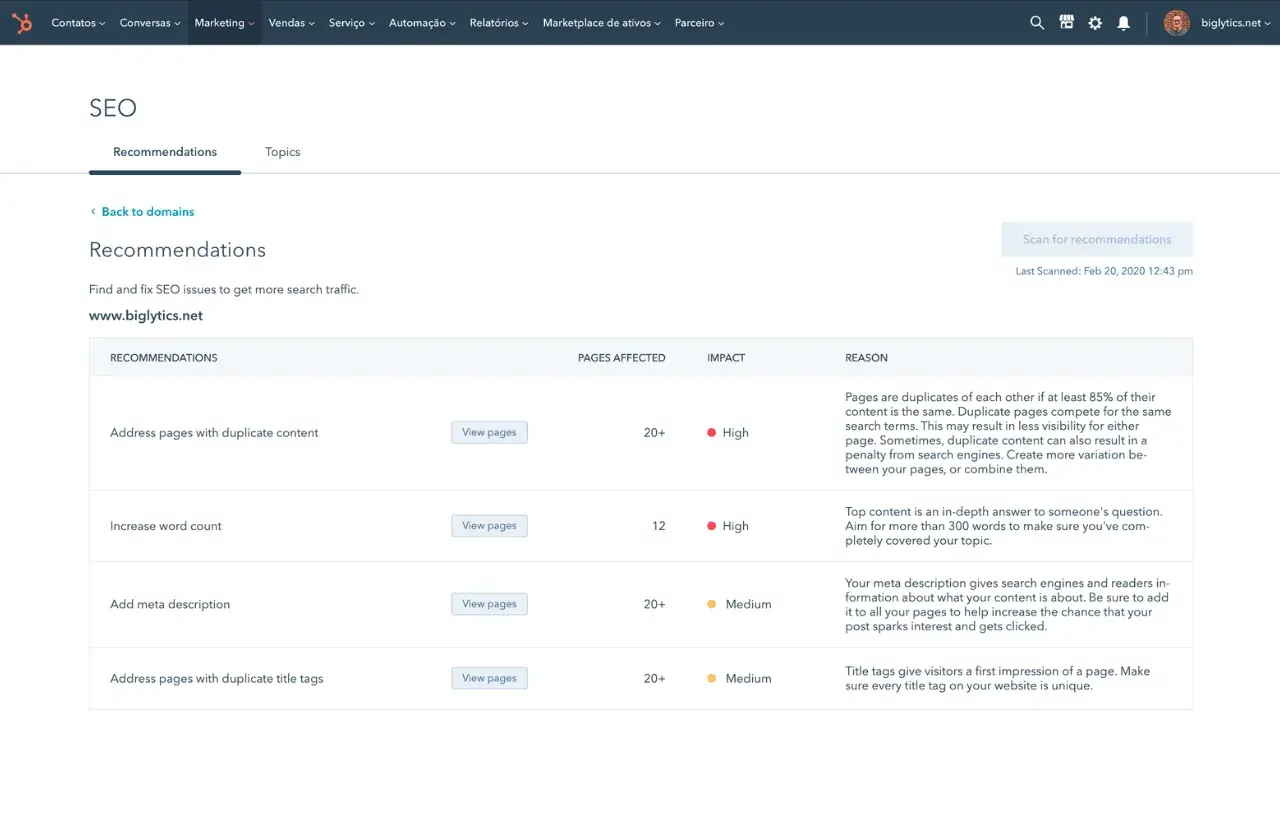
Pro tip: HubSpot’s Content Hub includes built-in SEO recommendations features for optimizing website content for search engines. It flags issues such as missing meta descriptions or low keyword density, saving B2B marketers from having to edit the post after publication.
SEO Checklist for B2B Website Content Writing
- Title Tag: Must contain the primary keyword near the beginning and remain under 60 characters.
- H1 Header: The main page title; there should be only one H1 per page, clearly stating the topic.
- Meta Description: A summary under 160 characters that encourages click-throughs from the search engine results page (SERPs).
- Header Tags (H2, H3): Use these to create a hierarchy and allow users to skim the content.
- Internal Links: Link to at least 3-5 relevant internal pages to pass authority and keep users on the site.
- Alt Text: Descriptive text for images that includes keywords where relevant; crucial for accessibility and image search.
- URL Structure: Keep URLs short, clean, and keyword-rich
- Schema Markup: Implement structured data, such as FAQ schema, to help search engines understand the content type and potentially win rich snippets.
Website Content Writing examples and templates
These are excellent case studies that show how companies balance tone, structure, and conversion optimization in their website content writing workflow.
1. AWS: simplifying complexity for decision-makers
Amazon Web Services (AWS) is a cloud computing giant that excels at explaining highly technical concepts to a broad audience, from developers to CTOs. For example, this blog on building physical AI breaks down complex architectures involving edge computing and AI agents without overwhelming readers with jargon.
![aws blog example, website content writing]](https://53.fs1.hubspotusercontent-na1.net/hub/53/hubfs/aws%20blog%20example%2c%20website%20content%20writing%5D.webp?width=650&height=521&name=aws%20blog%20example%2c%20website%20content%20writing%5D.webp)
I like how AWS makes its blogs digestible without hiding the complexity. Their use of architectural diagrams, bulleted feature lists, and clear process flows ensures that a CTO can quickly grasp the technical feasibility. More importantly, non-technical stakeholders can still understand the business value.
2. Nord Security: clarity and conversion focus
Nord Security (NordLayer) provides network access security solutions with a content strategy centered on directness and utility. It avoids fluff entirely, getting straight to actionable advice using numbered lists and bold headers. This “no-nonsense” website content writing approach builds immediate trust in the cybersecurity space, where clarity is paramount.
![nord security blog example, website content writing]](https://53.fs1.hubspotusercontent-na1.net/hub/53/hubfs/nord%20security%20blog%20example%2c%20website%20content%20writing%5D.webp?width=650&height=334&name=nord%20security%20blog%20example%2c%20website%20content%20writing%5D.webp)
I think their internal linking strategy is brilliant. Within a single post on endpoint security, they naturally link to related definitions and deeper dives, keeping the user engaged and reducing bounce rates.
Not only that, but NordLayer also carefully links to their product pages. Let’s take their endpoint security blog post as an example. As you can see, they include contextually relevant links to their solutions in the body instead of only at the bottom of the page.
3. Red Hat: bridging technology and business outcomes
Red Hat is an enterprise open-source software provider that masters the art of connecting technical implementation to tangible business results. Their topic pages, such as those on "Application Migration," use simple sentence structures to explain why a migration matters before diving into how to do it.
![red hat blog example, website content writing]](https://53.fs1.hubspotusercontent-na1.net/hub/53/hubfs/red%20hat%20blog%20example%2c%20website%20content%20writing%5D.webp?width=650&height=381&name=red%20hat%20blog%20example%2c%20website%20content%20writing%5D.webp)
I’ve read many Red Hat blogs, and one thing I admire is their consistency in terms of style and tone. Whether you are reading a high-level overview or a technical manual, the voice remains authoritative yet accessible. They excel at defining terms clearly before expanding on the strategic benefits, which is a key tactic for ranking in modern search engines.
If you need help creating website content that converts, download HubSpot’s content creation templates here. It’s free.
Tools for Website Content Writing
You’ve learned how to write content for a website. Now, let’s explore tools that streamline the entire workflow.
1. HubSpot's Agent Hub
![hubspot breeze ai assistant, website content writing]](https://53.fs1.hubspotusercontent-na1.net/hub/53/hubfs/hubspot%20breeze%20ai%20assistant%2c%20website%20content%20writing%5D.webp?width=650&height=505&name=hubspot%20breeze%20ai%20assistant%2c%20website%20content%20writing%5D.webp)
HubSpot's Agent Hub automates website content writing, analysis, and optimization for B2B teams with AI. Unlike standalone AI writers, Hubspot's AI tools have access to a company's CRM data and brand voice guidelines, allowing it to generate context-aware content.
With 42% of marketers now using AI to assist with writing first drafts, tools like Agent Hub are essential for staying competitive. By leveraging an integrated AI agent, B2B teams can bypass the initial drafting phase and move straight to strategic refinement. This way, they can ensure their output volume aligns with the demands of modern search engines without sacrificing quality.
Key Features
- Content Agent: Generates blog posts, landing pages, and social copy using brand voice data.
- Content Remix: Instantly repurposes a single asset (like a blog) into multiple formats (email, social, ads).
- Copilot: An always-on assistant that helps draft, edit, and research directly within the CMS.
Pricing: Included with HubSpot’s Content Hub and Marketing Hub Professional/Enterprise tiers.
Best for: Teams already using HubSpot who want AI that understands their specific audience and data.
What I like: The “Remix” feature is a game-changer for my workflow. I used to spend hours rewriting a blog post for LinkedIn and email. Agent Hub does this in seconds, and because it knows my previous content, it often sounds natural.
2. HubSpot’s Content Hub
![hubspot content hub blog editor, website content writing]](https://53.fs1.hubspotusercontent-na1.net/hub/53/hubfs/hubspot%20content%20hub%20blog%20editor%2c%20website%20content%20writing%5D.webp?width=650&height=286&name=hubspot%20content%20hub%20blog%20editor%2c%20website%20content%20writing%5D.webp)
HubSpot’s Content Hub centralizes website content writing, hosting, lead generation, and analytics ona single platform, eliminating the need for disparate plugins and third-party tools. It’s an AI-powered content marketing software (CMS) designed to help marketers create and manage content at scale.
Content Hub supports the information architecture that marketers created by providing a centralized content management system. Because the CMS connects directly to the CRM, marketers can track exactly which articles influence closed deals. For B2B organizations, this integration bridges the critical gap between content engagement and revenue generation.
Key Features
- AI Blog Writer: Drafts full blog posts and outlines based on keywords.
- Case Study Generator: Uses AI to create case studies based on CRM data.
- Smart Content: Personalizes text and CTAs based on visitor data.
- SEO Recommendations: Provides actionable optimizations directly in the editor.
Pricing: Free tools available; Professional starts at $450/mo; Enterprise at $1,500/mo.
Best for: Growing B2B teams that need a scalable, secure, and integrated content engine.
What I like: The integration of SEO recommendations and content creation is critical. I can write a post, and the system immediately flags if I've missed out internal links, meta titles, or alt-text before I hit publish.
3. WriteSonic
![writesonic, website content writing]](https://53.fs1.hubspotusercontent-na1.net/hub/53/hubfs/writesonic%2c%20website%20content%20writing%5D.webp?width=650&height=312&name=writesonic%2c%20website%20content%20writing%5D.webp)
Writesonic is an AI-powered content creation platform designed to accelerate the drafting process for marketing copy, blog posts, and product descriptions. It uses advanced language models and real-time web data to generate SEO-optimized text.
Key Features
- AI Article Writer: Generates long-form, factual articles with citations by accessing live Google data.
- Chatsonic: A conversational AI assistant that provides up-to-date answers and trends, unlike models limited to older training data.
- SEO Optimization: Includes built-in keyword scoring for optimizing the draft.
- Brand Voice: Allows users to upload brand guidelines to ensure consistent tone across all generated assets.
Pricing: Free trial available; Paid plans start at $39/mo.
Best for: Startups and content agencies looking to scale blog production and ad copy quickly.
What I like: I appreciate the “Article Writer” workflow. It helps me create SEO blogs by analyzing competing articles on Google with step-by-step AI assistance.
4. Grammarly Pro
![grammarly pro, website content writing]](https://53.fs1.hubspotusercontent-na1.net/hub/53/hubfs/grammarly%20pro%2c%20website%20content%20writing%5D.webp?width=650&height=287&name=grammarly%20pro%2c%20website%20content%20writing%5D.webp)
Grammarly Pro is an AI-powered writing assistant that goes beyond spell-checking to improve clarity, engagement, and delivery. It offers style guides and tone detectors to ensure that all writers on a team adhere to the same brand standards.
Key Features:
- Tone Detector: Identifies if text sounds confident, friendly, or aggressive.
- Style Guides: Custom rules for brand-specific terminology.
- Plagiarism Checker: Scans billions of web pages to ensure originality.
Pricing: Starts at $12/mo billed annually.
Best for: Editorial teams ensuring consistency across multiple writers.
What I like: The custom style guide feature helps me to stay consistent with the preferred communication style. I use it to flag internal jargon that we shouldn't use externally.
Common Website Content Writing Mistakes to Avoid
Even experienced marketing teams can fall into traps that undermine their website content writing efforts.
1. Ignoring search intent for vanity keywords
Search intent refers to the underlying goal a user has when typing a query into a search engine. A common mistake in website content writing is optimizing for high-volume keywords that have no commercial intent, resulting in traffic that never converts.
I once built an affiliate website that generated thousands of monthly visitors but almost no conversions. Eventually, I found out that I was targeting mainly informational keywords, like “how to meditate”. Then, I revamped my strategy to target bottom of the funnel (BOFU) keywords, such as “best meditation apps”. That’s when my website started to convert.
Pro tip: Applying copywriting frameworks can improve conversion for commercial intent web content. Use these copywriting templates to make your blogs more persuasive.
2. Overusing jargon and corporate speak
Corporate speak involves using complex, abstract language to describe simple concepts, often in an attempt to sound professional. This alienates readers who are looking for clear, direct answers to their problems.
When I write for tech brands, I have to explain technical subjects like generative AI to a broader business audience. I avoid unnecessary phrases that only engineers understand. If I have to use technical terms, I would explain them in plain terms.
Pro tip: Use HubSpot’s AI tools to create jargon-free content. B2B marketers can ask Agent Hub to “rewrite this paragraph to be more concise,” and it strips away the fluff instantly.
3. Postponing the core message
When blogs don’t directly address the user’s queries, they struggle to rank on Google. This is because in the age of AI search and short attention spans, users expect immediate value.
I always structure my headings as direct questions and the immediately following text as the direct answer. This is the core of AEO (Answer Engine Optimization). If a user has to scroll three times find answers to their query, they have likely already bounced back to Google.
4. Neglecting content freshness
Content freshness is a ranking signal that prioritizes up-to-date information, yet it is common for teams to mistakenly treat published articles as static assets. For example, some blogs contain:
- outdated statistics
- old dates
- broken links
- obsolete information
Consequently, search engines view the domain as less relevant, leading to a steady decline in organic traffic.
I used to focus exclusively on writing new articles, ignoring articles that I’ve already published. This changed when I noticed my top-ranking posts slowly slipping to page two. Now, I make it a habit to audit published content quarterly and update those that are outdated.
Pro tip: Use HubSpot’s Content Hub to monitor blog performance after they’re published. Schedule an audit if there are signs of a sustained decline in search performance over time.
How to Measure and Improve Website Content Performance
Knowing how to write website content isn’t enough. B2B teams must look beyond vanity metrics like “page views” and focus on engagement indicators that drive conversions.
|
Metric Category |
Specific Metrics |
What It Tells You |
How to Improve |
|
Traffic (SEO) |
Organic Traffic, Impressions, Rankings |
Is the content discoverable? |
Update meta tags, target long-tail keywords, and build internal links. |
|
Engagement |
Time on Page, Bounce Rate, Scroll Depth |
Is the content readable? |
Use bullet points, add visuals, and improve the “hook” in your intro. |
|
Impact (Revenue) |
Click-Through Rate, Conversion |
Is the writing persuasive? |
Test different CTA placements and align copy with specific buyer pain points. |
Regularly auditing these metrics allows for iterative improvements, turning underperforming pages into high-value assets.
My experience has shown that traffic alone doesn’t guarantee conversions. However, identifying the root cause can be cumbersome, especially if you don’t have a top-level view of visitors’ engagement.
HubSpot’s Content Hub analytics help marketers see which specific blog posts appear in the conversion path of closed deals. It provides attribution data that assists in creating content that not only ranks on search, but also drives leads and revenue.
Frequently asked questions about website content writing
How long should B2B web page content be?
B2B web content should be as long as necessary to fully answer the user's question and cover the topic comprehensively. While long-form content (1,500+ words) often ranks better for complex topics, a product definition might only need 300 words. Focus on depth and value rather than a specific word count.
How do you write website content for multiple personas?
Writing for multiple personas requires creating distinct pathways or sections that address unique pain points. Use role-based navigation (e.g., “For Marketers,” “For Developers”) or smart content features in a CMS like HubSpot Content Hub to dynamically change text based on the visitor's profile.
Do I need separate ABM landing pages if I have strong site pages?
Yes, Account-Based Marketing (ABM) campaigns perform best with highly personalized landing pages. While strong site pages drive general traffic, an ABM page should reference the target company’s industry, challenges, and name to maximize conversion rates.
Should I use AI to write website content?
AI should be used to assist with research, outlining, and drafting, but human editors must verify accuracy and tone. Tools like Agent Hub are excellent for overcoming writer's block and ensuring SEO alignment, but the final “human touch” is essential for building trust.
What is the best way to measure content impact on the pipeline?
The best way to measure pipeline impact is through multi-touch attribution modeling. This tracks a user's journey across multiple content pieces before they convert. HubSpot Content Hub provides attribution reports that help teams see which blog posts or pages influenced a deal.
Write Website Content that Ranks and Converts
Website content writing for B2B is a strategic balance of:
- SEO alignment
- User psychology
- Brand authority
By moving away from generic copy and embracing a structured, data-driven approach, growth teams can turn their websites into 24/7 sales engines.
Understandably, creating website content manually takes up significant time and resources. Marketers are under increasing pressure to expedite content creation without compromising quality. More importantly, they hope to create content that actually converts.
B2B teams can leverage the AI capabilities of HubSpot Content Hub and HubSpot's Agent Hub to scale content production. Additionally, AI Search Grader helps marketers to future-proof for AI search.
When you integrate these tools into your content creation workflow, you can improve your brand’s visibility at scale and increase sales.
Get access to HubSpot Content Hub now.
Free AI Content Writer
Ideate, create, and share content. Easily create...
- Blog articles.
- Website copy.
- Social posts.
- And more!
Artificial Intelligence