Dietrich Mateschitz, the founder of Red Bull, is one of my marketing heroes. Not only is he a brilliant business person but he is an absolute genius of marketing strategy. Here’s why.
The story of Red Bull isn’t just the story of a successful beverage; it’s the story of pioneering marketing principles and relentless product differentiation.
![Download Now: Free State of Marketing Report [Updated for 2025]](https://no-cache.hubspot.com/cta/default/53/db725f24-564c-483b-a28c-2d6ff9986516.png)
Dietrich Mateschitz, the founder of Red Bull, came across a little-known energy drink in Thailand and transformed it into a global phenomenon.
By creating a distinct product with a unique design and a powerful tagline, "Red Bull gives you wings," Dietrich ensured the brand was instantly recognizable, leading it to become one of the most successful businesses in the world.
He leveraged owned media, took bold ownership stakes in cultural trends, and used unconventional marketing tactics to generate buzz and word-of-mouth. His commitment to brand consistency and differentiation not only set Red Bull apart from competitors but also built a loyal customer base and a $16 billion empire.
The State of Marketing in 2025
HubSpot's Annual Inbound Marketing Trends Report
- Top Marketing Channels
- AI in Marketing
- Managing Privacy
- The Future of Marketing
Download Free
All fields are required.
Outside-the-Box Marketing Ideas from Red Bull
Here are some of the most innovative strategies that fueled Red Bull’s success that can also apply to your own business.
Embracing — and Encouraging — Rumors to Generate Buzz
One of the most unconventional strategies Red Bull applied to promote brand awareness was encouraging and perpetuating rumors about the product (which I imagine would drive most CEOs nuts).
For example, Dietrich intentionally remained vague about the ingredients in Red Bull, leading to wild speculations that it contained bizarre ingredients like bull testicles. Instead of quashing these bizarre rumors, he leaned into them, even dedicating pages on Red Bull’s website to subtly add fuel to the fire.
This strategy played into human curiosity, where mystery drove rabid interest and desire. By not confirming or denying the rumors, Red Bull kept people talking and guessing, which ultimately enticed consumers to try the product for themselves.
Dietrich knew that apathy was the worst thing that you could have as a business. By constantly finding ways to keep people interested in Red Bull, he activated the brand to keep it at the forefront of consumers' minds.
Leveraging FOMO to Capture Consumer Interest
Red Bull excels in leveraging scarcity tactics to create a sense of exclusivity and urgency. For example, when Red Bull was first approved for distribution in England, Dietrich knew he needed to attract the public's attention — and quickly.
So he had his team place empty Red Bull cans in trash bins all around London, creating the illusion that the drink was incredibly popular.
This social proof tactic played on the psychology of passersby, who would see the empty cans and think, "If so many people are drinking this, it must be worth trying."
Making potential customers feel like they were missing out helped drive initial consumer adoption and build a loyal customer base — not to mention increasing brand visibility and perceived popularity without the need for expensive advertising campaigns.
Extreme Profit Reinvestment to Drive Long-Term Gains
Dietrich's deep belief in the power of marketing is a key reason why I consider him a marketing genius.
For example, he was so committed to building a remarkable brand and believed so absolutely in core marketing strategies that he opted to reinvest profits back into marketing efforts, rather than taking meaningful cash out of the business for over 20 years.
This long-term strategy resulted in massive dividends in the form of hundreds of millions of dollars annually.
One of my favorite case studies on this is how Red Bull organizes and finances extreme sports events, spending their marketing budget to professionally film and broadcast them. They then offer this footage for free to TV networks to fill their airwaves.
This incentive-based strategy secures valuable airtime for Red Bull without the costs of traditional advertising.
While competitors were buying 30-second ad spots, Red Bull was likely investing the same amount of money in a completely different way — but enjoying hours of global television exposure reaching millions as a result.
Honing Brand Consistency and Product Differentiation to Drive Longevity
The tagline "Red Bull gives you wings" has been a cornerstone of Red Bull’s branding since Dietrich received a middle-of-the-night call from his friend at the advertising agency.
This tagline was not just a catchy phrase but a reflection of the brand's ethos and commitment to helping consumers push their limits and achieve extraordinary feats, enabling Red Bull to build a strong, recognizable brand that resonated deeply with its target audience.
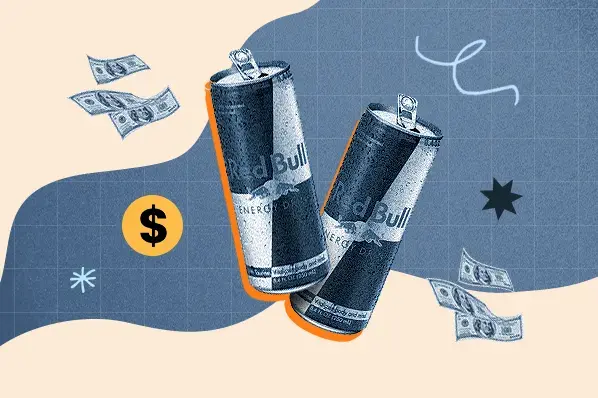
This consistency also extended to their product packaging, with the slim, tall can becoming instantly recognizable and synonymous with the brand. Dietrich understood the importance of being fundamentally different to stand out.
He designed the Red Bull can to be skinnier and taller, rather than the short, stocky design typical of other beverages, ensuring their product was visually identifiable on shelves.
This strategic differentiation, much like James Dyson’s approach with his vacuum cleaners, helped Red Bull carve out a unique space in the market, building strong brand recognition and loyalty.
Riding (Counterintuitive) Waves to Drive Rapid Growth
Dietrich's marketing genius also lies in his ability to identify and ride macro trends to drive business success.
This strategy aligns with Charlie Munger's ‘wave to surf’ metaphor, where companies capitalize on larger market opportunities to propel their own growth. In Dietrich’s case, he didn’t just find one wave to surf; he found three counterintuitive waves.
First, Red Bull tapped into the extreme sports wave, recognizing the growing popularity of adrenaline-fueled activities. Simultaneously, they capitalized on the emerging energy drink wave, creating a new category of beverages at a time when there were few established competitors.
Finally, Dietrich leveraged the owned media wave by buying a soccer team, hosting sporting events, and even sending a man into outer space. These bold moves garnered massive attention and distinguished Red Bull from its competitors, solidifying its position as an industry leader.
For more marketing strategies, check out the full episode of Marketing Against the Grain below:
This blog series is in partnership with Marketing Against the Grain, the video podcast. It digs deeper into ideas shared by marketing leaders Kipp Bodnar (HubSpot’s CMO) and Kieran Flanagan (SVP, Marketing at HubSpot) as they unpack growth strategies and learn from standout founders and peers.