.png?width=112&height=112&name=Image%20Hackathon%20%E2%80%93%20Horizontal%20(67).png)
.png)
From blogger to fellow blogger, I’ll share some simple tips to get you started in Google Docs along with some of the best templates for easy writing.
Table of Contents
How to Make a Blog on Google Docs
If you’re looking to start a blog from scratch, we have a guide for that. But the easiest way to write a blog post in Google Docs is to start with a template.
Here’s what I do:
- Log into Google Drive.
- Download a free blog post template. (Jump to some of my favorites.)
- Open the template(s), click File in the top left corner of your document, and select Make a copy. If you prefer, you could also copy and paste the template into a new blank document.
- Use the template as a guide to start writing your article.
.png)
6 Free Blog Post Templates
Save time creating blog posts with these free templates.
- "How-to" Post
- "What is" Post
- Listicle Post
- And More!
Download Free
All fields are required.
It’s up to you to choose the right template based on the type of content you’re writing. For example, if you’re writing a how-to blog post, you’ll need a template that allows you to break down the steps for completing a task.
On the other hand, a newsjacking blog post template will give you the flexibility to summarize a trending story with space to explain what the news means for your audience.
Regardless, your blog post will always have three main components:
- Introduction: The introduction sets the stage for what you’re covering and the problem you‘re about to solve. You’re not providing specific solutions in this section, just why it’s worth resolving. Here, you want to be relatable and get your readers to nod in agreement.
- Body: The body explains the solutions to the problem you set up in the introduction. You’re helping the reader meet the goals you outlined up top and reiterating why that's important.
- Conclusion: The conclusion wraps up your post with a brief statement reflecting the problem your post solved. It should also include a prompt to engage in further action.
Now, onto the good stuff: free blog post templates.
Free Google Docs Blog Post Templates
If you’re looking for a full suite of blog post templates to choose from, I’d start here. You’ll find tons of customizable options — from the standard “what is” and “how-to” templates to more specialized versions for case studies, behind-the-scenes features, and more.
In the meantime, I went ahead and pulled out four of my go-to blog post templates that work well in Google Docs:
- Evergreen Blog Post
- Newsjacking Blog Post
- Thought Leadership Blog Post
- Data-Driven Blog Post
1. Evergreen Blog Post Template
An evergreen blog post template is best for content that withstands the test of time. These articles explain foundational concepts that readers will continue to search for over time, such as “What is an editorial calendar?” or “What does TL;DR mean?”
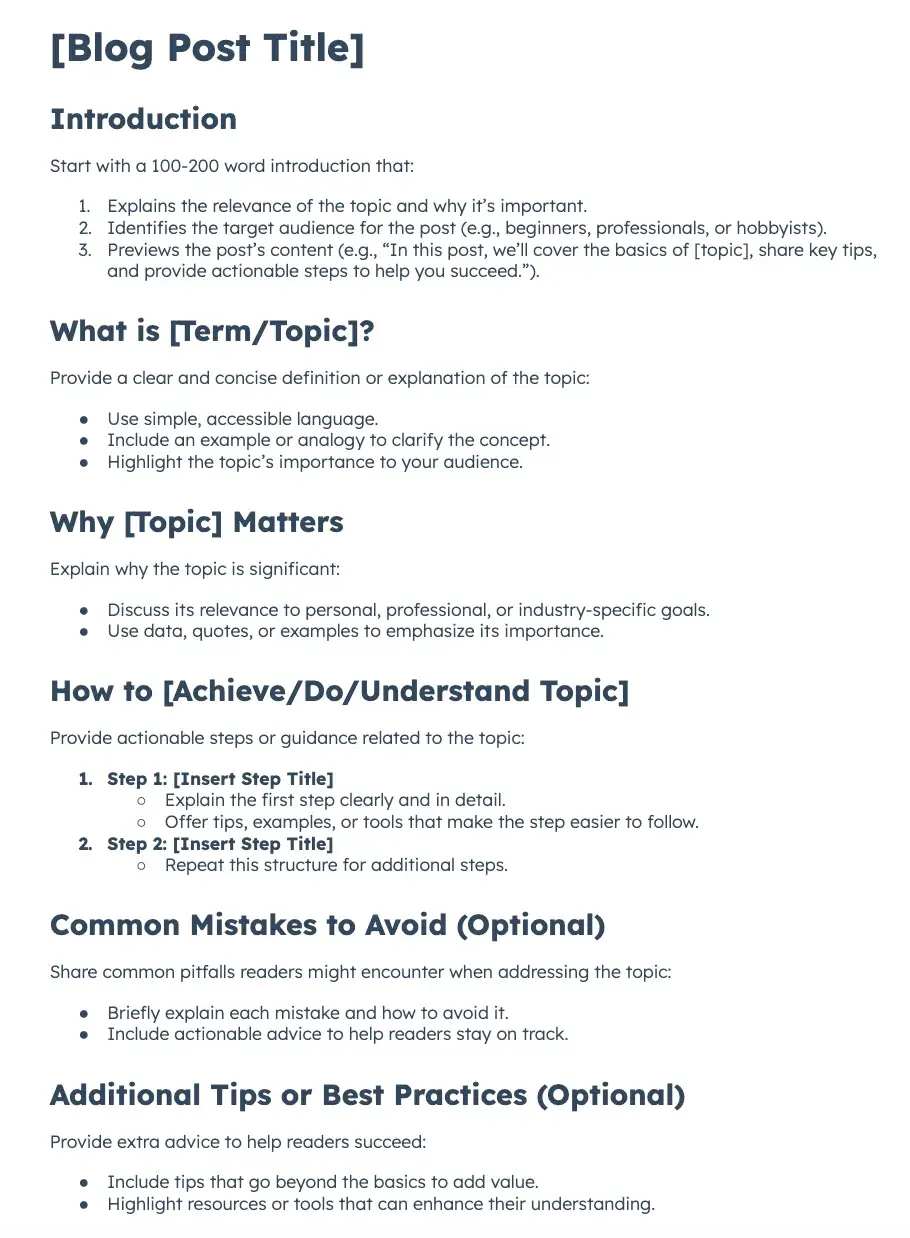
Download the full evergreen blog post template here.
Simple Evergreen Blog Post Outline
Introduction
Highlight the reason why what you’re talking about is important, which audience this applies to, and what you’ll be covering.
What is [Term/Topic]?
Provide a clear explanation of the topic, explore the concept further, and add examples to help define it.
Why [Term/Topic] Matters
Tell your readers why they should care about the term or the concept you’re writing about. Try to include at least one statistic, quote, or outside reference here.
How to [Achieve/Do/Understand Topic]
- Step
- Step
- Step
Provide actionable steps related to the topic. For optimal organization, give each step its own section header.
Common Mistakes to Avoid (Optional)
If there are any pitfalls the reader may encounter while completing the steps above, include them here with tips to avoid them.
Additional Tips or Best Practices (Optional)
If you have additional advice that will add value to the piece — like expert quotes, industry best practices, or helpful resources — list them here.
Closing
Wrap things up and remind your readers of the intended key takeaway from your writing.
Call-to-Action
Point your audience to other relevant resources or encourage them to take action based on what they’ve just read.
How to Make the Most of This Template
- Make sure the topic is timeless. Ask yourself: Will this topic remain valuable and relevant to my readers over time? You’ll still want to make regular updates to your evergreen blog posts, but the core is likely to stay the same.
- Provide actionable advice. Clearly outline any steps or best practices your reader should follow, and support your writing with real-world examples and analogies where possible.
- Incorporate visual elements. Reinforce your content with images and videos to help convey meaning and better illustrate your key points.
Evergreen Blog Post Examples
- What is AI? What Marketers Need to Know
- How to Write a Content Brief [Template + Examples]
- What Are Content Managers, and How Do You Become One?
2. Newsjacking Blog Post Template
A newsjacking blog post template is best for capitalizing on the popularity of a news story to amplify your brand — like “What Marketers Need to Know About the TikTok Ban” or “A Rundown on Open AI’s Latest Updates to ChatGPT.”
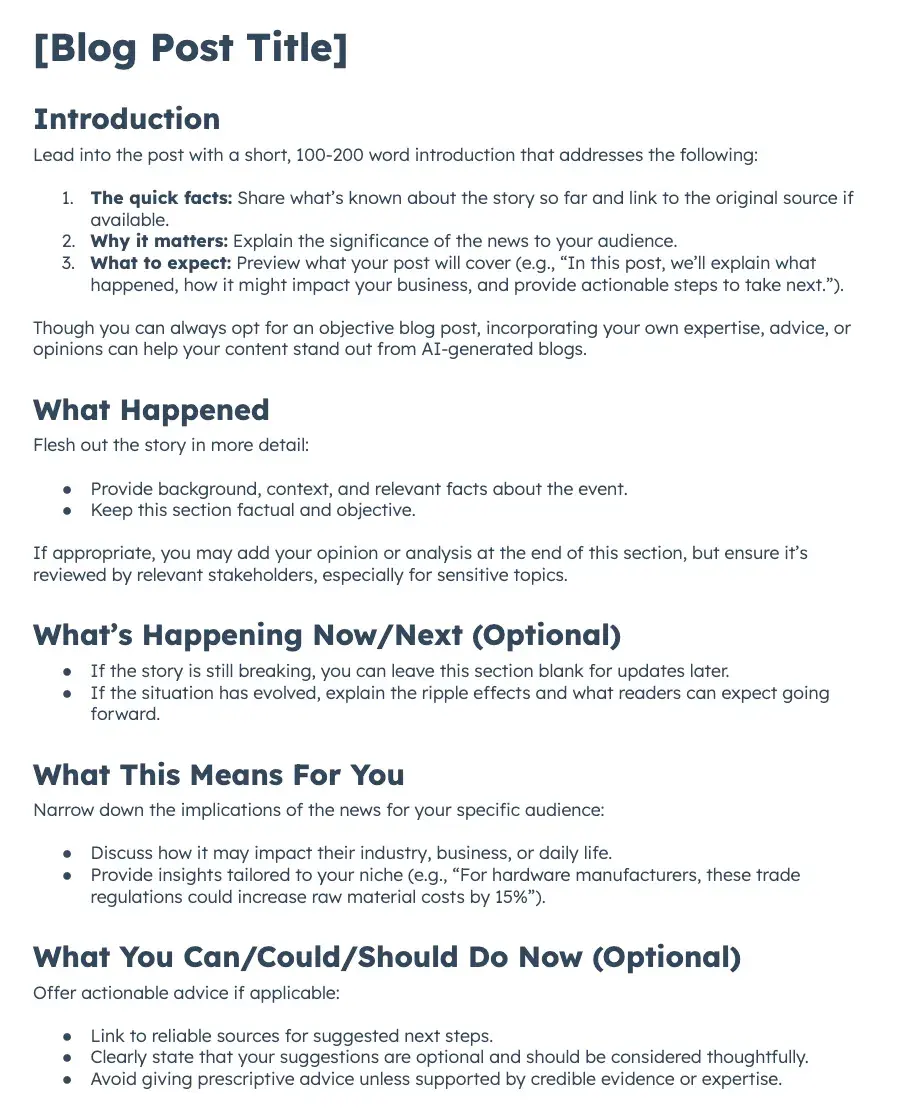
Download the full newsjacking blog post template here.
Simple Newsjacking Blog Post Outline
Introduction
Highlight the reason why what you’re talking about is important, which audience this applies to, and what you’ll be covering.
What Happened
Flesh out the story in more detail, and be sure to include sources. Keep the first part of this section factual, and then share your opinion if you feel inclined to do so.
What’s Happening Now/Next [Optional]
If the story is still breaking, this section will likely be fluid. Be sure to keep this updated as new information becomes available.
What This Means For You
Always connect the bigger picture to your audience. Highlight why this news matters to them and how this information informs their work or daily lives.
What You Can/Should/Could Do Now (Optional)
If you can link to relevant and reliable sources to inform the suggested next steps or action items, do that here. Don’t give advice unless you can back it up with credible evidence or expertise.
Closing
Wrap things up and remind your readers of the intended key takeaway from your writing.
Call-to-Action
Point your audience to other relevant resources or encourage them to take action based on what they’ve just read.
How to Make the Most of This Template
- Use a clear, factual approach to explain the situation. All of the facts and stats you pull in should support the points made in your article. The more source material you can reference, the better.
- Share your opinion, but make it justifiable. Take the time to flesh out your ideas and back up your points based on the facts of the story.
- Offer a unique angle. If readers can access a similar story elsewhere, you’re not creating value for them. Focus on what your audience needs to know based on the information being circulated.
Newsjacking Blog Post Examples
- Here's Everything You Need to Know about Deepfakes
- What California's New Data Privacy Act Means for Marketers
- Inside Rihanna's Super Bowl Halftime Show Marketing Engine
6 Free Blog Post Templates
Save time creating blog posts with these free templates.
- "How-to" Post
- "What is" Post
- Listicle Post
- And More!
Download Free
All fields are required.
3. Thought Leadership Blog Post Template
A thought leadership blog post template is best for offering a unique perspective about a topic, challenging a well-known idea, or highlighting your expertise. Think: “Why I Believe AI Won’t Replace Marketers” or “My Predictions for the Future of Social Commerce.”
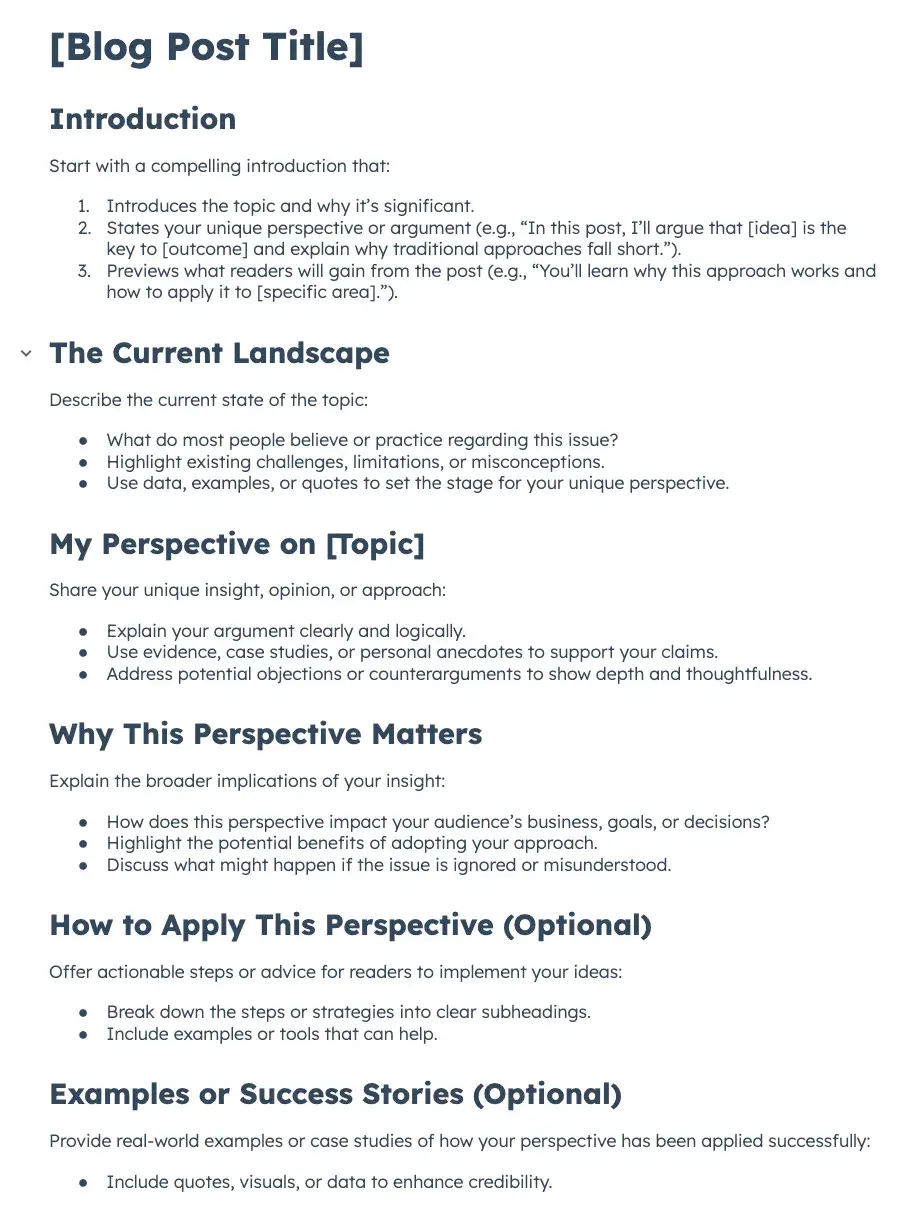
Download the full thought leadership blog post template here.
Simple Thought Leadership Blog Post Outline
Introduction
Highlight the reason why what you’re talking about is important, which audience this applies to, and what you’ll be covering.
The Current Landscape
Explore current conversations around the topic, highlight common or existing beliefs, and set the stage for your original perspective.
My Perspective on [Topic]
Clearly state your opinion, provide examples to support your claim, and thoughtfully debunk competing arguments.
Why This Perspective Matters
Explain the impact or potential business benefits of the idea you’re discussing to tie your perspective back to the reader.
How to Apply This Perspective (Optional)
If there are actionable steps your readers can take or tools they can use to implement your ideas, include them here.
Examples or Success Stories (Optional)
Bonus points if you can highlight a personal example or business case that demonstrates the successful application of your perspective in the real world.
Closing
Wrap things up and remind your readers of the intended key takeaway from your writing.
Call-to-Action
Point your audience to other relevant resources or encourage them to take action based on what they’ve just read.
How to Make the Most of This Template
- Explain why your perspective matters. Position yourself as a thought leader, and introduce a unique angle that adds value to a trending or otherwise evergreen topic.
- Support your argument with hard evidence. Case studies, visuals, and personal anecdotes will go a long way toward making your case.
- Address potential objections. Have you considered the counterarguments? Disprove them with facts based on what you know as an expert on the topic.
Thought Leadership Blog Post Examples
- Are AI Agents Worth It? HubSpot's CMO and VP Weigh In
- 11 Ways to Become a Better Blogger, According to the HubSpot Blog Team
- From Pretty Logos to Real Impact: How I Shifted My Focus from Visual to Emotional Branding
4. Data-Driven Blog Post Template
A data-driven blog post template is best for highlighting original research or statistics based on industry trends. You can use this template to dig into the numbers for topics like “Top Email Marketing Trends” or “How Marketers Plan to Invest in Short-Form Video This Year.”
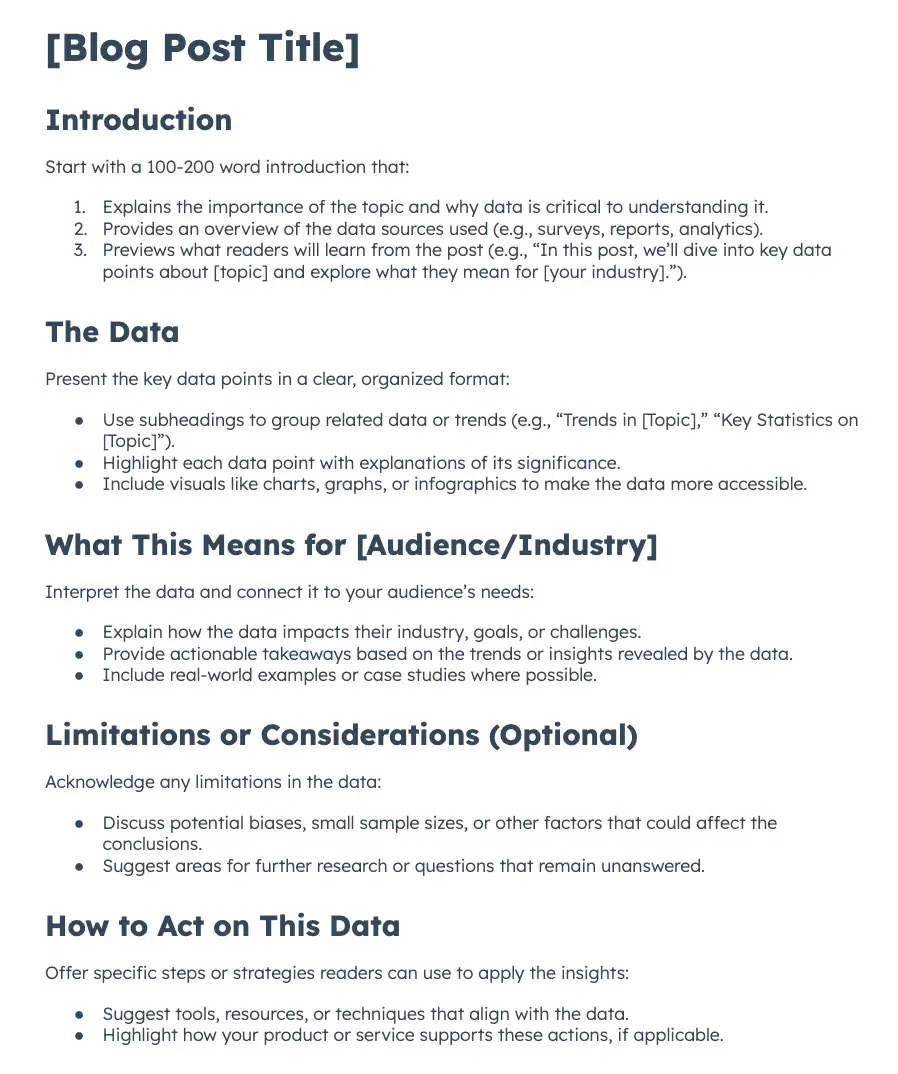
Download the full data-driven blog post template here.
Simple Data-Driven Blog Post Outline
Introduction
Highlight the reason why what you’re talking about is important, which audience this applies to, and what you’ll be covering.
The Data
Present the data up front, loud and clear. I recommend using subheadings for each data point to keep things organized and incorporating visuals to illustrate the data.
What This Means for [Audience/Industry]
Again, always reel the bigger picture in for your audience. Highlight why they should care about the data and any personal or business implications.
Limitations or Considerations (Optional)
Are there any potential biases or circumstances that the data doesn’t fully cover? If so, be sure to note that here.
How to Act on This Data
Provide actionable steps for applying the data you presented in the post. This is a good place to share any helpful resources or best practices for implementation.
Closing
Wrap things up and remind your readers of the intended key takeaway from your writing.
Call-to-Action
Point your audience to other relevant resources or encourage them to take action based on what they’ve just read.
How to Make the Most of This Template
- Clearly present the data. Focus on outlining the key points accurately, and don’t forget to give credit where credit is due if the data is outsourced.
- Connect the data to actionable takeaways. Based on your interpretation, discuss how readers can use these insights — or how you’ve applied the data in your own work.
- Use visuals. Charts, graphs, and infographics provide an alternate way to present the information and help reinforce your most important points.
Data-Driven Blog Post Examples
- How Much Does a Super Bowl Ad Cost [& Does It Get ROI]? A Data-Backed Deep Dive
- The 2025 State of Marketing & Trends Report: Data from 1700+ Global Marketers
- Workplace Loneliness Isn’t Getting Better [New Data]
Why Use Google Docs for Blog Post Templates
The big reason I like to use Google Docs for blog post templates is collaboration. The platform allows you to:
- Build, share, and save files and templates.
- Manage editing permissions and track version history/changes.
- Facilitate feedback, leave comments, and annotate suggestions.
- Download and convert your content into other file formats.
- Back documents up to the cloud.
- Upload your documents into a CMS.
Plus, the Google suite integrates with many of the systems I already use for work, like Asana and Slack. This makes it easier to streamline my workflow.
No More Starting From Scratch
Blog post templates are great starting points. They provide a structure that makes it easy to write content that's both helpful for readers and relatively quick and painless for you.
However, don’t get too caught up in the formula. Explore new formats, experiment with existing ones, and get creative with how you’re sharing information. After all, the goal is to consistently create content that has value for your audience.
If you do get stuck, download our free templates to break yourself out of that rut.
Editor's note: This post was originally published in June 2012 and has been updated for comprehensiveness.
6 Free Blog Post Templates
Save time creating blog posts with these free templates.
- "How-to" Post
- "What is" Post
- Listicle Post
- And More!
Download Free
All fields are required.