
If you’re using social media for marketing and you’re not measuring your dollars-and-cents ROI , you’re doing it wrong. As my favorite rap quote says, “If it don’t make dollars, it don’t make sense.”
Marketers wouldn’t dream of spending budget on banner or PPC ads without a measured and positive return on their investment; but for some reason, many of us still play dumb when it comes to the hard data about the performance of our social media marketing investments. And even if you’re not spending budget on Facebook or Twitter, remember: Time is money, and you’re probably spending a significant amount of time.
All too often, social media marketing advice comes from greasy, snake oil hucksters selling platitudes like “engage in the conversation,” or worse, “be awesome.” While advice like this is hard to disagree with, it’s not useful or concrete. Instead, we marketers should be measuring our social media marketing campaigns to determine what is making our businesses money -- and what isn’t. In other words, ignore the unicorns-and-rainbows superstitions.
How to Calculate the Value of Your Facebook & Twitter Followers
A while ago, in a HubSpot marketing team meeting, we were discussing how much we should be willing to invest to gain a new social media follower or Like, and I found myself at the whiteboard plotting out a formula. Over the course of the next few weeks -- with the help of several of my geeky colleagues -- I put together a formula to calculate a metric I call VOAL ( Value Of A Like ). Once you know your VOAL, you can plan your social media efforts with confidence they’ll generate a positive ROI.
Below is the formula and how it breaks down ...
L (Total Likes)
The total number of audience members connected to your social media account. On Facebook, these are Likes of your page, and on Twitter, these are followers.
UpM (Unlikes-per-Month)
The average number of fans who “unlike” your social network account each month. On Facebook, this is an “unlike,” and on Twitter, this is an “unfollow.”
LpD (Links-per-Day)
The average number of times you’re posting links, and potentially converting links driven from your social media account. On Facebook, this is the number of posts you’re making, per day, that lead to a page on your website. On Twitter, this is the number of times, per day, you’re tweeting these kinds of links.
C (Average Clicks)
The average number of clicks on the links to your site you’re posting on your social media accounts.
CR (Conversion Rate)
The average conversion rate of your website, from visit to sale or visit to lead. This can be an overall average, but for increased accuracy, use the conversion rate measured from traffic coming from the social network you’re calculating.
ACV (Average Conversion Value)
The average value of each “conversion.” In this context, a “conversion” is the action you’ve used to measure CR for. It could be average sale price or average lead value. For increased accuracy, use the average conversion value of traffic coming from the specific social network.
The ValueOfALike.com Calculator
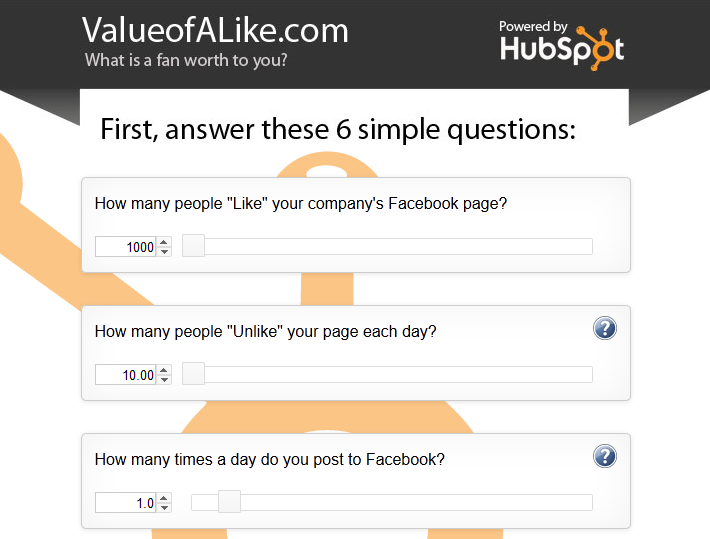
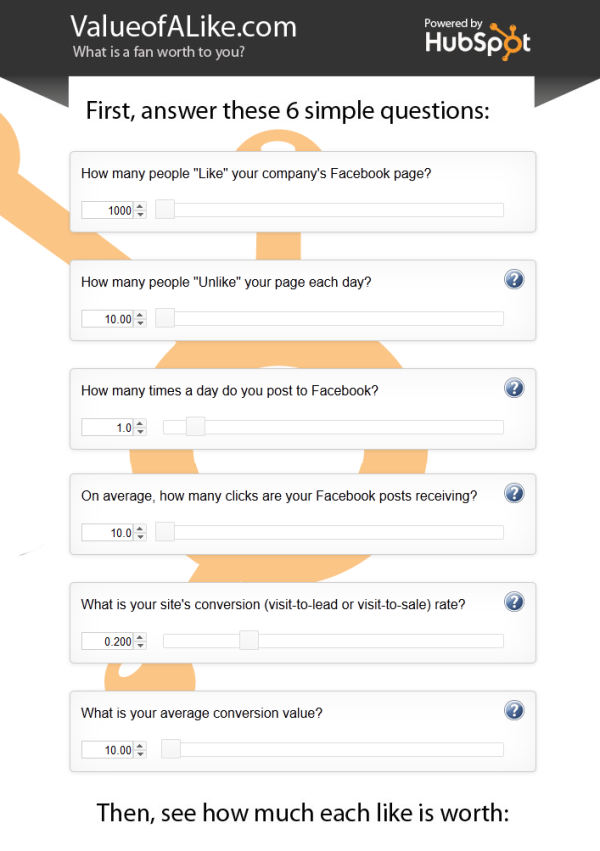
In my efforts to make sure all social media marketers can apply this formula, I built a free, easy-to-use little calculator at ValueOfALike.com . Answer six simple questions about your business' use of Facebook or Twitter and it will tell you exactly -- in concrete dollars and cents -- what each Like or follower is worth to your company. To calculate your value of a Facebook Like, you can easily answer these questions using your Facebook Insights and your closed-loop marketing analytics (in the calculator, click the question mark next to each question for an explanation about how to acquire each data point). For Twitter, you can use tools like Twitter's advertising analytics platform, closed-loop marketing analytics, as well as educated estimates to determine your Twitter numbers. Furthermore, each question input in the calculator is shown on a slider, so you can easily adjust the values up or down to see how changing various metrics will impact your bottom line.
You can answer the questions for either your Twitter or Facebook marketing efforts, and you can enter information based on lead generation or actual sales data. The calculator is flexible, and it's designed to help you put the VOAL formula to work for your brand in the way that makes the most sense for you.
VOAL Formula in Action: 3 Real-Life Examples
To demonstrate what the VOAL calculation would look like using realistic numbers, let’s start with an example from Facebook. HubSpot partner Kuno Creative 's Facebook Page has 3,103 total Likes, 30 unlikes per month, posts 1.3 posts per day, with each post getting an average of 190 clicks. Their visit-to-lead conversion rate for Facebook traffic is around 2%, and they report an average conversion value of $350 per lead. Because of their very high clickthrough rate of 6.12% and their huge $350 lead value, they have a VOAL of $1,729 .
On the other hand, if we look at some numbers from a different company -- Lynton Web , another HubSpot partner -- we see a different picture. They have a smaller Facebook presence with 174 total Likes, about 1 unlike per month, post 1.5 posts per day, get a single click on each link on average, and they told me their visit-to-lead conversion rate is around .8%. If we assume they have a $100 value per lead generated, they have a VOAL of $0.013 .
To demonstrate how we can apply the same VOAL math to Twitter, let’s use HubSpot’s Twitter metrics as an example. Here, I’ll be estimating the numbers. We have 258,522 followers and about 2,000 unfollows per month (as reported by Twitter’s advertising analytics platform). We post around once per hour -- so 24 posts per day -- and each tweet generates around 120 clicks. We have a visit-to-lead conversion rate of 55%, and let’s assume a value per lead of $40. This gives us a VOAL for Twitter of $0.32.
Applying VOAL to Your Social Media Marketing Efforts
Once you understand the true, monetary value of each of your business' social media connections, you can start to understand exactly how much time and money is worth spending to grow your social media reach , and you'll know which metrics you need to improve to get the most out of your efforts.
Play around with the calculator's sliders for each question to understand how each variable impacts your overall VOAL. How much does your VOAL change if you were to increase your posting frequency? What about boosting overall Likes? Remember, when it comes to social media marketing, “If it don’t make dollars, it don’t make sense.”
Check out the free calculator at
ValueOfALike.com
. What's your business' VOAL? What can you do to increase this value?

Rick Noel 2:10 PM on November 26, 2012
With our name of eBiz ROI, how could we not LOVE this post <3 - Social media is so much more powerful when you can attach value that people understand, thus believe in. Thanks for sharing.
Dan 2:15 PM on November 26, 2012
I have never thought about calculating the value of my Social Media following but I think it's a great idea!
Will be taking action on this info today, thanks for the great post!
Alex 3:09 PM on November 26, 2012
I think it is interesting that so many people are using social media for marketing when it is hard to rate how effective it is.
Sam 3:30 PM on November 26, 2012
Hmmm....looks interesting but a bit confusing too.......!!
Tor Ellingsen 3:59 PM on November 26, 2012
Awesome
This calculator together with the Coca Formula is a social media Marketing ROI sandwich:)
Sadie-Michaela Harris 4:56 PM on November 26, 2012
Geeky me LIKEs post like this one.
Makes sense thanks for sharing!
Jonnalyn Pascual 9:04 PM on November 26, 2012
Wow!That's great. I really do use social media but I do not know that there's a thing like this. This calculator can be a great help not only to a certain person but for those business people out there. And calculating your social media followers value can give you an idea how active you are in the community.
Marc Pearson 9:31 PM on November 26, 2012
It's a nice forumla to use if you are willing to take the time to calculate the value of one single user on your page. I think it's more important to calculate how you can reach all of these users, because each post isn't going to reach every follower you have.
Sharanyan Sharma 11:06 PM on November 26, 2012
I just checked my Facebook fan page Viral rate Through Value of a Like Tool. Looks like the measurement was Correct.
krishna 12:00 AM on November 27, 2012
Great, i just check with my fan page, good work! thanks
Olivier Blanchard 2:25 AM on November 27, 2012
1. The equation makes absolutely no sense, mathematically or otherwise. You're combining unrelated metrics, mixing monthly numbers with not-monthly numbers, combining net numbers with averages... It's soup. You're also missing cost figures, shares and comments. Pretty blatant oversights.
2. I don't know what you're measuring with it, but it isn't the value of a like. As an aside... is that a monthly value? A daily value? A forever value?
3. I tried to replicate your findings, using your Lynton Web numbers on Valueofalike.com and the numbers aren't anywhere close to what you are reporting in this article. If indeed the conversion rate is 0.8, the VOAL I get is $13,150. If it is 0.08, it's $1,320. If it's 0.008, it's $132. Here, you put it at $0.013. So either your website is wrong, or there's an extra calculation that you need to prompt your users to add to the number our tool provides.
This is pretty shoddy, guys.
PS: Since this doesn't go beyond last-click attribution, doesn't address offline transactions and ignores the way consumers navigate "likes" in layered distribution networks (where the brand is not the seller - like car makers and car dealers, for instance), this is basically an exercise in non-measurement.
If all you're going to do is measure average fan value against last-click online purchases, you would have been better off just dividing net sales $ attributable to inbound traffic from facebook by the number of page fans/likes. Faster, less contrived, and a lot easier to calculate... And just as useless.
Somidh Das 4:26 AM on November 27, 2012
This is a great post and idea to calculate the $ value through social media followers
Dylan Kelly 5:38 AM on November 27, 2012
I have to agree with much of what Olivier argues. There is no mathematical support to this equation. Likewise, the final part of the equation draws no correlation to match the click-through to the purchase – i.e. did that link from a post lead directly to a purchase. Instead it concentrates on ‘Average conversion value’
It also seems to ignore facilitator/3rd party led accounts. An example may be a shopping mall where they need to drive footfall into the centre and then into store.
I’m also slightly insulted that the article uses the words “greasy, snake oil hucksters” to describe those who dare suggest social media should ‘engage’. While I agree ROI is important, it is only one element to consider – and ‘engagement’ is certainly another.
It remains a tricky task to prove social ROI and while I admire Hubspot’s attempts to try something new - unfortunately this is far too random to constitute proof.
For info, we’re about to run a series of test cases to see if social media can have a direct impact on purchases in those ‘3rd party led accounts’ We’re using shopping centres as an examples – and if anyone wants to be kept up to date, please just drop me an email at dkelly@brayleino.co.uk
Gabriella Sannino 7:38 AM on November 27, 2012
Seriously? Wow, after hearing HubSpot was embracing a no Bullshit zone I'm baffled by your numbers/equations/and lack of understanding the most important part of social "value" = The human elements: shares & comments.
I have to agree with Olivier on this one "1. The equation makes absolutely no sense, mathematically or otherwise. You're combining unrelated metrics, mixing monthly numbers with not-monthly numbers, combining net numbers with averages... It's soup."
John Haydon 11:33 AM on November 27, 2012
You forgot one important value: The number of people who will actually take the time to understand what this formula means. I'm guessing its a very low number, which means that the value of your VOAL calculator is equally as low.
Robert Madison 2:23 PM on November 27, 2012
Definitely have to agree with O.B. on this. Even at first glance the equation does not - and cannot - do what you've asked it to do.
You want to find the Value of a "Like", but you have Like in the numerator of the very first ratio (which, the ratio itself makes no sense: Why divide the total number of likes on a page by the unlikes per month? You end up with this weird, Likes x Month...quantify/thing, divided by Unlikes. It makes no sense), but you also have likes in the denominator of the "Clicks/Like" ratio, so you're cancelling out the thing your trying to find the value of, namely, likes.
Don't want to be a party poooper, but nothing about this equation works. Nothing about it *can* work. It's logically flawed from the git-go.
Robert Madison 2:32 PM on November 27, 2012
*** "All too often, social media marketing advice comes from greasy, snake oil hucksters selling platitudes like “engage in the conversation,” or worse, “be awesome.” ***
As clear a case of "Pot, meet Kettle" as I've seen this week. But to be fair, it's early in the week.
Tawn Albright 6:11 PM on November 28, 2012
Our team at Rockhouse likes the direction this is going but agree with some of the mathmatical concerns. We tested this on data from a number of our live entertainment clients (NASCAR to clubs) and the immediate challenge we have to the formula relates to L/UpM. Seems you would need to subtract UpM rather than divide.
What we do appreciate is the attempt and candidly the guts to put something out there. We're of the opinion that Social Media fatigue is taking place and revenue conversion is much less than what's been touted. The more methodologies we can look at and extrapolate the better. This stuff is both art and science.
Marius 8:18 AM on November 29, 2012
Thanks for the example, for me it's ok. You have to do it step by step and will work.
Philip Sheldrake 6:09 AM on November 30, 2012
"For every complex problem there is an answer that is clear, simple, and wrong." (HL Mencken.) What's interesting here is this approach seems to be clear, not so simple and wrong.
Ascertaining the (expected or actual) ROI of any business activity is always of interest of course, and traditional accounting approaches don't serve the assessment of any intangible asset well, let alone social media activities. So despite the attention grabbing opener to this comment, I applaud any one trying to get a handle on it. But this isn't the way.
As Jim Sterne writes in Social Media Metrics: How to Measure and Optimize your Marketing Measurement: "The world of online marketing has been suffering from a delusion of precision and an expectation of exactitude."
And as I write in my own book: "I dislike any attempt to hijack the term ROI. Accountants know what ROI means, and they can only view any softening or redirection or substitution of its meaning by marketers trying to validate their investment plans as smoke and mirrors."
You don't even caveat this post with any discussion of the failings of last-click attribution. An unforgivable omission.
A comment is insufficient space to elucidate further, but if you are interested in my take, you can find it here – http://eulr.co/PDVArm
Christina 9:00 AM on November 30, 2012
I also have to agree with Olivier Blanchard.
I've been a business analysis for years and have to come up with formulas to analysis how a business is doing.
I can't make sense of your figures either.