
This is the second of three articles that share findings from The State of Inbound Lead Generation , a new HubSpot report based on statistical analysis of 1,400 customers' inbound marketing activities. The study identifies lead generation best practices based on results from these companies. The report and this article were written by Sophie L. Schmitt.
In the
last post
, we discussed the strong connection between Google indexed pages and leads. Here, we're taking a look at the significant positive relationship between blogs and leads. More specifically, we're looking at
blog usage as well as blog size
based on the number of articles available on the blog.
Blogs Need to Reach a Critical Mass of Articles to Generate Leads
We grouped 760+ HubSpot customers who blog into four different categories based on the size of their blogs. When comparing the median customer's monthly lead number in each category, we observed that leads started to grow once blogs
offered a critical mass of articles, on the order of 20 to 50 articles
.
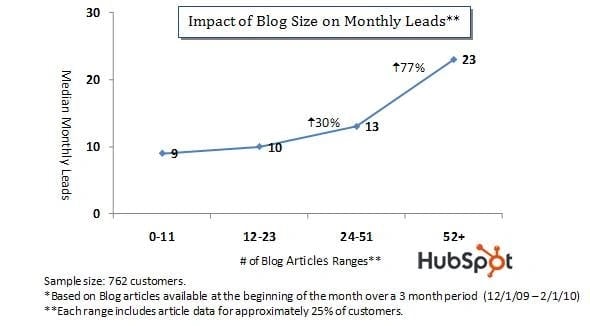
Customers with blog article numbers above this critical threshold are likely to have enough content to make a significant impact on search engines through additional indexed pages and new keywords with which to associate. In addition, other sites are more likely to link to a blog that offers a steady stream of content . Customers with blogs of 24+ articles are more likely to be committed to updating their blog frequently and, thus, are likely to generate more traffic from referring sites.
The graph also indicates that lead growth has the potential to accelerate for customers who grow blogs beyond the critical threshold . Customers with 52+ blog articles generated median leads that were 77% higher than the median result in the "24-51 article" group. This growth is twice the increase between the prior two groups (30%).
Marketers With Blogs Generate 67% More Leads
Along with blog size, we looked at plain and simple blog usage. We have written about the impact of blog usage on leads before . Here, we compared median leads of customers who blog to those of customers who don't. We looked at leads over a three month period (November '09 through January '10).
As expected, the median customer who blogs generated 67% more leads than the median customer who does not blog, or 15 vs. 9 leads. The results were the same for both B2B and B2C customers in our sample.
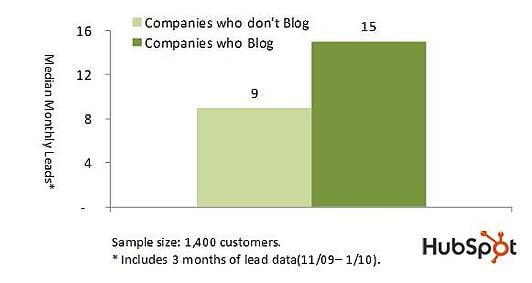
This graph also shows that marketers with small blogs (fewer than 10 articles available) generate similar lead results to marketers who choose not to create a blog .
Marketing Takeaways
Marketers who are not blogging are leaving leads on the table. Marketers who do blog must invest time and effort in developing a blogging process that ensures there is always a critical mass of articles available to attract visitors who convert to leads. Blogs impact leads because they:
- Grow indexed pages in Google more rapidly than by adding web site pages. As we showed earlier, the more Google indexed pages a site has, the more leads it is likely to obtain .
- Increase the number of keywords marketers rank for in Google . Through blogs, marketers have the opportunity to create unique content that can be different from their web site content. They have the potential to significantly increase the number of keywords they rank highly for in Google.
- Generate inbound links , which are a central factor in Google's organic search ranking algorithm. Other related sites are likely to link to a blog that provides interesting and fresh content.
- Increase repeat visitors . Blogs give visitors a reason to come back and interact with sites.
Read article 1
in this 3-part series.
Want to read more? Download the full State of Inbound Lead Generation report .
Live Webinar: The State of Inbound Marketing Lead Generation
|
Learn how companies are using inbound marketing techniques to generate higher volume and lower cost leads and customers.
Date and time: Wednesday, April 7, 2010 at 1:00pm EDT |

CapetownHolidays 8:11 AM on April 05, 2010
Thanks for this encouraging survey. It is tough to keep posting blogs and see so few results in Google Analytics, but we are now starting to see how a blog post with judicious choice of keywords can make a difference to the numberof leads we are receiving at our affordable holiday accommodation.
Rituraj 8:43 AM on April 05, 2010
This is Right, Bogging is essential for lead generation.
CL Walker 9:02 AM on April 05, 2010
It would be most interesting to know how this type of data would apply to candidates running for office at local through national races.
Michael R. Thomas 9:07 AM on April 05, 2010
Thanks for the clear data and infographics. I love these hard-data overviews! It seems, however, that I'm always left with another question -- Sorry.
Do you have any sort of metrics that outline the Industries to which these blogs and sites pertain (B2B, B2C) - I'm very curious to see if the stats are the same across both Business and Consumer Sales.
Thanks for your insights!
Nicolas Vega 9:12 AM on April 05, 2010
I like your post, congratulations, but I wondering, what happen with the timing? Your analysis was made for 3 months, but how many post do you need to reach a critical mass in the same period of time?
What is the impact or difference, if i write 52 post a year Vs 30 post a year? Do you have some stats about that?
Thanks
dewita 10:15 AM on April 05, 2010
Another reason to go blogging..
Cory 10:33 AM on April 05, 2010
Great info. Thanks
Sophie Schmitt 10:38 AM on April 05, 2010
Michael, thank you for your question. We did compare B2B to B2C firms and found the same relationships between article numbers and leads. We also found that median leads generated by firms who blog vs. those generated by firms who don’t blog were exactly the same for both groups.
Michael R. Thomas 10:42 AM on April 05, 2010
Thanks Sophie. It's extremely useful data to have. It reaffirms some assumptions that we've made (and that Hubspot has touted)...
I'm looking forward to more insights like these!
Victor Canada 10:47 AM on April 05, 2010
This is a helpful analysis. Good questions from the comments too. @Walker I believe candidates running for office would benefit from a blog. It means putting things in writing which some candidates will be hesitant to do.
Blogging is a game changer for almost any business who wants to build it's brand and get more exposure.
Tim Dreyer 11:59 AM on April 05, 2010
Great data here. We just launched our company blogs on March 1st and we're at the 11 - 13 post marks right now so it will be interesting to see what happens after April.
Tim Dreyer
PR Manager
Zebra Technologies
Sophie Schmitt 1:07 PM on April 05, 2010
Nicolas,
This would be a very interesting analysis which we did not undertake. The metric we looked at was simply blog articles available at one point in time (first day of the month). We looked at 3 months of data to ensure results were consistent over time but we did not look at # of articles written over different time periods. We will surely keep this in mind for a future study.
John McTigue 4:55 PM on April 05, 2010
I'll have to check the report, but I think there's another threshold at "at least one blog per day". That's an average of 20 posts per month. Why so many? As long as the content is consistently good, you will steadily add subscribers and leads. The really successful blogs (like this one) post several times a day.
Scott Armstrong 10:43 PM on April 05, 2010
Awesome post.
Incredibly helpful to put numbers to the question.
You guys rock!
Scott Armstrong
www.brainrider.com
DragolinDesign 3:48 PM on April 06, 2010
very interesting post, I like the fact that you try to confirm some 'generally accepted' theories with hard data, looking forward to the 3rd part !! (downloading the pdf as we speak)
Sidenote: don't want to be the party pooper, but you might want to stress that this applies to businesses enlisted at Hubspot, but should not be generalised ...
Good Post 9:31 AM on April 23, 2010
I would interesting to know what other factors if any influenced this results?
Were those blogs with over 20 posts in existence longer than those with fewer posts?
Did some of those blogs (in the over 20) category do more to promote their blogs?
While I agree with the premise that more content will lead to more traffic and sales leads, there must be more factors influencing these results than just that.
Kenny MacCarthy 4:30 AM on April 30, 2010
I'm wondering the period of time the "20 posts" is spread over?
I'm often getting flack about my blogging from other agents who are avoiding it. I'm going to share this. Might shut 'em up. Thanks.