


Today's consumers interact with AI agents, expect instant answers, and demand that businesses remember who they are across every channel. For CX leaders, the challenge isn’t just collecting data — it‘s activating it intelligently. We’re shifting from passive personalization based on static lists to an agentic era where AI and unified platforms predict needs before customers ask, creating seamless loops between marketing, sales, and service.
This guide provides a clear, actionable roadmap for building personalized customer experiences that drive real business results.
What is personalized customer experience?
Personalized customer experience is tailoring interactions using unified customer data across all channels. It’s the practice of adapting every touchpoint, from marketing emails to support chats, to the specific needs and history of an individual customer. It relies on connected data to ensure a customer feels known and valued, not just processed.
Unlike basic personalization, which might just swap a first name into an email subject line, a personalized customer experience connects the whole journey. It recognizes that a customer who just opened a critical support ticket shouldn’t get a generic “Buy Now” marketing email five minutes later. It’s dynamic, aware of context, and often powered by AI agents that can determine the next best steps for that specific person.
.webp)
Free Customer Journey Template
Outline your company's customer journey and experience with these 7 free templates.
- Buyer's Journey Template
- Future State Template
- Day-in-the-Life Template
- And more!
Download Free
All fields are required.
Form not available
Personalization Beyond Token Swaps
Basic personalization uses static data to insert customer details into predetermined templates, while personalized customer experience uses real-time, unified data to adapt every interaction based on immediate context and historical behavior.
- Basic personalization example: “Hello Diego, here is 10% off for your birthday.”
- Personalized Customer experience example: A customer visits your pricing page three times but doesn’t buy. An AI agent proactively triggers a chat, offering a comparison guide for their specific industry, references a webinar they watched last month, and offers to connect them with the specialist they spoke to previously.
The difference is depth and integration. Basic personalization relies on static data insertion like name tokens within isolated channels — an email team doesn't know what the support team just did.
A personalized customer experience takes a holistic approach, tailoring every interaction to the customer's immediate context and long-term history using unified data across marketing, sales, and service. Every touchpoint, whether human or AI-driven, feels relevant, helpful, and aware of previous interactions.
How to Personalize the Customer Journey
Personalizing the customer journey requires a shift from “campaign thinking” to “journey orchestration.” It’s about building a system that listens and responds to customer signals.

Below are eight steps to personalize the customer journey. For each step, I’ve provided a summary of the required action, followed by practical insights on how to execute it effectively, based on my experience leading CX teams.
Step 1: Unify your customer data.
Personalized customer experiences require unified data that breaks down silos between teams. A Smart CRM, or customer data platform (CDP) enables unified customer profiles and consent management by capturing interactions from multiple touchpoints in one timeline. This creates a single source of truth that teams and AI agents use to deliver contextually aware experiences.
In a relevant case study, HubSpot customer Care.com unified its marketing and sales data into one CRM, enabling faster lead follow-up and tighter coordination between teams. By giving sales reps real-time insight into which emails prospects opened and which pages they visited, Care.com shortened deal cycles and increased conversion efficiency.
Leading support at Skybound Entertainment, I’ve seen this firsthand. We have fans from Kickstarter campaigns, gamers from different game titles and consoles, Discord members from our customer community, and shoppers from our online store. We couldn’t personalize effectively until we connected these distinct identities using a CRM tool.
If your support data lives in one tool and your community data lives in another, you’re missing the full picture. Using a CRM can dramatically improve the customer experience when it is properly configured.
My advice is simple: prioritize that single source of truth before launching any personalization efforts.
Step 2: Define your high-value segments.
Personalization at scale requires focusing on high-value segments where tailored experiences deliver the greatest ROI. Define an Ideal Customer Profile (ICP) or priority segments using behavioral data, not just demographics — distinguish between “high-intent enterprise buyers” and “casual browsers” to allocate personalization resources effectively.
Pro tip: I’ve learned the hard way that trying to personalize everything for everyone burns out teams. At Greenhouse Software, rather than treating every ticket the same, we built a support model based on a multi-tiered SaaS pricing structure.
We set clear goals for each customer segment. This approach prevented team burnout while ensuring everyone received appropriate support levels.
Step 3: Map the journey and identify friction points.
Create a map that details every step a customer takes, from finding you to recommending you. Look specifically for “drop-off zones.” Is it the demo request form? The onboarding email sequence? These friction points are where personalization can really save the day. For retailers, mapping the ecommerce customer journey is critical to spotting these gaps.
Pro tip: When mapping journeys, I look for the “silent gap”— moments where customers stop engaging but haven't left yet.
At Skybound's online store, I noticed friction in the checkout process around shipping details. By identifying and addressing these drop-off spots, we converted more browsers into purchasing customers. Map these gaps in the customer journey to create targeted personalization that removes barriers.
Step 4: Prioritize clean, consented first-party data.
As third-party tracking fades, specific and voluntary data becomes the strongest foundation for personalization. Clean, voluntarily provided data enables accurate, compliant personalization that builds trust. Interactive mechanisms like quizzes or onboarding surveys move beyond inferring preferences from vague clicks to knowing exactly what customers want.
Use privacy-by-design principles: implement consent management, set frequency caps, and provide transparent preference centers. Research shows that 71% of consumers disengage when brands deliver irrelevant or overly intrusive personalization, underscoring the need for consent-first practices.
Give customers clear control over data collection, explain exactly how their information will be used, and set communication frequency limits to prevent over-messaging. State purposes explicitly: “We use this data to show you relevant tutorials, not to sell your information.” This approach keeps personalization helpful rather than intrusive.
Pro tip: At a previous web3 company I consulted, we created partner onboarding guides for over 20 digital art projects. Instead of guessing partner needs, we built an onboarding flow that asked explicitly about project specifications. This direct input cut incoming partner support tickets by 45% by anticipating specific needs before they arose.
Step 5: Connect your triggers across channels.
Cross-channel automation ensures the right message reaches customers at the right time based on their complete interaction history. By predicting customer behavior with AI, platforms can trigger contextually relevant actions: if a customer engages on social media, update their lead score; if they view a help article, send a follow-up email with related resources.
Use a single marketing automation platform to map out exactly when a journey starts (e.g., abandoned cart) and when it should stop (e.g., purchased item), ensuring the system “listens” across every channel so marketing, sales, and service work from the same behavioral signals.
Crunch Fitness operates across more than 500 locations and uses HubSpot Marketing Hub and Agent Hub to help each franchise create localized marketing at scale. In a HubSpot case study, the team is reported to send more than 15 million targeted emails per month, generate over 2 million leads per year, and drive more than 1 million landing page views, all while keeping messaging personalized to each community.
Pro tip: Triggers should respond to customer passions, not just clicks. At Skybound, we analyzed cross-channel signals using tools like Breze — examining store purchases and social engagement to identify fan interests.
When fans showed deep interest in specific characters or game genres, we triggered personalized emails with relevant news and exclusive items, shifting from generic blasts to engagement that resonated.
Step 6: Use AI to create content faster.
Generative AI produces content variations at scale, eliminating the need to manually write dozens of email versions or build distinct landing pages for every segment. AI-powered personalization accelerates segmentation, content creation, and next-best-action recommendations.
Tools like HubSpot’s Content Personalization enable you to tailor a core message for specific audiences, such as “C-Level Executives” versus “Technical Users.”
Pro tip: To personalize content and digital experiences efficiently, stop building rigid pages and start building modular content systems. For SaaS, this means adapting to headlines to match the visitor’s industry. For ecommerce, it means swapping hero images based on past affinity.
In my experience at Skybound, we tested swapping out product images based on customer interests and intent to drive sales. By combining personalization tokens with an AI-generated variations, you can scale from one core asset to hundreds of relevant experiences without blowing the budget.
Step 7: Empower service reps with a unified workspace.
When personalization moves from a digital interface to a human interaction, context is everything. Provide your support team with a unified agent workspace that sits right in their sidebar. This helps them see the customer’s full digital footprint, including recent purchases, marketing email opens, and interactions with your AI agents.
The result is a “warm handoff” where the rep knows exactly what the customer had already tried, preventing the frustration of repetition.
Pro tip: At SmartRecruiters, I led a team of enterprise support and professional services reps. The key to success was giving them the full context of the client’s lifecycle. When teams know complete customer history, not just the current issue, they can consult strategically rather than troubleshoot blindly. HubSpot Service Hub makes this easy by placing the entire context right next to the chat window, helping agents build immediate rapport.
Step 8: Measure revenue impact and iterate.
Don't just measure “open rates” or “CSAT” in isolation. To prove the ROI of personalization, you must measure the “lift” in key business metrics like Revenue Per Visitor (RPV) or Average Order Value (AOV).
Compare personalized cohorts against non-personalized control groups. This is the only way to demonstrate that your personalization strategy is actually driving the bottom line, rather than just increasing engagement metrics that don't convert.
Pro Tip: Stop reporting vanity metrics and start reporting on revenue.
At a previous subscription box clothing business, I shifted the conversation with my executive team by implementing a “universal control group” strategy. We held back a small percentage of our audience from receiving personalization to establish a clean baseline.
The result? We proved that the personalized cohort had a significantly higher Customer Lifetime Value (LTV) than the control group.
Free Customer Journey Template
Outline your company's customer journey and experience with these 7 free templates.
- Buyer's Journey Template
- Future State Template
- Day-in-the-Life Template
- And more!
Download Free
All fields are required.
Form not available
Personalized Customer Service Tactics That Scale
Scaling personalized customer service requires moving from manual processes to AI-powered systems that deliver individualized experiences without linear headcount growth. The key is combining unified customer data, AI agents for routine tasks, and strategic human intervention for complex issues — enabling teams to treat every customer as a priority without overwhelming support staff.
Modern personalized service relies on tools like HubSpot's AI, which powers AI-driven personalization and automation. Service teams need unified agent workspaces that automatically surface customer history, sentiment, and product usage data. Then, AI agents handle routine inquiries while human reps focus on complex issues requiring empathy.
1. Deploy AI agents, not just chatbots.
What is personalized customer service in the AI era? It is the ability to resolve issues proactively using context, not just answering FAQs. The old way was a rigid chatbot that got stuck if you asked a question it didn’t know. The new way is using an autonomous AI agent, like HubSpot’s Agent Hub, which can think through complex questions.
How to implement: Connect your AI agent to both your knowledge base and your order management system simultaneously.
If a customer asks, “Where is my order?” the agent shouldn’t simply direct them to a shipping policy. It should look up the order status via API and reply, “Your package is in Memphis and will arrive Tuesday.” This moves the interaction from “deflection” to “resolution.”
AI primarily provides value in personalization through prediction (what will they buy next?) and generation (drafting the email). To keep it trustworthy, adopt a “human in the loop” model for high-stakes communications. Use hallucination guardrails and strictly ground AI agents in your own knowledge base and data. Force it to cite your own internal data sources for transparency.
2. Use “next best action” for reps.
Your human agents are often overloaded with information. You can remove the pressure by using AI to suggest the “next best action” direction in their workspace.
How to implement: When a ticket opens, the system should analyze the customer’s sentiment, tenure, and value.
If a high-value customer has a low NPS score, the “next best action” might be to flag a manager or offer a loyalty discount. If it’s a new user, the action might be to send a getting started guide. This helps every rep perform like your best rep.
3. Asynchronous video responses.
Personalized video responses add human connection to complex issues or high-value accounts when text feels impersonal.
How to implement: For complex issues or high-value accounts, have your reps record a 60-second Loom or TechSmith Capture screen share, addressing the customer by name. “Hey John, I saw your question about the API integration. Here is exactly where you need to click…” While you can’t do this for every ticket, it’s highly effective for high-touch moments and builds trust fast.
4. Dynamic routing based on customer value.
Dynamic routing ensures high-value customers receive priority support by automatically directing them to specialized agents based on their lifecycle stage, account tier, or risk status.
How to implement: When I worked at Greenhouse Software, we implemented logic that routed tickets based on the customer lifecycle stage and value tier.
For example, if an “Enterprise” or “At-Risk” customer submits a ticket, your system should recognize their email and immediately route them to a specialized senior agent or customer success manager, bypassing the general queue. This ensures your highest-value customers always get your highest-quality support resource, automatically.
Best for: Retention. High-value customers expect high-touch service. Dynamic routing delivers this without manual intervention.
Benefits of Customer Experience Personalization
Personalized customer experiences deliver six measurable business benefits: reduced customer acquisition costs, increased average order value, higher retention rates, decreased churn, reduced buyer's remorse, and improved operational efficiency. These outcomes stem from using unified customer data and AI to deliver relevant interactions at every touchpoint, creating experiences that feel attentive rather than generic.
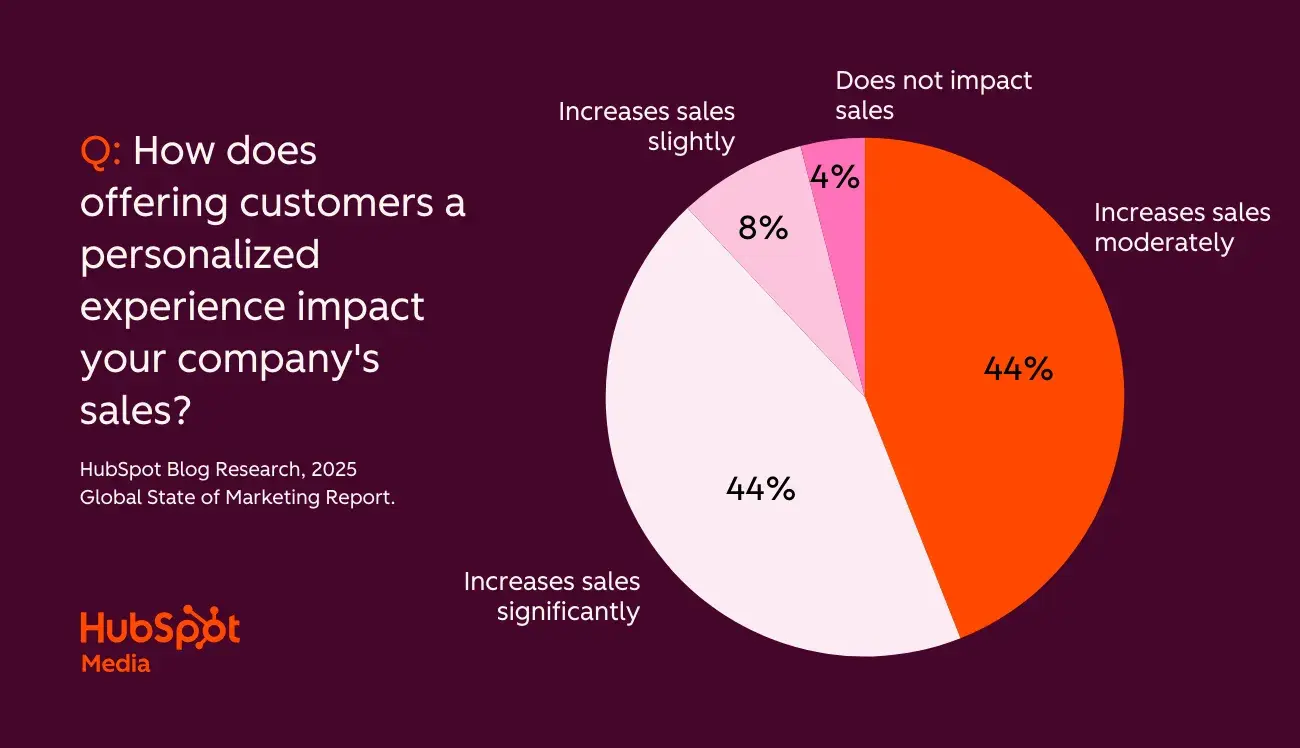
HubSpot's State of Marketing Report found that personalization is the number one driver of marketing ROI, with 44% of marketers reporting it increases sales significantly and another 44% seeing moderate sales increases. The data is clear: effective personalization improves acquisition, conversion, retention, and customer satisfaction in measurable ways.
Why invest the resources? The data is clear. Effective personalization improves acquisition, conversion, retention, and customer satisfaction. In fact, HubSpot’s State of Marketing Report found that personalization is the number one driver of marketing ROI, helping teams drive revenue and reduce friction in measurable ways.
Reduced Customer Acquisition Cost (CAC)
Targeted content converts faster, lowering acquisition costs by increasing ad spend efficiency. Personalization ensures marketing budgets reach the right people with relevant messages instead of wasting impressions on generic campaigns. When support and marketing data are unified, teams stop spending money retargeting unhappy customers and start doubling down on their happiest advocates.
Increased Average Order Value (AOV)
Contextual cross-selling recommends the right add-on at the right time, increasing wallet share naturally. According to Zendesk benchmark data, 3 in 4 consumers will spend more with businesses that provide a good customer experience, driven largely by the fact that 76% of customers expect personalization.
This creates a powerful flywheel where customers are happy to buy more because the suggestions feel like a service, not a sales pitch.
Higher Retention Rates
Customers stay where they feel understood. Personalized experiences are a huge driver of loyalty. This is my main focus at Skybound Entertainment. By orchestrating sentiment-driven engagement loops that addressed friction before it escalated, we saw an over 50% increase in our Trustpilot rating. That social proof became a massive retention engine.
Decreased Churn
Predictive personalization identifies at-risk customers before they leave. The Twilio-Segment 2024 State of Personalization Report reveals that 86% of business leaders expect a significant shift from reactive to predictive personalization across their industry.
At a previous subscription box clothing business, we didn't wait for cancellations. We monitored friction triggers like customers returning items from two consecutive boxes to identify at-risk subscribers early. Proactive intervention with the right offer reduced churn significantly by addressing problems before customers hit the “cancel” button.
Reduced Buyer's Remorse
Effective personalization can triple the likelihood of reducing customer regret during key journey points, according to recent Gartner surveys. When a customer feels like you “get” them, buyer's remorse evaporates and is replaced by confidence.
Operational Efficiency
Personalization significantly reduces time-based metrics like Average Handle Time (AHT). When agents have immediate access to a customer's complete history and intent, they skip the interrogation phase and go straight to the solution. This context-driven efficiency enables teams to serve more customers with the same headcount, directly improving cost management and scalability.
Measuring the benefits of personalization and proving ROI comes down to isolating impact through control group testing. Run A/B tests where one group receives the personalized experience, and another receives the generic version, then measure lift in Revenue Per Visitor (RPV), conversion rate, and retention rate.
Beyond revenue metrics, tracking operational efficiency improvements like hours saved by AI agents creates a holistic business case that resonates with leadership.
Personalized Customer Experience Examples
Three leading brands demonstrate how effective personalized customer experiences work in practice: Spotify packages user data as retention features, Canva adapts onboarding flows based on user intent, and Netflix personalizes visual content presentation to match individual preferences.
See these website personalization examples for more inspiration and how data-driven personalization creates measurable engagement and loyalty gains.
1. Spotify: The “Data-as-Product” Approach

What they do: Spotify doesn’t just use data to improve the backend. They package the data as a feature. “Discover Weekly” and “Spotify Wrapped” are personalized experiences entirely from user behavior.
Why it works: Spotify turns passive usage data into an active retention hook, creating a sense of ownership and loyalty that generic platforms can’t match.
2. Canva: Intent-Based Onboarding

What they do: Upon sign-up, Canva asks one simple question: “What will you be using Canva for?” (Teacher, Student, Small Business, Enterprise). The entire dashboard, template suggestions, and email onboarding flow instantly adapt to that specific persona.
Why it works: Canva solves the “blank page” paralysis by presenting only the most relevant assets, dramatically shortening the time-to-value for new users.
3. Netflix: Dynamic artwork Customization

What they do: Netflix doesn't just recommend titles; they personalize the thumbnail image you see for them. If you watch romance, the artwork for Good Will Hunting might highlight the couple. If you watch comedy, it highlights Robin Williams.
Why it works: Netflix reframes the value proposition of the same product to match the specific psychological preference of the user, driving higher engagement without creating new content.
Frequently Asked Questions about Personalized Customer Experience
How do I personalize with limited data?
Personalize with limited data by starting with explicit first-party information collected directly from customers through interactive onboarding quizzes or preference centers. Ask simple questions like “What is your main goal today?” or “Which topics interest you most?” to gather zero-party data — information customers voluntarily provide about their preferences and needs.
What is the best platform setup for a growing team?
The best platform setup for growing teams centers on a Smart CRM that unifies customer data across all functions. Avoid “point solutions” that don't talk to each other. The best setup connects Marketing Hub and Service Hub to the same underlying database (like HubSpot). This ensures that a support rep can see the marketing emails a customer opened, and a marketer knows not to email a customer who has an open high-priority ticket.
How do I avoid personalization that feels creepy?
Avoid creepy personalization by using only data customers know they‘ve shared and by explaining why recommendations are relevant. The "uncanny valley" of personalization occurs when businesses use data customers didn’t realize was being tracked.
Implement consent management, frequency caps, and transparent preference centers to maintain trust. Use the phrase “Because you...” to explain recommendations (e.g., “Because you bought hiking boots, we thought you'd like these socks”). This transparency makes personalization feel helpful rather than invasive by providing logical reasons for suggestions.
When should you scale from pilots to programs?
Scale personalization from pilots to full programs when you have clean data and “proven lift.” Don‘t roll out a massive program until you’ve run a pilot on one channel (e.g., Email) with one segment. Once you can prove that personalization increased conversion by a measurable percentage in that pilot against a control group, you have the business case to invest in broader orchestration tools and content generation.
What skills and roles do I need to sustain this?
Sustaining personalized customer experiences requires more than just marketers. Organizations need three core roles:
- Data Operations to keep the CRM clean, manage integrations, and ensure data hygiene.
- Journey Orchestrators to map the logic flows, triggers, and suppression rules.
- Content Creators (aided by AI) to generate the volume of assets needed for different segments.
Your 90-day Execution Roadmap
Here is how to move from fragmented data to agentic orchestration in one quarter.
Month 1: The Foundation
- Objective: Establish a unified “Single Source of Truth.”
- Actions:
- Audit & Cleanse: Audit your CRM data health. Identify and merge duplicate records to prevent “split brain” customer profiles.
- Unify Sources: Integrate your primary offline data sources (POS, event attendance) with your online behavioral data in your Smart CRM.
- Consent Framework: Implement a robust consent management platform (CMP) to ensure all subsequent personalization is compliant by design.
Month 2: The Pilot
- Objective: Prove ROI with a targeted segment.
- Actions:
- Select one segment: Don't target everyone. Target your “High-Value” or “At-Risk” segment.
- Launch first-party data enrichment: Deploy an interactive mechanism (quiz, onboarding survey) to gather explicit preference data.
- Orchestrate one flow: Launch a single, high-impact behavioral trigger (e.g., “abandoned browse” or “post-purchase education”) across email and one other channel.
- Measure lift: Run this against a strictly held-out control group to establish the revenue delta.
Month 3: The Scale
- Objective: Operationalize efficiency and expand reach.
- Actions:
- Deploy AI agents: Implement AI agents (like Agent Hub) to handle Tier 1 support queries, fed by the unified data established in Month 1.
- Expand channels: Mirror your successful Month 2 workflows onto a new channel (e.g., SMS or in-app messaging).
- Operationalize feedback: Create a formal loop where support sentiment (CSAT/NPS) automatically pauses or triggers marketing workflows.
Build personalized customer experiences that scale.
A personalized customer experience means tailoring every interaction to each customer's needs, using unified data across marketing, sales, and service. Unlike basic personalization, it connects the entire journey, so every touchpoint feels relevant and helpful.
The benefits? Higher conversion rates, stronger loyalty, and measurable business growth. To get started, unify your customer data, map triggers, use AI, and measure what matters.
Free Customer Journey Template
Outline your company's customer journey and experience with these 7 free templates.
- Buyer's Journey Template
- Future State Template
- Day-in-the-Life Template
- And more!
Download Free
All fields are required.
Form not available