The debate rages on about whether or not your marketing content such as ebooks and webinars should be gated behind lead-capture forms. However, there is plenty of content such as case studies, FAQs, fact sheets, and brochures that aren't very suitable for lead generation and can benefit from being ungated and readily available in organic search.
This type of content is frequently published in PDF form, and as an important part of your inbound marketing strategy, it should get the same SEO treatment as everything else you publish. The next time you're ready to release new PDFs out into the world, follow these 6 steps to quickly optimize them before you publish to ensure crawlers can find and index them for searchers.
6 Steps to Optimize a PDF for Search
1.) Create your PDF in a text-based program. When you use Microsoft Word or Adobe Acrobat, crawlers can read and index the content.
2.) Follow SEO best practices when writing your content. Optimize your content as you would any other content for your site. Use relevant keywords in your content, H1 and H2 tags in the copy, and make sure your images include alt tags.
3.) Crawlers can read links in a PDF, too. Build in links to relevant pages on your website so readers can get back to your site from the PDF. This is particularly important if your PDF is shared via email or social networks, as those readers may not have been to your site before.
4.) Save the file as a PDF with a relevant file name. For example, my PDF on vegetarian Thanksgiving recipes would be called Vegetarian-Thanksgiving-Recipes.pdf. This will also help users identify the content of the PDF if they share it with others or save it for later use.
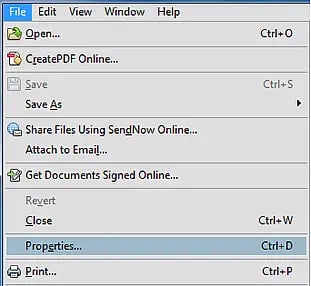
5.) Fill out the Document Properties. Open your PDF in Acrobat, and fill in the document properties by going to the Menu and clicking File >>> Properties.
You'll see a screen pop up called Document Properties. Make sure you're on the Description tab, and fill in the Title, Author, Subject, and Keywords fields.
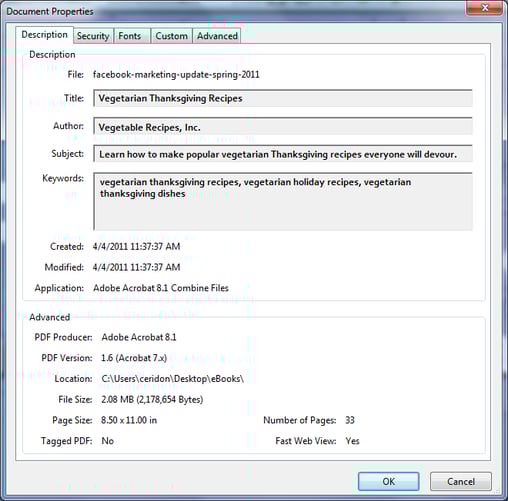
What you write in the Title field will be what appears in search results. If it is empty, search engines will auto-fill it with something in the content of your PDF, which will likely be less relevant for a searcher. Use keywords in your title for which you want your PDF to rank.
Unless you yourself are a brand name (which you very well may be!), fill the Author field with your company's name. Most people see more searches on their company than their own names.
Treat the Subject field like a meta description. Write it for users to help drive conversions.
Fill in the Keywords field with 3 or 4 keyword phrases you're targeting in your PDF, separating each phrase with commas.
6.) Find popular pages on your site. Once you click OK, publish your PDF to pages on your site that are frequently crawled so it's easier for search engines to find and index the PDF.
Pretty easy, right? Optimizing PDFs is a quick, simple step you can take to make content like case studies, fact sheets, brochures, product overviews, and other valuable content assets more search engine-friendly.
Do you optimize PDFs for organic search? Have you run into problems trying to do so?

Richard Milton 11:48 AM on November 17, 2011
Hi Corey, I'd very much like to know your basis for saying that
"When you use Microsoft Word or Adobe Acrobat, crawlers can read and index the content."
PDF's are image files and cannot be read by crawlers. Only their titles.
Alex 12:01 PM on November 17, 2011
Great article for the SEO begginner. I did not know this and now i will most definitely use it.
Thanks,
David 12:03 PM on November 17, 2011
Wow, i did not know how you get your pdfs in search results. I have seen them but was at a loss on how they did it.
Thanks a million.
Deborah Rowell 12:16 PM on November 17, 2011
My comment is in response to Richard Milton's comment. Sometimes PDF files are saved as only images. It depends upon the way they are made and the way they are saved. That is what Corey Eridon wants everyone to understand. The key is to maintain the text when saving the PDF file. When text in a PDF file can be highlighted by dragging your mouse across it, and you can copy and paste that text into another program such as a Word document, then you know that the crawlers can also read and index the content. This is the way that I saved a PDF file on our Kitchen Views website, but I used a different program. You can go to http://www.kitchenviews.com/pdf/kv_10_tips_for_a_smoother_design_journey.pdf and see it for yourself. The next step is to include clickable links, which is easily done in Word and Acrobat. Item 5 is news to me and we will now incorporate this information into our PDF files. Thanks to Corey.
Janet Voigt 12:41 PM on November 17, 2011
I love this blog, and was worried at first since I create the artwork in QuarkXpress, but I just opened a PDF in Adobe Acrobat and am able highlight, copy and past the text, so it should work.
Todd 1:14 PM on November 17, 2011
A word of warning: if the content in the PDF is mostly the same as the page linking to it (e.g. a case study), but sure to set a canonical header to avoid a duplicate content penalty. See Google Webmaster Tools for more information.
Michael 3:27 PM on November 17, 2011
This is really helpful. I didn't know that Search Engines could read PDF, but now that I think about it, I guess it makes sense.
Deborah, your feedback is very helpful, thanks.
Aakar 1:08 AM on November 18, 2011
I never knew, PDF document can be optimized for Search. Thanks HubSpot for such an wonderful tip.
Salman G. 1:17 AM on November 18, 2011
It's a great post bu Hubspot. Optimizing .pdf files is a best option, as similar to web files. You have to be sure that the .pdf text is readable. MS Word, Excel, Powerpoint files can be converted into readable pdf files through Acrobat and pdf maker plugins.
Jussi Vesterinen 4:19 AM on November 18, 2011
Very welcome tip. I have been struggling to insert share buttons to my PDF eBooks,thanks.
Lindsay 9:27 AM on November 18, 2011
Thanks for the tips. I didnt realize you could put links in a pdf. Hopefully I can make it work the next time I create a pdf. Cheers.
Juli 10:52 AM on November 18, 2011
Thanks for the tip about document properties. I hadn't thought of that one! Dose anyone know if using Header formatting (as offered in word processors) maters?
Steven Leconte 7:19 AM on November 21, 2011
In some instances it seems like the PDF document gets better results than the actual web page.
I wonder if these tips have something to do with it.
Janet Voigt 12:05 PM on November 21, 2011
Do you get the same benefits if your pdf is attached to a call to action button (which is attached to a landing page) as you would just having it on your web site?
mark Peditto 2:08 PM on November 28, 2011
Great article. We started using an instant quote form at www.artisticfiberglasspools.com that takes info from a selection form and translates all info to an instant PDF contract. We have built this program so anyone in the swimming pool industry would have the ability to send instant contracts on the fly. For more info please email mark@artisticpools.us again great article and like You said proper head tags and alt tags are so important so spiders can get that important information.
Vin 2:37 PM on November 28, 2011
Like @Jussi, I'd be interested, too, if it's possible (and if so, how) to include clickable social media share buttons in a PDF.