.png?width=112&height=112&name=Image%20Hackathon%20%E2%80%93%20Horizontal%20(67).png)

Spoiler: it is. It’s one of the best ways to establish thought leadership, get your audience’s attention, and build trust with them.
Over the years, I’ve written hundreds of blogs for businesses in a wide range of industries — and I’ve seen what works, what doesn’t, and how things are changing. So buckle up, and I’ll show you why blogging for business is still so valuable for driving inbound leads — and strengthening your entire marketing plan.
Table of Contents
- What is business blogging?
- The Benefits of Blogging for Business
- How to Start Blogging for Your Business
.png)
6 Free Blog Post Templates
Save time creating blog posts with these free templates.
- "How-to" Post
- "What is" Post
- Listicle Post
- And More!
Download Free
All fields are required.
What is business blogging?
Business blogging is exactly what it sounds like: using blog content to grow your business.
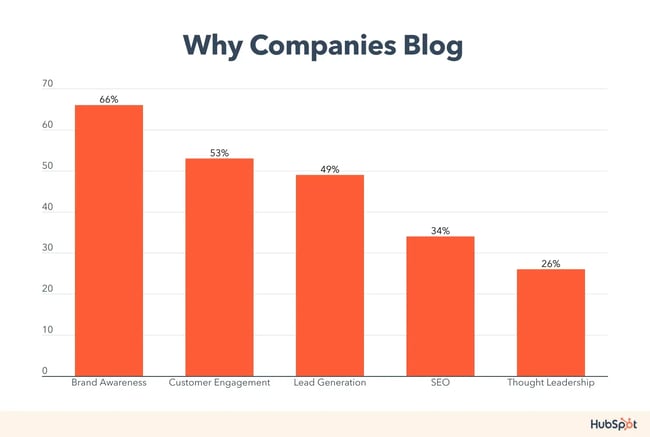
Marketers who participated in HubSpot's 2025 State of Blogging Report report blogging for various reasons, but more than half said they do so for brand awareness (66%) and customer engagement (53%).
With AI making it easier to create half-way decent content, mediocre doesn’t cut it anymore. I don’t believe it ever truly did, but now that the bar is higher, dumping a bunch of low-value posts online just for SEO isn’t where you want to invest.
The biggest benefits in blogging for business and marketing kick in when you focus on quality and:
- Speak to your customers (wherever they are on their journey)
- Answer their questions
- Offer thought-provoking information that show why you are the expert
Done right, your blog can build momentum — and fuel everything else you’re doing. What’s more, your email, social media can also drive traffic right back to your blog—and in turn, into your pipeline.
The Benefits of Blogging for Business
Whether you established your company decades ago or are just starting your business, I firmly believe that content marketing remains one of the most effective ways to grow your audience.
Not all content is written. Audio, video, and interactive media all have a place in your marketing plan. But no matter the format, your blog gives that content a home — and a chance to keep working long after it’s published. (Which, incidentally, is something I teach clients and marketers how to do.)
That is, as long as you do it right. At that point, your blog becomes a business asset loaded with benefits.
1. It gives your content a home.
Some companies treat their blog as a space for company updates — new hires, acquisitions, and other newsworthy info.
And sure, your blog is absolutely the right place to share that. If you’re sending out press releases, why send the traffic elsewhere? Hosting those updates on your site means you get the visibility, the clicks, and the algorithm juice when people come looking for the details.
That’s a huge win in and of itself. But, it’s only part of the story.
I look at business blogs as a central hub for everything you publish — and it’s one that you own.
Unlike social media, where content disappears in 48 hours, and is subject to algorithmic chaos, you own your real estate. Plus, it gives you somewhere to send people who want to know more about your business. (More on that below).
So what kind of content should call your blog home?
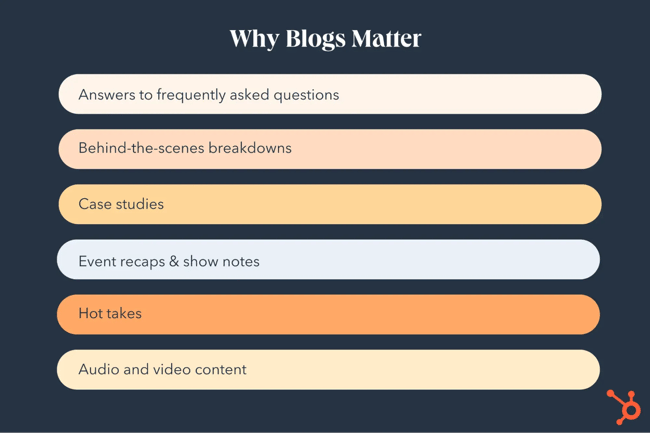
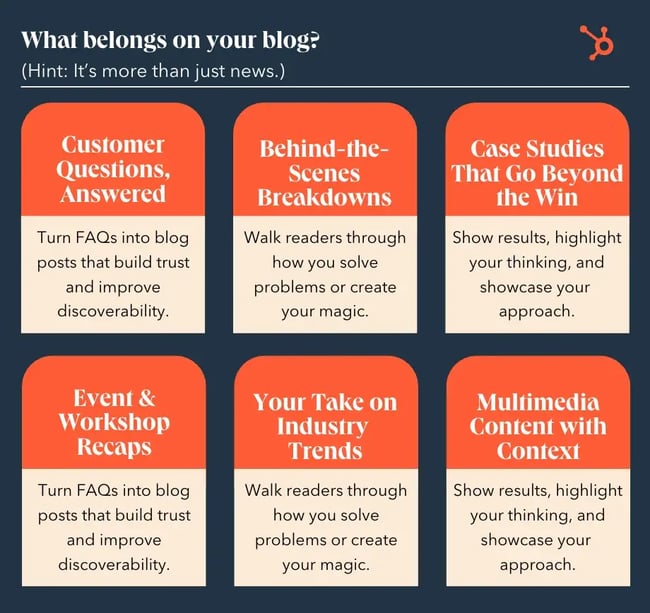
I want to encourage you to think outside of the announcement box and consider adding the following to your content strategy:
- Answers to the questions your customers are already asking
- Behind-the-scenes breakdowns of how you work or solve problems
- Case studies that show results and offer insight
- Recaps of events, workshops, or webinars (think show notes, etc.)
- Your take on what’s happening in your industry (without waiting to be asked)
- Audio and video content (with transcripts and additional content)
- High-level recaps pointing to content you publish elsewhere
When you publish valuable content, your audience will take notice.
In fact, I want you to think of your blog as a home base.
It turns your blog into a one-stop shop for your content while making it easier to maximize your efforts, repurpose your content, and make sure everything you’re doing works toward your goals.
2. It builds authority and credibility.
What’s the first thing people do when they want to know about your company?
They Google you.
In my opinion, that’s the biggest job of having a website in the first place. They can see that you’re the real deal.
Your blog builds trust by showing your growing audience how you think and giving them insights into who you are as a company.
In other words, by showing you know your stuff instead of just telling, your blog sets you up as a believable expert. And at the end of the day, that's why many choose to start a blog.
It also helps your sales process, sometimes more than you think.
Some people will read a few posts before ever reaching out. Others might land on one helpful article and decide you’re worth a conversation. (Yay, inbound — and that’s the goal of SEO blogging!)
And if you’re keeping track of the questions your customers are asking (which I always recommend), your blog becomes a resource you can send instead of rewriting the same answers over and over again.
That kind of content saves time and builds trust, and helps shorten the decision cycle.
But a word of caution, consistency matters.
While your audience may or may not take notice (or care) that you publish erratically, Google certainly does. So while frequency doesn’t have to mean posting every day, I recommend a regular cadence to keep the search engine gods happy.
Pro tip: Having trouble with the “consistently” part? A tool like HubSpot's AI blog writer can help you generate valuable content in minutes.
Interested in other AI tools? I wrote this article to compare ChatGPT, Claude, and Gemini (so you don’t have to).
6 Free Blog Post Templates
Save time creating blog posts with these free templates.
- "How-to" Post
- "What is" Post
- Listicle Post
- And More!
Download Free
All fields are required.
3. It fuels the rest of your marketing.
Not every blog is going to have a huge domain authority. And not every business is going to make SEO the priority right out of the gate.
That’s okay.
When you’re starting out, I actually recommend the opposite — focus less on keywords and more on creating high-quality content that sets the stage for what you want to be known for. You can always optimize later.
Pro tip: Even if SEO isn’t your top priority, I still recommend structuring your post so search engines can easily crawl it, and optimizing for a few search terms that match the content.
And that brings me to the bigger point — your blog should never be a one-and-done.
The last thing I want is for you to hit publish on your blog and leave it stranded in cyberspace, never touching it again.
If you’ve gone to the effort of creating really great content, you deserve to squeeze every bit of value from it.
I teach a content strategy that starts with your goals and events, using them to fuel your new content — and your other marketing efforts.
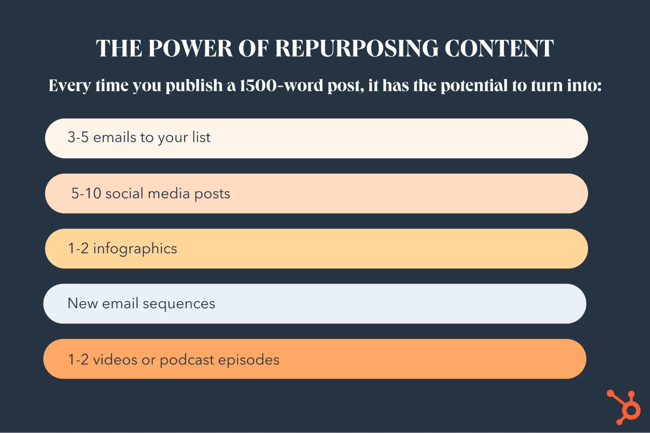
Every time you publish a 1500-word post, it has the potential to turn into:
- 3-5 emails to your list
- 5-10 social media posts
- 1-2 infographics
- New email sequences
- 1-2 videos or podcast episodes
Plus, you may be able to repackage the ideas into webinars, ebooks, and more.
Note: I’m using 1500 words as a ballpark. Yours could be much shorter or much longer.
I’ve seen a single blog post fuel an entire quarter of marketing. That said, I usually recommend publishing monthly if and when you can.
4. It drives inbound traffic (without paying for ads).
More website visitors? Yes, please. Especially if they’re my ideal customers.
But the early days of the internet are gone, and few people randomly stumble over your home page without some kind of search intent.
Usually, they land on your site because they know your name, you’ve paid to show up in their feed, or your SEO strategies are working as intended.
It’s the third category that drives this business blogging benefit.
Blogging gives you a way to attract new visitors without paying for every click.
Every blog post you publish is another chance to show up when someone Googles a question you’re qualified to answer. And unlike ads, that visibility doesn’t turn off when your budget runs out.
High-quality, helpful, and engaging blog content helps you drive the kind of traffic you want to see, as long as it’s written with conversion in mind.
That doesn’t mean selling hard in every post. Because your goal should be to guide people toward the logical next step, if they’re ready. That might mean joining your list, downloading a resource, booking a call, or just diving deeper into your content.
Which brings me to the next point.
5. It helps convert traffic into leads.
Everyone loves traffic, but it’s only great if it’s actually the right people heading to your site.
Unfortunately, traffic means nothing if it doesn’t translate to money in the bank, though it can give you lots of good data for future content, messaging, and site improvements.
That said, traffic is a numbers game. Only a fraction of the folks who land on your blog will take any kind of action to turn into a lead. Of those that do, only a small percentage will turn into opportunities, and a smaller portion yet will become clients.
The process looks something like this:
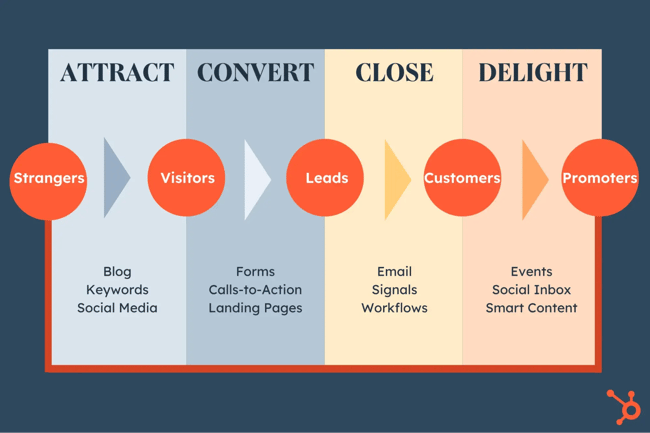
A lot of marketers visualize this as a funnel, though HubSpot talks about it as a flywheel, where there are always new opportunities to engage people even if they don’t become buyers.
That’s why good content is only the starting point — you need to be sure you’re making it easy for readers to keep moving. The easiest way to do this is by adding a clear call-to-action to every blog post.
That doesn’t mean adding a pushy CTA to every paragraph. Instead, I want you to look through your existing content to see what else would be helpful to your readers. Could be a resource, another article, or even an invitation for a short conversation.
In my own work (and with clients), I’ve seen the difference that simple, thoughtful calls to action make — as long as they flow naturally with the post and are related to the problems you’re solving for.
One of the best blogging benefits is converting traffic into sales — as long as you don’t let your posts become dead ends.
6. It boosts your SEO and link-building potential.
I’ve talked a lot about how blogs help you show up in search, so I won’t go too much deeper into SEO keywords or optimization.
What’s more important is that your content should be worth linking to.
Backlinks happen when other sites link to your content — and they’re still a big deal for SEO.
Backlinko’s 2025 data shows that the first results on Google average nearly 4x the amount of backlinks than those in positions 2-10. Unfortunately, 94% of all content has zero backlinks. That’s a massive missed opportunity.
And as much as I hate the term “low-hanging fruit,” it’s really yours for the taking to make your site surge higher in Google rankings.
Keep in mind that it’s not just humans deciding to link to your site.
As AI-powered search tools become more common, they’re referencing and citing authoritative content, which means that you might just get more traffic to your site via ChatGPT. (You can even track some of this in Google Analytics — here’s how.)
That means your blog can gain even more exposure — and credibility — without extra effort. That is, just as long as you create good content that people — and bots — want to link to.
7. It scales over time (and works while you sleep).
I usually talk about your website as a 24/7 salesperson who works even when you don’t. (This is even more true as chatbots get better and better!)
Your blog helps with that. And the moment you hit publish, you can trigger a long-term strategy that builds momentum over time.
According to HubSpot’s 2025 State of Blogging Report, 50% of marketers saw higher ROI from blogging in 2024 compared to 2023.
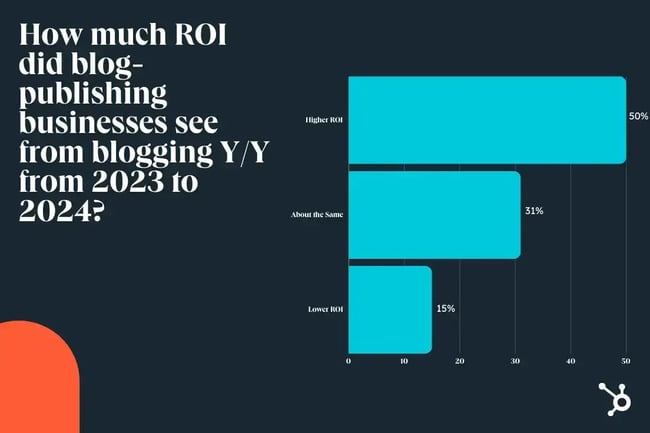
That alone is reason to keep at it. And the data backs it up. 45% of marketers whose companies blog say they’re investing more in 2025.
I see this as proof of what I’m seeing in the wild — consistently posting high-quality evergreen content has a snowball effect.
Here’s how it works, in a nutshell
- You write a well-targeted blog post today.
- It gets initial traffic and engagement.
- Over weeks, months, or even years, it continues to attract new readers through search, shares, and AI recommendations.
- That traffic fuels leads even when you aren’t actively promoting the post.
Now, I don’t want you to rest on your laurels by publishing and ghosting. But you can take time off — and yes, sleep — without feeling guilty.
Yes, blogs still matter.
There are plenty of bonus perks that come with blogging. Think beyond traffic, leads, and SEO. And remember, there are lots of reasons businesses might want to start a blog.
Not every blog post needs to drive traffic or convert like crazy to be valuable.
Sometimes, I use the blog to test out messaging before I build a whole campaign. It’s fast, low-cost, and way easier to pivot if something doesn’t land.
Other times, a post helps me learn more about what my audience cares about — or doesn’t. And sometimes, it’s just fun — an opportunity to post a hot take or something fun that humanizes the business.
Ready to dive in? Our guide on how to start a successful blog has everything you need.
How to Start Blogging for Your Business
By now, you’ve seen how blogging can support your business — driving traffic, building trust, supporting your sales process, and creating real long-term value.
If you take just one thing away from this, I want it to be this:
The benefits of blogging don’t come from publishing more content. They come from publishing the right content—intentionally and consistently.
I’ve seen what happens when a blog is treated like a box to check. It becomes a time suck, a chore, and worst of all—a missed opportunity.
The magic really starts to build when you start with strategy and layer in thought leadership and expertise.
Editor's Note: This post was originally published in November 2020 and has been updated for freshness, accuracy, and comprehensiveness.
6 Free Blog Post Templates
Save time creating blog posts with these free templates.
- "How-to" Post
- "What is" Post
- Listicle Post
- And More!
Download Free
All fields are required.